SMM February 6 News:
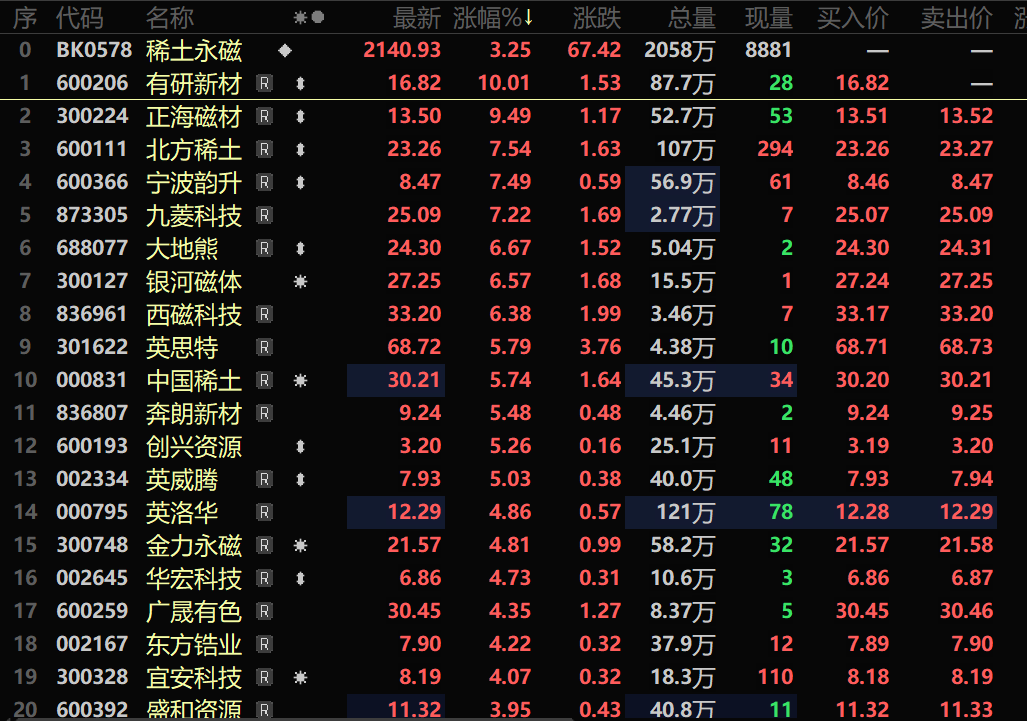
The humanoid robot concept has once again gained traction. Coupled with increased inquiries in the rare earth spot market and rising spot prices across the rare earth industry chain, the rare earth permanent magnet concept sector has seen two consecutive days of gains after the holiday. Following a 2.08% increase on February 5, the sector rose by 3.25% as of 14:05 on February 6. In terms of individual stocks: Youyan New Materials hit the daily limit, Zhenghai Magnetic Material rose by 9.49%, while China Northern Rare Earth, Ningbo Yunsheng, and Jiuling Technology also posted significant gains.
Increased Inquiries in the Rare Earth Spot Market
》Click to view SMM rare earth spot prices
》Subscribe to view historical trends of SMM metal spot prices
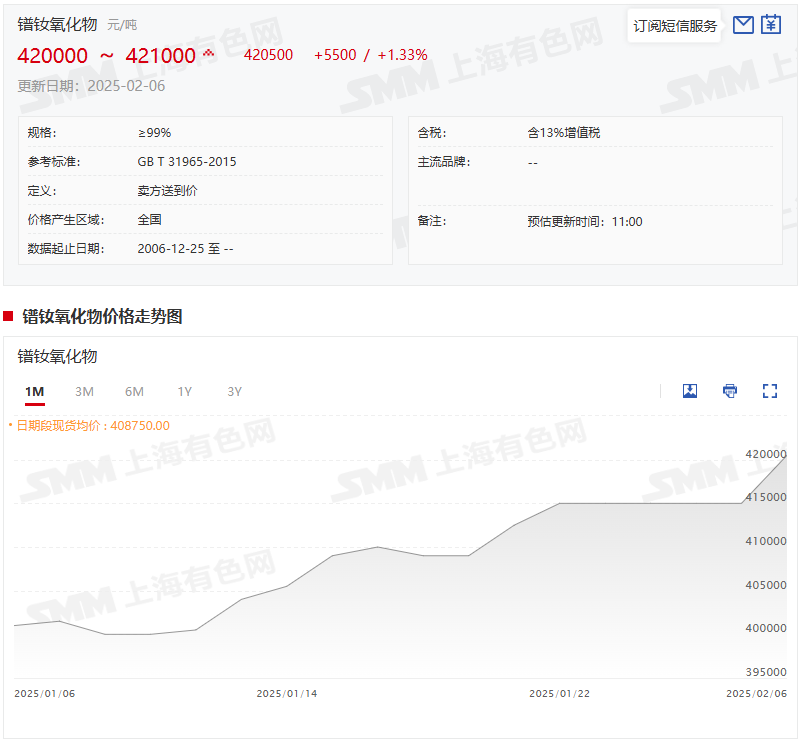
Regarding spot prices: On February 6, prices across the rare earth industry chain, from the mining end to oxides, metals, and scrap, mostly increased. The average price of SMM Pr-Nd oxide on February 6 was 420,500 yuan/mt, up by 5,500 yuan/mt or 1.33% from the previous trading day. From the performance of the rare earth spot market: After the holiday, although most rare earth-related enterprises have resumed normal operations, the festive atmosphere still lingers in the market. In terms of market activity, inquiries in the rare earth market have increased, but actual transactions remain subdued. However, transaction prices are relatively high, and low-priced supplies are scarce.
For the future performance of the rare earth industry chain, the recovery of Myanmar ore imports will be a key factor influencing the price trend of rare earths. Due to the persistent instability in Myanmar ore supply, many industry participants have expressed concerns. According to some rare earth ore importers, the timeline for the recovery of Myanmar ore remains unclear, and it seems there is still a long wait ahead. Before the Chinese New Year, a small number of miners managed to import limited quantities of Myanmar ore, but this was far from sufficient to meet market demand. Large-scale import activities remain heavily restricted. Against the backdrop of unstable supply from Myanmar ore, some industry observers predict that if Myanmar ore imports do not return to normal in Q1 2025, considering the tight market supply and the potential prolonged disruption of Myanmar ore supply, rare earth prices are expected to continue their upward trend. Based on this forecast, the industry remains concerned about the future supply of Myanmar ore and vigilant about the sustained rise in rare earth prices.
Voices from Various Sides
A research report by Guotai Junan Securities stated that in recent years, Myanmar's rare earth production has grown rapidly, becoming China's largest source of imports. However, due to political turmoil and the risk of resource depletion, supply may face significant constraints. On the demand side, the domestic "program of large-scale equipment upgrades and consumer goods trade-ins" policy is expected to enhance the end-user prosperity cycle, potentially leading to a steady rise in rare earth prices. The second phase of the rare earth sector's reversal may gradually unfold. Recommended stocks include JL MAG Rare-Earth, China Rare Earth, and China Northern Rare Earth.
On February 3 local time, US President Donald Trump stated that he hopes to secure the supply of rare earth mines from Ukraine in exchange for continued US aid to the country. Trump mentioned that the US is seeking an agreement with Ukraine, under which Ukraine would provide rare earth minerals and other resources to ensure continued US assistance. Additionally, Trump noted that negotiations to end the Russia-Ukraine conflict are making progress.
A research report by Guojin Securities pointed out that the "Rare Earth Management Regulations" have officially been implemented, impacting imported ores and secondary utilization. The regulations, which took effect in October 2024, impose stricter constraints on imported ores (accounting for 23% of global supply) and secondary utilization (accounting for 21% of global supply). This implies that supply channels outside of quotas will become more orderly and compliant. The disruption in Myanmar's supply continues, and the introduction of a new resource fee may elevate the industry's cost curve. The turmoil in Kachin State, a key rare earth production area in Myanmar (accounting for 10% of global Pr-Nd supply), led to border closures earlier. In November, import volumes were down 63% MoM and 78% YoY. Although the border reopened in December, normal production has not yet resumed. According to SMM, the Kachin Independence Army plans to impose a resource fee of 20,000 yuan per mt, which will increase the cost of some Myanmar ores, thereby raising the price center of rare earths. The growth rate of quotas has slowed, and supply-demand improvements are expected to continue. The quota growth rate for the entire year of 2024 is only 6%, significantly slower. Considering the sustained electrification of vehicles and robust demand for industrial robots and two-wheel EVs, the report estimates that global rare earth demand growth rates for 2024-2026 will be 9%, 10%, and 11%, respectively. It also estimates that if the quota growth rate in 2025 is less than 15%, global rare earth supply and demand are expected to continue improving. By the end of 2024, Pr-Nd oxide prices are expected to rebound to 410,000 yuan/mt, and with supply-demand improvements and cost increases, the average price in 2025 is projected to reach 450,000 yuan/mt.
According to estimates by Tianfeng Securities, each Tesla humanoid robot requires 3.5 kg of NdFeB permanent magnets, which is 1.75 times the amount used in an NEV. By 2025, Tesla's demand for high-performance NdFeB permanent magnet materials for its robots is expected to reach 6,150 mt, indicating that humanoid robots may replace NEVs as a new growth driver for rare earth permanent magnet demand.
Guolian Securities believes that the demand side of the rare earth industry chain is expected to recover under multiple catalysts, including NEVs, wind power, home appliances, and industrial robots. On the supply side, the growth rate of China's total rare earth mining quotas has slowed, and rare earth ore imports are unlikely to increase significantly due to disruptions in imports from regions such as the US and Myanmar. Meanwhile, as the concentration of China's rare earth industry increases, rare earth groups are expected to enhance their pricing power and support rare earth prices at the bottom. Guolian Securities estimates that based on high-performance NdFeB demand in major application areas such as NEVs, wind power, and industrial robots, global demand for high-performance NdFeB in 2024 will reach 174,000 mt, up by 20,000 mt YoY. Among them, the demand for high-performance NdFeB in NEVs, wind power, industrial robots, variable frequency air conditioners, energy-saving elevators, and consumer electronics is expected to be 73,000 mt, 35,000 mt, 14,000 mt, 17,000 mt, 10,000 mt, and 8,000 mt, respectively. Additionally, the agency forecasts that global Pr-Nd oxide demand for 2024-2026 will be 98,000 mt, 107,000 mt, and 116,000 mt, respectively, while global Pr-Nd oxide supply is expected to be 103,000 mt, 107,000 mt, and 111,000 mt, respectively, with supply-demand gaps of +5,400 mt, +500 mt, and -4,500 mt. The supply-demand pattern is expected to continue improving in 2025-2026.
Recommended Reading:
》Rare Earth Market Quiet After Chinese New Year Holiday: What Lies Ahead? [SMM Analysis]
》Export Control Announcement Released! Will Rare Earth Product Exports Be Affected? [SMM Analysis]



