Among the numerous components of new energy vehicles (NEVs), battery cells play a crucial role. As the core part of a battery, a battery cell is a key component for storing and releasing electrical energy. It directly determines the driving range, safety performance, and overall performance of NEVs.
Currently, lithium-ion batteries have become the most mainstream type of battery cell in NEVs. Lithium-ion batteries offer advantages such as high energy density, long cycle life, light weight, and environmental friendliness, aligning with the development needs of NEVs. For NEVs, the importance of battery material supply is self-evident.
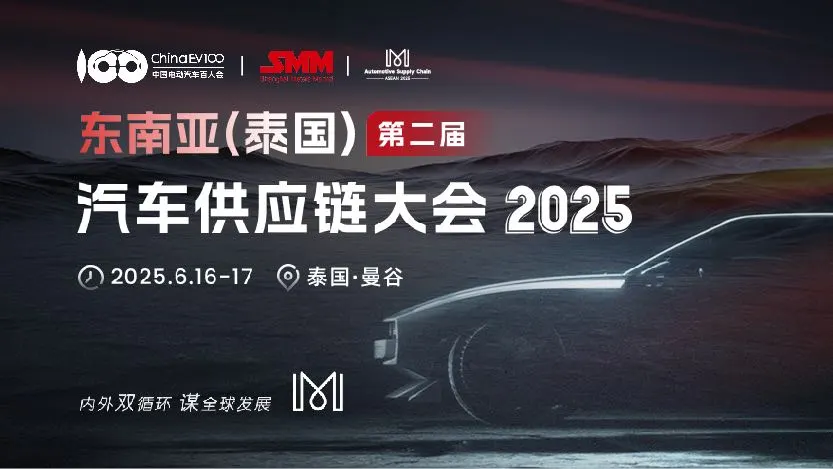
Based on this, the 2025 SMM 2nd Southeast Asia Automotive Supply Chain Conference, hosted by SMM Information & Technology Co., Ltd. (hereinafter referred to as SMM), will be held in Bangkok. Meanwhile, a roundtable forum with the theme of "Battery Material Supply Chain - Possibilities for Southeast Asia Linkage in Battery Cell Chemical Materials" will be specially organized. We sincerely invite industry elites to jointly explore these challenges and opportunities and work together to promote the prosperity and development of the automotive industry in Southeast Asia and globally.
2025 SMM Southeast Asia Automotive Supply Chain Conference
Guest Introduction
At this conference, he will participate in the roundtable forum to discuss "Battery Material Supply Chain - Possibilities for Southeast Asia Linkage in Battery Cell Chemical Materials".

Scan the QR code to view conference details
2025 SMM Southeast Asia Automotive Supply Chain Conference
Conference Agenda
DAY 1
08:00-09:00
Registration and Morning Tea
09:00-09:10
Opening Ceremony, Welcome Speech by the Host
09:10-09:20
Speeches by the Vice Chairman and Secretary General of China EV100 and Leaders of SMM
09:20-09:40
Latest Policies on the Automotive Industry in Southeast Asia
Topic Logic: Thailand's EV3.0 and Revised Policy EV3.5
09:40-10:00
Automobile Brand Building and Differentiation Strategies in the Southeast Asian Market
Topic Logic:
1. Cultivating Brand Awareness: The Japanese and South Korean markets are mature.
2. Cultural Differences: There are significant cultural differences among Southeast Asian countries, and brands need to fully consider local cultural characteristics during the brand-building process. For example, consumers in the Thai market prioritize luxury and comfort, while those in the Malaysian market may place greater emphasis on the practicality and cost-effectiveness of vehicles.
10:00-10:25
Tea Break
10:25-11:25
Roundtable Forum: Construction and Optimization Pathways for Localized Supply Chains in Southeast Asia
Guest Speakers:
·Martin Knoss, Regional President for Passenger Cars, Commercial Vehicles, and Off-Road Vehicles, ASEAN Market Segment, Power Solutions Division, Robert Bosch Automotive Technology (Thailand) Co., Ltd.
·Harendra Saksena, Chief Procurement Officer, Ather Energy
·Peter Klöpfer, Senior Manager, Rutronik Elektronische Bauelemente GmbH
·Ma Ming, General Manager, Joyson Safety Systems (Thailand)
Topic Logic:
1. Possibility of Diversified Localized Cooperation Pathways: Under the requirement of a certain average localization rate in various countries, the original industry chain may not fully follow suit.
What are the possibilities for diversified cooperation among the industry chains of China, Europe, the United States, Japan, and local countries? How do enterprises from various parties view this issue?
2. Unstable Supply Chain: The relatively complex political and economic environment in Southeast Asia may lead to instability in the supply chain.
3. High Logistics Costs: For example, the varying levels of industrial development in different regions of Indonesia can lead to increased costs when transporting goods from one port to another.
11:25-11:55
Roundtable Forum: Southeast Asia Automotive Supply Chain - Import Matters (Services, Pricing, and Landing Support Possibilities)
Guest Speakers:
Yi Yanting, VP, SMM Information Technology Co., Ltd.
Topic Logic:
1. Material Pricing: The information asymmetry in the material market in Southeast Asia leads to low price transparency.
How should imported materials be priced after landing? What about service support? What if local materials are even less transparent and not recognized by end-users?
2. Difficulty in Supplier Management: The large number of suppliers in Southeast Asia with varying management levels may lead to price opacity and instability. For example, some suppliers may adopt a low-price strategy to secure orders but may have hidden risks in product quality and delivery dates.
12:10-14:00
Lunch + Networking Session
14:00-15:00
Roundtable Forum: Research on the Acceleration of Electrification and Localization of Core Components in Thailand
Guest Speakers:
·Xu Xiaolong, Deputy General Manager, Inovance United Power Systems (Thailand) Co., Ltd.
·Ross, Head of a Certain OEM Chip Division
Topic Logic:
Accelerating the Localization of Core Components is a Trend: Issues such as local government policies, core component supply chains, implementation, and talent follow-up.
15:00-15:30
To Be Determined Speaker
15:30-16:00
Tea Break
16:00-16:20
To Be Determined Speaker
16:20-16:40
To Be Determined Speaker
16:40-17:20
Roundtable Forum: Selection of Investment and Factory Construction Models in Southeast Asia: Analysis of the Pros and Cons of Joint Ventures and Wholly-Owned Subsidiaries
Topic Logic:
1. Difficulty in Choosing Partners: In a joint venture model, enterprises need to select suitable partners. However, in Southeast Asia, there may be numerous and uneven partners, making it difficult to choose.
For example, some partners may lack technical capabilities or management experience, making it challenging for joint ventures to achieve the expected results.
2. Cultural Conflicts: Joint ventures may face issues related to cultural conflicts. For instance, when Chinese enterprises collaborate with local enterprises, differences in management philosophies and work styles due to cultural disparities may lead to unsmooth cooperation.
3. High Risks in Sole Proprietorship: Under the sole proprietorship model, enterprises need to independently bear all risks and challenges. For example, policy changes and market fluctuations may lead to difficulties in the operation of sole proprietorships.
18:30-20:30
Cocktail Dinner
DAY 2
09:00-09:30
Forward-Looking Feasibility of Integrated Die Casting in Thailand
09:30-09:20
Roundtable Forum: Logic of Global Market Supporting Orders for Southeast Asia's Local Supply Chain
Discussion Logic:
1. How do customers from markets other than the local market perceive such a large-scale shift in the industry supply chain?
2. What are the new requirements for products or compliance after the shift?
10:20-10:50
Tea Break
10:50-11:40
Roundtable Forum: Possibility of Linkage in Southeast Asia for the Battery Materials Supply Chain - Battery Cell Chemical Materials
Guest Speakers:
·Tony - General Manager, SEVB Technology (Thailand) Co., Ltd.
·Liu Rui - Chairman, Innowave (Malaysia) New Materials Technology Co., Ltd.
· Jin Changxi - Sales Director for Japan, South Korea, and Southeast Asia, Electrolyte Division, Tinci Materials
Discussion Logic:
1. Risks of Trade Barriers: Despite the many advantages in Southeast Asia, uncertainties in the international trade environment may still impact the battery materials supply chain.
For example, trade barriers such as anti-dumping and countervailing duty investigations may increase operational costs and market risks for enterprises.
2. Technical Standards and Certifications: Different countries have varying technical standards and certification requirements for battery products, necessitating enterprises to invest more resources to meet market access requirements.
This may pose certain challenges to the layout of the battery materials supply chain in Southeast Asia.
3. Supply Chain Stability: Relying on local raw material supplies may face risks of supply disruptions or price fluctuations.
Therefore, enterprises need to strengthen supply chain management and risk control to ensure a stable supply of raw materials and cost control.
11:40-13:00
Lunch + Networking Session
14:00-17:30
Automaker Demand Matchmaking Meeting
Scan the QR code to view meeting details
Previous Attendees

2025 SMM
2nd Southeast Asia Automotive Supply Chain Conference
Date: June 16-17, 2025
Venue: Bangkok, Thailand
Scan the QR code to view meeting details


