SMM reported on May 8: By the end of April, many domestic lithium mining enterprises had successively released their performance reports for Q1 2025 and the full year of 2024. In recent years, as lithium prices plummeted, lithium mining enterprises, once thriving, have found themselves in a situation of narrowing profits or even losses. Now, after a period of adjustment in the industry, how have the performances of major lithium mining enterprises fared? SMM has compiled the performance of several lithium mining enterprises, as detailed below:
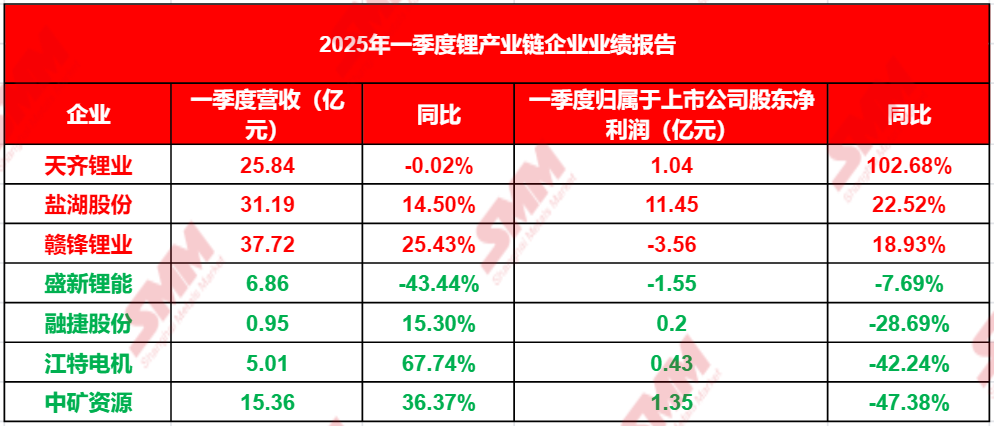
In terms of Q1 2025 performance, Tianqi Lithium and Ganfeng Lithium, collectively known as the "Lithium Battery Duo," both delivered notable results. The former not only turned a profit from a loss in Q1, with a substantial increase of 102.68% in net profit attributable to shareholders of listed companies. The latter, although still incurring a net loss, saw a narrowing of losses compared to the same period in previous years, with a net loss attributable to shareholders of listed companies of 356 million yuan, compared to a loss of 439 million yuan in the same period last year, representing a YoY increase of 18.93% in losses.
Enterprises such as Chengxin Lithium, YOUNGY, and Jiangxi Special Electric Motor have all experienced varying degrees of drag on their performances due to factors such as the decline in lithium prices and a significant drop in lithium chemical prices. Among them, although Salt Lake Potash's Q1 performance showed significant growth, with stable production and sales of lithium carbonate products, most of its revenue came from its other potassium chloride business. The significant increase in market prices for potassium chloride drove Salt Lake Potash's performance growth compared to the same period in previous years.
In Q1, lithium carbonate prices rose first and then fell, with some lithium chemical plants reducing or halting production after prices dropped below the 70,000 yuan/mt threshold
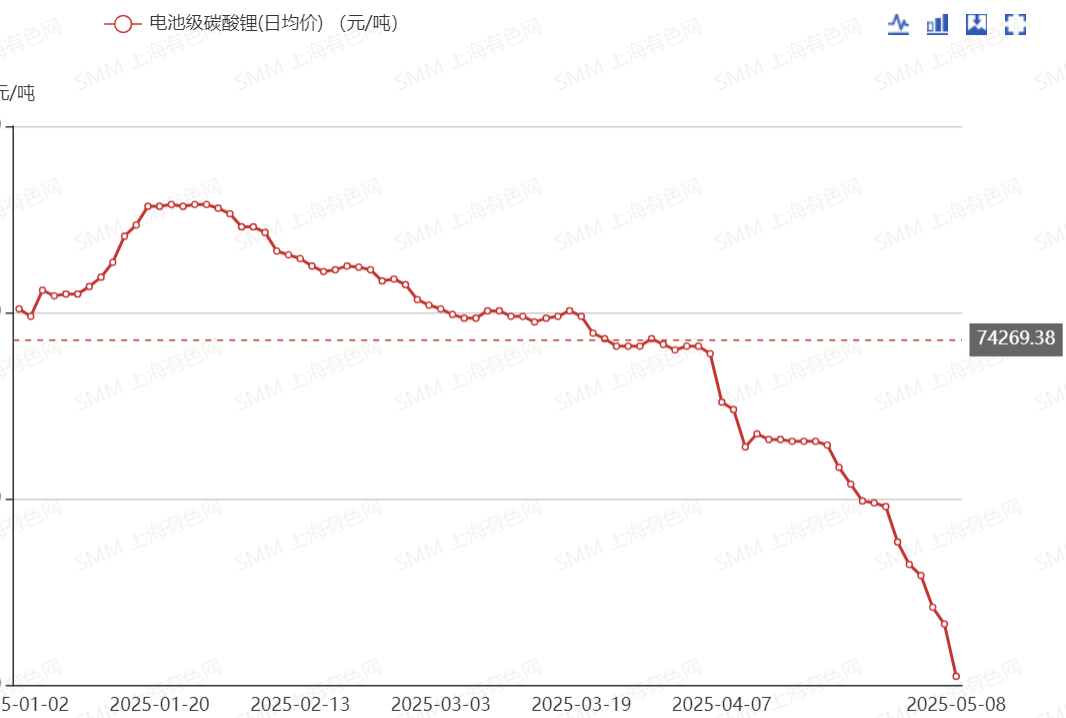
Reviewing the lithium price trend in Q1, according to SMM spot quotes, the spot price of domestic battery-grade lithium carbonate showed a trend of rising first and then falling in the past quarter. After a brief uptick in mid-to-late January, prices continued to decline, reaching 74,000 yuan/mt by March 31, a drop of 1,100 yuan/mt from 75,100 yuan/mt at the beginning of the year, representing a decline of 1.46%. The average spot price of lithium carbonate in Q1 was 75,812.63 yuan/mt, a YoY decline of 25.33% from 101,534.48 yuan/mt in Q1 2024.
》Click to view SMM's spot quotes for new energy products
Breaking down the various stages, in mid-to-late January, the price of battery-grade lithium carbonate rose due to multiple positive factors. Additionally, some downstream enterprises were still in the stockpiling phase before the holiday, leading to relatively active market inquiries and transactions. Upstream smelters, due to cost pressures, maintained a strong stance on quotes for long-term contract discount coefficients and spot prices for 2025. Meanwhile, the inventory-to-sales cycle of upstream smelters showed a significant slowdown in pressure compared to the same period last year, with relatively small shipping pressure, which also supported the price increase to a certain extent.During this period, traders also took advantage of the active purchasing by downstream enterprises to raise prices. Consequently, lithium carbonate prices climbed steadily from the first half to mid-January, driven by these combined factors.
However, as most upstream lithium chemical plants gradually resumed production from maintenance in February, lithium carbonate production increased significantly MoM. Coupled with the off-season in downstream demand, the lithium carbonate market saw a renewed surplus amid increased supply and decreased demand. In March, although downstream demand picked up somewhat, domestic lithium carbonate output reached a record high in March, up 23% MoM, approaching the 80,000 yuan/mt threshold, due to the continuous ramp-up of some lithium carbonate production lines. The surplus in the lithium carbonate market intensified further, dragging spot lithium carbonate prices down continuously.
In April, downstream demand remained relatively stable, falling short of previous incremental expectations. Although some small and medium-sized plants on the supply side had reduced output, the total lithium carbonate output was expected to remain high due to the strong supply from first- and second-tier lithium chemical plants. Overall, both supply and demand for lithium carbonate remained high and stable in April, making it difficult to reverse the surplus situation. Against this backdrop, spot quotes for battery-grade lithium carbonate continued to fall in April, breaking below the 70,000 yuan/mt threshold and continuing to decline. As of May 8, spot quotes for battery-grade lithium carbonate had fallen to 63,500-67,000 yuan/mt, with an average price of 65,250 yuan/mt.
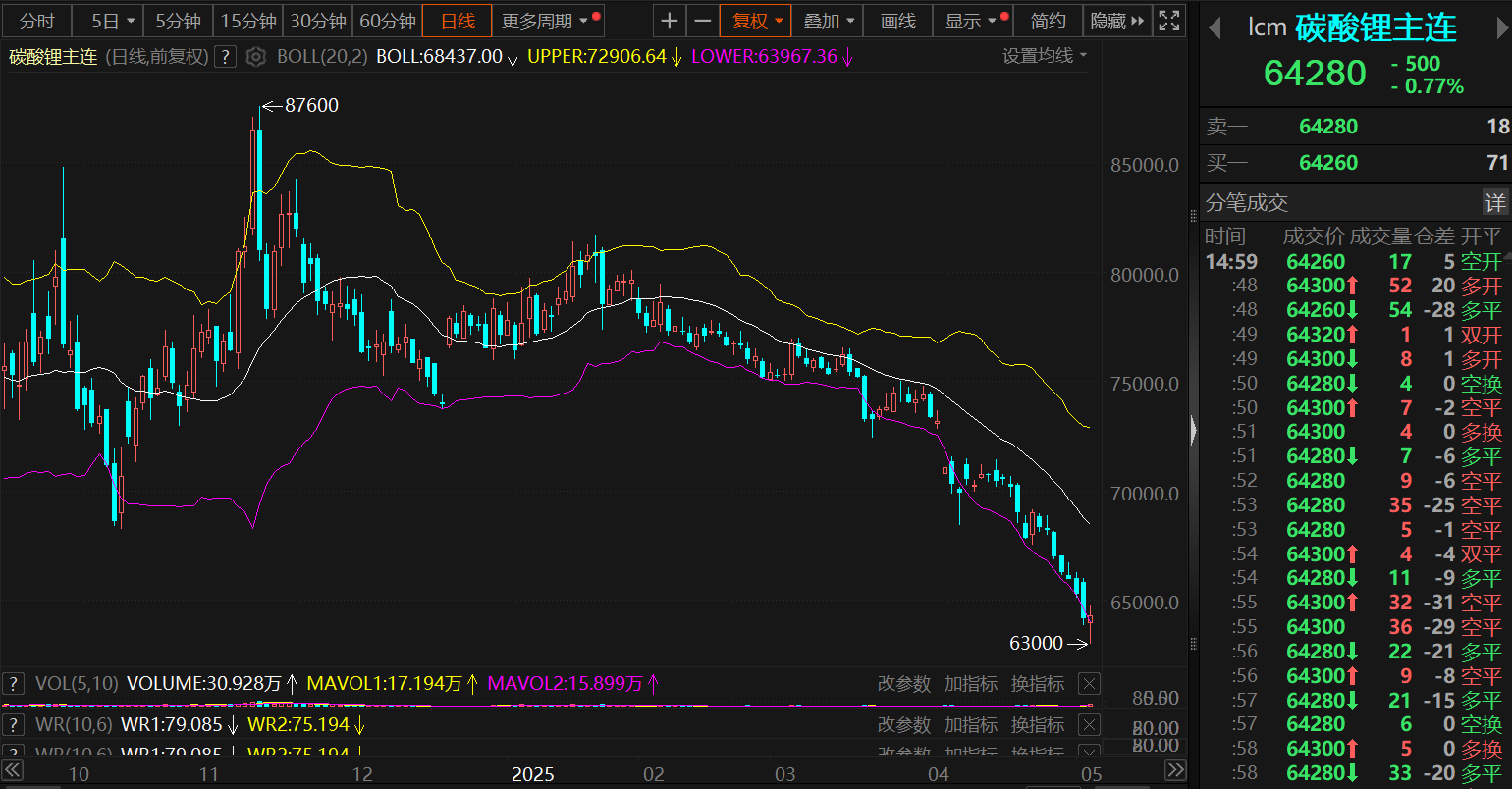
In terms of futures prices, the main lithium carbonate futures contract also showed a trend of rising first and then falling in Q1, reaching a peak of 81,680 yuan/mt during the daytime session on January 21, the highest since November 21, 2024. However, lithium carbonate futures prices broke below the 70,000 yuan/mt threshold earlier than spot prices, falling to 69,890 yuan/mt during the daytime session on April 8. After a brief period of volatility and recovery, prices continued to decline, hitting a low of 63,000 yuan/mt during the daytime session on May 8, a record low since listing after seven consecutive days of decline.
Looking ahead to May, SMM expects that both supply and demand for lithium carbonate will increase to a certain extent, but the supply scale will still outpace demand, and lithium carbonate is expected to remain in surplus. SMM believes that although current downstream production schedules are steadily rising, the proportion of customer-supplied materials at material plants has increased compared to Q1, resulting in no significant improvement in purchasing demand from downstream material plants. Amid the persistent surplus in lithium carbonate and the current downward trend in ore prices, it is difficult to provide upward support for lithium carbonate prices. Moreover, according to SMM's latest understanding, some upstream lithium chemical plants have already reduced or halted production due to cost pressures. However, considering that the accumulated inventory level in the market remains high and the sentiment of significant surplus continues to ferment, lithium carbonate prices may continue to face downward pressure.
Despite the current weakness in lithium prices, lithium mine enterprises remain optimistic about the future of the lithium market.
Although sentiment is slightly pessimistic in the short term due to oversupply in the lithium carbonate market, upstream enterprises within the lithium battery industry chain still hold expectations for the future of the lithium market in the medium and long term.
When discussing the future development of the lithium industry, Tianqi Lithium expressed confidence in the long-term growth of the new energy sector. In 2024, the global energy transition has entered a critical phase. Governments, enterprises, and various sectors of society worldwide are accelerating the adoption of clean energy to address the challenges of climate change. Despite changes in relevant policies due to shifts in the macroeconomic environment and fiscal pressures in some countries, the development of the new energy vehicle (NEV) and energy storage system (ESS) industries continues to receive widespread support globally. From the perspectives of speed, scale, and intensity, the global lithium industry is still in an upward phase of development. Therefore, from a medium and long-term perspective, the company believes that the fundamentals of the lithium industry will continue to improve in the coming years.
Ganfeng Lithium mentioned at a previous earnings conference that with lithium carbonate prices falling to low levels, capital expenditures in the industry have significantly slowed down, and the growth rate of industry supply is expected to decline. At the same time, some mines have begun to cut production and suspend operations. With the sustained growth in demand in the future, the supply-demand pattern is expected to gradually improve.
Jiangxi Special Electric Motor mentioned during an investor survey that, looking ahead to 2025, it is expected that the supply and demand for lithium carbonate will both increase year-over-year (up YoY). On the supply side, overseas increments will be contributed by projects at South American salt lakes and African spodumene mines, as well as by the expansion of domestic low-cost integrated spodumene and salt lake mines. On the demand side, the main driving factors include the boosting effect on NEV consumption from the ongoing implementation of the trade-in policy for vehicles, as well as the rapid growth in global ESS demand. It is expected that the industry will still be in a period of capacity exit in 2025, with prices fluctuating considerably at the bottom but with less volatility compared to 2024.
YOUNGY anticipates that in recent years, the downstream demand for lithium batteries in the NEV and ESS markets has been continuously growing. From a medium and long-term perspective, the lithium battery materials industry still has room for growth and development prospects. In 2025, the company will closely monitor changes in the external environment, strengthen its research and judgment on industry trends, coordinate and deploy various operational management tasks, and further enhance its profitability.
Chengxin Lithium predicts that currently, the lithium chemicals industry is affected by the downturn cycle, with product prices operating at low levels. As lithium prices continue to decline, the industry's supply capacity will gradually exit the market. On the downstream demand side, the NEV and ESS markets have been continuously growing. The company firmly believes in the long-term development prospects of the lithium battery new energy industry and is full of confidence in the future. In 2025, the company will closely monitor changes in the external environment, strengthen its research and judgment on industry trends, coordinate and deploy various operational management tasks, and strive to improve its operating performance.
Lithium prices fluctuate unpredictably; major enterprises are balancing risks through futures hedging
Tianqi Lithium issued an announcement on March 27 regarding the implementation of lithium carbonate futures hedging, mentioning that the company is a new energy materials enterprise centered around lithium.The company's main business includes lithium ore mining, production, processing, and sales of lithium concentrates, lithium chemical products, and their derivatives. In recent years, the market prices of the company's main products have fluctuated significantly, posing substantial risks to the company's production and operation. With the listing of lithium carbonate futures, it has provided the company with an important avenue for price discovery and risk avoidance. Therefore, the company intends to carry out commodity futures hedging business related to its production and operation, effectively combining futures and spot markets to mitigate the risks posed by price fluctuations to the company's operations and ensure the company's healthy and sustainable operation.
Ganfeng Lithium also issued an announcement on January 22 regarding the company and its holding subsidiaries conducting commodity hedging, with the primary aim of reducing the adverse impacts of lithium carbonate price fluctuations on the company's operations. Ganfeng Lithium has been deeply involved in the lithium industry for over two decades, possessing a mature and stable team that can maintain constant attention to industry dynamics and keenly perceive industry trends. The company has formulated the "Futures and Derivatives Trading Management System," established a futures and derivatives trading working group, and clearly defined the operational norms, approval authorities, organizational structure setup and responsibilities, business processes, and risk management aspects of commodity futures and options. It has also staffed each position with professionals and implemented corresponding risk control measures. The company will strictly adhere to the requirements of relevant systems, implement risk prevention measures, and operate prudently. The company's commodity futures and options hedging business is feasible.
Faced with the fluctuating trend of lithium prices, Jiangxi Special Electric Motor stated that the company will continue to leverage the hedging function of the futures market to avoid market risks arising from price fluctuations, continuously improve ore beneficiation and smelting levels, reduce raw material and processing costs, and persistently carry out internal control management, risk management, and cost-reduction and efficiency-enhancement efforts. Meanwhile, the company is also actively seeking and developing high-quality lithium ore resources globally to broaden its lithium resource supply channels. The company will continue to monitor the development of the solid-state battery industry and the opportunities for demand growth that exceed expectations, cultivate internal strengths, and patiently await the arrival of the next cycle.
YOUNGY has also mentioned that the company conducts lithium carbonate hedging business in accordance with relevant hedging regulations and in conjunction with its production and operation situation to avoid the price fluctuation risks in spot market transactions and achieve expected risk management objectives. In 2025, with the expansion of the company's production and sales scale, it will continue to strengthen cost management and enhance the company's profitability.
Chengxin Lithium also mentioned during an investor activity survey that the company is utilizing futures financial instruments for hedging to reduce the impact of product price fluctuations on its operating performance.The company will actively implement the aforementioned measures to strengthen its ability to respond to related risks, strive to enhance corporate performance, and promote the company's long-term sustainable development.
On April 25, 2025, Sinomine Resource Group issued a feasibility announcement regarding the company's engagement in commodity futures and options hedging business. The announcement mentioned that the company is primarily engaged in the development and utilization of new energy raw materials for lithium batteries, with its main products being lithium chemical products such as lithium hydroxide and lithium carbonate. In recent years, the selling prices of the company's lithium chemical products have been significantly impacted by market price fluctuations. To mitigate the operational risks posed by product price fluctuations, the company intends to utilize the hedging functions of financial instruments to selectively engage in commodity futures and options hedging business for product risk exposures related to its production and operation activities, effectively reducing the risks associated with market price fluctuations of products and ensuring the stable and sustainable development of its main business.
In response to the fluctuations in lithium carbonate prices, Salt Lake Potash has also taken certain measures. The company stated that, on one hand, it is continuously optimizing production processes through the upgrading of a refined management system to comprehensively enhance product quality and strengthen market competitiveness. On the other hand, it is deeply exploring the potential for cost reduction and efficiency enhancement, starting from aspects such as supply chain optimization and energy consumption control, to achieve effective cost reduction. Meanwhile, the company will establish a professional team to conduct in-depth research on the futures market, scientifically utilize financial instruments such as hedging, and reasonably hedge against price fluctuation risks, adopting more flexible strategies to address market challenges and fully safeguard the stability and sustainability of its operating performance.
Below are the detailed performance situations of specific enterprises:
Salt Lake Potash:
In April, Salt Lake Potash released its Q1 2025 performance report. According to the announcement, the company achieved a total revenue of 3.119 billion yuan in Q1, representing a year-on-year increase of 14.50%. The net profit attributable to shareholders of the publicly listed firm reached 1.145 billion yuan, up 22.52% YoY. Regarding the reasons for the company's performance growth, Salt Lake Potash stated that the production and sales of its core products, potassium chloride and lithium carbonate, remained stable. Potassium chloride production was approximately 964,900 mt, with sales of approximately 891,100 mt. Lithium carbonate production was approximately 8,514 mt, with sales of approximately 8,124 mt. Among them, potassium chloride, as one of the company's main revenue sources, experienced a significant increase in market prices due to factors such as market supply-demand relationships, thereby driving the company's performance growth compared to the same period last year.
Tianqi Lithium:
Tianqi Lithium previously released its Q1 2025 report, showing a revenue of 2.584 billion yuan, down 0.02% YoY. The net profit attributable to shareholders of the publicly listed firm was 104 million yuan, turning from a loss of 3.897 billion yuan in the same period last year.
Tianqi Lithium stated that the improvement in its Q1 performance was mainly attributable to two key factors. On one hand, the company's controlling subsidiary, Windfield Holdings Pty Ltd, achieved significant results in shortening the pricing cycle for lithium ore. The time-cycle mismatch between the pricing mechanism for chemical-grade lithium concentrates of its wholly-owned subsidiary, Talison Lithium Pty Ltd, and the pricing mechanism for the company's lithium chemical product sales, which had existed in previous years, has been greatly alleviated. With the successive arrival of newly purchased lithium concentrates in China and the gradual consumption of existing inventory, the cost of chemical-grade lithium concentrates consumed in the production costs at the company's various production sites has basically aligned with the latest purchase prices. Meanwhile, influenced by the capacity ramp-up and technological upgrades of its in-house production facilities, the company achieved YoY growth in the production and sales volumes of lithium compounds and derivatives in Q1 2025, further enhancing its profitability.
On the other hand, the impact of the tax dispute ruling on the net profit of the company's significant associate, Sociedad Químicay Minera de Chile S.A. (SQM), was recognized in 2024. According to Bloomberg's forecast data, SQM's Q1 2025 performance is expected to increase YoY. Consequently, the company's investment income recognized from this associate in the current reporting period increased YoY.
Ganfeng Lithium:
Ganfeng Lithium announced that its operating revenue in Q1 2025 was 3.772 billion yuan, down 25.43% YoY. The net loss attributable to shareholders of the publicly listed firm was 356 million yuan. Although this represents a narrowing of losses compared to the 439 million yuan loss in the same period last year, the company is still operating at a loss.
In its announcement, Ganfeng Lithium stated that the main reasons were the decline in lithium prices and the increase in the proportion of domestic sales, which led to a YoY decrease in cash received from the sale of goods and the provision of services, as well as the relatively high discount rate for bills receivable, prompting the company to proactively control the scale of bill discounting. Meanwhile, the decline in the share price of Pilbara Minerals Limited, a financial asset held by the company, resulted in a loss from changes in fair value, but the company partially hedged this impact by actively employing collar option strategies.
Sinomine Resource Group:
On April 25, Sinomine Resource Group released its Q1 2025 performance report. According to the announcement, the company achieved a total operating revenue of 1.536 billion yuan, up 36.37% YoY. The net profit attributable to shareholders of the publicly listed firm was 135 million yuan, down 47.38% YoY.
Sinomine Resource Group stated that in Q1 2025, the company achieved sales of 8,964.43 mt of lithium chemical products, up 13% YoY.However, affected by market fluctuations in the lithium battery and new energy sector, the selling prices of lithium chemical products declined significantly YoY, leading to a drop in the gross profit margin of the company's lithium battery and new energy business. Facing downward pressure in the industry, the company actively implemented various cost-reduction and efficiency-enhancement measures to mitigate the risks of market price fluctuations.
Chengxin Lithium:
On April 29, Chengxin Lithium released its Q1 2025 performance report, which mentioned that the company achieved a total revenue of 686 million yuan in Q1, down 43.44% YoY; its net loss attributable to shareholders of the publicly listed firm reached 155 million yuan, a decrease of 7.69% compared to the same period last year, when the loss was 144 million yuan.
Regarding the reasons for the company's losses, Chengxin Lithium stated that, affected by the continued downturn in the lithium chemical industry, the selling prices and sales volumes of lithium chemical products during the reporting period declined compared to the same period last year. Additionally, changes in raw material prices lagged behind those of products, leading to a decline in financial indicators such as the company's operating revenue, net profit attributable to shareholders of the publicly listed firm, net profit attributable to shareholders of the publicly listed firm excluding non-recurring gains and losses, and earnings per share compared to the same period last year.
YOUNGY:
At the end of April, YOUNGY released its Q1 2025 performance report. Annual report data showed that the company achieved a total revenue of 95.0535 million yuan, up 15.30% YoY; its net profit attributable to shareholders of the publicly listed firm was 20.0339 million yuan, down 28.69% YoY. Regarding the reasons why the company's revenue still increased by more than 15% YoY amid falling lithium prices, YOUNGY stated that the main reason was the smooth progress of the raw ore outbound transportation and toll processing business, which led to an increase in the production and sales volumes of lithium concentrates.
In 2024, YOUNGY achieved a total revenue of 561 million yuan, down 53.6% YoY; its net profit attributable to shareholders of the publicly listed firm was 215 million yuan, down 43.4% YoY. When mentioning the reasons for the company's performance changes, YOUNGY stated that during the reporting period, affected by changes in the lithium battery materials industry and a significant YoY decline in product prices, the company's operating revenue and net profit both decreased to a certain extent YoY, but the company's performance changes were generally in line with industry development trends.
Jiangxi Special Electric Motor:
On April 29, Jiangxi Special Electric Motor released its Q1 2025 performance report. The announcement showed that the company achieved a total operating revenue of 501 million yuan in Q1, up 67.74% YoY; its net loss attributable to shareholders of the publicly listed firm was 43.0832 million yuan, down 42.24% YoY, compared to a loss of 30.2891 million yuan in the same period last year.Regarding the reasons for the company's revenue growth, Jiangxi Special Electric Motor stated that it was mainly due to the increase in sales of lithium chemical products. The decline in profit during the reporting period was attributed to the decrease in selling prices of lithium chemical products, which led to a decrease in gross profit margin.


