
SMM April 15 News:
In the metal market:
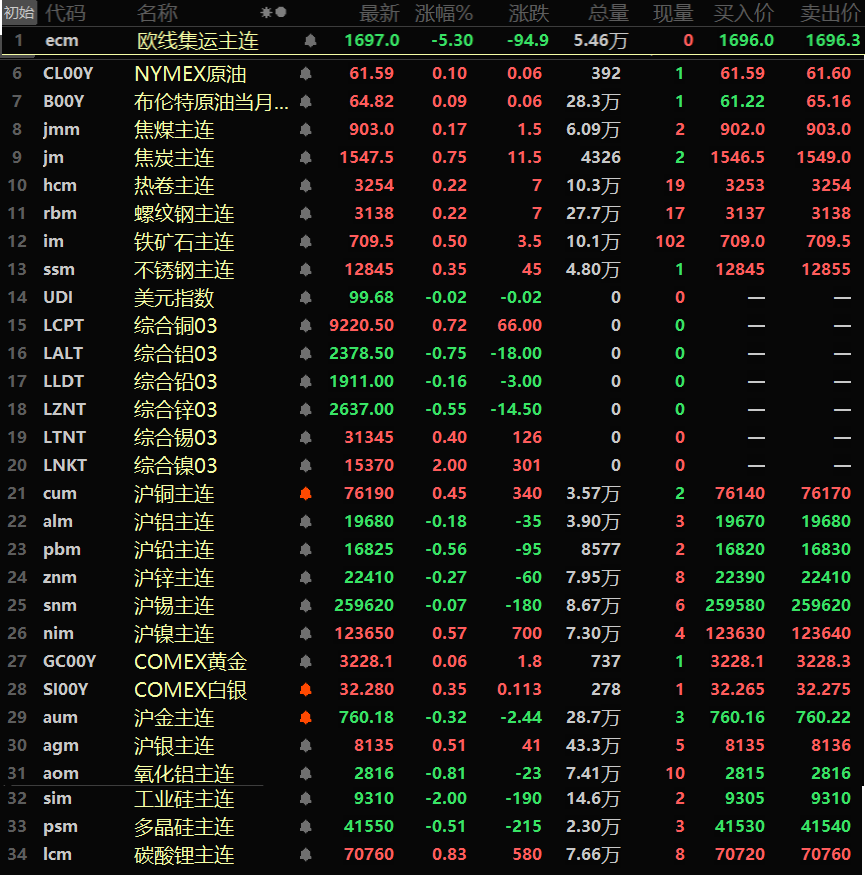
Overnight, domestic and overseas metal markets showed mixed performance, with domestic market changes all within 1%. SHFE nickel led the gains with a 0.57% increase, SHFE copper rose 0.45%, while SHFE lead led the losses with a 0.56% drop. In the overseas market, LME nickel rose 2%, LME copper increased 0.72%, and other metals declined, with LME aluminum leading the losses at 0.75%. Alumina main contract fell 0.81%.
In the ferrous metals series, all products rose, with iron ore leading the gains at 0.5%, while rebar and HRC both increased by 0.22%. In the coking coal and coke sector, coking coal rose 0.17%, and coke increased 0.75%.
In the precious metals sector, overnight COMEX gold fell 0.55%, while COMEX silver rose 1.14%. Domestically, SHFE gold dropped 0.32%, and SHFE silver increased 0.51%.
As of 6:42 AM on April 15, the overnight closing market
》Click to view SMM futures data dashboard
On the macro front:
Domestically:
【Steady Start! China's Q1 Goods Trade Imports and Exports Totaled 10.3 Trillion Yuan, Up 1.3%】 Despite increasing external challenges, various departments and foreign trade entities actively responded, driving a steady start to China's foreign trade imports and exports in Q1. Exports exceeded 6 trillion yuan, achieving a rapid growth of 6.9%, demonstrating strong resilience under pressure. Exports to over 170 countries and regions increased. The transformation of Chinese manufacturing towards high-end, intelligent, and green production showed strong momentum. Exports of ships and marine engineering equipment, and specialized equipment increased by 10.8% and 16.2%, respectively. New energy products continued to play a significant role in the global green transition, with exports of wind turbines, lithium batteries, and EVs increasing by 43.2%, 18.8%, and 8.2%, respectively. 》Click for details
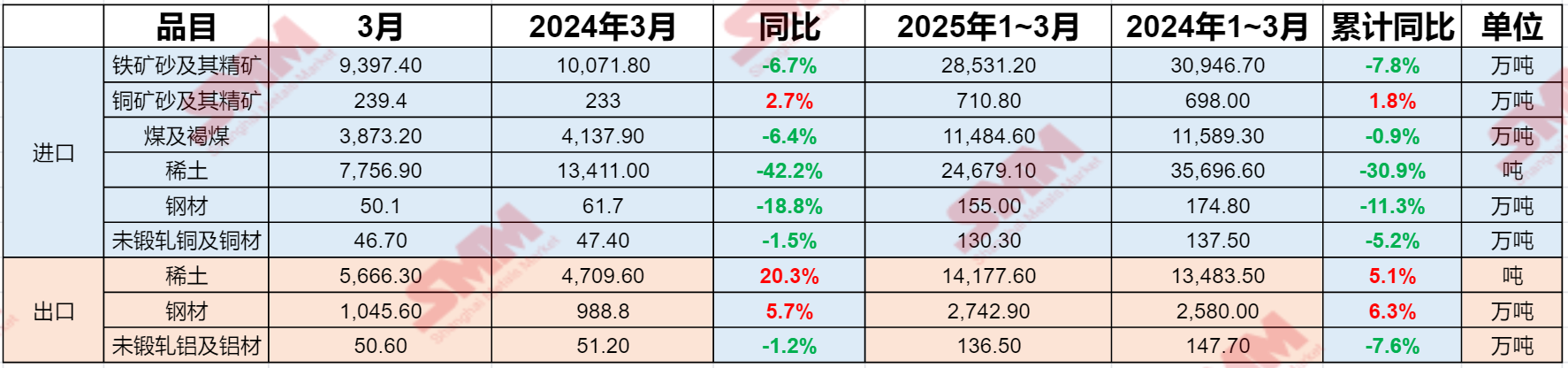
SMM compiled the import and export data of some products in the metal industry based on the General Administration of Customs data, as follows:
【Central Bank: Q1 Social Financing Increased by 15.18 Trillion Yuan, New RMB Loans Reached 9.78 Trillion Yuan, M2 Up 7% YoY in March】 According to preliminary statistics from the central bank, the cumulative increase in social financing scale in Q1 2025 was 15.18 trillion yuan, 2.37 trillion yuan more than the same period last year. Among them, RMB loans to the real economy increased by 9.7 trillion yuan, 586.2 billion yuan more YoY; foreign currency loans to the real economy decreased by 96.7 billion yuan, 249 billion yuan more YoY; entrusted loans increased by 5.5 billion yuan, 105 billion yuan more YoY; trust loans increased by 53.1 billion yuan, 145.2 billion yuan less YoY; undiscounted bankers' acceptances increased by 530 billion yuan, 20.2 billion yuan less YoY; net corporate bond financing was 525.1 billion yuan, 472.9 billion yuan less YoY; net government bond financing was 3.87 trillion yuan, 2.52 trillion yuan more YoY; domestic stock financing by non-financial enterprises was 96.2 billion yuan, 19.9 billion yuan more YoY. RMB loans increased by 9.78 trillion yuan in Q1. By sector, household loans increased by 1.04 trillion yuan, including short-term loans (160.3 billion yuan) and medium and long-term loans (883.2 billion yuan); loans to enterprises (institutions) increased by 8.66 trillion yuan, including short-term loans (3.51 trillion yuan), medium and long-term loans (5.58 trillion yuan), and a decrease in bill financing (544.2 billion yuan); loans to non-banking financial institutions decreased by 86.6 billion yuan. Central bank data showed that at the end of March, the balance of broad money (M2) was 326.06 trillion yuan, up 7% YoY. 》Click for details
On the US dollar:
The US dollar index fell 0.1% overnight, marking five consecutive days of decline. The US dollar has decoupled from US Treasury yields, as the dollar fell last week while Treasury yields rose. This has sparked speculation that investors are shifting investments out of the US due to concerns about the durability and impact of tariffs. US Fed Governor Waller stated on Monday that the Trump administration's tariff policies have significantly impacted the US economy and may lead the Fed to cut interest rates despite high inflation to avoid a recession. (Wenhua Comprehensive)
On other currencies:
A report released by the New York Fed on Monday showed that short-term inflation expectations among US citizens reached their highest level since the fall of 2023, as public assessments of personal financial conditions and hiring prospects declined. The euro was basically flat at $1.1359, after hitting $1.1473 on Friday, the highest level since February 2022.
The US dollar fell 0.39% against the yen to 142.93 yen, after dropping to 142.05 on Friday, the lowest level since last September.
The US dollar fell 0.18% against the Swiss franc to 0.814 francs.
The pound rose 0.88% to $1.3195.
The Australian dollar rose 0.84% to $0.6338, extending last week's gain of over 4%.
On data:
Today, China's April 15 medium-term lending facility (MLF) operation size, China's April 15 MLF winning bid rate, UK February unemployment rate - ILO standard, UK February three-month average earnings including bonuses YoY, Eurozone April ZEW economic sentiment index, Germany April ZEW economic sentiment index, Eurozone March total reserve assets, US April New York Fed manufacturing index, US April New York Fed manufacturing future six-month expectations index, US March import price index YoY, Canada March unadjusted CPI YoY, Canada March central bank core CPI MoM, Canada March core CPI - common YoY, Canada February manufacturing sales MoM, and other data will be released.
In addition, President Xi Jinping will pay a state visit to Malaysia and Cambodia from April 15 to 18, and the Reserve Bank of Australia will release the minutes of its April monetary policy meeting.
On crude oil:
Overnight, oil prices in both markets rose, with US oil up 0.1% and Brent oil up 0.09%. The main reasons were the easing of trade tensions and data showing a significant rebound in China's March crude oil imports, but gains were limited by concerns that the trade war could weaken global economic growth and suppress fuel demand.
According to Securities Times, late on April 11 local time, US Customs and Border Protection announced that smartphones, routers, and some computers and laptops would no longer be included in the 125% so-called "reciprocal tariff" previously imposed on Chinese imports. This is the latest in a series of policy statements that first imposed tariffs and then suspended them, creating uncertainty for investors and businesses. Meanwhile, Monday's data showed that China's March crude oil imports rebounded significantly from the previous two months, up nearly 5% YoY.
However, since the beginning of the month, Brent and US crude have fallen by about $10 per barrel. OPEC on Monday lowered its 2025 global oil demand growth forecast for the first time since December, citing data received in Q1 and the impact of US trade tariffs. OPEC stated in its monthly report that global oil demand will increase by 1.3 million barrels per day in 2025 and 1.28 million barrels per day in 2026. Both forecasts are 150,000 barrels per day lower than last month's figures. John Kilduff, a partner at Again Capital, said, "OPEC's downward revision of global demand estimates highlights the troubles caused by tariffs and all other uncertainties in the market." "The market is still sorting out the impact of tariffs." Analysts led by Daan Struyven said in a report that global oil demand in Q4 2025 is expected to increase by only 300,000 barrels per day YoY, adding that the slowdown in demand for petrochemical raw materials is expected to be the most significant. (Wenhua Comprehensive)


