SMM, April 11:
Metal Market:
At the close of the day, domestic base metals collectively rose, with SHFE tin leading the gains at up 3.62%. Other metals, except SHFE aluminum, rose more than 1%: SHFE copper up 1.79%, SHFE nickel up 1.95%, SHFE lead up 1.14%, and SHFE zinc up 1.25%. SHFE aluminum rose 0.41%. Alumina main contract fell 0.14%.
In addition, lithium carbonate main contract fell 0.54%, silicon metal main contract fell 1.2%, polysilicon main contract fell 1.55%, and European container shipping main contract fell 1.97%.
Overseas, as of 15:03, base metals generally rose, with LME tin up 1.03% leading the gains, while other metals rose less than 1%.
In the ferrous metals series, stainless steel rose 0.4%, iron ore rose 0.71%, and rebar rose 0.26%. In coking coal and coke, coking coal fell 2.72%, and coke fell 1.42%.
In precious metals, as of 15:03, COMEX gold rose 1.32%, hitting a record high of $3,241.5/oz, marking its fourth consecutive gain. COMEX silver rose 1.55%, recording its fifth consecutive gain. Domestically, SHFE gold rose 2.71%, hitting a record high of 763.62 yuan/gram, and SHFE silver rose 1.62%.
Market as of 15:03 today
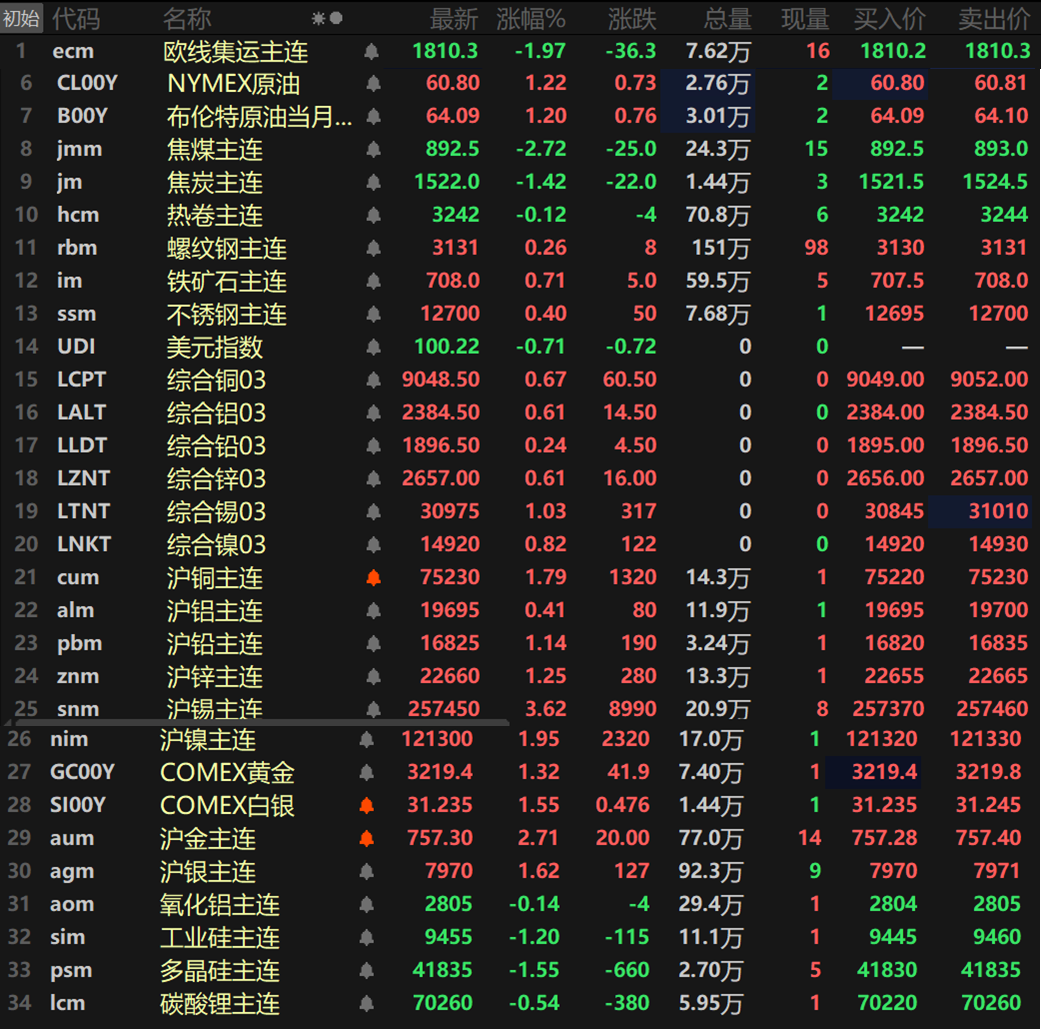
》Click to view SMM Market Dashboard

Macro Front:
Domestic:
【China Semiconductor Industry Association: "Integrated Circuit" Origin Determined by Four-Digit Tariff Code Change Principle, i.e., Wafer Fab Location Recognized as Origin】The China Semiconductor Industry Association issued an urgent notice on the "Origin" determination rules for semiconductor products on April 11. According to the General Administration of Customs, the origin of "integrated circuits" is determined by the four-digit tariff code change principle, i.e., the wafer fab location is recognized as the origin. It is recommended that the origin of "integrated circuits," whether packaged or unpackaged, be declared based on the location of the wafer fab during import customs clearance.
US Dollar:
As of 15:03, the US dollar index fell 0.71% to 100.22, hitting a low of 99.64. Data from the US Bureau of Labor Statistics showed that the US March CPI fell 0.1% MoM, unexpectedly negative, the lowest since May 2020, well below the market expectation of 0.1%. The US March CPI rose 2.4% YoY, below expectations and previous values. The US March core CPI rose 2.8% YoY, falling for the second consecutive month, the lowest since March 2021; core CPI rose 0.1% MoM, the lowest since June 2024. After the data release, traders bet that the US Fed will resume rate cuts in June and may lower the policy rate by a full percentage point by year-end. However, the report was not enough to ease market concerns, as inflation risks significantly increased after the full tariff impact.
Several US Fed officials spoke intensively, emphasizing attention to inflation upside risks, warning that tariffs could trigger persistent price pressures, and hinting at no rush to cut rates in the short term. On April 10, Boston Fed President Collins stated that the US Fed may lower rates later this year, but tariff-driven inflation could delay further cuts; Dallas Fed President Logan believed that maintaining stable rates temporarily is the best approach while waiting for clearer economic impacts from tariffs; Goolsbee described tariffs as stagflationary shocks, posing challenges to the US Fed as there is no universal solution to such shocks.
Data from the US Labor Department on Thursday showed that US consumer prices unexpectedly fell in March, but inflation improvement is unlikely to persist due to tariffs. Traders currently bet that the US Fed will resume rate cuts in June and may lower rates by a full percentage point by the end of 2025. Attention is on the US PPI data to be released tonight. (Wenhua Comprehensive)
Data:
【PBOC Deputy Governor Xuan Changneng Attends and Chairs ASEAN+3 Finance and Central Bank Deputies Meeting: The Meeting Discussed the Impact of US Tariff Policies on Global and Regional Macroeconomic Situations】PBOC Deputy Governor Xuan Changneng attended the ASEAN+3 (10+3) Finance and Central Bank Deputies Meeting in Kuala Lumpur, Malaysia, from April 8 to 9, 2025, and chaired related discussions as the co-chair of the 10+3 financial cooperation mechanism. The meeting discussed the impact of US tariff policies on global and regional macroeconomic situations, improvements to the Chiang Mai Initiative Multilateralization (CMIM) mechanism, and the ASEAN+3 Macroeconomic Research Office (AMRO), reaching a series of consensuses on deepening regional policy coordination and strengthening regional financial safety nets. The meeting unanimously passed the legal arrangements for RMB contributions under the CMIM mechanism. The finance and central bank deputies of China, Japan, and South Korea held a meeting during the same period, exchanging views on the economic situation and regional financial cooperation. Xuan Changneng highlighted that, facing the challenges of rising global uncertainty, the PBOC will implement a moderately loose monetary policy, support stable financial market operations, and consolidate the momentum of economic recovery. Additionally, Xuan Changneng held bilateral talks with South Korea's Deputy Finance Minister Choi Ji-young, South Korea's Central Bank Deputy Governor Kwon Min-soo, and Singapore's Monetary Authority Deputy Managing Director Leong Sing Chiong, exchanging views on the impact of global uncertainty on various countries. (Cailian Press)
Today, the UK February GDP MoM, UK February Industrial Production MoM, UK February Industrial Production YoY, UK February Goods Trade Balance (seasonally adjusted), UK February Trade Balance (seasonally adjusted), Germany April CPI YoY (preliminary), Switzerland March Consumer Confidence Index (seasonally adjusted), China March M2 Money Supply YoY (April 11-17, time uncertain), China March Social Financing Scale (YTD), China March New Yuan Loans (YTD), US March PPI YoY, US March Core PPI YoY, and US April University of Michigan Consumer Sentiment Index (preliminary) will be released. Additionally, noteworthy events include: 2025 FOMC voter and Chicago Fed President Goolsbee speaking at the New York Economic Club; ECB President Lagarde speaking at the Eurogroup press conference; 2025 FOMC voter and St. Louis Fed President Moussalem speaking on the US economy and monetary policy; FOMC permanent voter and New York Fed President Williams speaking on the economic outlook and monetary policy.
Crude Oil:
As of 15:03, oil prices in both markets rose, with US oil up 1.22% and Brent oil up 1.2%, but weekly performance may mark the second consecutive week of decline due to concerns that trade conflicts will weaken economic growth, severely impacting oil consumption.
BMI analysts stated in a report on Friday that oil prices are expected to remain under pressure as investors assess ongoing trade conflicts. ANZ senior commodity strategist Daniel Hynes said in a report on Friday that concerns about a global economic slowdown are weighing on oil prices. He added that the bank predicts a 1% drop in oil consumption if global economic growth falls below 3%.
The US Energy Information Administration (EIA) on Thursday lowered its global economic growth forecast and warned that tariffs could severely impact oil prices, while also lowering US and global oil demand estimates for this year and next.
BMI analysts stated that the OPEC+ meeting on May 5 could be critical, potentially signaling the group's willingness to intervene to maintain market stability. Analysts said, "If the meeting announces further production increases, it could trigger a new wave of sell-offs." (Wenhua Comprehensive)

SMM Daily Review
►【SMM Nickel Sulphate Daily Review】April 11: Nickel Sulphate Prices Remain Stable
►【SMM MHP Daily Review】April 11: Indonesian MHP Prices Pull Back
►Silver Rises Slightly, Market Activity Slows Ahead of Weekend【SMM Daily Review】


