Golden Snake Ushers in Ambitions, Welcoming the Festive Season. With the Chinese New Year break behind us, February has quietly arrived. However, looking back at the past month, SHFE lead's performance in the first month of the new year was less than satisfactory. Following a 3.51% decline in December 2024, the SHFE lead main contract continued to fall in January. As of January 27, the SHFE lead main contract closed at 16,675 yuan/mt, with a monthly decline of 0.54%.
However, on the first trading day after the Chinese New Year holiday in February, the lead market saw a "good start." The most-traded SHFE lead contract surged to 17,110 yuan/mt, reaching a one-month high. The overseas market also strengthened in tandem, with LME lead successfully breaking through the $2,000 mark, peaking at $2,020.5/mt, a two-month high.
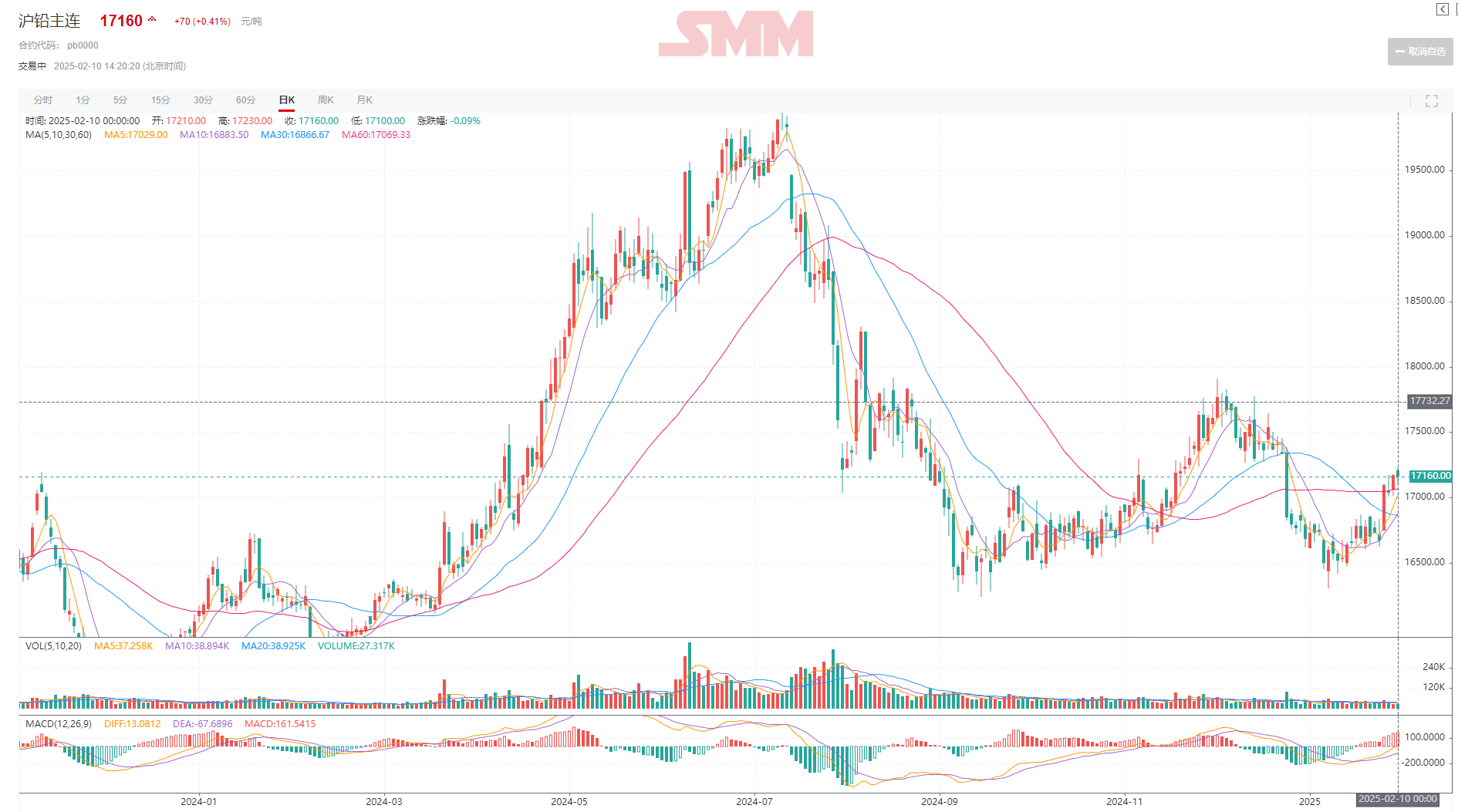
》Click to View Futures Market Trends
In the spot market, according to SMM spot quotations, as of January 27, SMM 1# Lead Ingot spot prices also showed a downward trend. As of January 27, SMM 1# Lead Ingot average spot price was 16,600 yuan/mt, down 125 yuan/mt from 16,725 yuan/mt on December 31, 2024, a decline of 0.75%.
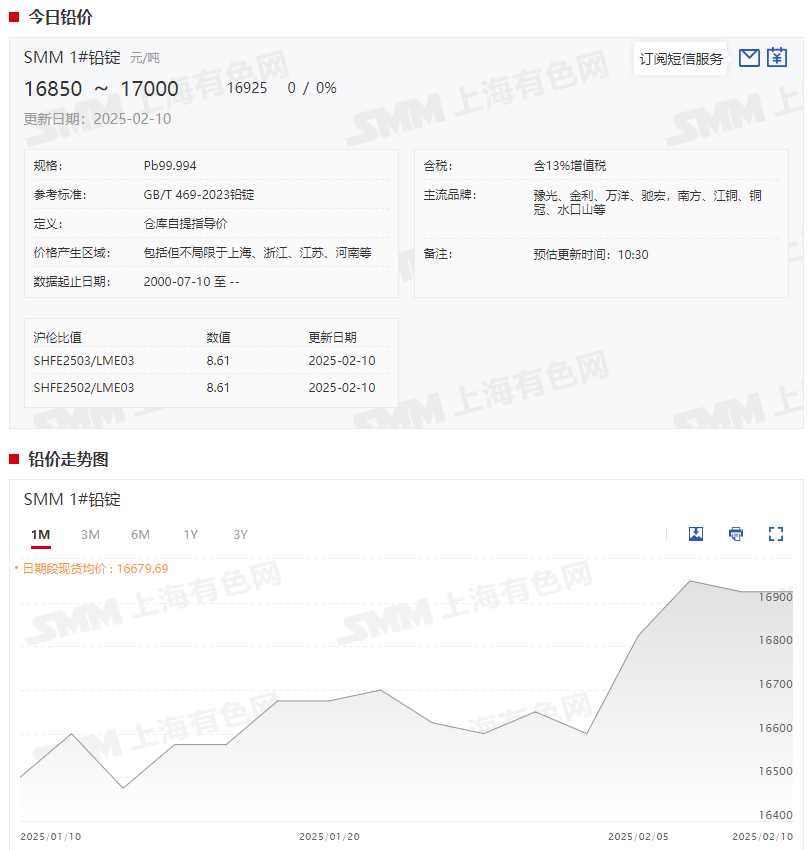
》Click to View SMM Lead Product Spot Prices
Fundamental Review
Primary Lead:
According to an SMM survey, the monthly operating rate of SMM primary lead enterprises in January totaled 63.39%, showing a significant MoM decline compared to December 2024. The main reason was that some primary lead smelters gradually entered routine maintenance or production cuts during the Chinese New Year holiday, leading to an overall decrease in operating rates.
In terms of production, SMM surveys revealed that the reduction in electrolytic lead production in January exceeded the forecast in the previous report. This was mainly due to unexpected maintenance or equipment failures in some medium and large enterprises. For instance, smelters in Jiangxi, Yunnan, Hunan, and Inner Mongolia underwent maintenance, Guangdong smelters extended their maintenance periods, and Qinghai smelters experienced unexpected equipment failures, resulting in significant production reductions.
Secondary Lead:
According to an SMM survey, the monthly operating rate of SMM secondary lead enterprises in January was around 40.64%. Frequent heavy pollution weather in December 2024 led secondary lead smelters to cooperate with environmental protection-related controls, reducing or halting production, which tightened supply. Additionally, as the Chinese New Year atmosphere intensified in January, downstream battery producers began their holiday earlier than usual, and pre-holiday stockpiling demand was weaker than in previous years, making lead ingot transactions challenging. Under these circumstances, secondary lead smelters were more inclined to reduce or halt production during the holiday, with some smelters postponing their resumption of production until after the holiday. According to SMM data, secondary refined lead production in January fell by 13.36% MoM and 15.12% YoY.
Inventory:
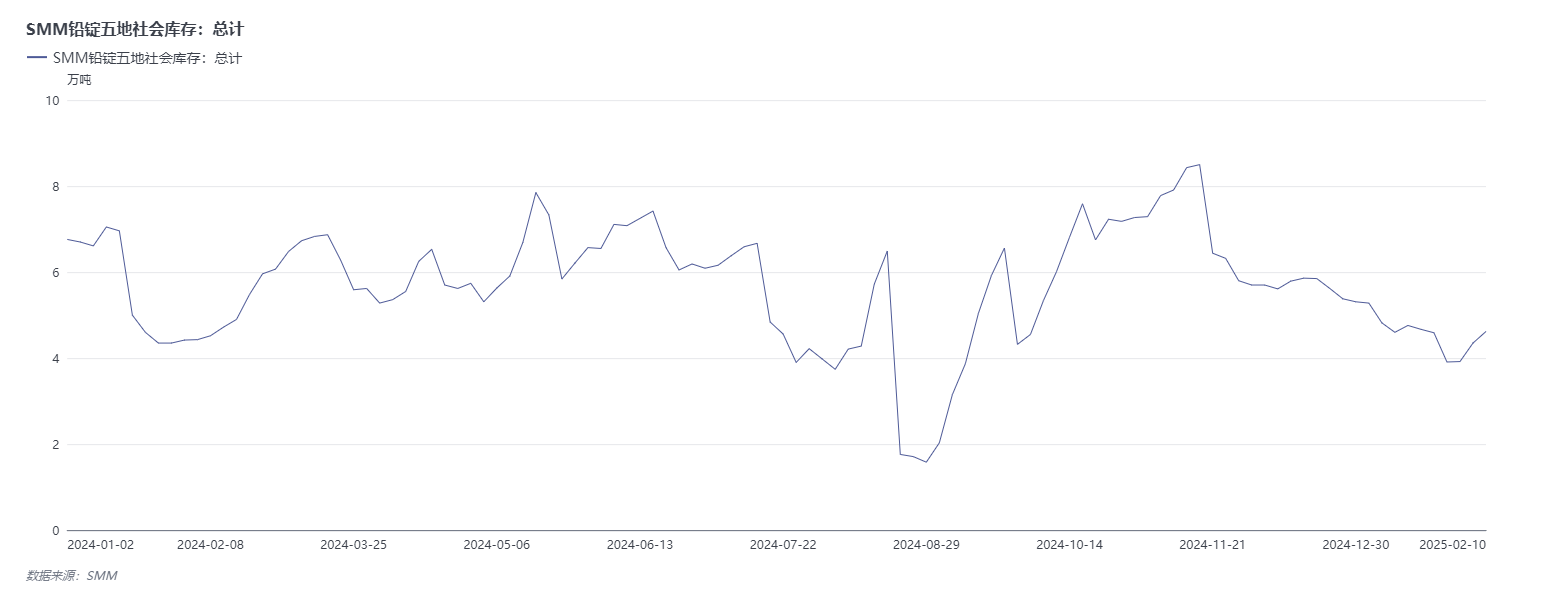
According to SMM data, in January, SMM Five-Region Lead Ingot Social Inventory showed a downward trend. As of January 27, the total social inventory of SMM lead ingots in the five regions was 39,200 mt, down 13,900 mt from 53,100 mt on December 30, 2024, a decrease of 26.18%. In January, due to increased maintenance at lead smelters, both primary and secondary lead production decreased simultaneously. Meanwhile, downstream enterprises were in a pre-holiday restocking phase, and regional supply differences in lead ingots led some downstream enterprises to procure from nearby warehouses. In mid-to-late January, with the widespread start of the Spring Festival travel rush, the reduction in logistics vehicles made long-distance shipments more challenging, further prompting downstream enterprises to opt for nearby warehouse sources.
Downstream Consumption:
According to an SMM survey, at the end of January, coinciding with the Chinese New Year holiday, the operating rate of downstream lead-acid battery enterprises declined significantly between January 17 and January 31, dropping from 72.27% on January 17 to 12.77%, a total decrease of 59.5 percentage points. Before the holiday, lead-acid battery market consumption was sluggish, with dealers completing pre-holiday restocking in early January. Coupled with the subsequent suspension of logistics, some lead-acid battery enterprises began halting production as early as January 15, while others gradually stopped between January 18-25, with the latest enterprises ceasing operations by January 28. During the Chinese New Year holiday, lead-acid battery enterprises largely paused production and sales, leading to a simultaneous reduction in demand for lead ingots.
Overall, in January, the lead market fundamentals showed a dual decline in supply and demand. Although primary and secondary lead enterprises experienced varying degrees of maintenance and production cuts near the Chinese New Year holiday, their operating rates were relatively better compared to the "collective holiday" situation of downstream enterprises. Moreover, the anticipated concentrated pre-holiday restocking by downstream enterprises in January did not materialize, with major enterprises adopting a more scattered procurement approach and prolonged observation periods. As a result, lead prices faced overall pressure in January.
February Lead Market Outlook
Looking ahead, on the supply side, primary lead enterprises are undergoing maintenance, and secondary lead enterprises are resuming production at a slower pace. The main pressure currently lies in the primary lead segment, where the challenge is how to quickly digest the lead ingot inventory accumulated by primary lead smelters during the Chinese New Year consumption lull. For secondary lead enterprises, the number of holiday shutdowns this year was higher, resulting in a YoY decline in lead ingot inventory buildup.
On the consumption side, lead-acid battery enterprises are gradually resuming operations after the holiday. Considering the limited pre-holiday restocking by major enterprises, restocking demand is expected to emerge after the Lantern Festival, which could help reduce primary lead inventory to some extent. However, it is worth noting that the current terminal consumption in the lead-acid battery market remains weak, with production enterprises' orders showing no significant improvement, and lead consumption primarily driven by rigid demand.
Additionally, during the Chinese New Year holiday, a series of tariff policies attracted attention, including mutual tariff hikes between China and the US, US tariff increases on Mexico and Colombia, and a temporary pause in the "tariff war" between the US and Canada. These developments heightened market risk aversion. Meanwhile, domestic market rumors about carbon peak-related environmental protection expectations also emerged, necessitating continued attention to macro policy changes.
In summary, February's lead market is primarily a process of post-holiday supply and demand recovery. In early February, the market is expected to remain sluggish in both supply and demand, with lead prices more influenced by macro news and capital-driven factors. In mid-to-late February, as upstream and downstream enterprises return to normal operations, lead ingot supply and demand are expected to increase simultaneously, with market transactions focusing more on fundamentals and the pace of post-holiday destocking.
For more exciting content, please follow SMM's China Lead Industry Chain Monthly Report released in mid-to-early each month.
Institutional Comments
Yong'an Futures stated that on the supply side, scrap volumes are weak YoY, and recyclers have limited sources. Smelters have not fully resumed operations, but downstream operating rates have increased demand for primary and secondary lead. Logistics have not fully recovered, pushing lead prices higher. In December, concentrate operating rates declined, while imports increased. On the demand side, battery export orders are expected to recover, battery plants have resumed operations, and inventory restocking is limited. Market prices have risen, with the price difference between primary metal and scrap at -25. LME inventory remains under pressure, and SHFE lead destocking is limited. The trade-in policy continues into the new year, and demand for power and start-stop batteries is expected to improve in March. However, overall consumption remains weak, with orders only meeting rigid demand. This week, downstream restocking and stockpiling under low inventory conditions have driven localized tightness and price rebounds, which are expected to ease as logistics recover. Continued attention is needed on next week's weather and transportation impacts on local supply and demand, as well as downstream price observation and procurement amid tight battery scrap.
Shanghai Zhongqi Futures noted that during the Chinese New Year holiday, primary lead enterprises in Hunan and Yunnan underwent holiday or maintenance shutdowns, while other enterprises mainly maintained normal production. Secondary lead enterprises saw an increase in holiday shutdowns, leading to a significant decline in output. On the consumption side, downstream battery producers generally halted production during the holiday, with only a few enterprises continuing operations, primarily consuming their own lead inventory. On the inventory side, as of January 27, SMM domestic lead ingot social inventory stood at 39,200 mt, up 100 mt MoM. Overall, during the holiday, lead market supply-side production cuts and holiday shutdowns were less than those on the consumption side. With more secondary lead enterprises on holiday, the market anticipates post-holiday downstream restocking. Attention should be paid to the recovery of post-holiday consumption, with SHFE lead expected to fluctuate upward in the short term.
Tongguan Jinyuan Futures commented that during the holiday, primary lead smelters underwent limited maintenance, with in-plant inventory expected to increase by 40,000-50,000 mt. However, secondary lead smelters experienced more maintenance, and logistics constraints slowed inventory buildup. Meanwhile, post-holiday restocking expectations exist as downstream enterprises resume operations, with increased capital positions driving lead prices to break through the 17,000 yuan/mt level. However, downstream enterprises have not fully resumed operations, and pre-holiday stockpiled inventory remains unconsumed, leading to sluggish transactions after lead price increases. In the short term, the market is capital-driven, and caution is advised against chasing price increases. Attention should be paid to inventory data from three sources.
Yide Futures noted that on the primary lead side, crude lead supply is tight, with frequent supply disruptions due to environmental protection-related controls during the winter pollution season. On the secondary lead side, environmental protection-driven production restrictions on secondary lead smelters have been lifted, while battery scrap recyclers are on holiday, leading to tight battery scrap supply and halted smelter recycling. Secondary lead production is expected to decline. On the demand side, downstream lead-acid battery destocking is slow. Currently, refined lead smelting and downstream battery production are undergoing routine holiday maintenance, resulting in a dual decline in supply and demand in the lead industry.


