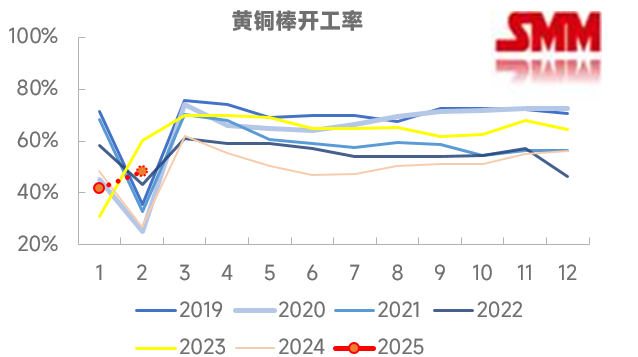
Significantly Affected by the Chinese New Year Holiday, January Operating Rates of Copper Billet Producers Declined Noticeably
According to SMM, the operating rates of copper billet producers in January 2025 were 41.69%, down 14.45% MoM. Specifically, the operating rate of large enterprises was 44.71%, medium-sized enterprises 37.37%, and small enterprises 33.35%.
In January 2025, the operating performance of the copper billet industry was significantly impacted by the Chinese New Year holiday, aligning with market expectations. According to SMM, due to the holiday arrangements, most small and medium-sized enterprises ceased production and entered holiday mode by mid-January, while large copper billet enterprises typically began their holidays two to three days before Chinese New Year's Eve. However, prior to the holiday, overall market orders had already decreased, leading to a slowdown in workshop production. Compared to large enterprises, small and medium-sized enterprises experienced a more pronounced decline in operating rates due to their earlier holiday schedules. Additionally, the limited number of offers from overseas suppliers before the holiday resulted in tight brass supply in the market, further impacting the operating rates of copper billet producers.
Operating Rates of Copper Billet Producers Expected to Recover Slowly in February, Small and Medium-Sized Enterprises Under Pressure
SMM forecasts that the operating rates of copper billet producers in February 2025 will reach 48.33%, up 6.64% MoM. According to SMM, while large enterprises are expected to resume work around the eighth day of the first lunar month, medium-sized enterprises around the tenth day, and small enterprises generally after the Lantern Festival, the delayed return of non-local employees will likely postpone the full production recovery of medium and large enterprises until after the Lantern Festival. Meanwhile, as the downstream market takes time to recover after the holiday, most production workshops are expected to operate at minimal capacity. Large enterprises, due to their relatively faster resumption of work, are anticipated to have a significantly quicker pace of sales and shipments in the early stages compared to small enterprises.
Additionally, copper billet producers relying primarily on imported copper scrap as raw material indicated that, although the tariff policies from the Trump era have largely been finalized, most enterprises remain cautious about purchasing secondary copper raw materials from the US. Currently, the supply of secondary copper raw materials in the Ningbo market is not abundant, prompting upstream suppliers to prefer selling to manufacturers offering higher prices. This undoubtedly adds pressure on small and medium-sized enterprises, further affecting February's operating rates.
In summary, SMM expects the operating rates of copper billet producers in February to show a slow recovery trend.