Domestic Ore
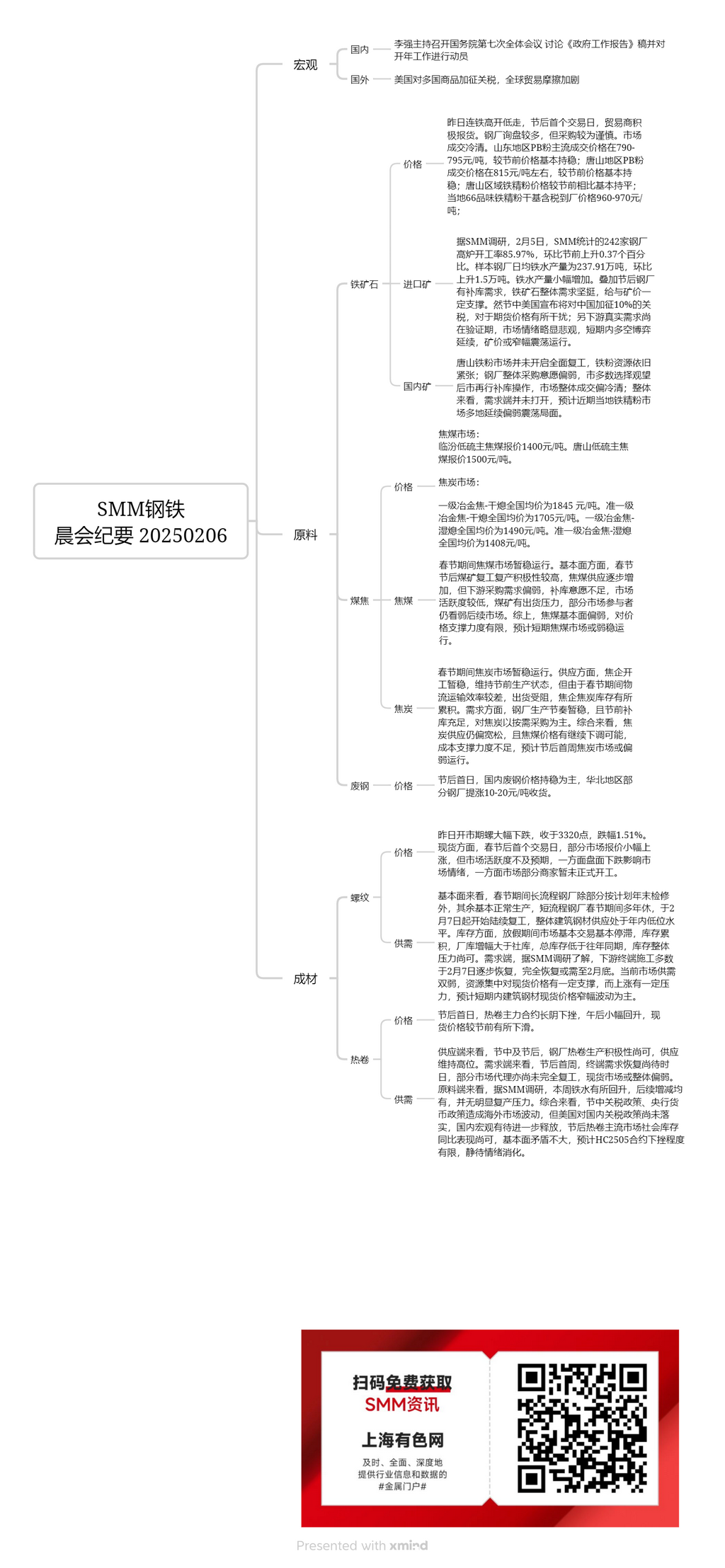
The prices of Fe66% iron ore concentrates in the Tangshan region remained basically flat compared to pre-holiday levels. The delivery-to-factory price of local Fe66% iron ore concentrates (dry basis, tax-included) was 960-970 yuan/mt. The Tangshan iron ore market has not fully resumed operations, and iron ore resources remain tight. Steel mills showed weak purchase willingness overall, with most opting to observe the market before restocking. Market transactions were generally sluggish. Overall, demand has not yet picked up, and the local iron ore concentrates market is expected to fluctuate downward in the near term.
Imported Ore
On the first trading day after the holiday, traders actively offered cargoes. Steel mills made numerous inquiries but were cautious in their purchases. Market transactions were sluggish today. In Shandong, the mainstream transaction prices of PB fines were 790-795 yuan/mt, basically stable compared to pre-holiday levels. In Tangshan, PB fines were transacted at around 815 yuan/mt, also basically stable compared to pre-holiday levels.
According to an SMM survey, as of February 5, the operating rate of blast furnaces at 242 surveyed steel mills was 85.97%, up 0.37 percentage points from pre-holiday levels. The daily pig iron production of the sample steel mills was 2.3791 million mt, up 15,000 mt. Pig iron production increased slightly. Coupled with post-holiday restocking demand from steel mills, overall demand for iron ore remained strong, providing some support for ore prices. However, during the holiday, the US announced a 10% tariff increase on Chinese goods, which disrupted futures prices. Additionally, downstream real demand is still in the verification phase, and market sentiment appeared slightly pessimistic. In the short term, the tug-of-war between longs and shorts is expected to continue, and ore prices may fluctuate rangebound.
Coking Coal:
The price of low-sulfur primary coking coal in Linfen was 1,400 yuan/mt, while in Tangshan, it was 1,500 yuan/mt.
During the Chinese New Year holiday, the coking coal market remained stable. On the supply side, post-holiday coal mines showed high enthusiasm for resuming production, and coking coal supply gradually increased. However, downstream demand was weak, with insufficient restocking willingness, leading to low market activity. Coal mines faced pressure to sell, and some market participants remained bearish on the subsequent market. In summary, the fundamentals of coking coal were weak, providing limited support for prices. The coking coal market is expected to remain stable with a weak trend in the short term.
Coke:
The nationwide average price of Grade I metallurgical coke (dry quenching) was 1,845 yuan/mt. For Quasi-Grade I metallurgical coke (dry quenching), it was 1,705 yuan/mt. The nationwide average price of Grade I metallurgical coke (wet quenching) was 1,490 yuan/mt, while Quasi-Grade I metallurgical coke (wet quenching) was 1,408 yuan/mt.
During the Chinese New Year holiday, the coke market remained stable. On the supply side, coke plants maintained stable operations, continuing pre-holiday production levels. However, due to low logistics efficiency during the holiday, shipments were hindered, leading to an accumulation of coke inventories at coke plants. On the demand side, steel mills maintained stable production rhythms, and pre-holiday restocking was sufficient, with coke purchases mainly on an as-needed basis. Overall, coke supply remained relatively ample, and with the possibility of further declines in coking coal prices, cost support was insufficient. The coke market is expected to fluctuate downward in the first week after the holiday.
Construction Steel
Yesterday, rebar futures dropped significantly, closing at 3,320 points, down 1.51%. In the spot market, on the first trading day after the holiday, some market quotations rose slightly, but market activity fell short of expectations. On one hand, the decline in futures prices affected market sentiment; on the other hand, some market participants had not yet fully resumed operations.
From a fundamental perspective, during the Chinese New Year holiday, blast furnace steel mills maintained normal production except for some planned year-end maintenance, while EAF steel mills typically shut down for the holiday and are expected to gradually resume operations starting February 7. Overall, construction steel supply remained at a low level for the year. In terms of inventory, market transactions were almost stagnant during the holiday, leading to inventory accumulation. In-plant inventory increased more than social inventory, and total inventory was lower than the same period in previous years, with overall inventory pressure being moderate. On the demand side, according to an SMM survey, most downstream construction activities are expected to gradually resume from February 7, with full recovery likely by the end of February. Currently, the market is characterized by weak supply and demand. Concentrated resources provide some support for spot prices, but upward pressure remains. In the short term, construction steel spot prices are expected to fluctuate rangebound.
HRC:
On the first day after the holiday, the most-traded HRC contract fell sharply but rebounded slightly in the afternoon. Spot prices declined compared to pre-holiday levels.
On the supply side, during and after the holiday, steel mills showed moderate enthusiasm for HRC production, keeping supply at high levels. On the demand side, in the first week after the holiday, end-use demand recovery remained slow, and some market agents had not fully resumed operations, leading to overall weakness in the spot market.
On the raw material side, according to an SMM survey, pig iron production increased this week, with subsequent fluctuations expected, but there was no significant pressure for resumption.
In summary, during the holiday, tariff policies and central bank monetary policies caused fluctuations in overseas markets. However, the US tariff policy on China has not yet been implemented, and domestic macroeconomic policies are yet to be further clarified. Post-holiday, mainstream HRC market social inventories showed moderate YoY performance, with no significant imbalances in fundamentals. The decline in the HC2505 contract is expected to be limited, awaiting sentiment stabilization.