SMM News, February 1:
Currently, energy storage system products on the market generally adopt battery cells with a capacity of 280Ah.
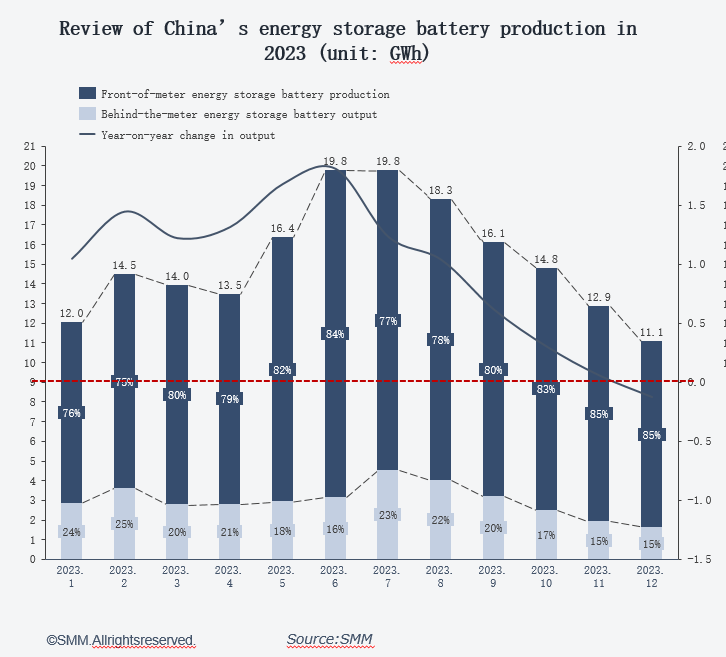
From the production perspective, the proportion of front-of-meter energy storage accounted for about 80% or more in 2023. In order to reduce the number of PACK cells and consequently the number of connectors in energy storage systems, thus lowering the cost of energy storage and enhancing the consistency of battery cells, there is an industry consensus on reasonably expanding the capacity of energy storage cells. Taking the 300Ah+ cells for example, most of the 300Ah+ energy storage cells still use the size (71173) of the 280Ah cells from the same manufacturer, which means a higher energy density can be achieved within the same volume, thereby reducing the overall cost of the energy storage system and improving project profitability. In the marketing of the 300Ah+ cell products by energy storage battery manufacturers, cost reduction is one of the most prominent selling points. In this context, the ability to mass-produce 300Ah+ cells has become a reflection of the product and technological competitiveness of lithium battery companies. Leading energy storage manufacturers are successively launching 300Ah+ cells, initiating a race to upgrade from 280Ah to 300Ah+. Based on incomplete statistics from SMM, companies expected to mass-produce 310+Ah cells by 2024 include CATL, ZF New Energy, Zhongchuang Xinhang, Penghui Energy Storage, Tianneng Battery, and Chu Energy New Energy, etc.
Various storage systems equipped with the new generation of high-capacity cells have been announced and are continuously being rolled out, raising the system capacity to 5MWh. The market favors the 310+Ah demand, considering 310+Ah to be the optimal choice for current large-capacity cells and 5MWh systems. The scale production and delivery of 310+Ah cells have just begun, and everything awaits verification by the market and time. Additionally, SMM believes that apart from price, more focus is placed on safety, reliability, and stability for energy storage products, including indicators such as degradation rate and cell brand. For energy storage enterprises, it is crucial to establish extensive sales channels, build brand recognition, and improve and optimize product quality in the future.
For More Details: Patrickxu@smm.cn


