【SMM Analysis】Annual Review of Overseas Energy Storage Market in 2023
Disruptions in the US Domestic Battery Industry Supply Chain
According to data from the US EIA, the US installed a capacity of approximately 4.99 GW from January to November 2023, an increase of approximately 28.2% compared to the previous year.
Although the first quarter of 2023 was relatively slow, there was a strong push in the latter part of the second quarter, and high growth was maintained in the third quarter.A record high for the year was set in July with an additional installation capacity of 1.5 GW.
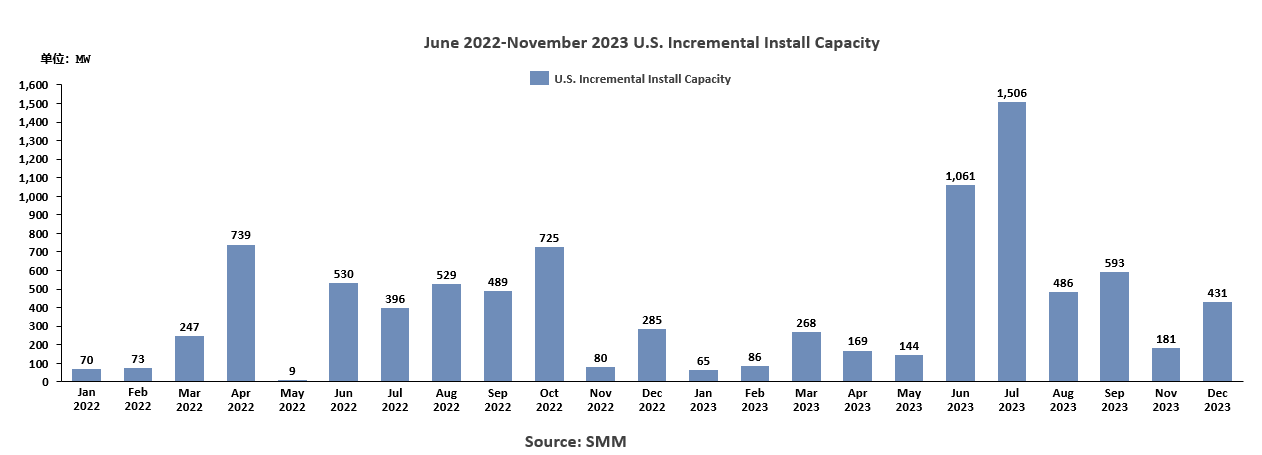 The North American market has experienced various disruptive factors such as frequent interest rate hikes, leading to an increase in the cost of funds and a subsequent decrease in the profitability of energy storage projects, weakening corporate investment willingness, and supply chain challenges such as a tight supply of transformers, doubling delivery times, etc.
As a result of these factors, project delays and grid connection delays have occurred, resulting in significantly lower actual project installation scales than expected.
In addition to supply chain disruptions, the complex approval process in the US has also been a major factor causing project delays.
In terms of residential energy storage, there was negative growth in the US residential installations in Q2 of 2023, with a nearly 15% decline compared to the previous year.
The main reason is that the residential solar power generation incentives introduced by California in 2022 have to some extent exhausted the installation demand for 2023.
However, looking at long-term demand, expectations for residential energy storage in the US remain optimistic.
Outlook for the US Energy Storage Market
Despite a slowdown in demand due to factors such as the Federal Reserve's interest rate hike and delayed delivery of energy storage components such as transformers, the North American energy storage market is expected to maintain rapid growth over the long term, driven by ITC subsidies, energy transition, and market incentives.
Following the enactment of the Infrastructure Investment and Jobs Act (IRA), the US has announced a $300 billion investment in the clean energy sector, with a significant portion allocated to battery factory construction, surpassing Europe in this field.
The IRA also increased the ITC tax credit offset for solar energy from 26% to 30% and extended the deadline. As the interest rate hikes in the US come to an end, EPC costs are expected to decrease due to easing inflation pressures.
Additionally, the US Energy Management Association has introduced policies and measures aimed at simplifying grid connection processes, improving and alleviating the issue of project delays.
Overall, there is still a significant long-term growth potential for the US energy storage market. However, addressing the cost and availability of raw materials will be the biggest challenge for the US to fully meet the demand for lithium-ion battery storage within its domestic supply chain.
Currently, China holds about 90% of the global lithium-ion battery manufacturing industry and almost the entire material processing industry. While it may not be too difficult for the US to source lithium resources from countries with which it has free trade agreements by 2030, it will still need to compete with other countries for supply, with China remaining a key destination for lithium resources worldwide.
For more information contact : ginawen@smm.cn


