At the 2025 Indonesia Mining Conference & Critical Metals Forum - Nickel, Cobalt, and NEV Session, STJ Budi Santoso, Master of Geology and Chairman of the Indonesian Association of Geologists (IAGI), shared insights on the topic "Exploration Experts Share: Developing Indonesia's Critical Mineral Reserve Potential and Enhancing Downstream Industry Capabilities as Top Priorities."
The Role and Challenges of Exploration
Drivers of Exploration: Current and Future State of the Mining Industry
Since Q4 2020, most commodity prices have risen, with some reaching multi-year highs. Global metal demand doubles every 20 to 30 years, and media projections suggest cumulative copper demand from 2017 to 2042 could reach 689Mt. Exploration spending is expected to increase by 65% by 2027.
Greater Exploration Challenges
Current exploration data indicates that the discovery depth for base metals is twice that of gold, while the unit discovery cost for gold mines has doubled over the past decade.
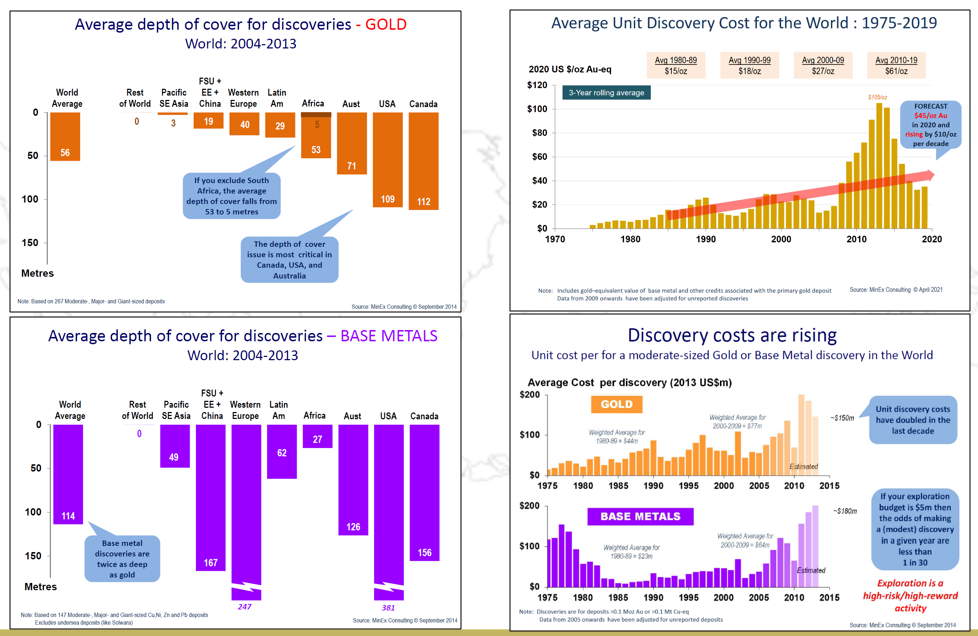
For base metals, assuming an exploration budget of $5 million, the probability of a moderate discovery in any given year is less than one in thirty. Thus, exploration is a high-risk/high-reward activity.
Exploration Challenge: Discovery-to-Production Ratio
Rough estimates show that only 11 of the 229 oil fields discovered since 1990 are currently in production.
Exploration Challenge: Time from Discovery to Production Readiness
On average, mines take 16.3 years from discovery to production. Despite shorter construction times, the lengthy processes of exploration, permitting, and financing prolong the timeline for mine commissioning.
Factors affecting the lead time of geological resource exploration include:
Exploration, permitting, and studies;
Financing and permitting for open-pit/underground development;
Commodity prices.
Exploration Challenge: Timing of Exploration and Discovery in Indonesia
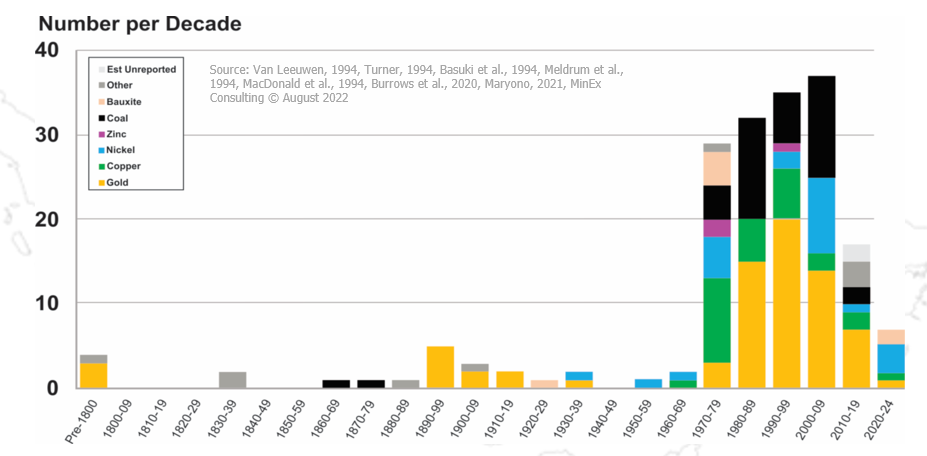
Most, if not all, existing mineral discoveries are results of exploration under the Work Contract (CoW) and Mining License (KP) systems. Whether the current licensing regime and its subsequent mechanisms can match or surpass these outcomes remains debatable. So far, this seems unlikely.
Discovery-to-Production Cycle: Roles of Government and Industry
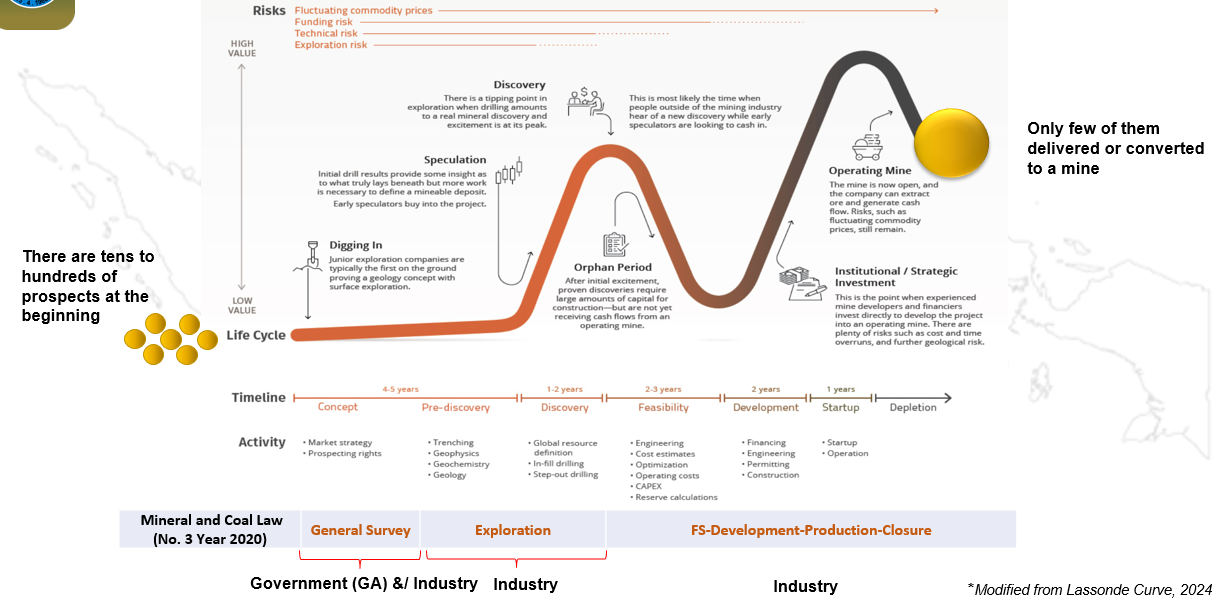
Exploration Overview and Indonesia’s Mineral Resource Inventory
Compilation of Indonesian Metal Occurrences, Mineralized Zones, and Mines
Consensus on Exploration:
Since the 1980s, exploration has primarily been conducted by foreign exploration and mining companies—preparation time;
Not all projects have or will have economic viability—high risk, low success rate;
Exploration success is measured and reflected through discoveries—a frequently misunderstood aspect;
A comprehensive and sustained approach is needed—based on geological surveys, technology, and trust-building;
Exploration/mining is a high-risk, long-term business—requiring commitment;
Assurance is needed: long-term regulatory certainty—exploration as a critical aspect of sustainable mining.
Resources and Reserves of Major Commodities in Indonesia, 2019-2023
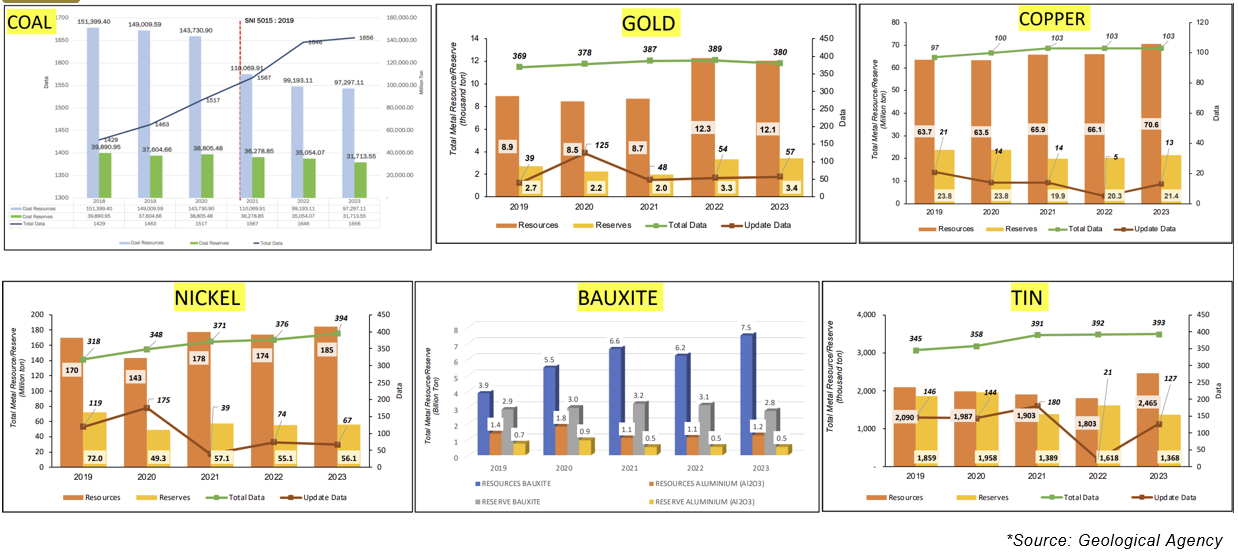
Status of Resources and Reserves of Metals in Indonesia
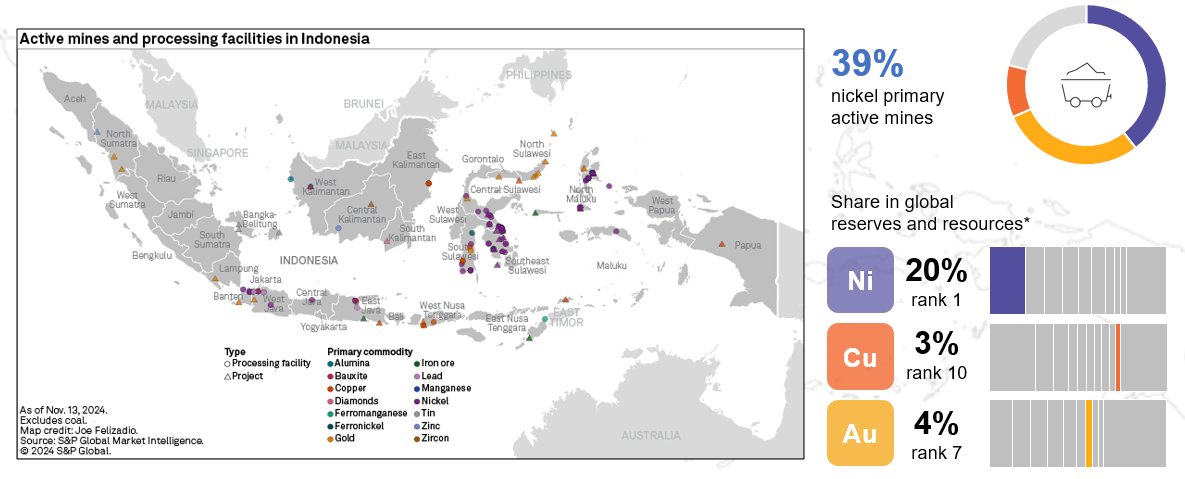
Is the current situation sustainable, or is there potential for growth?
Conduct systematic and comprehensive exploration, and keep discovering!
Nickel Reserves and Consumption in Indonesia: A Case Study of Nickel in 2020
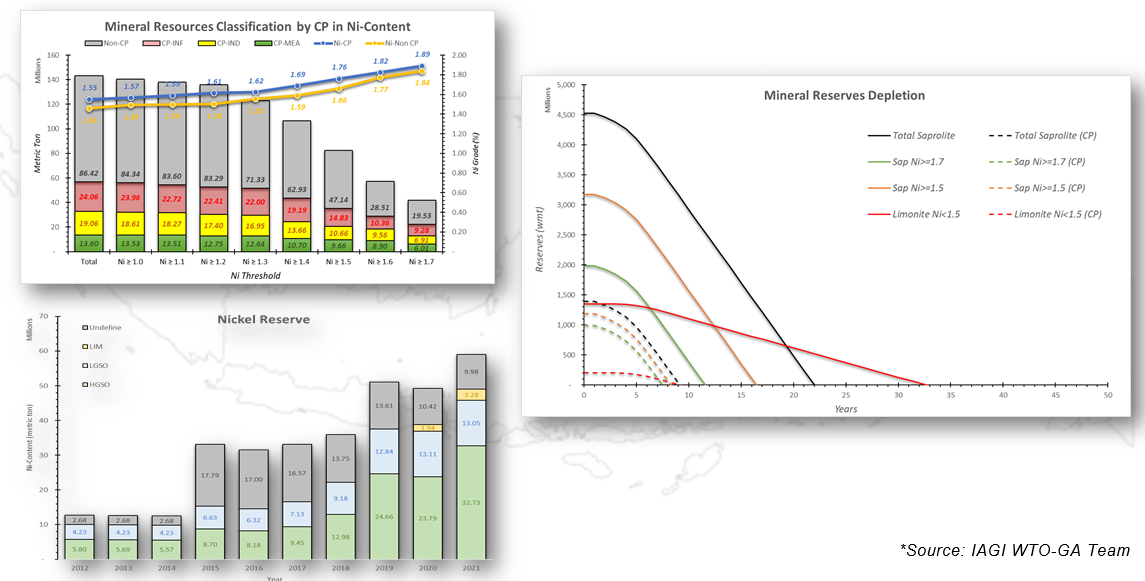
Conclusion
Exploration is a high-risk, long-term business that requires a systematic and comprehensive approach, as well as long-term commitment and perseverance. It is a crucial and urgent pillar for the development of a sustainable downstream industry in mining. Without exploration, there will be no resource reserves, and without reserves, sustainable downstream development cannot be achieved.
Indonesia is rich in critical and strategic mineral resources. However, as the resources of existing mines gradually deplete, the acceleration of exploration efforts has become increasingly urgent and important.
The government authorizes geological agencies to participate in inventory work during the preliminary investigation phase, providing regional 3G data (geological, geophysical, and geochemical) as well as high-quality regional and local prospect maps, due to the economic value of geological information.
To achieve reliable inventory, a comprehensive system for reporting exploration results, resources, and reserves must be established, including the following elements:
1. Competent Persons (CPI, CP) with technical expertise and bound by professional ethics.
2. Reputable reporting guidelines/standards, such as the KCMI guidelines and SNI.
3. A spirit of good mining practices, encompassing requirements for environmental protection, Environment, Social, and Governance (ESG), and Sustainable Development Goals (SDGs).


