
SMM February 6 News:
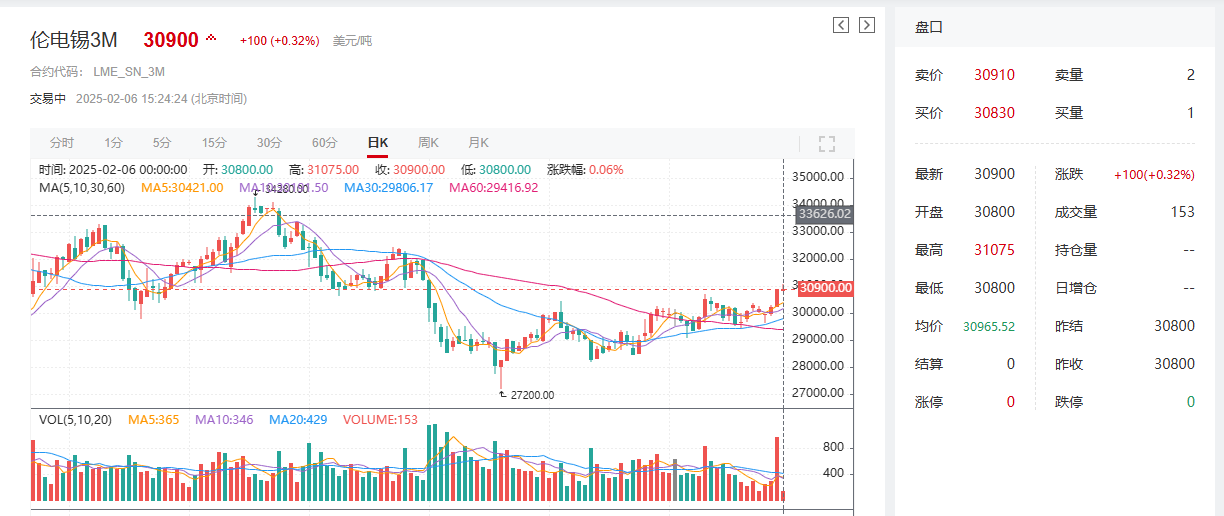
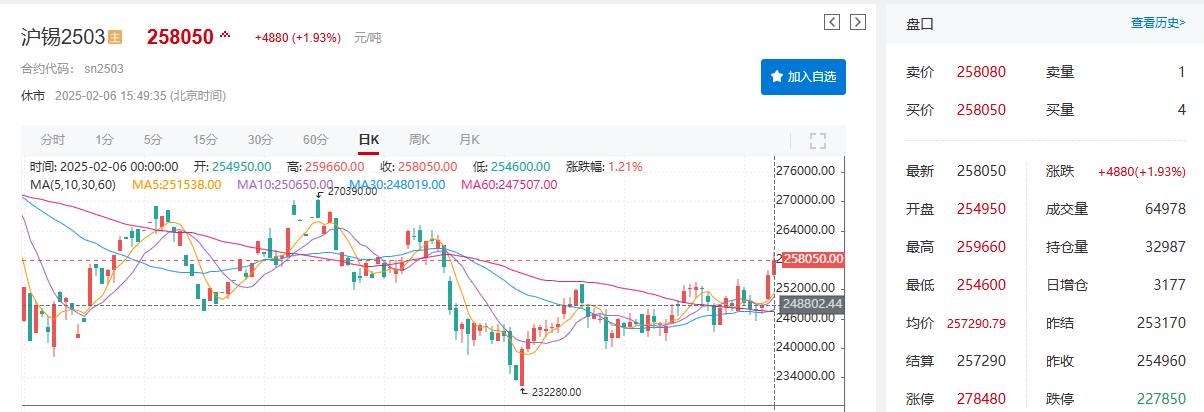
During the Chinese New Year break in the Year of the Snake, LME tin rose by 2.31%. After the holiday, SHFE tin, which had not opened during the break, showed a need for catch-up gains due to the increase in LME tin during the holiday. The US dollar pulled back to around 107.7, and metals broadly rose. Market optimism was active, with bulls increasing positions, and multiple factors such as the continued suspension of mining in Wa State, Myanmar, and the impact of local conflicts in North Kivu Province, DRC, on tin ore supply contributed to significant increases in SHFE tin over the two trading days after the holiday. As of 15:24 on February 6, SHFE tin rose by 1.93% to 258,050 yuan/mt, while LME tin rose by 0.32% to $30,900/mt.
》Click to view SMM Metal Futures Data Dashboard
Fundamentals
Spot Tin Prices Continue to Rise, Up 5.28% Year-to-Date

》View SMM Tin Products Spot Quotes
》Subscribe to View SMM Historical Spot Price Trends
Spot Market: Since the beginning of 2025, tin prices have continued the upward trend from 2024, with the center moving higher. On February 6, SMM 1# tin was quoted at 257,800–260,200 yuan/mt, with an average price of 259,000 yuan/mt, up by 5,400 yuan/mt or 2.13% from the previous trading day. Compared to the average price of 246,000 yuan/mt on December 31, 2024, it increased by 13,000 yuan/mt, a rise of 5.28%.
Based on SMM's analysis of current market dynamics, on February 6, the tin market exhibited a clear divergence, with strong performance in the futures market and relatively weaker performance in the spot market. The futures market showed robust upward momentum due to tight supply conditions, while the spot market, affected by high inventory levels and the current off-season for demand, experienced less significant price increases compared to the futures market.
Tin Ore Imports From Myanmar, DRC, and Australia Declined, Leading to a Sharp Drop in Domestic Tin Ore Imports in December
》Click to View SMM Tin Industry Chain Database
According to tin ore import data from the General Administration of Customs, domestic tin ore imports in December 2024 were 80,000 mt (approximately 3,786 mt (metal content)), down 33.75% MoM and 50.99% YoY. The sharp decline in December was mainly due to reduced tin ore imports from Myanmar, DRC, and Australia, while imports from other countries remained stable. Specifically, tin ore imports from Myanmar in December were 30,000 mt (approximately 518 mt (metal content)), showing a significant decline compared to December 2023. Although Wa State authorities in Myanmar have expressed intentions to resume production, no specific timeline has been provided. Based on current market analysis and forecasts, Wa State authorities are expected to resume production in Q1 or Q2 after the holiday. Since the implementation of the mining suspension policy, Wa State authorities have faced significant fiscal pressure, making post-holiday production resumption highly probable. Meanwhile, tin ore imports from DRC and Australia also decreased to some extent, but considering their annual average import levels remain consistent with historical standards, this is considered a temporary adjustment with no significant impact on the overall domestic tin ore supply. Tin ore imports from other countries remained basically flat compared to historical levels, and barring special circumstances, are expected to maintain current levels.
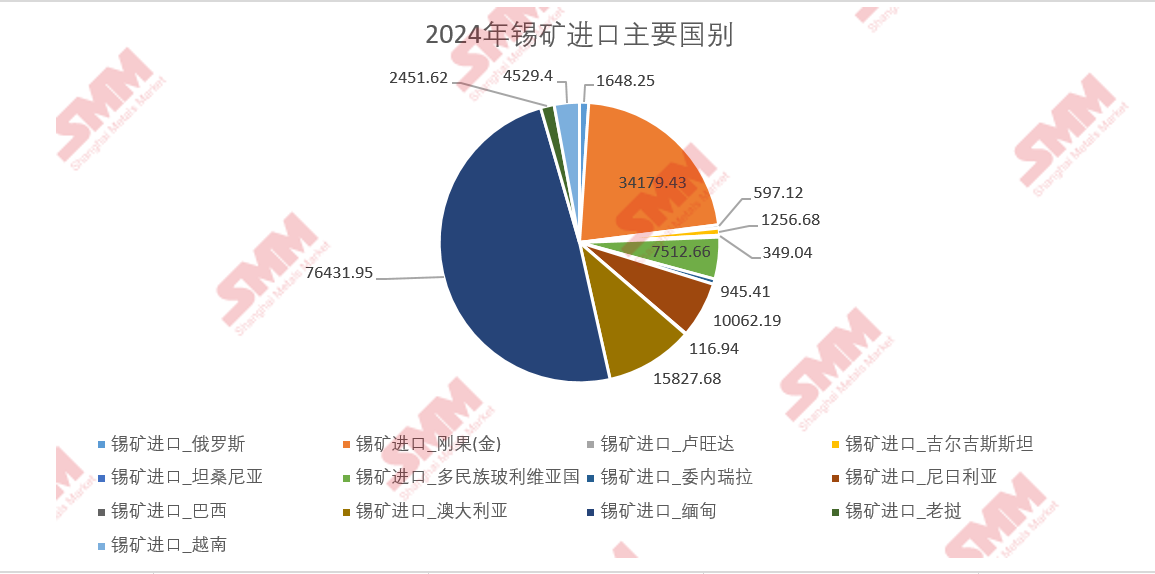
According to data from the General Administration of Customs, China's cumulative tin ore imports from January to December 2024 totaled 158,000 mt, down 31.20% YoY. In 2024, tin ore imports from Myanmar amounted to approximately 76,400 mt, accounting for 48.12% of total imports, down 57.66% YoY. Tin ore imports from DRC were approximately 34,100 mt, accounting for about 21% of total imports, second only to Myanmar.
Market Outlook
For the tin market outlook, disruptions affecting tin ore supply have not yet eased. Wa State in Myanmar has not resumed production, and DRC, as China's second-largest source of tin ore imports in 2024, has raised concerns about African tin ore supply due to local conflicts. With no signs of easing supply concerns from the top two sources of tin ore imports, combined with continued market optimism and expectations of domestic macroeconomic benefits, tin prices are expected to continue fluctuating upward in the short term. However, considering Wa State authorities' intentions to resume production, any concrete news of production resumption from Wa State could impact tin prices.
Institutional Comments
Minmetals Futures commented that, according to the latest SMM statistics, domestic refined tin production in January was 15,960 mt, up 2% YoY. The Chinese New Year break did not affect domestic refined tin production. Alphamin's mine in North Kivu Province, DRC, is currently affected by local conflicts, raising the possibility of disruptions to African tin ore supply. Considering the uncertainty of the conflict in DRC, tin prices are expected to continue fluctuating upward.
Tongguan Jinyuan Futures stated that overall, armed conflicts in DRC have increased concerns about tin ore supply, while AI-related themes have boosted consumption expectations. SHFE tin showed catch-up gains after the market reopened. Currently, the upstream and downstream of the industry chain have not fully resumed operations, with smelters gradually resuming production before the Lantern Festival, and downstream and end-user enterprises resuming production and operations between the eighth and twelfth days of the first lunar month. The market holds expectations for post-holiday restocking by downstream players, and tin prices are expected to continue fluctuating upward in the short term.


