

42results found for 'national policy'
Sort by : |
- Groundbreaking Ceremony Held for Jingshan 200 MW/400 MWh ESS Project
Recently, the groundbreaking ceremony for the Jingshan 200 MW/400 MWh power-grid-side standalone ESS project, located in Duruan Town, Pengjiang District, was successfully held, marking the full commencement of construction on this key provincial and municipal new-type ESS power station project. As the province’s first energy storage project approved for national policy-based financial instruments, and also the country’s first 100-megawatt-class technical demonstration project for colloidal LFP ESS batteries, the Jingshan energy storage project has a total investment of over 500 million yuan, a total installed capacity of 200 MW/400 MWh, and covers an area of approximately 50 mu. It is located on the north side of the 220 kV Jingshan substation in Duruan Town. The commencement of the Jingshan energy storage project is an important measure by Pengjiang District to actively integrate into the city’s “13158” new-type industrial system.
Mar 11, 2026 17:36  Sudden Turmoil in the Strait of Hormuz Is Reshaping the Global Phosphorus Chemical Landscap
Geopolitical conflict in the Middle East led to a blockade of the Strait of Hormuz, cutting off the global sulphur supply chain (China’s import dependence exceeds 50%, with the Middle East accounting for 56%). Sulphur prices surged to 4,395 yuan/mt, directly pushing up phosphate fertiliser costs. Rigid demand from spring ploughing provided support, but China’s policies to ensure supply and stabilise prices curbed phosphate fertiliser gains。
Mar 9, 2026 08:29- Li-ION BATTERY China 2025 you can’t afford to miss
Li-ION BATTERY China 2025 Officially Announced and Scheduled
Jun 18, 2025 16:15 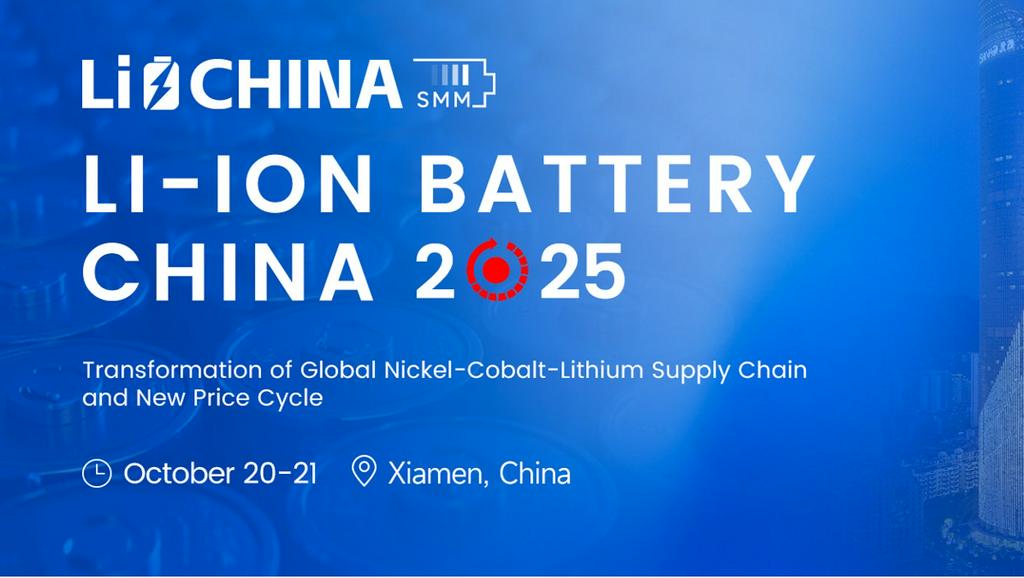 The grant event in lithium battery industry - SMM Li-ION BATTERY China 2025 is coming !
The SMM Lithium Battery Raw Materials Conference 2025 will be held in Xiamen on October 20-21, 2025, focusing on the critical challenges and opportunities in the supply chain of key battery raw materials such as nickel, cobalt, and lithium amid the global energy transition. The conference aims to analyze international policy shifts, supply-demand dynamics, and pricing mechanisms from multiple perspectives, fostering a more stable, transparent, and efficient industry chain. Key Topics Include: 1.Global Market Trends: Examining the impact of geopolitics, trade policies, and supply-demand imbalances on nickel, cobalt, and lithium pricing and supply chains. 2.SMM Pricing System: Interpreting the authoritative price formation mechanism and providing future trend forecasts. 3.Industry Chain Collaboration: Facilitating long-term contract negotiations and one-on-one business matchmaking to enhance upstream-downstream cooperation. 4.Technological Innovation: Exploring cutting-edge advancements in battery materials to support corporate strategic planning. Highlights: 1.Full Industry Chain Participation: Gathering global stakeholders, including resource extraction, refining, R&D, and end-use manufacturers. 2.Authoritative Market Insights: SMM will release in-depth analysis and price benchmarks for nickel, cobalt, and lithium. 3.Efficient Networking: Structured business matchmaking to promote long-term supply chain partnerships. 4.This conference will deliver forward-looking insights, empowering enterprises to navigate resource flows and market transformations while advancing the sustainable development of the global new energy industry chain.
Jun 18, 2025 14:59- BAIC and SAIC Lead Industry in Optimizing Supply Chain Collaboration
[SMM News]: It is reported that on June 11, Beijing Automotive Group Co., Ltd. officially released the "Statement on Responding to the Automotive Industry's Call to 'Combat Cut-throat Competition' and Optimize Supply Chain Collaboration," introducing three groundbreaking supply chain management measures. This makes it the first automaker in China to explicitly prohibit the use of commercial acceptance bills and open itself up to public supervision. Meanwhile, SAIC also announced that, in order to actively implement the national policy decisions aimed at ensuring the stability of the industry chain and supply chain and promoting the high-quality development of the automotive industry, it would unify the payment terms for suppliers to within 60 days and refrain from using settlement methods such as commercial acceptance bills that increase the financial pressure on suppliers.
Jun 11, 2025 15:13 - BAIC and SAIC Initiate Supply Chain Reforms to Combat Cut-throat Competition
[SMM News]: It is reported that on June 11, Beijing Automotive Group Co., Ltd. officially issued the "Statement on Responding to the Automotive Industry's Call to 'Combat Cut-throat Competition' and Optimize Supply Chain Cooperation," introducing three groundbreaking supply chain management measures. This makes it the first automaker in China to explicitly prohibit the use of commercial acceptance bills and open itself up to public supervision. Meanwhile, SAIC also announced that, in order to actively implement the national policy decisions aimed at ensuring the stability of the industry chain and supply chain and promoting the high-quality development of the automotive industry, it would unify the payment terms for suppliers to within 60 days and refrain from using settlement methods such as commercial acceptance bills that increase the financial pressure on suppliers.
Jun 11, 2025 15:12 - "Limited supply" of quotas! National subsidies for home appliances suspended in multiple regions, with a new round of policies potentially on the way
During the 618 shopping festival, the "national subsidy" for home appliances in many regions has shifted from a unified subsidy to a voucher-based subsidy. A reporter from Cailian Press visited home appliance stores in Jiangsu, Guangdong, and other regions and learned that the relevant "national subsidy" discounts have entered a "scramble" mode. During interviews, industry practitioners often responded with terms like "limited quantity" and "quota allocation." Meanwhile, in Chongqing, Hubei, and other regions, the "national subsidy" for consumer goods, including home appliances and renovation products for kitchens and bathrooms, under the trade-in program, has been suspended or adjusted. As an important measure to expand domestic demand and boost consumption, the trade-in subsidy policy has effectively driven sustained consumption rebound and improvement. Data from the Ministry of Commerce shows that since the beginning of this year, the sales volume of consumer goods under the trade-in program has exceeded RMB 1 trillion. The "braking" of the "national subsidy" may be related to the depletion of subsidy funds. Announcements from multiple regions mention: "The subsidy amount applied for in this batch has reached the limit" and "The subsidy funds for this round have been fully utilized." However, market analysts believe this is a temporary situation, and a new round of subsidies may be restarted. Jiangsu's "national subsidy" requires "queuing for quota," with digital products being "hard to come by" Cailian Press reporters have noticed that on major online shopping platforms, the national subsidy in Jiangsu is currently temporarily unavailable for collection and use. A local consumer told the reporter that they had their eye on an Apple smartwatch and wanted to see if there would be a better deal during the 618 shopping festival. "But then I found out the subsidy was suspended, so I canceled my purchase plan. After all, it's not a necessity, so I just considered it money saved." Offline, Cailian Press reporters visited multiple large electronics and appliance malls and brand stores in Nanjing, Jiangsu, and learned that the widespread national subsidies for home appliances and 3C digital products have been suspended since June 1. However, this is not a complete halt but rather a "quota-based" management approach. When asked whether and when there would be a new round of widespread national subsidies, the interviewed merchants all expressed that they were unaware or had not received any notifications. Cailian Press reporters learned that if consumers wish to use the national subsidy, the specific process is as follows: First, register and queue at the merchant where they intend to make a purchase, then wait for the merchant to "scramble" for the allocated subsidy quota on the relevant platform, and finally, the merchant will notify the consumer to proceed with payment for the order. The waiting time for this process is uncertain and depends on factors such as the merchant's success in securing the quota and the number of people in the queue. At a Gree counter in a JD.com electronics mall, a salesperson told the reporter that if consumers want to use the national subsidy, they may need to wait in line for 2-3 months. "Consumers don't need to scramble for this national subsidy; we'll do it for them. However, the quota allocated to each store is limited, and we can't guarantee when we'll be able to secure the quota." At a Hisense TV counter, a salesperson also mentioned that waiting in line for the national subsidy might take several months. "I'm not sure if you can wait that long. If you have a current need, it's better to just buy it directly," they said. However, since it's currently the 618 shopping festival period, even without using the national subsidy, most stores are offering relatively favorable selling prices. One of the main promoted products at the aforementioned Gree counter is a 1.5-horsepower, first-tier energy efficiency split-type air conditioner, priced at over 6,000 yuan. According to the salesperson, it has relatively comprehensive functions and a higher price among similar products in the store. Currently, after discounts (without using the national subsidy), the actual selling price is less than 4,000 yuan. However, not all products have such significant discounts. A similar product priced at over 4,000 yuan nearby has a selling price after discounts that is close to the aforementioned higher-priced product. It's worth noting that salespeople at different stores have varying views on the "quota" and estimates of waiting times. At a Midea counter in a Suning.com store, a salesperson told reporters that after queuing, it might only take a few days to use the national subsidy. "We just secured a quota of 100,000 yuan this morning. I predict that if you register and queue now, you'll receive a notification soon. It's still very cost-effective to enjoy the national subsidy on top of the discounted price," they said. On the other hand, reporters learned on-site that currently, the subsidy quota management for 3C digital products like mobile phones in the Jiangsu region is much stricter than for home appliances. At this stage, consumers can hardly use the national subsidy to purchase digital products. At various digital brand stores, reporters found that unlike the previous sales strategy of directly informing consumers about the post-subsidy prices, salespeople are no longer proactively mentioning the national subsidy. If asked whether the national subsidy can be used, most salespeople will directly state that it has been suspended and then introduce the current in-store promotional activities. However, at a Xiaomi Home store, a salesperson told reporters that there is actually still a national subsidy for digital products, but the quota is extremely limited. "I think it can be considered negligible. We don't expect to secure it at all. You can just treat it as non-existent. The quota for appliances is larger than that for digital products. If you're buying appliances, it might be worth waiting in line," they said. After Jiangsu suspended the widespread national subsidy, merchants of 3C digital products like mobile phones have also been actively launching promotional activities, hoping to maintain consumers' purchasing enthusiasm in this way. At the aforementioned Xiaomi Home store, except for products that have just been released, almost all other mobile phones are available with discounts. At an Apple counter in a JD.com appliance store, a salesperson told reporters that previously, the national subsidy policy for mobile phones only covered products priced below 6,000 yuan, so most mobile phone products in the Apple store were ineligible. The recent 618 selling prices have hit the lowest levels in store history. For instance, the iPhone 16 Pro and iPhone 16 Pro Max models offer a 2,000-yuan discount across all storage variants compared to their launch prices. Multiple Regions Temporarily Halt National Subsidies, Potential Reboot in H2 Jiangsu's subsidy suspension is not an isolated case, with Chongqing, Hubei, and Guangdong also experiencing temporary unavailability of national subsidies. Caixin reporters found that Guangdong's consumer goods trade-in public service platform posted a notice on June 5, 2025, suspending discount vouchers for the "Guangzhou Home Improvement & Kitchenware Campaign" until further notice. On JD.com, Chongqing's home appliance subsidy page displayed "activity under upgrade" with unavailable vouchers during the transition, while Hubei's smart home subsidies were similarly paused. The Chongqing Commerce Commission confirmed that Phase 1 subsidy funds were fully utilized by June 3, with Phase 2 policies still under formulation. Can physical stores honor subsidies? Stores in Guangzhou told Caixin that vouchers could be used if successfully claimed. "Quantities are now limited. WeChat mini-program vouchers sell out quickly each morning, though UnionPay may have residual stock," said one retailer. Initial ample funding is nearing depletion, creating a first-come-first-served scenario. Midea Smart Home staff noted no customer complaints about voucher availability under normal circumstances. This year's expanded "program of large-scale equipment upgrades and consumer goods trade-ins" allocated 300 billion yuan from ultra-long special bonds for trade-in initiatives. Subsidies are accelerating market impact. Ministry of Commerce data shows that by May 31, 2025, the trade-in program generated 1.1 trillion yuan in sales across five categories, distributing 175 million direct consumer subsidies. Breakdown: 49.863 million consumers purchased 77.618 million home appliances; 53.529 million bought 56.629 million digital devices; and 57.626 million home improvement orders were completed. AVC noted that 2025's recovering consumer market and frequent promotions drove rapid subsidy utilization, with H1 expenditure projected at 70% of total funds. Judging from the responses of relevant departments in regions where the policy has been suspended, the "national subsidy" may not come to an end. The Chongqing Municipal Commission of Commerce stated that the second phase of the trade-in subsidy policy is expected to be introduced in early June. A relevant official from the Jiangsu Provincial Department of Commerce responded to the media, stating that currently, some platforms are undergoing rectifications or system upgrades. After adjustments, consumers will be able to receive and use the subsidies normally, and each platform and merchant will implement quota management. Xiao Yunxuan, an analyst from the Major Home Appliances Department of AVC Revo, stated that the early national subsidy policies primarily focused on inclusive subsidies, aiming to rapidly activate the market through a "flood-like" approach. However, as the rate of fund depletion far exceeded expectations, the policy model urgently needed transformation. The "quota allocation" model pioneered by Jiangsu is becoming an important reference for national policy adjustments. This model precisely controls the pace of fund depletion through daily and monthly fund limits, combined with a phased subsidy distribution mechanism. This shift alleviates the pressure on local governments for audit and write-off, reduces the risk of fund misuse, and forces enterprises to abandon the competitive strategy of blindly pursuing subsidy amounts. Instead, they are shifting towards rational competition that focuses more on market demand and product value, promoting the industry's transformation towards high-quality development. It is worth noting that Ding Lin, Deputy Director-General of the General Office of the National Development and Reform Commission (NDRC), mentioned at the "China Economic Roundtable" recently launched by Xinhua News Agency that the allocation of funds for accelerating the trade-in of consumer goods should be expedited, and the process for applying for subsidies should be simplified. The second half of the "national subsidy" may be just around the corner.
Jun 9, 2025 08:16 - Hubei Hydrogen Power Launches Demonstration Operation of Hydrogen-Powered Cold Chain Logistics on Wuhan-Yichang Expressway for "Hydrogen Vehicle 10,000-Mile Journey", Initiating a New Journey for Green Logistics
On May 27, in the early summer, the launch event for the "Hydrogen Vehicle 10,000-Kilometer Journey" hydrogen energy cold chain demonstration operation on the Wuhan-Yichang Expressway, organized by Hydrogen Power Technology Hubei Hydrogen Power, was grandly held at the SPIC Central China Hydrogen Energy Industry Base. Representatives from government departments, industry associations, enterprises, and experts gathered to witness a crucial step forward in the large-scale application of hydrogen energy cold chain transportation, providing an innovative model for China's green logistics transformation under the "dual carbon" goals. Since the launch of the national policy for hydrogen fuel cell demonstration city clusters in 2020, China's fuel cell vehicles have accumulated nearly 500 million kilometers of real-world operation, accumulating a wealth of application scenarios and operational experience. The "Hydrogen Vehicle 10,000-Kilometer Journey" event, initiated by the Fuel Cell Vehicle Demonstration Application Support Office of the China Automotive Technology & Research Center in collaboration with industry enterprises, aims to comprehensively evaluate the operational performance of fuel cell vehicles in typical scenarios through real-world verification covering over 13,000 kilometers across the country's key "four vertical and four horizontal" hydrogen energy expressway demonstration lines and connecting five major city clusters, providing authoritative data support for the large-scale development of the industry. As an important part of the national demonstration, the Hubei regional event focuses on the Wuhan-Yichang Expressway hydrogen energy cold chain demonstration line, led and operated by Hubei Hydrogen Power. Hubei Hydrogen Power is a hydrogen energy transportation operation platform led by the SPIC Group. Currently, it operates 259 hydrogen energy vehicles in Wuhan and serves as the vice president unit of the "Jiangcheng Green Distribution Alliance" in Wuhan, representing a model enterprise for green freight distribution in the city. The demonstration operation route utilizes 4.5-ton cold chain vehicles equipped with hydrogen fuel cell systems produced by Sinohydrogen Technology Wuhan Lvdong, with a round-trip mileage of 1,080 kilometers. The route passes through the Sinopec hydrogen refueling stations at the Qianjiang and Zhijiangxi service areas on the Wuhan-Yichang Expressway, primarily undertaking the distribution of daily necessities for supermarkets, catering institutions, e-commerce platforms, and other livelihood-related products, providing an innovative model for the green transformation of the national cold chain logistics industry through the integration of "hydrogen energy + cold chain." At the event site, representatives from government departments, industry associations, and enterprises shared their insights from perspectives such as policy support, industry trends, technological innovation, and business models. The consensus from the discussions was that in recent years, the domestic cold chain industry has developed rapidly with policy support, with the scale of cold storage facilities continuously expanding and the demand for cold chain vehicles increasing. The cold chain transportation industry is also undergoing a reshuffle, with large-scale application, standardized management, and the application of low-carbon technologies being the future trends in cold chain transportation. The emergence of hydrogen energy cold chain vehicles is timely, effectively addressing the environmental protection and cost bottlenecks of traditional logistics and promoting the standardized development of the industry. Currently, hydrogen energy cold chain vehicles have met the conditions for large-scale market promotion in terms of technology and cost. It is recommended that the government strengthen policy guidance and industrial support, while enterprises themselves should also actively innovate their business models, integrate the technology chain, industry chain, and capital chain, continuously expand application scenarios, accelerate the commercialization of hydrogen energy cold chain, support the low-carbon development of the cold chain industry, and simultaneously promote the rapid development of the hydrogen energy industry. "Hydrogen-powered vehicles on the road, smoothly traversing Hubei", with the issuance of the departure order for the "Hydrogen Vehicle 10,000-Mile Journey", the hydrogen energy cold chain demonstration vehicles on the Wuhan-Yichang Expressway, fully loaded with a green mission, officially embarked on their journey. This also marks that Hubei's exploration in the field of hydrogen energy transportation has entered a new stage of large-scale verification. The successful holding of this launch event signifies that Hubei is at the forefront of the country in exploring the hydrogen energy cold chain field. With the continuous advancement of the nationwide real-vehicle verification of the "Hydrogen Vehicle 10,000-Mile Journey", China's hydrogen energy industry will accelerate towards a new stage of large-scale and industrialized development under the combined effects of technological innovation, scenario expansion, and policy coordination, contributing hydrogen energy's strength to the realization of the "dual carbon" goals.
May 28, 2025 22:32 - Yunnan Chihong Zn & Ge Co., Ltd.: In 2024, the metal production of lead-zinc concentrates reached 289,800 mt, and its affiliated smelters achieved comprehensive profitability for the first time.
SMM reported on May 21: In the first ten days of May, Yunnan Chihong Zn & Ge Co., Ltd. released the record of investor relations activities for April and Q1. It was reported that in 2024, the company achieved a total metal production of 289,800 mt of lead-zinc concentrates from mines and 651,400 mt of smelted lead-zinc products. Among them, the output of zinc alloy was 193,500 mt, up 31.54% YoY, reaching a new historical high. The company achieved an operating revenue of RMB 18.803 billion, a net profit attributable to shareholders of publicly listed firms of RMB 1.293 billion, and an operating net cash flow of RMB 2.366 billion. All its smelters achieved comprehensive profitability for the first time. According to public information, Yunnan Chihong Zn & Ge Co., Ltd. is a state-owned A-share publicly listed firm primarily engaged in the lead-zinc-germanium industry, integrating geological exploration, mining, beneficiation, smelting, chemical engineering, deep processing, logistics, trading, and scientific research. By the end of 2024, the company had a comprehensive production capacity of 420,000 mt/year of lead-zinc concentrate metal, 630,000 mt/year of refined lead-zinc, 60 mt/year of germanium-containing germanium products, and over 1,000 mt/year of precious and rare metals such as gold, silver, cadmium, bismuth, and antimony. In terms of lead-zinc concentrate production in 2024, the company produced a total of 289,800 mt (metal content) of lead-zinc concentrates, a decrease of 50,800 mt (metal content) YoY. The main reasons for the decline were as follows: Firstly, in response to the national policy call for "green mines and intelligent upgrades" and to further optimize production processes, the Huize Mining's 2024 safety benchmark mine construction project and the deep safety system optimization project affected the annual output. Secondly, due to issues with the safety production license application at Rongda Mining, some production systems at the Jiawula mining area were shut down for renovation from January to August 2024 and only resumed production in September. The Yishengyuan mining area required technological transformation of some existing production systems, and the rectification work is still actively underway, with production yet to resume. Regarding the cost situation at the company's lead-zinc mine and smelting ends, Yunnan Chihong Zn & Ge Co., Ltd. stated that since 2024, the company has thoroughly implemented the "five-dimensional" closed-loop cost management, continuously carried out comprehensive benchmarking and cost reduction across all elements, maintaining the full cost of lead-zinc concentrates from mines at the forefront of the industry. The full processing cost of smelted zinc products has achieved "five consecutive years of decline," reaching the best level in history. Taking zinc prices as an example, reviewing the zinc prices in 2024, under the backdrop of strong favourable macro front and supply-demand mismatch in the zinc ore market, zinc prices fluctuated upward in 2024, with a closing price of RMB 25,460/mt on December 31, 2024, representing a significant annual increase of 18.36%. The performance of spot prices was also not to be outdone. According to SMM spot quotes, as of December 31, 2024, the average spot price of SMM #0 zinc ingot was reported at RMB 25,900/mt, an increase of RMB 4,280/mt from RMB 21,620/mt at the end of 2023, representing a growth rate of 19.8%. Entering 2025, according to announcements, Yunnan Chihong Zn & Ge Co., Ltd. achieved a total operating revenue of RMB 5.144 billion in Q1 2025, up 10.10% YoY. Net profit attributable to shareholders of the publicly listed firm was RMB 494 million, up 1.40% YoY. In Q1 2025, the company's lead-zinc concentrate production was 69,600 mt in metal content, a decrease of 17,400 mt in metal content YoY. This was mainly due to the impact of the deep safety system optimization project implemented by Huize Mining on current production. Specifically, regarding the reasons for the decline in Q1 production, Yunnan Chihong Zn & Ge Co., Ltd. stated that the decrease in lead-zinc concentrate production from the company's mines in Q1 2025 was primarily due to actively responding to the national policy call for "green mines and intelligent upgrades" and further optimizing production processes. Huize Mining began implementing the deep safety system optimization project at the end of 2024, and the project's construction affected Q1 production. The decrease in lead-zinc smelting product production was mainly due to the impact of annual maintenance conducted by Chihong Comprehensive Utilization and Hulunbuir Chihong. Looking back at zinc prices in Q1 2025, in the futures market, the main SHFE zinc contract generally exhibited a weak and fluctuating trend. As of March 31, the main SHFE zinc contract was reported at RMB 23,455/mt, with a quarterly decline of 7.33%. Breaking it down by stage, in January, the growth in zinc ingot supply was limited, but downstream demand significantly weakened, providing insufficient fundamental support for zinc prices. Additionally, the domestic zinc ore market gradually loosened, causing zinc prices to decline throughout January. In February, coinciding with the Chinese New Year holiday, the post-holiday inventory buildup in China fell short of expectations. Coupled with the downstream sector's relatively optimistic expectations for subsequent consumption, zinc prices saw a rally amid a favourable macro environment. However, as domestic and overseas inventories increased simultaneously, and with actual end-user consumption still requiring time to materialize, the center of SHFE zinc prices continued to shift downward in February. In March, zinc prices maintained a fluctuating trend, with downstream consumption recovery still falling short of expectations. Nevertheless, social inventory remained at a low level. Coupled with favourable macro factors from the Two Sessions and expectations for production cuts at overseas smelters, zinc prices rose significantly. However, in March, the international escalation of Trump's tariff policies led to a decline in market risk appetite, which in turn put pressure on zinc price movements. In terms of spot prices, according to SMM spot quotes, zinc prices generally exhibited a downward fluctuating trend in Q1. As of March 31, the SMM #0 zinc ingot spot quote fell to RMB 23,370/mt, a decrease of RMB 2,530/mt from RMB 25,900/mt at the end of 2024, representing a decline of 9.77%. 》Click to view SMM spot quotes for zinc products On March 28, Yunnan Chihong Zn & Ge Co., Ltd. announced that due to significant price fluctuations in non-ferrous metal products and raw materials influenced by various factors such as domestic and overseas economic and policy conditions, in order to effectively reduce commodity market risks and hedge against the adverse impacts of price fluctuations in major raw materials and products on the company's production and operations, and based on judgments regarding macroeconomic trends, changes in industrial structure supply and demand, and trends in product and raw material prices, as well as the company's 2025 production plan, the company intends to utilize the hedging functions of options and futures instruments for risk control. The varieties involved in hedging include lead, zinc, and silver. When asked about the main drivers of the company's future profit growth, Yunnan Chihong Zn & Ge Co., Ltd. stated the following: First, the company adheres to a resource-first strategy. As of now, it has retained over 32 million mt of lead-zinc resources and owns two world-class high-grade lead-zinc mines. By pursuing both internal exploration and external mergers and acquisitions, the company has achieved resource reserves growth exceeding consumption for several consecutive years, forming a resource reserve scale that is safe, controlled, ensures supply stability, and supports continuous operations. Second, in recent years, the company has accelerated the layout of the zinc alloy and germanium deep-processing industry chain. By the end of 2024, the zinc alloy capacity had surged to 220,000 mt/year, and the market share of zinc alloy products has been increasing year by year. Third, the company focuses on the integration of digitalization and intelligence, with steady progress in the construction of smart mines and intelligent factories. In recent years, it has achieved significant breakthroughs in a number of key and original technologies, and multiple technical and economic indicators in mining, beneficiation, and smelting have taken the lead in the industry. Fourth, the company has established an efficient operational model integrating mining and smelting, as well as combined lead-zinc smelting. It continues to implement the "five integrations" closed-loop cost management and carry out comprehensive benchmarking for cost reduction, maintaining the full cost of lead-zinc concentrates from mines at the forefront of the industry and achieving a continuous five-year decline in the full processing cost of smelted zinc products.
May 21, 2025 14:04 - [SMM Analysis] It will be difficult to reverse the off-season pattern in the short term. Next week, the price of grain-oriented silicon steel will be in the doldrums.
[Fierce market competition may lead to a slight decline in the price of grain-oriented silicon steel next week] Looking ahead, the pressure on the supply side will continue to emerge. With the production release of enterprises such as Baowu Group and Shougang Group, there will be significant inventory pressure. Although there is policy support on the demand side, the actual conversion of orders takes time, making it difficult to reverse the off-season pattern in the short term. Overall, it is expected that the price of grain-oriented silicon steel will be in the doldrums next week.
May 15, 2025 15:41