

25results found for 'metal scrap'
Sort by : |
![[SMM Analysis] H1 2026 Overseas Secondary Aluminum Market Review & H2 Outlook: Supply Eases, Demand Leads](https://imgqn.smm.cn/production/admin/votes/imageslvDRc20240314085754.png) [SMM Analysis] H1 2026 Overseas Secondary Aluminum Market Review & H2 Outlook: Supply Eases, Demand Leads
[SMM Analysis] H1 2026 Overseas Secondary Aluminum Market Review & H2 Outlook: Supply Eases, Demand LeadsThe overseas secondary aluminum market shifted from supply-driven gains to demand-led corrections in H1 as geopolitical risks eased and downstream demand remained weak. At the same time, the UAE, the EU and the US introduced measures to strengthen domestic scrap resource management, reinforcing aluminum scrap's strategic role in global supply chains. In H2, SMM expects demand recovery to be the key driver of prices, while policy will continue to shape trade flows and premium scrap availability.
Jul 10, 2026 10:05- UAE Issues Ministerial Decision No. 105 of 2026: Ban on Exports of Scrap Takes Effect in Early June
According to the UAE Ministry of Foreign Trade's Ministerial Decision No. 105 of 2026 and the latest feedback from traders, the UAE officially published and implemented a temporary export ban on certain industrial wastes and metal scraps on 3 June 2026, for a duration of 4 months, precisely targeting iron, aluminum, and copper scrap. SMM learned that the core objective of this policy is to retain raw materials domestically; notably, copper ingots are explicitly exempted to encourage high-value-added exports. Given that the UAE had previously imposed a fixed export duty of USD 109/MT on copper scrap, which had already severely squeezed direct export arbitrage margins, this ban will have a limited marginal impact on the copper scrap market. Instead, the primary impact will be concentrated on the copper alloys, such as Honey, Ocean, and Gun metal. From the perspective of global trade flows, the main Asian consumption destinations for UAE scrap are India and South Korea. Due to China's stringent import standards for recycled materials and the historically negligible volume of direct scrap shipments from the UAE to China, this new regulation is expected to have virtually no substantial impact on the Chinese domestic scrap metal supply.
Jun 24, 2026 17:03 - Jinfeng Precious Metal Materials (Jiangsu) Co., Ltd. Supports SMM in Creating the "2027 Global Copper Foil Industry Chain Distribution Map"
Under the global trend of vehicle electrification, China's and the European and American NEV markets have maintained high growth, driving the expansion of battery enterprises; wind power and PV installations continue to grow, and the demand for energy storage and filtering shows considerable growth prospects. Downstream automotive electronics and server sectors in the electronic circuit copper foil industry have maintained good growth with state support; with the advent of the 5G era, a new wave of development in the consumer electronics industry has driven production growth of high-performance flexible copper clad laminates. However, as copper foil enterprises continuously release new capacity in and outside China, fierce competition has brought severe profit challenges. Capacity integration, cost reduction and efficiency improvement, and enhancing product competitiveness have become the core of industry development. SMM , in response to the demands of industry users, as an independent third-party platform, with the aim of promoting the development of the global copper foil industry, has organized and sorted out copper foil industry resources in and outside China for market reference and study. Here, we join hands with Jinfeng Precious Metals Materials (Jiangsu) Co., Ltd. to sincerely invite outstanding enterprises and industry experts to assist in the production of , and to provide your valuable suggestions, jointly making positive contributions to the development of the copper foil industry. We strive to present a more objective industry landscape, and will invite all sectors of the industry chain to participate in production and supervision, helping to promote the distribution and dissemination of the global copper foil industry map throughout the process! (Click the link to get it for free: ) Jinfeng Precious Metals Materials (Jiangsu) Co., Ltd. is based in Jiangsu, serving the entire country. It is a comprehensive full-industry-chain service provider integrating precious metal scrap recycling, coating removal processing, high-purity precious metal powders, precious metal compounds, and catalytic material production and sales. It has deeply cultivated the fields of copper foil, chlor-alkali chemical industry, and water treatment electrolytic electrode recycling and regeneration, with complete recycling qualifications and guaranteed compliant operations. The company's core business focuses on waste electrode recycling and substrate regeneration. It specializes in the recycling and disposal of waste iridium-coated anode plates from copper foil plants, as well as ruthenium-iridium coated anode meshes and ruthenium-platinum coated cathode meshes from chlor-alkali and water treatment industries, supported by a mature back-pull anode coating removal process. This process completely strips the precious metal coating and returns the titanium substrate intact, significantly reducing clients' raw material loss costs and achieving dual recycling of both titanium and precious metals. With in-house standardized production and purification workshops, we mass-produce high-purity precious metal raw materials. Our main products include 99.95 high-purity iridium powder, 99.95 high-purity ruthenium powder, as well as precious metal salts such as chloroiridic acid, ammonium chloroiridate, iridium trichloride, and ruthenium trichloride, and we also supply various precious metal catalysts. All products strictly comply with national industry standards, ensuring stable purity and controllable quality, suitable for multiple industrial scenarios such as electrolysis, electroplating, and chemical catalysis. Our business covers all categories of precious metals including platinum, palladium, rhodium, iridium, ruthenium, gold, and silver, integrating the entire process from scrap recycling, hydrometallurgical refining, powder synthesis, compound preparation, to finished product sales. The company adheres to the concept of green recycling development, relying on mature hydrometallurgical purification technology, achieving high precious metal recovery rates, transparent pricing, and efficient settlement. We have long served upstream and downstream enterprises in the new energy copper foil, chlor-alkali, environmental water treatment, and fine chemical industries, providing industrial clients with one-stop precious metal recycling solutions through compliant qualifications, stable supply, and comprehensive after-sales service. Jinfeng Precious Metals Materials (Jiangsu) Co., Ltd. Contact: Director Du Tel: 138 6166 6239 Address: No. 1079 Binjiang West Road, Jiangyin, Jiangsu SMM Contact Bao Jinyong 13159338158 baojinyong@smm.cn
Jun 23, 2026 16:01 - [SMM Analysis] Aluminium Scrap Evolves Into Strategic Resource: Nations Roll Out Policies to Secure Domestic Supply
As resource security and decarbonization become increasingly important, major economies are strengthening efforts to retain aluminum scrap. From the EU's review of export controls and the U.S. strategic asset proposal to Japan's circular economy initiatives and policies in the UAE and South Africa, these developments could reshape global scrap flows and affect secondary aluminum markets.
Jun 6, 2026 23:27 - Uchida Corporation Assists SMM in Creating the "2026 Global Secondary Copper Industry Distribution Map"
The global secondary copper industry is at a critical stage characterized by tightening resources, green transformation, and intensifying global competition. As environmental protection policies continue to tighten and the energy crisis deepens, secondary copper, with its significant environmental and economic advantages, plays an increasingly prominent role in alleviating tight supply of primary copper and promoting low-carbon development. Currently, the global copper industry chain faces multiple pressures including fragile supply, demand transformation, and low-carbon upgrading. Major economies have successively included copper in their critical minerals lists, and international competition over secondary copper resources is becoming increasingly fierce. Optimizing the industry chain structure, improving recycling efficiency, and harmonizing global standards have become urgent priorities for the industry. To help the industry gain a comprehensive understanding of global policy trends and market landscapes, SMM and Uchida Corporation have joined hands to produce the , focusing on industry development directions and conveying market insights, aiming to provide practitioners with an authoritative and professional industry distribution guide. (Click the link to receive for free:) Focusing on Resource Recycling, Connecting Global Markets Basic Information · Company Name: Uchida Corporation · Headquarters: Itami City, Hyogo Prefecture, Japan · Established: 2013 Main Business Recovery, sorting, processing, and sales of stainless steel, copper, aluminum, and other non-ferrous and special metals, as well as international procurement and export trade. Core Business Activities · Dismantling project contracting · Participation in large-scale bidding projects · Recovery of industrial metal scrap generated by recycling and dismantling companies · Bulk metal exports to clients outside China · Global metal raw material procurement and trade Production and Processing Capacity · Factory Facilities: 2 metal recycling plants, 1 copper wire nodules processing plant · Monthly Processing Capacity: Copper: approximately 300 mt Stainless steel: approximately 500 mt Aluminum: approximately 200 mt Total: over 1,000 mt Qualifications and Licenses · ISO9001 (Quality) · ISO45001 (Occupational Health and Safety) · ISO14001 (Environment) · Hyogo Prefecture Specified Construction Business License (Special-7) No. 303544 · Hyogo Prefectural Public Safety Commission License: Metal Scrap Dealer · Hyogo Prefectural Public Safety Commission License: Machinery and Tools Dealer · Industrial Waste Collection and Transportation License International Trade and Export Advantages · Leveraging high-grade recycled metal resources from Japan, maintaining long-term stable exports to Asian and European and US markets · Establishing an international procurement network to achieve multi-channel supply of recycled metal raw materials · Strictly implementing quality sorting and processing standards to meet ex-China clients' requirements for composition and specifications · Providing one-stop trade services from sourcing and processing to logistics Business Philosophy With efficiency and environmental protection at its core, leveraging a comprehensive qualification system, promoting cross-border resource recycling, and creating long-term sustainable value for clients. Uchida Corporation SMM Joint Production Contact Liu Mingkang 156 5309 0867 liumingkang@smm.cn
May 26, 2026 15:11 - Sixth Stop of SMM Japan Field Trip Post 2026 3rd GRMI: KINKI SANGYO
On May 12, the 2026 SMM (3rd) Global Renewable Metal Industry Chain Summit & Battery Recycling Forum , organized by Shanghai Metals Market (SMM), drew to a successful close at the Sheraton Grande Tokyo Bay Hotel in Tokyo, Japan! Following the event, SMM arranged an overseas field trip for delegates. The delegation paid visits to renowned local recycling enterprises in Japan to learn about operational practices and technological advancements in Japan's recycled non-ferrous metal sector. On the afternoon of May 15, the delegation visited KINKI SANGYO CO.,LTD. and received a warm welcome from the firm’s management. Company Profile KINKI SANGYO CO.,LTD. has grown steadily since its founding with the support of numerous partners, always adhering to the core objectives of responding to the needs of the times and driving industrial development. As its business scale has expanded, the company has gradually established a solid industrial foundation in the field of metal resource recycling and built a stable supply system covering both China and ex-China markets. Headquartered in Izumi-Otsu City, Osaka Prefecture, with a sales office in Izumi City, the company maintains high-standard professional operations throughout the entire process—from the procurement and processing of metal scrap to sales and export—and is committed to contributing to industrial development in Japan and the broader Asian region. The company is well aware that sustained corporate growth depends on trustworthy quality and efficient management. To this end, the company has fully implemented and obtained ISO 9001 certification, the quality management system established by the International Organization for Standardization (ISO). Through this system, the company has established rigorous operational procedures and quality control mechanisms, ensuring that product quality remains consistently stable and reliable, and guaranteeing the continuous supply of high-grade metal raw materials that meet the requirements of steelmaking enterprises and other partners. The spirit of continuous improvement advocated by ISO 9001 has also become part of the company culture, with all employees constantly pursuing greater efficiency and superior quality in their daily work, with enhancing client satisfaction as their shared goal. In terms of business philosophy, the company adheres to a "people-oriented" approach, believing that talent is the most fundamental resource of an enterprise. The company encourages employees to continuously enhance their capabilities, closely integrating personal growth, corporate interests, and social value, earning the trust of partners through honest management and steady development. The company actively promotes open cooperation, establishing long-term and stable business relationships with various industries in and outside China, while continuously exploring new market opportunities to build a broader and more solid international network for the future. Looking ahead, KINKI SANGYO CO.,LTD. will continue to leverage its professional expertise, international vision, and rigorous quality management system to continuously strengthen its comprehensive competitiveness, contributing to socioeconomic development, resource recycling, and broader international cooperation. This visit was an important practice of SMM in building an international recycled metals industry exchange platform, creating a bridge for direct dialogue and experience sharing between Chinese and Japanese enterprises. Through on-site observation and face-to-face exchanges, attendees gained in-depth understanding of KINKI SANGYO CO.,LTD.'s technological advantages, operational management experience, and market positioning strategies in the recycled metals sector. They gained particularly valuable insights in areas such as refined processing of scrap metals and collaborative operations across the entire industry chain, providing valuable references for Chinese enterprises to optimize production models and enhance technological capabilities.
May 22, 2026 15:48 ![[SMM Conference] 2026 SMM (3rd) GRMI: Gathering Industry Leaders amid Global Push for Sustainable Development](https://imgqn.smm.cn/production/admin/votes/imagesOizPX20260520144226.jpeg) [SMM Conference] 2026 SMM (3rd) GRMI: Gathering Industry Leaders amid Global Push for Sustainable Development
[SMM Conference] 2026 SMM (3rd) GRMI: Gathering Industry Leaders amid Global Push for Sustainable DevelopmentOn May 12, the 2026 SMM (3rd) Global Renewable Metal Industry Chain Summit & Battery Recycling Forum , organized by Shanghai Metals Market (SMM), drew to a successful close at the Sheraton Grande Tokyo Bay Hotel in Tokyo, Japan! Conference Background Driven by global sustainable development and circular economy initiatives, recycled metals and battery recycling have gained growing strategic importance. Facing rising metal demand and dwindling natural resources, recycling stands out as an eco-friendly and cost-effective alternative, backed by supportive policies and investment worldwide. As a major Asian recycling powerhouse, Japan boasts robust secondary metal output and sophisticated recycling technologies. It has also rolled out massive funding plans to expand e-waste recycling infrastructure and scale up relevant processing capacity. Centered on the theme "Low Carbon, Global Echoes", the 2026 GRMI gathered worldwide enterprises, experts and officials to exchange insights on circular economy trends, technological breakthroughs and industry policies. This event comprises three forums ( Main Forum, Recycling Forum, and Renewable Resources Equipment Forum ) and multiple panel sessions. Key Highlights Reshaping the Global Recycled Metal Market — Policy Drivers and New Hotspots in India, Pakistan, the Middle East & Japan Shifting Dynamics in Southeast Asia's Recycled Metals: The Malaysia-Thailand Trade Decline and Vietnam's Rising Recycling Economy Resource Contention in the Secondary Lead Market: Redefining the Global Supply Chain Interpreting Recycled Copper Policies in China, the US, Europe, and Japan and Strategies for Future Raw Material Competition Innovation Drives Green Recycling: the Technological Frontier of China's Flotation, Crushing and Sorting Equipment Breaking Through the Challenges of the Recycling Industry: Real-World Case Studies from High-Quality Suppliers Click to view photo gallery Main Forum Opening Remarks Adam Fan, Chairman, SMM Hao Qi Chairman, KINKI SANGYO CO.LTD. May 11 Main Forum Keynote Speeches [Keynote Speech] - Global Recycled Metals Industry Market Analysis: Policy Instruments, Corporate Responses, and Future Challenges Speaker: Rock Ding, Consulting Project Manager, SMM Rock expects that aluminum scrap production will continue to grow in the future, and global aluminum scrap supply and demand will maintain a tight balance before 2030. Regarding the copper scrap market, SMM expects that from 2026 to 2030, global copper scrap market supply and demand will continue to grow, and the market will remain in a state of persistently tight supply. The global recycling industry faces challenges including shortages of recycled raw materials supply, rising resource protectionism, cross-border logistics and transportation restrictions, lack of unified global governance, bottlenecks in recycling technology, and incomplete recycling system development. [Keynote Speech] - From India to the World: Sustainable Growth and Responsibility of a Leading Recycler Speaker: Sanchit Jain, Executive Director, Jain Resource Recycling Limited Developed markets (North America, Europe) generate over 70% of the world's scrap; North America has a recycling input rate of 57%, and Europe's aluminum recycling rate reaches 81% — yet their demand growth has slowed down, with scrap becoming a surplus resource exported abroad; Developing countries are where demand is surging — yet collection rates remain below 5%, dominated by informal operators lacking traceability; Globally, policies and market initiatives promoting traceability of recycled resources and ESG disclosure are accelerating at an increasing pace. Scrap generation and consumption exhibit a regional mismatch, with the resource gap formed by supply-demand misalignment increasingly demonstrating strategic significance; Scrap is no longer simply surplus off-cuts, but a core strategic resource reshaping the global recycled resource trade landscape. Recycling Has Become a Core Pillar for Industrial Incremental Growth Why Does the Recycling Industry Hold Critical Strategic Value Today? Secondary resource supply can cover over 40% of future incremental metal demand; reducing dependence on highly volatile primary ore resources. Recycling is the optimal viable pathway for the industry to achieve sustainable and scalable development. [Keynote Speech] - URBAN MINING India's Non-Ferrous Recycling Decade Opportunities & Challenges from a Smelter's Perspective speaker: Pratik Gupta, Assistant Vice President - Operations, Pondy Oxides and Chemicals Ltd Four Core Drivers in Resonance, Continuously Driving Steady Expansion of India's Non-Ferrous Metal Demand 1. Energy Transition Acceleration India has set a clear target of achieving 500GW of non-fossil energy installed capacity by 2030. Power grid expansion, power transmission line construction, and renewable energy integration infrastructure are advancing comprehensively—all of which are high-consumption areas for copper and aluminum, directly boosting rigid demand for both metals. 2. Accelerating EV Penetration India has set a development target of 30% new energy vehicle penetration rate by 2030. A single EV uses approximately 3–4 times the amount of copper compared to traditional internal combustion engine vehicles. Meanwhile, the development of the power battery industry will give rise to an independent scrap recycling system, further opening up incremental space for non-ferrous metals. 3. Large-Scale Infrastructure Investment Implementation Leveraging the 11.1 billion rupee National Infrastructure Pipeline plan, projects including galvanized steel, power infrastructure, and urban rail transit will continue to be implemented over the next decade, providing sustained long-term support for zinc, copper, and aluminum market demand. 4. Manufacturing PLI Policy Empowerment India's Production Linked Incentive (PLI) scheme covers 14 key industries, focusing on metal-intensive sectors such as electronics, automotive, power battery, and capital goods. With policy support, the share of domestic manufacturing continues to rise, driving steady growth in non-ferrous metal consumption. Panel Discussion: Reshaping the Global Recycled Metal Market — Policy Drivers and New Hotspots in India, Pakistan, the Middle East & Japan Moderator: Adam Fan, Chairman, SMM Panelists: Sanjeev Phadke, The Treasurer of BMR, Bureau of Middle East Recycling (BMR) Amar Singh, Secretary General, Material Recycling Association of India (MRAI) Bin Zhang, Trade Director, TOUCHI INTERNATIONAL CORP. Jawed Ahmed, Founder and CEO, Al Qaryan International DMCC Recycling Forum Ketnoye Speech: Key Issues and Challenges Affecting the US Secondary Metals Industry Speaker: Adam Shaffer, Vice President of International Trade and Global Affairs, REMA Panel Discussion Shifting Dynamics in Southeast Asia's Recycled Metals: The Malaysia-Thailand Trade Decline and Vietnam's Rising Recycling Economy Moderator: Rock Ding, Consulting Project Manager, SMM Panelists: Eric Tan, President, Malaysia Nonferrous Metals Association Achirawat Thanasethatokul, Managing Director, Mahanakorn Metalscrap Co., Ltd. Jimin Choi, CEO/Founder, ETREE PTE LTD Michelle Leung, Head of Asia Metals and Mining Sustainability, Bloomberg Intelligence [Keynote Speech] - Analysis of Japan's Recycled Copper Market Speaker: AW YONG YI CHEONG, Senior Secondary Copper Analyst, SMM AW YONG YI CHEONG noted that the current Japanese copper scrap market is gradually transitioning toward a highly competitive "seller ecosystem." Trading models that rely solely on spot cargo procurement are increasingly exposed to the risk of supply disruptions. To secure long-term resource supply, enterprises purchasing externally from outside China need to move beyond traditional spot trading mindsets and establish structural cooperative relationships through deep-binding approaches such as signing long-term contracts and equity partnerships, in order to adapt to the persistently tight market landscape. Panel Discussion Resource Contention in the Secondary Lead Market: Redefining the Global Supply Chain Moderator: Rock Ding, Consulting Project Manager, SMM Panelists: Pratik Gupta, Assistant Vice President - Operations, Pondy Oxides and Chemicals Ltd Eric Tan, President, Malaysia Nonferrous Metals Association Panel Discussion Interpreting Recycled Copper Policies in China, the US, Europe, and Japan and Strategies for Future Raw Material Competition Moderator: AW YONG YI CHEONG, Senior Secondary Copper Analyst, SMM Panelists: Allan Zhang, Head of the Recycled Copper Business Unit, Hailiang Group Co., Ltd. Mr. Vishal Jatia, CEO, GREENLAND AMERICA INC WENCESLAO MANZANO HERNANDEZ, Director, DIMEXA HOLDINGS PTE. LTD. Shunsuke Kuwada, Overseas Manager, Hirata Corporation Co.,Ltd Yoshimichi Murakami, Executive Director, Wakoh Metal Co., Ltd. [Keynote Speech] - Current Status of Lead-Acid Battery in Japan Speaker: Yuji Tanamachi, CEO, IRUNIVERSE The volume of lead-acid battery scrap generated in Japan continues to decline. The reason is the sharp decrease in the number of end-of-life vehicles (ELVs) retired in China. Over a decade ago, the number of ELVs generated in Japan exceeded 5 million units, but now it is approximately 2.7 million units, nearly halved. The chart on the right shows the increase in the average service life of passenger vehicles. The significant decline in ELV numbers was mainly driven by two factors: first, continued decline in new car sales in Japan, directly driven by population decline; second, the climbing scale of used car exports. Since the auction model was popularized in Japan a decade ago, not only ordinary used cars but even retired vehicles could be traded through auctions. Logically, a decrease in total ELV numbers should lead to a corresponding reduction in the number of dismantling enterprises. However, the reality was quite the opposite: the number of dismantling enterprises backed by ex-China capital from Iran, Saudi Arabia, Syria, the Kurdish region, and China continued to grow. Award Ceremony SMM Recycled Metals Industry Premium Scrap Yards SMM Recycled Metals Industry Premium Traders SMM Recycled Metals Industry Premium Equipment Enterprises May 12 Renewable Resources Equipment Forum Panel Discussion Innovation Drives Green Recycling: the Technological Frontier of China's Flotation, Crushing and Sorting Equipment Moderator: Bo Zhou, EVP, SMM Panelists: Owen Liang, Deputy General Manager, Foshan GreenField Environmental Protection Machinery Equipment Co., Ltd. Xian Lu, Chairman, Shandong Luyou renewable resources equipment Co., Ltd. Haihua Cheng, International Trade Minister, Jiangsu Huahong Technology Stock Co.,Ltd. [Keynote Speech] - Volatility Eats Margins for Breakfast Managing Risk Now That Tariffs, Geopolitics, And Supply Shocks Have Driven Base Metal Prices to Multi-year Extremes Speaker: Harsha Ramesh, CEO & Co-founder, Pillar Hedge Aluminum—Supply Shock From February to April 2026, aluminum prices surged by over 20% at their peak within just two months, driven by the following key factors: Strait of Hormuz Disruption: Iran conflict closes shipping lanes; approximately 9% of global supply at risk Gulf Production Hit: EGA flagship plant shut down for up to one year; Bahrain's ALBA halted Compounding Tariff Impact: US Midwest premiums widened significantly, tariffs reshaped physical trade flows Keynote Speech: Precision Sorting Green Future Speaker: Jianan Li, Overseas Sale, Zhejiang Tianli Equipment Technology Co., Ltd. [Panel Discussion] - Breaking Through the Challenges of the Recycling Industry: Real-World Case Studies from High-Quality Suppliers Networking among medium-to-large-scale scrap yards/traders Conference Check-in The 2026 SMM (3rd) Global Renewable Metal Industry Chain Summit & Battery Recycling Forum has now come to a successful conclusion. We sincerely appreciate the strong support from all industry participants and partners. Looking forward to meeting you again next year!
May 20, 2026 13:39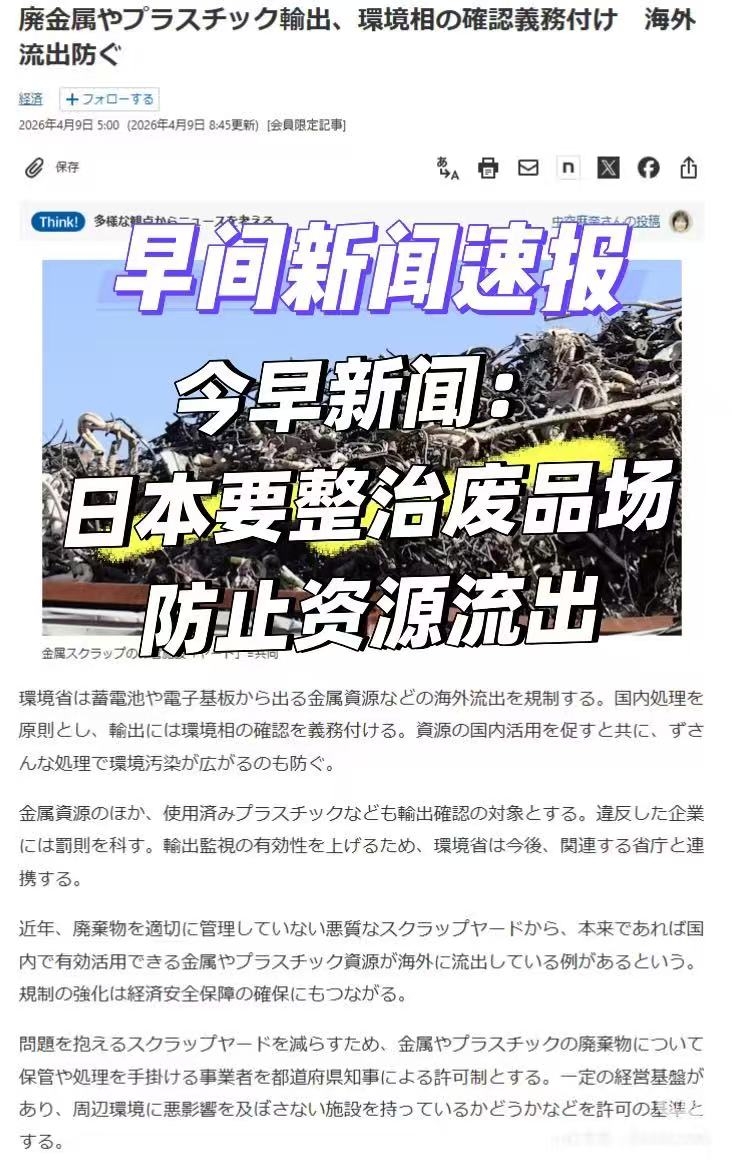 Japan's Waste Disposal Law Amendment: New Metal Resource Control Regulations and Reactions
On April 9, 2026, the Japanese Cabinet officially approved the latest amendment to the Waste Disposal and Public Cleansing Act (commonly known as the "Waste Cleansing Act"). The core of the amendment is to upgrade metal recycling operations from a notification system to a permit system, and to impose a new obligation requiring confirmation from the Minister of the Environment for scrap metal exports.
May 1, 2026 10:27- 【SMM Aluminum News Flash】Malaysia enforces stricter controls on metal scrap and e-waste
As of the 5th of February 2026, Malaysia has enforced a nationwide absolute ban on e-waste imports from other countries, citing environmental and corruption reasons as the main drivers. Earlier in February, the Home Ministry has also announced the continuity of 'Op Hazard' to combat illegal activities related to e-waste and metal scraps in Malaysia, with up to 7 billion Malaysian Ringgit worth of seizures related to these illegal operations in 2025.
Feb 5, 2026 11:45 - [SMM Analysis] Tungsten Inventory Depletion in Europe Triggers Panic Buying, Accelerating Global Price Uptrend
Last week, surging European tungsten prices, driven by low inventories and panic buying, highlighted a severe supply-demand imbalance. While the scrap market sees a global shift due to high Asian premiums, EQR’s progress in Spain and Australia is strategically reshaping the non-Chinese supply landscape. Despite post-Lunar New Year caution, the upward price trend remains firm.
Feb 2, 2026 16:35