

41results found for 'metal recycling'
Sort by : |
- [EMR Resumes Scrap Shredder Operations in Camden]
European Metal Recycling resumed phased operations at its scrap shredder in Camden, New Jersey, after a court overturned the temporary suspension of its licence. The facility had been idled following a fire and must meet additional safety requirements before fully restarting. EMR has introduced a new lithium-ion battery fire-risk framework, while local residents remain concerned about repeated fires and smoke exposure.
Jul 16, 2026 16:13 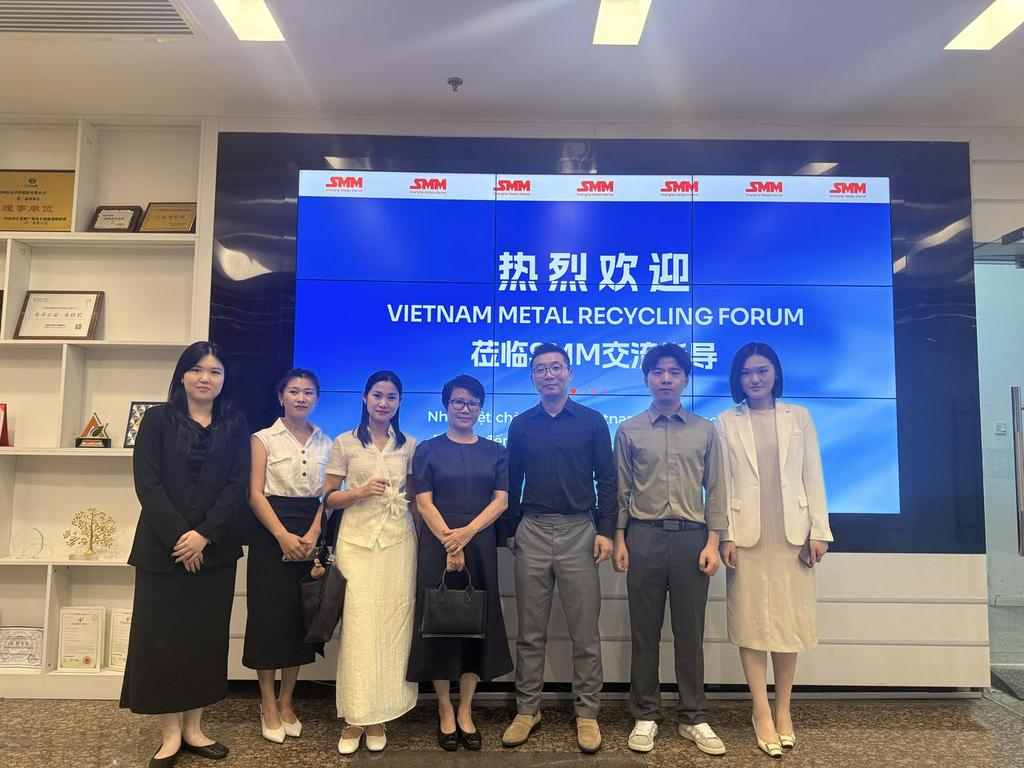 VMRF’s Return Visit to SMM: A Milestone for Vietnam’s Recycled Metals Industry Cooperation
On July 10, a delegation from the Vietnam Metal Recycling Forum (VMRF) — including Anh, Tran Thi Van, Phuong and Hoang Minh — visited the headquarters of Shanghai Metals Market (SMM) in Shanghai. SMM CEO Logan Lu welcomed the guests, alongside Horin Dong (Senior Overseas Marketing Manager), Cindy Zhang (Global Recycled Metals Project Manager), Date Song (Global BD Manager, Base Metals Conferences & Events Team), and Catherine Zhan (Overseas Marketing Manager). The two sides engaged in in-depth discussions covering Southeast Asia’s recycled metals industrial chain services, overseas market expansion, and joint industry summit cooperation. During the visit, SMM shared its latest global strategic layout. Against the backdrop of robust demand in Southeast Asia, Africa, and South Asia, SMM has set up new offices in Vietnam, South Korea, India and Zambia, forming a multi-regional overseas hub network. Through these local touchpoints, SMM will move closer to the upstream and downstream of local industry chains, providing more efficient one-stop market services to partners in Vietnam, ASEAN, and beyond for the recycled metals, aluminum, lead-acid battery, and ferrous metals sectors. In addition, SMM also introduced three major industry events it will hold in ASEAN in H2: 2026 SMM Global Lead-Acid Battery Supply Chain Industry Conference (Nov 19-20) in Ho Chi Minh City; SMM AICE 2026 Southeast Asia (Vietnam) Aluminium Conference (Nov 23-24) in Ho Chi Minh City; -SMM ASEAN Ferrous Metals Summit 2026 (Nov 26-27) in Malaysia Notably, in 2025, SMM Chairman Adam Fan led Catherine Zhan, SMM's Overseas Marketing Manager, on a trip to Vietnam to meet the VMRF team, where SMM introduced its comprehensive core businesses and service capabilities, including multi-commodity information, price data, industry surveys, and conferences and exhibitions, building a solid bridge for future cooperation. Now, a year later, this return visit by VMRF is of great significance to SMM and marks a further deepening of bilateral cooperation. Group Photo of VMRF at the 2025 SMM APAC Lead-Acid Battery Industry Conference in Vietnam Group Photo of the 2025 SMM Visit to VMRF VMRF was established to connect enterprises, recycling plants, traders, and partners within Vietnam's metal recycling industry. As a platform for sharing information, reports, market trends, and technology, VMRF is committed to helping its members achieve sustainable development and elevate industry standards. Since forging ties with VMRF at last year's offline event in Vietnam, SMM has placed great importance on the friendly cooperation with VMRF. In the future, SMM is looking forward to establishing a long-term, stable, and normalized deep collaboration mechanism with VMRF, continuously carrying out joint efforts in industry exchanges, market information sharing, and summit co-promotion. Leveraging SMM's multiple Southeast Asian industry conferences, both sides will strive to build a supply-demand matching platform and jointly support the standardized and international development of Vietnam's recycled metal industry chain.
Jul 13, 2026 11:21- Shyam Steel Opens Non-Ferrous Recycling and Copper Alloy Facility in UAE
Shyam Steel Group has opened its first overseas manufacturing facility in the UAE’s Hamriyah Free Zone, with an initial investment of AED 60 million. The plant will focus on non-ferrous metal recycling and alloy production, with annual capacity of 24,000 tonnes of aluminium alloys and 6,000 tonnes of copper alloys.
Jul 9, 2026 09:38 - Runli Zihuan invites you to attend the 2026 SMM (2nd) Northern Cable Industry Conference
The north is the core hinterland of China's cable industry. Relying on its industrial heritage, complete entire industry chain support, and favorable policies from Beijing-Tianjin-Hebei coordinated development, it has built a complete industrial cluster integrating raw material processing, cable production, new material R&D, and intelligent equipment manufacturing. The regional cable industry boasts an annual output value exceeding 100 billion yuan, with a solid industrial foundation and broad market space. Compared with the advantageous industrial clusters of the Yangtze River Delta and the Pearl River Delta, the northern cable industry still faces shortcomings such as scattered industrial resources, weak industry-academia-research collaboration, and insufficient risk resistance capability of the industry chain. Breaking down collaboration barriers has become key to industry upgrading. will be held from July 23 to 24, 2026 at the Crowne Plaza Qingdao Jinshui, Shandong . The conference focuses on three major themes: industrial collaboration, green intelligence, and globalization. SMM , together with Runli (Shandong) Resource Recycling Industry Co., Ltd. , invites customers from the entire industry chain to gather, explore industry opportunities, and promote the quality and upgrading of the northern cable industry. Click to attend. We look forward to meeting you at the conference. Runli (Shandong) Resource Recycling Industry Co., Ltd. is a large-scale comprehensive renewable resource recycling enterprise in the Shandong region, focusing on non-ferrous metal recycling. It integrates online and offline collection channels, and has built a modern recycling industrial base covering recycling and warehousing, intelligent sorting, metal purification, and finished product production and sales. The company adheres to compliant operations, holds complete environmental protection operation qualifications and standardized management processes, strictly controls pollutant discharge in every production step, and takes resource reduction, reuse, and recycling as its core development direction. It helps reduce industrial solid waste, lowers raw material costs for manufacturing, and supports the regional green economy and the implementation of the "dual carbon" goals. It is committed to becoming a professional and reliable renewable resource recycling service provider in the North China region. Its business covers various types of industrial copper scrap off-cuts, waste cables, dismantled metals from obsolete equipment, comprehensive solid waste from factories, and other categories. It has a professional dismantling and sorting team and supporting environmental protection facilities, and the entire process meets environmental protection-related control requirements. It can stably supply copper scrap in large quantities, meeting the production needs of downstream processing industries such as cables, hardware, and conductive materials. The company has established standardized quality control and logistics distribution systems. Leveraging mature industry resources and years of practical experience, it balances economic benefits with ecological responsibility, proactively promotes the transformation and upgrading of the resource recycling industry, empowers resource recycling with technology, and builds a large-scale, intelligent, and green comprehensive resource recycling industry platform. Collaborate with upstream and downstream partners to build a low-carbon industrial ecosystem, and create a regional benchmark comprehensive utilization enterprise for renewable resources. Contact Information Shang Yiying 139 2018 5888 SMM Conference Contact Zhang Guolei 166 0190 0190 zhangguolei@smm.cn
Jul 8, 2026 10:58 - [SMM Aluminum Flash News] Dhanvanti Engineering Expands Global Presence with 250+ Non-Ferrous Recycling Projects
India's Dhanvanti Engineering has completed over 250 non-ferrous metal recycling projects and strengthened its presence across India, the Middle East and Africa. Its proprietary Tilting Rotary Furnace (TRF) technology has been successfully adopted in aluminium alloy ingots, wire rods, extrusion and copper recycling, helping improve metal recovery, reduce energy consumption and support sustainable metal recycling worldwide.
Jul 7, 2026 11:09 - Last Friday LME Copper Edged Up Slightly, Fundamental Destocking Provided Support [SMM Copper Morning Brief]
SMM Morning Meeting Minutes: Last Friday night, LME copper opened at $13,354.5/mt, dipped to $13,343/mt shortly after the opening, then drifted slightly higher to a high of $13,392/mt before settling at $13,357.5/mt, up 0.54%. Trading volume reached 8,500 lots, and open interest stood at 250,000 lots, a decrease of 587 lots from the previous trading day, indicating bears reduced positions. Last Friday night, the most-traded SHFE copper 2608 contract opened at 102,710 yuan/mt. The price center dipped to 102,710 yuan/mt after the opening, then moved in a "W" shape. Near the close, it reached a high of 103,010 yuan/mt, and finally settled at 102,790 yuan/mt, up 0.14%. Trading volume was 16,300 lots, and open interest was 151,000 lots, a decrease of 811 lots from the previous trading day, indicating bulls reduced positions.
Jul 6, 2026 09:01 - Aurubis Launches €190M CRH Facility in Hamburg for Advanced Metal Recycling
Aurubis commissioned the "Complex Recycling Hamburg (CRH)" I at its Hamburg site, a world-first facility with an investment of 190 million euros aimed at strengthening Europe's strategic metal recycling capabilities. The plant can process copper, lead, and sulfur simultaneously in a single production unit.
Jul 4, 2026 23:02 - New Regulations on Power Battery Maintenance Take Effect
The supporting implementation rules for Ministry of Industry and Information Technology (MIIT) Order No. 73 have been fully rolled out. The cost ceiling for repairing or replacing LFP batteries is set at 150 yuan/kWh, and for ternary lithium batteries at 180 yuan/kWh—meaning the once-common practice of "replacement instead of repair" costing tens of thousands of yuan has become a thing of the past. For the chemical and materials industry, however, a far more significant signal than the repair price cuts lies buried in another detailed rule: the residual value of end-of-life batteries belongs to the vehicle owner and can be transparently deducted from repair costs. What appears to be a consumer-friendly policy designed to benefit vehicle owners in fact installs a "compliant raw material engine" for the entire rare and precious metal recycling industry chain. In the past, large volumes of end-of-life batteries flowed into the black market due to opaque repair practices, causing valuable lithium, cobalt, and nickel resources to be lost in crude smelting processes. Now, for the first time, the ore veins of this "urban mine" are being systematically channeled through formal repair channels to compliant chemical recycling enterprises. From a resource strategy perspective, the improvement of the power battery repair and recycling system is essentially the construction of a flowing "urban mine." According to MIIT data, in 2024, China's comprehensive utilization of power batteries reached 301,000 mt, from which 2,000 mt of lithium metal, 2,000 mt of cobalt, and 5,000 mt of nickel were extracted, equivalent to 4%–7% of the resources required for power battery production during the same period. This proportion may appear modest, but the growth curve is extremely steep. The State Administration for Market Regulation estimates that by 2030, the market size of power battery recycling in China will surpass 100 billion yuan, at which point recycled metals will account for a substantially higher share of power battery raw material supply. Compared with the long process of ore mining, beneficiation, and smelting, battery regeneration and extraction technologies consume significantly less energy, generate markedly lower carbon emissions, and reduce dependence on imported ore resources. It is worth noting that the large-scale recycling of end-of-life LFP batteries is also accelerating. Although the LFP chemistry contains no high-value metals such as cobalt or nickel, the recovery value of the lithium element is becoming increasingly prominent. Institutions including the Guangzhou Institute of Energy Conversion under the Chinese Academy of Sciences have developed a Joule-heating shock-activated water leaching technology that has achieved a lithium leaching rate exceeding 99%, while the leaching tailings can be synergistically upgraded to produce high-energy-density cathode materials, further improving resource utilization efficiency across the entire system. Overall, this new maintenance regulation is not an isolated consumer-side policy but a critical link in the entire power battery recycling industry chain — front-end maintenance standardizes the export of end-of-life batteries, mid-end recycling ensures the collection of rare and precious metals, and back-end metallurgy achieves closed-loop resource regeneration. As compliance across the entire chain deepens, China’s circular supply capacity for rare and precious metals will continue to be released.
Jun 30, 2026 18:46 - Jinfeng Precious Metal Materials (Jiangsu) Co., Ltd. Supports SMM in Creating the "2027 Global Copper Foil Industry Chain Distribution Map"
Under the global trend of vehicle electrification, China's and the European and American NEV markets have maintained high growth, driving the expansion of battery enterprises; wind power and PV installations continue to grow, and the demand for energy storage and filtering shows considerable growth prospects. Downstream automotive electronics and server sectors in the electronic circuit copper foil industry have maintained good growth with state support; with the advent of the 5G era, a new wave of development in the consumer electronics industry has driven production growth of high-performance flexible copper clad laminates. However, as copper foil enterprises continuously release new capacity in and outside China, fierce competition has brought severe profit challenges. Capacity integration, cost reduction and efficiency improvement, and enhancing product competitiveness have become the core of industry development. SMM , in response to the demands of industry users, as an independent third-party platform, with the aim of promoting the development of the global copper foil industry, has organized and sorted out copper foil industry resources in and outside China for market reference and study. Here, we join hands with Jinfeng Precious Metals Materials (Jiangsu) Co., Ltd. to sincerely invite outstanding enterprises and industry experts to assist in the production of , and to provide your valuable suggestions, jointly making positive contributions to the development of the copper foil industry. We strive to present a more objective industry landscape, and will invite all sectors of the industry chain to participate in production and supervision, helping to promote the distribution and dissemination of the global copper foil industry map throughout the process! (Click the link to get it for free: ) Jinfeng Precious Metals Materials (Jiangsu) Co., Ltd. is based in Jiangsu, serving the entire country. It is a comprehensive full-industry-chain service provider integrating precious metal scrap recycling, coating removal processing, high-purity precious metal powders, precious metal compounds, and catalytic material production and sales. It has deeply cultivated the fields of copper foil, chlor-alkali chemical industry, and water treatment electrolytic electrode recycling and regeneration, with complete recycling qualifications and guaranteed compliant operations. The company's core business focuses on waste electrode recycling and substrate regeneration. It specializes in the recycling and disposal of waste iridium-coated anode plates from copper foil plants, as well as ruthenium-iridium coated anode meshes and ruthenium-platinum coated cathode meshes from chlor-alkali and water treatment industries, supported by a mature back-pull anode coating removal process. This process completely strips the precious metal coating and returns the titanium substrate intact, significantly reducing clients' raw material loss costs and achieving dual recycling of both titanium and precious metals. With in-house standardized production and purification workshops, we mass-produce high-purity precious metal raw materials. Our main products include 99.95 high-purity iridium powder, 99.95 high-purity ruthenium powder, as well as precious metal salts such as chloroiridic acid, ammonium chloroiridate, iridium trichloride, and ruthenium trichloride, and we also supply various precious metal catalysts. All products strictly comply with national industry standards, ensuring stable purity and controllable quality, suitable for multiple industrial scenarios such as electrolysis, electroplating, and chemical catalysis. Our business covers all categories of precious metals including platinum, palladium, rhodium, iridium, ruthenium, gold, and silver, integrating the entire process from scrap recycling, hydrometallurgical refining, powder synthesis, compound preparation, to finished product sales. The company adheres to the concept of green recycling development, relying on mature hydrometallurgical purification technology, achieving high precious metal recovery rates, transparent pricing, and efficient settlement. We have long served upstream and downstream enterprises in the new energy copper foil, chlor-alkali, environmental water treatment, and fine chemical industries, providing industrial clients with one-stop precious metal recycling solutions through compliant qualifications, stable supply, and comprehensive after-sales service. Jinfeng Precious Metals Materials (Jiangsu) Co., Ltd. Contact: Director Du Tel: 138 6166 6239 Address: No. 1079 Binjiang West Road, Jiangyin, Jiangsu SMM Contact Bao Jinyong 13159338158 baojinyong@smm.cn
Jun 23, 2026 16:01 - [Lithium Battery: GEM Focuses On Expanding High-End Product Market For Ternary Precursor Business]
On June 18, GEM disclosed that its main business growth drivers include focusing on core businesses such as key metal recycling and extraction, power lithium battery recycling, and new energy material core manufacturing. In the ternary precursor business, the company focuses on expanding the high-end product market. Regarding ternary cathode materials, the company focuses on high-profit segments such as small power applications, planning shipments to exceed 35,000 tons in 2026 and 60,000 tons in 2028. At the same time, the company is actively positioning itself in next-generation battery material technologies. High-nickel, ultra-high-nickel ternary cathode materials, and lithium-rich manganese-based cathode materials are considered the mainstream research directions for future solid-state batteries. The company has teamed up with Ningbo Eastern University of Technology and the academician team of Sun Xueliang to promote the industrialization of related technologies.
Jun 18, 2026 15:45