

7results found for 'alms'
Sort by : |
![[SMM Conference] ICM 2026: Insights on Global Tin Market Dynamics, Trade Transition & Sustainable Development](https://imgqn.smm.cn/production/admin/votes/imagesyAKNA20260616115925.jpeg) [SMM Conference] ICM 2026: Insights on Global Tin Market Dynamics, Trade Transition & Sustainable Development
[SMM Conference] ICM 2026: Insights on Global Tin Market Dynamics, Trade Transition & Sustainable DevelopmentFrom June 3 to June 5, Indonesia Critical Minerals 2026 was held at the Pullman Jakarta Central Park in Jakarta, Indonesia. The conference was organized by Shanghai Metals Market (SMM) and co-organized by the Indonesia Nickel Miners Association (APNI) , the Ministry of Foreign Affairs of the Republic of Indonesia , the National Economic Council of Indonesia , and MMR , in a strategic partnership with the Jakarta Futures Exchange . The conference featured six dedicated forums: the main forum, the nickel and cobalt forum, the tin forum, the coal & energy transition forum, the aluminum forum, and dedicated sub-forums, attracting 3,500+ attendees from 45 countries and regions worldwide, featuring more than 120+ speakers sharing insights on market prices, supply-demand patterns, industry policies, low-carbon development, and ESG development, etc. Conference Background of Tin Forum In 2022, both LME and SHFE tin annual prices closed lower, and the market at the time may not have anticipated that this would serve as the prelude to a three-year upward cycle. From 2023 to 2025, tin prices recorded three consecutive years of gains, with both LME and SHFE tin surging over 30% in 2025. Entering 2026, the upward trend has continued, with tin prices hitting a new record high and becoming one of the most closely watched metals in the industrial metals market. However, this rally has not been smooth. In the past two years, tin prices have fluctuated significantly within an upward channel, driven by deep adjustments in global supply-demand patterns, especially multiple disruptions on the supply side. On the demand side, emerging sectors such as AI servers, PV welding strips, and NEVs have rapidly risen, coupled with a recovery in consumer electronics, continuously highlighting tin's strategic value in high-end manufacturing and steadily expanding rigid demand. On the supply side, global tin resources are highly concentrated, production resumptions in Myanmar have fallen short of expectations, some ex-China mining areas have been disrupted by geopolitical factors, and Indonesia—a key link in global refined tin supply—has seen its industrial policy adjustments become a critical variable affecting market expectations. Reviewing Indonesia's tin industry policy, the past two years have shown a clear trajectory of "standardizing and regulating, tightening exports, and promoting downstream development." In 2024, the Mining Work Plan (RKAB) was adjusted from an annual to a three-year basis, and exports experienced temporary fluctuations during the policy transition. In 2025, Indonesia further strengthened governance over illegal mining, shutting down some illegal tin mines, cracking down on smuggling activities, and adjusting tin ore royalty fees, leading to higher production costs. Entering 2026, the policy direction has become clearer, with studies on restricting refined tin exports, lowering export quotas, and plans to raise tin royalty tax rates, promoting the transition from resource exports to high value-added processing. These adjustments are reshaping the rhythm and trade patterns of the global tin supply chain. As an important platform connecting the global tin industry chain with the Indonesian resource market, the Tin Forum focuses on the latest developments in Indonesia's tin policies, the evolution of the global tin supply-demand pattern, price trend analysis, and industrial cooperation opportunities. It brings together government officials, industry experts, miners, smelters, and downstream end-user representatives to jointly explore new opportunities in the global supply chain amid the transformation of Indonesia's tin industry. Click to view photo gallery of tin forum Tin Forum June 4 Visit to the Association of Indonesian Tin Exporters (AETI) Shanghai Metals Market (SMM) is pleased to announce that an SMM-led delegation, headed by SMM Copper & Tin Overseas Marketing Manager Jenny Wu and made up of delegates from the Indonesia Critical Minerals Conference & Expo 2026 , conducted a formal visit to the Association of Indonesian Tin Exporters (AETI) on June 4. The event was organized by SMM and co-organized by Indonesia’s Ministry of Foreign Affairs, National Economic Council, Indonesia Nickel Miners Association (APNI), and MMR, with the Jakarta Futures Exchange as the strategic partner. This visit underscores SMM’s commitment to fostering long-term, win-win partnerships between Indonesia’s top mineral exporters and global metals industry stakeholders. Supply and Demand Exchange Session June 5 Opening Remarks Speaker: Adam Fan, Chairman of SMM Keynote Speech Keynote Speech: DRC Tin Ore: Current Supply Status and Market Dynamics Insights Speaker: Raj Chug, General Manager, Mining Mineral Resources Keynote Speech: African Tin Ore: Resource Potential and Supply Chain Breakthrough Paths Amid Supply Shortages Speaker: Egyul Mamoko, Metallurgist Expert, CTCPM (Cellule Technique de Coordination et de Planification Minière) [Panel Discussion] Global Tin Mine Supply Seminar: Current Status, Opportunities, and Future Challenges Moderator: Vicky Qiao, Senior Analyst at SMM Panelists: Egyul Mamoko, Metallurgist Expert, CTCPM (Cellule Technique de Coordination et de Planification Minière) Erwin Setyawan, Head of Trading & Operation, Jakarta Futures Exchange Joseph G. Miller Esq, Strategic & Defense Metals Specialist/Director, Mission Critical Metals, Mission Critical Metals Keynote Speech: The Development Trend of the Tin Market in China Speaker: Zheyu Zhang, Tin Market Analyst, Marketing Department, Yuntin (Honghe) Investment Development Co., Ltd. Keynote Speech: Opportunities and Challenges for Smelters Under Indonesia's New Tin Industry Policies Speaker: Yazid Kanca Surya, Chief Executive Officer, Jakarta Futures Exchange Fragmented Global Supply Chain System Reshaping of the Geopolitical Landscape : Trade disputes and geopolitical tensions are profoundly altering traditional commodity trade patterns. Industrial Security :Countries are increasingly prioritizing long-term stable supply of strategic resources over short-term price advantages. Focus on Critical Minerals : Tin’s industry role is no longer isolated; it has become a core issue in the global energy transition and high-end manufacturing sectors. Evolution of the Tin Market The industry is entering a new phase where credibility is as important as capacity. Promoting Downstream Industrialisation (Hilirisasi) •Historical Development Background: Indonesia has long been dominated by the supply of primary processed products, with most downstream value addition achieved outside China. • Strategic Goals : Indonesia is adjusting export policies, trade management, and supply chain oversight to retain high-value-added industries within the country. Strengthening regulation and cracking down on illegal mining are not punitive measures, but rather efforts to build a transparent system to help the local area vigorously promote the development of downstream industries. Smelters Under Pressure Upstream uncertainties: Illegal mining disrupts the market, raw material supply fluctuates, and price trends are difficult to predict. Downstream market requirements: Strict compliance standards, full transparency in raw material traceability, and continuously rising screening thresholds for buyers. Market Volatility Intensifies The uncertainty in the current operating environment has increased significantly. Enterprises must not only cope with production risks, but also simultaneously address the multiple pressures arising from external shocks and rising operating costs. Investment Barriers in Deep Processing Keynote Speech: Deepening Downstream Diversification, Joining Hands to Foster Long-term Prosperity Guest Speaker: HARRY BUDI SIDHARTA, S.T, MM., Vice President Director, PT Timah (Persero) Tbk Keynote Speech: Challenges and Opportunities for China's Tin Industry amid Global Tin Ore Supply Changes Guest Speaker: Huanbo Qin, Market Analyst, International Tin Association China Keynote Speech: Analysis of Global Tin Price Trends and Future Outlook Speaker: Vicky Qiao, Senior Analyst, Shanghai Metals Market Price Trend Overview Price Review: Amid macroeconomic and geopolitical disruptions, market fundamentals have provided structural support Key Points: Tight mine-side supply has established a long-term price floor, while macro liquidity has primarily driven price fluctuations. Tin Resources and Mine Supply Landscape Supply elasticity is limited, accompanied by a high geographic concentration of reserves; the global static mine life is less than 15 years. Rising mine production alongside shrinking global resources has accelerated reserve depletion in producing countries. DRC: Output from major mines remained stable; however, M23 militant activities increased market uncertainty. ►Risks 1. The M23 armed conflict has spread to the Masisi region east of the Bisie mine and the Goma border crossing between the DRC and Rwanda, directly disrupting the original tin ore transportation route via Goma to Dar es Salaam. 2. To mitigate conflict risks, security at the Bisie mine has been reinforced, and freight routes have been adjusted northward to reroute through Uganda, ultimately destined for the port of Mombasa in Kenya. Nevertheless, market concerns persist that further spread of the M23 conflict could disrupt normal production operations at the mine. 3. The DRC recently experienced an Ebola outbreak, with confirmed cases concentrated in Beni and Bunia, areas adjacent to Uganda. Strict disease prevention measures have been implemented at both the mine and along transportation links; Bisie's mining and freight activities have yet to be affected by the pandemic impact. However, the market remains apprehensive about the local mineral supply outlook. Myanmar's Man Maw Tin Mine: Production Resumptions Hindered • 90% of Myanmar's tin ore production is concentrated in Wa State. To ensure rational resource extraction and stable regional development, Wa State suspended all tin ore mining starting in 2023, with new mining permits only reissued in July 2025. Due to the local rainy climate, the mine pits accumulated significant water during the suspension, making drainage the primary challenge upon work resumption. As the water accumulation issue affected multiple pits, the cost-sharing arrangements for drainage among mining enterprises were long delayed and never finalized. The resulting obstruction of drainage work has directly constrained the mine's production resumption progress. •In February 2026, the local government issued detailed rules clarifying the cost-sharing standards for drainage, and the Wa State tin mine immediately began resuming production. •Currently, strict approval and control of civilian explosives in Myanmar, compounded by disruptions to mining and logistics caused by the rainy season, have led to progress in local production resumptions falling short of expectations. Full resumption is expected only by 2027. The number of new tin mine projects globally is scarce, with generally low ore grades and lengthy development-to-production cycles. New projects generally have low ore grades, posing upside risks to future mining costs and increasing operational difficulty. Only three new projects have grades above 1%. Lower ore grades mean that more raw ore must be processed to produce the same amount of tin metal. The future supply landscape will be markedly differentiated, with total planned and under-construction projects reaching 173.5 kt in capacity, and just four major projects accounting for over 67%. Global supply will be highly dependent on these core mine projects, while five new projects in Australia can only bring a small incremental increase with limited impact. Global Tin Ingot Supply The high concentration of primary tin smelting capacity limits the global supply elasticity of tin ingots. Keynote Speech: Achieving the Trading and Risk Hedging of Pure Tin Ingots Through the Standardized Trading Mechanism of the Futures Market – Commodity Futures Trading Regulatory Authority Guest Speaker: Ima Siti Fatimah, Head of the Commodity Futures Trading Development Bureau, Ministry of Trade of the Republic of Indonesia Keynote Speech: Under the Drive of Geopolitical Policies: Global Strategic Metal Tin Trade Restructuring, Breakthroughs in North American Secondary Production, and New Logic in Solder Consumption Guest Speaker: Joseph G. Miller Esq, Strategic & Defense Metals Specialist/Director, Mission Critical Metals, Mission Critical Metals ► Securing Supply: US Plan to Reshore Critical Metal (Tin) Capacity • Lessons drawn from COVID-19 and World War II. • No primary tin capacity currently exists in North America: no tin ore mining operations, no tin ore smelting capacity. • The US secondary tin market is regionally fragmented. • The US government supports the Nathan Trotter primary/secondary tin smelter. • The Trump administration has made multiple investments in the critical metals sector. • Security situation in the DRC and surrounding regions. ► Data Center Tin Consumption Estimates How much tin is consumed per gigawatt of installed data center capacity? • Servers, GPUs, network systems: 500–1,500 mt. • Power systems, switchgear: 100–400 mt. • Control devices, communication equipment, cooling systems: 50–200 mt. • Tin usage per gigawatt of installed AI data center capacity is approximately 1,200–1,500 mt. Additionally, the speaker noted: the PV industry's annual tin consumption is about 25,000 mt, with average annual new installations of around 30 GW, corresponding to tin demand of 36,000–45,000 mt. Keynote Speech: Due Diligence in the Indonesian Tin Sector: A Tradition of Early Adoption and Pathways for ESG Leadership Guest Speaker: Josue Ruiz, Director of Facility Engagement, Responsible Minerals Initiative Keynote Speech: Malaysian Tin Mine: Market Breakthrough and Global Expansion from the Perspective of Critical Minerals Guest Speaker: DATO DEREK TENG, Director of the SETARA JELITA SDN BHD, President of the MALAYSIA MARITIME SILK ROUTE RESEARCH SOCIETY Critical Minerals in the New Era Strategic Positioning and Core Applications of Tin National Strategic Cornerstone: Listed in the “Critical Minerals List” by many countries, it holds an irreplaceable core position in securing national resource security and maintaining the resilience of global supply chains. Modern Industrial Lifeline: The core raw material for electronic solder manufacturing, it supports semiconductor packaging, PCB circuit boards, and other electronic information industries, serving as the “industrial monosodium glutamate” of modern manufacturing. Frontier Technology Engine: Empowering emerging technologies such as 5G communications, NEV batteries, PV modules, and AI chips, it drives the dual transformation of the digital economy and green transition. Tin: The “Industrial MSG” Driving High-Tech Industries ► A Core Member of the Global Critical Minerals System U.S. Official Designation: According to the U.S. Geological Survey (USGS) “2025 Critical Minerals List,” tin is formally listed as a critical mineral, regarded as a strategic resource vital to national economic development and national security. Global Industry Consensus: In the mineral assessment systems of the EU and other developed economies, tin also occupies a core position. It is an indispensable “emerging cornerstone mineral” supporting the global digital economic transformation and the upgrade of the new energy industry. The global tin application structure in 2025 is very clear: 53% is used in semiconductors and high-end electronic solder, 16% in fine tin chemical new materials, 11% in food-grade tinplate and tin cans, and 8% directly in the PV green new energy industry. Tin Applications in High-Growth Sectors Currently, three major high-growth tracks worldwide are continuously driving rigid incremental demand for tin. First, AI computing power and hyperscale data centers: The tin consumption per unit of high-end AI servers is 3–13 times that of ordinary servers. With the explosive growth of global AI computing power demand, the demand for high-end solder will continue to grow rapidly. Second, new energy vehicles: Tin consumption per vehicle is about three times that of internal combustion engine vehicles, and for intelligent car models, it can reach up to 1.5 kg per vehicle. Third, advanced packaging: The solder ball usage of advanced packaging technologies such as HBM (High Bandwidth Memory) is more than five times that of traditional DRAM. Malaysia at a Crossroads The Decline of a Former Empire and Opportunities for Transformation ► Glorious History · Tin Empire: In the 1960s, Malaysia was the world's veritable "Tin Empire." Its tin production once accounted for one-third of the global total, and revenue from tin exports represented as much as 60% of the country's total export revenue, dominating the global tin trade landscape. ► Current Situation · Dual Challenges: However, after industrial iteration, its share of global production was only 0.2% in 2023, with annual output falling to 6,100 mt, marking a sharp decline. Malaysia still holds considerable secondary resource reserves of 780,000 tonnes, with native ore depleted but tailings holding significant potential. ► Future · Reshaping Value Strategic Empowerment: Leverage the new strategic identity of “critical minerals” to enhance discourse power and bargaining power in the international supply chain. Industrial Leap: Shift away from dependence on primary tin ingot exports and move towards high value-added deep processing manufacturing and the establishment of a circular economy system. Core Challenges Faced Currently, Malaysia’s tin industry faces four core structural challenges. Market Breakthrough: Reshaping Value Embrace the New Identity and Extend into Downstream High Value-Added Sectors Build a Regional Circular Economy Center Core Strategy: Fully leverage Malaysia’s industrial advantage as a global electronics manufacturing center, turning the large amount of tin-containing scrap generated during production—including solder dross, waste circuit boards, etc.—into valuable recycled tin resources, and establish an “urban mining” resource recycling system. Keynote Speech: From Waste to Value: How Smelters and Recycling Enterprises Uncover Hidden Treasures in Tin Ore By-Products Guest Speaker: Justin Wang, Director of Marketing and Technology, Stannum Solutions(Shanghai) Co., Ltd.
Jun 16, 2026 11:59- [SMM Analysis] Philippine Inventory Continues to Accumulate, Indonesia Premium Narrows, and RKAB Flexible Policy Opens a New Stage
Philippine Market: Port inventories continued to accumulate, high freight costs coupled with smelters pushing for lower prices, ore prices faced increasing downside risks This week, CIF China quotes for Philippine nickel ore were generally flat WoW, with no significant loosening or increases across various grades. Specific quotes were: CIF China: Ni 1.3% at $49–52/wmt, 1.4% at $57–60/wmt, 1.5% at $65–67/wmt; CIF Indonesia: 1.3% at approximately $48–50/wmt, 1.4% at approximately $56–58/wmt. Supply and Weather As of June 12, Philippine nickel ore inventory at Chinese ports totaled approximately 5.77 million wmt, equivalent to around 45,300 mt in nickel metal content, up WoW as supply remained ample. Weather conditions at mining areas were relatively manageable, with no major typhoons or heavy rainfall disrupting supply chains recently. However, spot freight rates stayed high, providing minimal support for miners' FOB prices, intensifying cost pressure on miners' shipments. Some mines opted to hold off on shipments, awaiting next week's new round of bidding results before making decisions. Demand and Inventory Demand side, smelters' desire to bargain down prices remained strong, continuing to pressure miners with ample inventories, while the buyer-dominant landscape persisted. Smelters in both China and Indonesia held inventories that fluctuated at highs, with weak short-term restocking willingness and sluggish trading in the market. Considering the continued accumulation of port inventories, high freight costs squeezing miner margins, coordinated price pushing by smelters, and rising wait-and-see sentiment among miners, ore prices could edge down further in the coming weeks. Indonesian Market: Smelters' High Inventories Continued to Weigh on Prices, Premiums Showed a Narrowing Trend The HMA was unchanged at $18,799.29/mt. Theoretical HPM prices were: Ni 1.6% at approximately $70.75/wmt, 1.2% at approximately $49.84/wmt. The delivery-to-factory price for 1.6% ore was $73.8–78.8/wmt, with premiums at +3 to +8 dollars, flat WoW and significantly narrower than earlier highs. Looking ahead, with ore supply continuing to be ample and smelters' willingness to bargain down prices increasing, premiums are expected to have room to decline further. Indonesia's local ore supply was relatively abundant, with some mines taking advantage of weather windows to maximize production. According to BMKG: Sulawesi (Morowali Utara) experienced relatively dry weather with calm seas and smooth shipping; East Halmahera saw persistent rainfall with wave heights of 1.4–2.0 m; Obi had light rain with wave heights of 1.3–1.6 m, with shipment efficiency affected in both areas. This week, the saprolite ore market saw ample cargo availability and relatively active trading volumes. However, with inventories at many smelters staying at sufficient levels, the desire to push for lower prices strengthened noticeably. In some industrial parks, unloading vehicle queues appeared this week, directly reflecting the market reality of loose ore supply and persistently high delivery-to-factory volumes. Traded grades were concentrated at 1.45–1.50% Ni, while high-grade ore (≥1.6%) remained scarce. In addition, spot limonite ore was priced at approximately $26–34/wmt, with the price range widening. The market exhibited some divergence, with select transactions at lower prices and a few at higher levels, as the overall center shifted slightly lower WoW, mainly dragged down by high freight costs. The discount to the theoretical HPM price remained deep and detached. Sulphuric acid supply stayed relatively tight, HPAL operating rates were low, and purchasing prices for limonite ore remained under pressure. Policy Developments Newly approved RKAB for nickel ore were relatively rare this week, with the market widely expecting more approvals to be released in July. Meanwhile, Indonesian Energy and Mineral Resources Minister Bahlil Lahadalia stated that the government would implement an "orderly and flexible" policy for 2026 mineral and coal RKAB, where production quota adjustments would be linked to global commodity price trends and domestic industrial demand—moderately expanding production when prices rise and tightening promptly when prices are under pressure to maintain supply-demand balance. This statement reserved policy space for within-year quota revisions, warranting ongoing market attention to the release periods of subsequent official documents. The DSI takeover mechanism for ferroalloy exports entered a transition period on June 1, with NPI (HS 7202.60.00) highly likely to be included; Harita’s PT Trimegah had already completed the first DSI single-window export declaration, with smooth operations. The government was simultaneously pushing forward a strict crackdown on under-invoiced contracts, with relevant departments set to consult with industry associations to close loopholes.
Jun 12, 2026 19:45 - Gold Price in 2026: New Market Structure Paves the Way for a Rise to $4,920
June 8, 2026 Increased mine production, rising recycling, but declining overall demand—at first glance, not a typical environment for new price records. Nevertheless, the experts at Metals Focus forecast an average gold price of $4,920 per ounce for 2026, representing a 43 percent increase from the previous year. This apparent contradiction stems from a profound structural shift in the gold market that has far-reaching implications for the industry. Bullion and coins overtake gold jewelry for the first time The most significant change is taking place on the demand side: In 2026, physical investments in bullion and coins are expected to replace gold jewelry as the largest source of demand for the first time. This trend was already emerging in 2025, when physical investment demand climbed 16 percent to a twelve-year high—driven primarily by growth in China (up 28 percent) and India (up 17 percent). At the same time, global jewelry production plummeted by 19 percent to a five-year low of 1,646 tons. For 2026, Metals Focus anticipates a further decline of 11 percent. The historically high price level is forcing consumers and manufacturers to opt for lighter pieces, lower karat grades, or more affordable alternatives such as gold-filled materials. Consequently, gold is not disappearing from demand but is shifting its primary function from a consumer good to a pure investment product. Unlike jewelry purchases, this investment demand is far less price-sensitive and is primarily driven by motives such as asset protection, diversification, and hedging against currency risks and uncertainties. Lower overall demand—but a higher gold price Although overall demand is expected to decline in 2026 due in part to a slowdown in the jewelry sector, the high quality of buyers supports the projected price surge. Simply looking at total tonnage falls short in the current environment. As early as 2025, gold-backed exchange-traded products (ETFs) recorded their highest annual inflows since 2020, at 803 tons. The driving forces behind this were tariffs, growing U.S. government debt, doubts about the Federal Reserve’s monetary policy independence, and geopolitical tensions. These factors will persist in 2026 and will be exacerbated by high stock market valuations and uncertainties regarding the long-term trajectory of the U.S. dollar. The precious metal is thus assuming an increasingly strategic role in investment portfolios. Central banks are buying less—but still at unusually high levels This strategic importance is also reflected in the behavior of central banks. Although net purchases fell by 22 percent to 848 tons in 2025, after having exceeded the 1,000-ton mark for three consecutive years, geographically broad-based demand remains well above pre-2022 levels. Sales were limited to a few countries and served primarily to rebalance portfolios following the recent gold rally. Despite headwinds such as the ongoing energy crisis, Metals Focus expects historically high net purchases in 2026 as well. While the pace of buying is slowing, the trend toward greater diversification of official reserves remains intact. Gold mines are producing more—but supply is slow to respond On the supply side, global mine production reached a new record of 3,817 tons (up 2 percent) in 2025. Growth was driven by new mines, expansions, and higher contributions from small-scale mining. A further increase of 2.4 percent to 3,907 tons is forecast for 2026, with all regions except Oceania and Europe expected to grow. Given the enormous price surge, this supply growth is nevertheless moderate and underscores that even strong price signals in the mining industry do not immediately lead to massive jumps in production. Compounding the issue is the fact that producers are grappling with significant cost increases: Global all-in sustaining costs (AISC) rose by 12 percent to $1,552 per ounce in 2025 due to inflation and taxes. For junior companies, this means that while a higher gold price improves the profitability of projects, factors such as grade, location, and infrastructure are increasingly decisive for success in light of cost trends. Why even record prices are barely triggering a recycling wave The supply of recycled gold is also responding sluggishly. In 2025, the volume rose by only 2.8 percent to 1,404 tons—a 13-year high that is, however, subdued relative to price trends. A 5.1 percent increase is forecast for 2026. This apparent contradiction can be explained by owners’ strong desire for security: precisely because of prevailing uncertainties, scrap gold is being sold less frequently. Paradoxically, the very factor driving prices is simultaneously limiting the additional supply that would normally cool the market. The Iran War Delays the Next Uptrend Short-term volatility remains a factor, however. Following new record highs at the start of 2026, a previously overbought market combined with shifting U.S. interest rate expectations led to a correction. The war in Iran is further fueling inflation, which limits the scope for interest rate cuts in the U.S. and drives up bond yields. In the short term, this is a headwind for gold, although geopolitical conflicts usually support the metal. Metals Focus, however, expects the rally to return once the situation calms down. The underlying premise: Policymakers are likely to tolerate slightly higher inflation rather than jeopardize economic growth through overly restrictive monetary policy. Conclusion: In 2026, it’s no longer just volume that counts in the gold market The market environment for 2026 is more complex than a purely quantitative analysis of supply and demand would suggest. The buyer structure is changing, strategic players are acting less price-sensitive, and structural drivers such as global debt and geopolitical risks remain. At the same time, supply from mines and recycling is growing only slowly. What is decisive, therefore, is not so much the absolute tonnage of total demand, but rather the fact that gold is undergoing a permanent shift from a consumer good to a strategic investment and reserve asset. The projected average price of $4,920 thus does not reflect mere exaggeration, but rather is an expression of a new, more resilient market structure. Source: https://goldinvest.de/en/gold-price-in-2026-new-market-structure-paves-the-way-for-a-rise-to-usd4-920
Jun 9, 2026 14:13 - Middle East Situation Temporarily Calms Down, Aluminum Prices Fluctuate at Highs for Adjustment [SMM Aluminum Morning Meeting Minutes]
[Middle East Situation Calms Temporarily, Aluminum Prices Fluctuate and Adjust at Highs] Amid geopolitical risks in the Middle East, a wait-and-see sentiment in the market is expected to persist. The overseas supply gap is expected to provide strong underlying support for aluminum prices, while expectations of rising energy costs also serve as a bullish driver for aluminum prices. However, high inventory pressure in China remains relatively evident, which is expected to cap the upside room for domestic aluminum prices. In the short term, China's aluminum prices are expected to primarily fluctuate and adjust.
Jun 9, 2026 09:21 - Silver Institute Warns: Silver to Face Undersupply for Sixth Consecutive Year as Investment Demand Grows Increasingly Influential!
According to the annual World Silver Survey released by the Silver Institute, as the silver market is expected to see a significant supply gap, investors should prepare for volatility intensifies and potential liquidity issues in the silver market for the remainder of this year. According to the survey conducted by UK-based research firm Metals Focus, the silver market is expected to see its sixth consecutive annual deficit , with a shortfall of 46.3 million ounces. This highlights how years of undersupply have been steadily eroding above-ground inventory, leaving the market highly vulnerable to fresh bouts of fluctuations. Although supply remained relatively stable — mine production is expected to be basically flat and recycling volume rose to a multi-year high — it was not enough to meet demand. As a result, the persistent deficit has steadily reduced available inventory, making the market increasingly sensitive to demand shifts and investment flows. Philip Newman, Managing Director of Metals Focus, said in an interview that the latest survey showed the silver market is increasingly driven by investment flows, macroeconomic uncertainty, and tightening liquidity. Although Metals Focus remains optimistic about silver's trajectory heading into 2026, the report noted that the outlook is not without risks. Uncertainty in the global economy due to escalating geopolitical tensions and ongoing turmoil in the Middle East could dampen industrial demand for silver. Industrial demand for silver is expected to decline 3% this year to 639.6 million ounces, marking the second consecutive annual decline. However, Newman noted that despite the decline, the sector remains at historically strong levels and well above pre-conflict levels, underscoring silver's critical role in various modern technologies. Growth Drivers The report noted that the weakest segment of industrial consumption this year had been its biggest growth driver. Analysts expect silver consumption in the PV sector to decline 19% this year , as rising prices have forced manufacturers to reduce silver usage in PV panels or seek alternative materials. Newman added that substitution pressures had emerged before silver prices reached extreme levels. He noted that the rapid rally over the past year was a key factor forcing manufacturers to make adjustments. Despite headwinds facing PV sector demand, Newman said the resilience of industrial consumption stems from more diversified application fields. He explained that demand from data centers, broad electrification of the global economy, and EV manufacturing are all sources of growth in silver consumption. While industrial demand faces headwinds, Newman believes investment demand has once again become a driver of the broader market . Newman said: "You could see losses in the industrial sector being offset by retail investment. That's not beyond the realms of possibility." A Significant Shift One of the most significant shifts in the silver market is the growing influence of investment demand, particularly retail purchases and exchange-traded products (ETPs). Following record inflows in 2025, ETP holdings are expected to increase again. Metals Focus expects global ETFs to see modest net inflows of approximately 30 million ounces; however, Newman said this small net increase masks dramatic fluctuations underneath. He noted: "Given the massive liquidations we've already seen this year, that's quite a significant swing compared to where we are now." Beyond flows, ETFs are having an increasing impact on the physical market. Large inflows remove metal from circulation, causing available supply tightens and triggering a liquidity squeeze ; while outflows rapidly release metal back into the market, amplifying price fluctuations. The survey highlighted that demand for silver coins and bars is expected to grow 18% in 2026, reaching the highest level since 2022. Meanwhile, physical demand remains a key pillar of the market, with strong buying interest helping to tighten supply conditions, particularly during periods of strong price momentum and market stress . Indian Market Far from Saturated Newman noted that physical demand has shown resilience globally, but he emphasized that India remains one of the most important markets for silver. Even at elevated prices, strong retail purchases, limited selling, and steady seasonal demand continue to support global consumption. He added that Indian investors have shown a greater willingness to hold silver rather than take profits on rebounds, which has intensified tightness in the physical market and limited available supply. Meanwhile, Newman said that while higher silver prices may affect total investment volumes, they are not expected to undermine overall demand. He predicted: " I think you're going to see a significant increase in spending from retail investors. " Looking ahead, Newman expects Indian demand to continue serving as a key support pillar for silver. Despite demand reaching a record high in 2025, Newman believes the Indian market is far from saturated. He said: "Looking at the purchasing levels we've seen, I don't feel the market is becoming saturated. If we get another good monsoon season, this year could be another positive year."
Apr 16, 2026 18:42 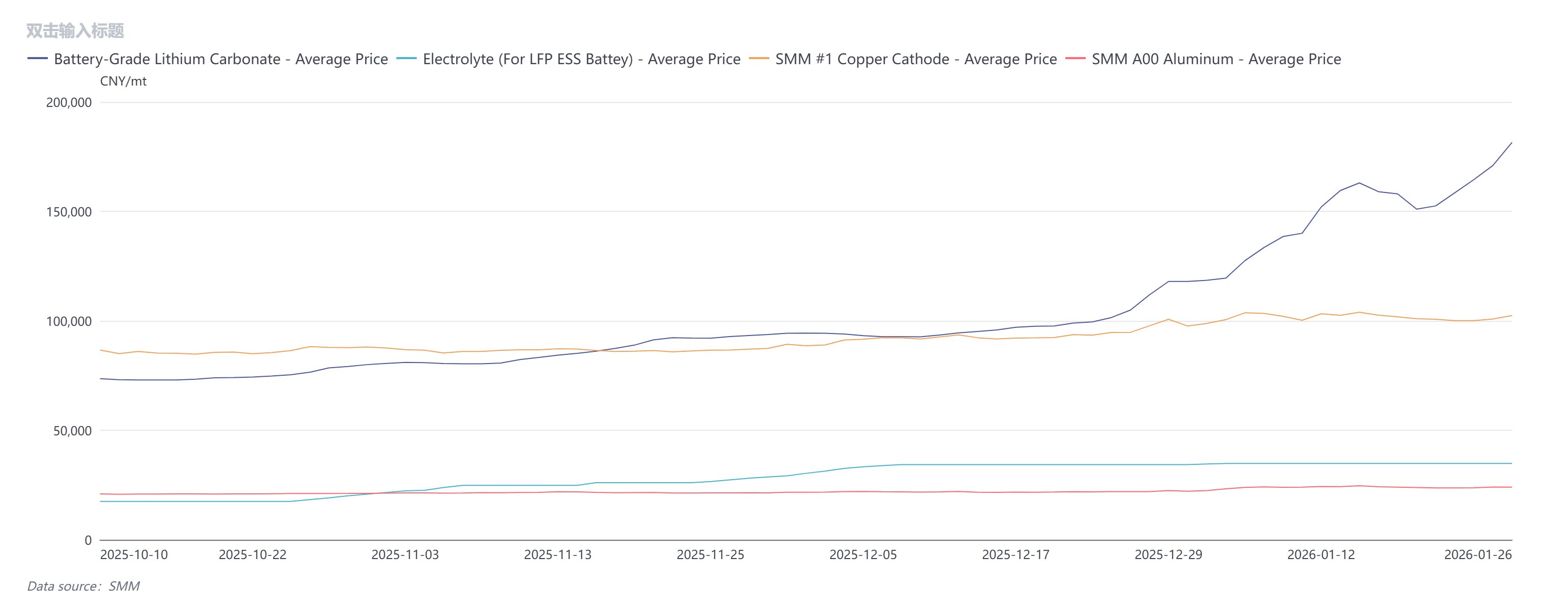 Amidst Middle East Conflicts: What is the Path Forward for China's Energy Storage Exports?
Recent Middle East conflicts have disrupted the region's booming energy storage market, a major destination for Chinese exports. To assess the real impact on Chinese supply chains and project deliveries, we must analyze baseline demand amidst these geopolitical uncertainties.
Mar 9, 2026 17:58- SHFE Tin Continuously Boosted by Geopolitical Events, Price Hits Limit Up at 376,920 yuan/mt on January 12 [SMM Tin Brief Review]
[SMM Tin Review: SHFE Tin Boosted by Macro Events, Prices Hit Limit Up at 376,920 yuan/mt on January 12]
Jan 12, 2026 17:31
Loaded to the end