

100results found for 'Solar Energy'
Sort by : |
- [SMM PV Update] Conversion Efficiency 18.8%, Fraunhofer Institute and Source Energy Develop Silicon-Based Space PV Module
The Fraunhofer Institute for Solar Energy Systems (Fraunhofer ISE) in Germany, in partnership with US Source Energy, has developed a series of silicon-based PV modules for satellites. This product line combines silicon-based cells with shingled matrix interconnection technology and automated manufacturing, aiming to provide a low-cost solution for low Earth orbit (LEO) satellites as an alternative to the currently expensive and supply-constrained III-V PV technology used in space applications.
Aug 7, 2026 13:21 - [SMM PV Flash] Planned Selection as Advanced Intelligent Factory in Jiangsu Province! Hongyuan Green Energy's Jiangyin Base Smart Manufacturing Strength Gains Provincial Recognition Again
Recently, the Jiangsu Provincial Department of Industry and Information Technology issued the Public Notice on the Proposed List of Advanced-Level Smart Factories in Jiangsu Province for 2026, in which Hongyuan Solar Energy (Wuxi) Co., Ltd. (hereinafter referred to as "Hongyuan Green Energy Jiangyin Base") was successfully selected. Following its recognition as a Jiangsu Provincial Green Factory, the Jiangyin Base has once again received authoritative provincial-level endorsement, marking new breakthroughs in smart manufacturing, digital transformation, and green manufacturing, and injecting new momentum into cultivating new quality productive forces in the new energy industry and promoting high-quality development of manufacturing.
Aug 5, 2026 13:16 - Silver – A Complex Bottoming Process Continues
August 3, 2026 The precious metals markets remained highly volatile over the past several days while continuing to trade within what has ultimately been a relatively narrow range. Gold began the week with an upside gap and rallied to US$4,116, only to retreat to US$3,996 shortly before yesterday's Federal Reserve interest rate decision. Following the announcement, prices rebounded back to US$4,116 within hours before coming under renewed pressure late in the session and during early Asian trading, falling to US$4,042 and US$4,028, respectively. Overall, however, little has changed compared to last week's close of US$4,054. Silver traded within a range of US$56.62 to US$60.09 over the same period. Both metals remain locked in an uncertain sideways consolidation as they continue searching for a clear bottom and a decisive trend reversal. Two Time Horizons, One Market The precious metals market continues to be influenced by two very different time horizons. On one hand, a structural demand story unfolding over many years—driven largely by China—continues to provide strong fundamental support for gold. On the other hand, Federal Reserve policy, bond market developments, corrections in technology and semiconductor stocks, and the escalating conflict with Iran continue to generate short-term shocks that affect not only gold and silver but virtually every financial market sector. The Fed Holds Steady While the Market Tightens Financial Conditions This tension between long-term fundamentals and short-term volatility was highlighted once again by the Federal Reserve's latest policy decision. The U.S. central bank left interest rates unchanged at 3.50%–3.75% for the fifth consecutive meeting. More noteworthy than the decision itself, however, was the reaction in the bond market. While two-year Treasury yields declined, the 30-year Treasury yield surged to approximately 5.21%, its highest level in nearly two decades. Fed Chair Warsh deliberately avoided providing forward guidance, instead pointing to the increases already taking place across the yield curve. The result is an unusual situation: although the Fed has left its policy rate unchanged, the bond market is effectively tightening monetary conditions on its own through rising long-term yields. Real Yields Versus Currency Debasement For gold and silver, this environment creates conflicting forces. Rising long-term real interest rates traditionally weigh on precious metals, while declining confidence in long-duration government bonds and growing concerns about fiscal deficits and currency debasement strengthen gold's appeal as an alternative store of value. Geopolitics Continues to Fuel Inflation Concerns The already complicated picture has been further intensified by the military escalation between the United States and Iran. Following Iranian missile attacks on U.S. positions, CENTCOM responded with strikes against Islamic Revolutionary Guard Corps (IRGC) targets. Brent crude oil briefly climbed above US$94 per barrel amid concerns over the Strait of Hormuz, through which roughly one-fifth of global oil shipments normally pass. Higher energy prices continue to increase inflationary pressures worldwide, reinforcing the Federal Reserve's cautious approach toward monetary policy. Selling Pressure from Financially Stressed Holders While geopolitical risks continue to support inflation concerns, they have also created selling pressure in the gold market. Financially strained Gulf states and countries such as Turkey have reportedly sold portions of their gold reserves to stabilize their currencies. These transactions temporarily increase supply but do not alter the longer-term demand trend. Instead, they represent a transfer of gold from weaker holders to long-term strategic buyers, particularly in Asia. China's Strategic Gold Accumulation Remains the Dominant Long-Term Story Zentralbank-Goldreserven China vs USA, vom 27. Juli 2026. © BMO, Gold.de The recent market turbulence has overshadowed what remains the dominant long-term narrative: China's systematic accumulation of gold. According to a recent BMO analysis, China has accumulated approximately 29,500 tonnes of above-ground gold since 1949, compared with an estimated 32,200 tonnes held by the United States. Remarkably, 93% of China's total gold accumulation has occurred during the past 25 years. The People's Bank of China officially reports gold reserves of around 2,300 tonnes, but discrepancies between reported central bank purchases and actual gold flows from the United Kingdom and Switzerland since 2022 suggest China's true holdings could be closer to 5,200 tonnes. Two Targets, One Timeline Based on these estimates, BMO outlines two potential milestones. China would require approximately 2,911 additional tonnes to match U.S. official central bank reserves, a target that could be reached in roughly five years at the current pace of purchases. To match total U.S. above-ground gold holdings, China would need only around 2,700 tonnes, a level that could potentially be reached in as little as two years. Shanghai and Hong Kong Are Emerging as a New Pricing Hub Globale Gold Handelsplätze, vom 27. Juli 2026. © BMO, Gold.de At the same time, China continues expanding the Shanghai Gold Exchange while strengthening Hong Kong as an offshore gold trading center through new clearing systems, the Delivery Connect program, and the reintroduction of U.S. dollar-denominated gold futures. Together, these initiatives are creating a second global pricing hub alongside the London Bullion Market Association (LBMA) and New York's COMEX, while supporting the broader internationalization of the renminbi. Gold Remains Resilient Despite Strong Headwinds Despite the challenging macroeconomic backdrop, gold has shown remarkable resilience. The actively traded August futures contract gained 0.91% yesterday to close at US$4,065.50 , a respectable performance considering both the geopolitical escalation and the Federal Reserve meeting. BMO continues to forecast additional upside during the second half of 2026, targeting approximately US$4,750 by the fourth quarter once inflation concerns related to the conflict begin to ease. The Jackson Hole symposium at the end of August is widely viewed as the next major catalyst. Silver Caught Between Conflicting Forces Silver currently finds itself in a particularly difficult position. Historically, silver follows gold's direction, often with considerably higher beta. If gold successfully maintains support around US$4,000 and resumes its recovery, silver could potentially deliver even stronger gains. Unlike gold, however, silver lacks one critical pillar of the China investment thesis: there is no structural central bank demand providing long-term support. Instead, silver remains much more dependent on two other factors—the direction of real interest rates and industrial demand, particularly from the solar energy sector, which has remained relatively resilient despite inflationary pressures and higher energy costs. Silver Forms a Potential Wedge Pattern Silber in US-Dollar, Tageschart vom 17. Juli 2026. © Gold.de Since late June, silver has been attempting to establish a slow, narrow and rather confusing bottoming formation. Prices remain well below both the declining 50-day moving average at US$63.99 and the relatively flat 200-day moving average at US$70.71. At the same time, bears have repeatedly tested the broad support zone between US$55 and US$60 without achieving any meaningful downside follow-through, leaving a potentially bullish wedge pattern intact. Daily stochastic indicators have yet to generate meaningful upside momentum and continue to drift sideways, reflecting the fading media attention toward precious metals and the typically quieter summer trading environment. Nevertheless, prospects for a recovery remain favorable. Seasonally, silver has historically performed well between late June and early September, making a return toward the rapidly declining 50-day moving average appear entirely plausible later this summer. Given the growing number of bearish forecasts calling for gold to fall toward US$3,500, the market could just as easily remember that precious metals remain within a long-term secular bull market. Only six months ago, gold and silver had outperformed nearly every other asset class. A sudden shift in market sentiment could therefore transform the current setup into what many investors would view as an attractive "buy-the-dip" opportunity. Conclusion: Silver's Bottoming Process Remains Complicated The precious metals sector continues to move through a complex period in which long-term structural trends are colliding with short-term macroeconomic shocks. While gold remains fundamentally supported by China's ongoing accumulation strategy and growing concerns about currency debasement, rising long-term real yields, the Federal Reserve's cautious stance, weakness in technology stocks, and escalating geopolitical tensions continue to weigh on near-term price action. Silver, meanwhile, remains trapped between US$56 and US$60, searching for a decisive trend reversal. Seasonal patterns and the emerging wedge formation continue to support the case for a recovery later this summer. The central investment thesis for the second half of the year remains unchanged. Once inflation concerns related to the geopolitical conflict begin to ease and interest-rate uncertainty subsides, gold could resume its advance. Given silver's historically higher beta, it would likely outperform during such a move. Unlike gold, however, silver lacks the powerful structural support provided by central bank buying and therefore remains more dependent on industrial demand—particularly from the solar sector—and on the direction of real interest rates. Overall, the current consolidation can still be viewed as a potential buy-the-dip opportunity within an ongoing secular bull market, although investors continue to await more convincing technical confirmation, such as a sustained move back above silver's 50-day moving average. Source: https://goldinvest.de/en/silver-a-complex-bottoming-process-continues
Aug 5, 2026 10:05 - [SMM PV News] 1.5 GW Cooperation! Trinasolar Partners with Al-Raebi to Explore the Middle East PV Market
Recently, Trinasolar and the Middle Eastern company Al-Raebi for Trading and Solar Energy Systems Company officially signed a Memorandum of Understanding (MoU). According to the MoU, the two parties will cooperate on PV projects with a total scale of approximately 1.5 GW from 2026 to 2029, jointly explore development opportunities for large-scale PV projects in the Middle East, and work together to promote the green and low-carbon transition of regional energy. As a globally leading provider of PV+ESS smart energy solutions, Trinasolar will fully leverage its leading TOPCon 3.0 technology advantages and extensive global project experience, combined with Al-Raebi's local resources and project development capabilities accumulated through years of in-depth cultivation in the Middle East market, to continuously promote cooperation on large-scale ground-mounted power stations and industrial and commercial PV projects, delivering more efficient and reliable PV solutions to local clients and meeting the region's growing demand for clean energy.
Aug 4, 2026 13:17 - Shenzhen Energy Group Announces Shortlisted Suppliers for 2026-2028 Photovoltaic Module Procurement
On July 28, Shenzhen Energy Group-affiliated enterprises' 2026- 2028 annual photovoltaic module centralized procurement supplier pre-selection project was announced. The shortlisted companies are TCL Zhonghe Energy Technology (Jiangsu) Co., Ltd., Gaojing Solar Energy Co., Ltd., Hongyuan Green Energy Co., Ltd., JinkoSolar Co., Ltd., Shenzhen Qiming Photovoltaic Technology Co., Ltd., Trina Solar Co., Ltd., Tongwei Co., Ltd., Zhejiang Aixu Solar Technology Co., Ltd., Zhengtai New Energy Technology Co., Ltd., China Energy Conservation Solar Technology (Zhenjiang) Co., Ltd.
Jul 31, 2026 16:43 - TCL Zhonghuan, Gokin Solar, Jinko, TrinaSolar and 6 Other Enterprises Shortlisted for Shenzhen Energy’s 1 GW PV Module Supplier Pre-qualification Pool
On July 28, the public announcement of the shortlisted candidates for the concentrated procurement supplier pre-selection project of PV modules from 2026 to 2028, conducted by an affiliate of Shenzhen Energy Group, was released. The shortlisted enterprises included TCL Zhonghuan Energy Technology (Jiangsu) Co., Ltd., Gokin Solar Co., Ltd., HoYuan Green Energy Co., Ltd., Jinko Solar Co., Ltd., Shenzhen Qiming PV Technology Co., Ltd., TrinaSolar Co., Ltd., Tongwei Co., Ltd., Zhejiang AIKO Solar Energy Technology Co., Ltd., Chint New Energy Technology Co., Ltd., and CECEP Solar Energy Technology (Zhenjiang) Co., Ltd.
Jul 31, 2026 10:31 - [SMM Brief] PV module bidding capacity from 7.2-7.26 was 3,567.35 MW, with an average winning bid price of 0.75 yuan/W
During the statistical period from July 20 to July 26, 2026, SMM recorded that Chinese enterprises won a total of 41 PV module projects, with an average winning bid price of 0.75 yuan/W. The total procurement capacity awarded amounted to 3,567.35 MW, up 2,084.93 MW from the previous statistical period.
Jul 29, 2026 11:03 - [Solar: Trinasolar and Al-Raebi explore 1.5GW solar pipeline in Yemen]
Trinasolar has signed an MoU with Yemen-based Al-Raebi for Trading and Solar Energy Systems Company to explore a potential 1.5GW pipeline of large-scale solar projects in Yemen between 2026 and 2029. The companies will assess project opportunities, technical requirements and cooperation models, including the potential deployment of Trinasolar’s TOPCon 3.0 modules. The agreement also covers opportunities across the wider Middle East.
Jul 27, 2026 09:43 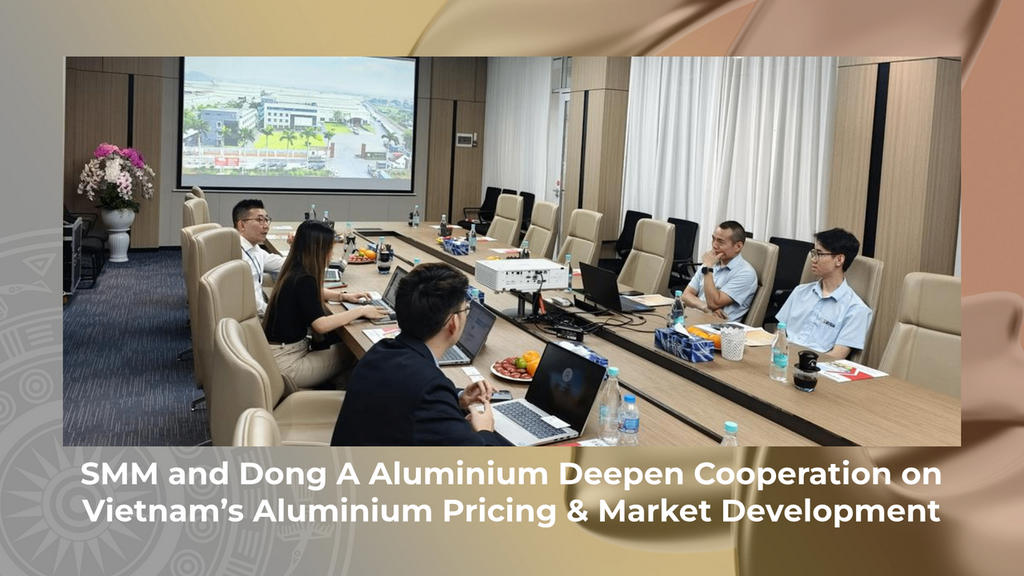 SMM Visits Dong A Aluminum to Jointly Explore Vietnam's Aluminum Pricing and Market Development
On July 22, 2026, a delegation from SMM Information & Technology Co., Ltd. (SMM) visited Dong A Aluminum Company Limited and was warmly received by Deputy General Manager Cao Jiawang and Procurement Manager Chen Jiejun. The two sides held in-depth exchanges on topics including the development of Vietnam's aluminum price system, corporate procurement status and pricing models, trends in the aluminum processing industry, and cooperation for the SMM AICE 2026 Southeast Asia (Vietnam) Aluminum Conference. The SMM delegation included: Logan Lu , CEO of SMM Cason Lou , Director of Aluminium Processing, Marketing Department Lexi Chen , Key Account Manager for Overseas Information Sales Chin Khai Yuen , Senior Overseas Aluminium Analyst They were welcomed by key representatives from Dong A Aluminum, including: Cao Jiawang , Deputy General Manager Chen Jiejun , Procurement Manager Focusing on Procurement Practices: Coexistence of Multiple Pricing Models During the meeting, Dong A Aluminum elaborated on its current procurement status and price usage model. As one of the largest aluminum semis exporters in Vietnam, Dong A Aluminum's procurement system has both international and local characteristics, forming a flexible but complex pricing mechanism. Dong A Aluminum stated that the Vietnamese market currently lacks a locally recognized price reference system with international credibility, and enterprises face challenges such as inconsistent pricing benchmarks and scattered price information in actual operations, hoping that SMM can promote the standardization of Vietnam's aluminum price system. SMM introduced that since July 3, 2026, SMM has officially launched the Vietnam 6063 (non-homogenized) aluminum billet processing fee and SMM Vietnam 6063 (non-homogenized) aluminum billet price point, updated on a daily basis on each trading day. Meanwhile, SMM plans to officially release the SMM Vietnam aluminum price and elaborate on the methodology at the SMM AICE 2026 Southeast Asia (Vietnam) Aluminum Conference to be held in Ho Chi Minh City from November 19 to 20. Dong A Aluminum expressed high attention to this, believing that the launch of SMM Vietnam aluminum price is expected to provide enterprises with a more transparent and authoritative pricing reference, reduce transaction costs, and improve market efficiency. Discussing Industry Trends: Opportunities and Challenges in the Aluminum Processing Industry The two sides also exchanged views on the current status of Vietnam's aluminum processing industry. As a member of a Singapore-based holding group system, Dong A Aluminum has a total investment of over $200 million and an annual comprehensive capacity of 150,000 mt. In 2025, the company's Phase III expansion project was officially completed and put into operation, with six new aluminum extrusion lines installed, bringing the total number of extrusion lines to 25. The company has now established a wide sales network across the country, and its products are popular in multiple international markets such as the US, Australia, Canada, Europe, and Japan. Dong A Aluminum noted that with the commissioning of Vietnam's first aluminum project (Phase I with an annual capacity of 150,000 mt), the Vietnamese aluminum industry chain is accelerating to complete the last link. The increase in local primary aluminum supply will bring new procurement options and cost optimization opportunities for aluminum processing enterprises. At the same time, the imminent implementation of the Carbon Border Adjustment Mechanism (CBAM) and the adjustments to tariff policies in key export markets such as the US have also imposed higher requirements on enterprises' market layout and pricing strategies. The two sides also reached a consensus on cooperation for the SMM AICE 2026 Southeast Asia (Vietnam) Aluminum Industry Conference. Dong A Aluminum indicated that it would actively consider participating in the conference to jointly promote the internationalization of the aluminum market in Vietnam and Southeast Asia. This visit further deepened the communication and mutual trust between SMM and Vietnam's leading aluminum processing enterprises. It provided important first-hand information for market research and data collection on the Vietnamese aluminum pricing system and injected new momentum into the standardization of aluminum pricing in Vietnam. About Dong A Aluminum Dong A Aluminum Co., Ltd. is located in Tan Dan Industrial Park, Le Dai Hanh Ward, Haiphong City, Vietnam. It is an aluminum products producer with high industry reputation and relatively large production scale in Vietnam. The company is a member of a Singapore-based holding group, with a total investment exceeding $200 million and an annual comprehensive capacity of 150,000 mt. It is also one of the largest exporters of aluminum semis in Vietnam. The company owns a modern factory covering an area of nearly 120,000 m², equipped with intelligent and advanced production lines. It has established a fully automated, closed-loop production process covering aluminum ingot storage, melting and casting, extrusion, spraying, anodizing, wood grain treatment, deep processing, and finished product assembly. The company fully applies an intelligent ERP management system to achieve automated management of the entire production and operation process. Currently, the company has 25 extrusion lines with tonnages ranging from 600 mt to 4,500 mt. In 2025, the Phase III expansion project was officially completed and put into operation, successfully entering the list of Vietnam's Top 500 enterprises. With a development direction of becoming a comprehensive aluminum application solution provider, Dong A Aluminum's products are widely used in construction, home furnishings, electronics and power, solar energy, and other fields, and it continues to expand the application of aluminum semis in machinery equipment, precision parts, and the automotive industry. As of now, Dong A Aluminum has established an extensive sales network nationwide, with over 800 dealers, and actively exports to multiple international markets including the US, Australia, Canada, Europe, and Japan. Facing the future, Dong A Aluminum always adheres to the development philosophy of "innovation as the core, quality as the foundation, and service as the commitment," continuously optimizes its production system, upgrades its technological strength, and actively promotes Vietnam's aluminum industry onto the global industrial landscape. Join the Conversation at SMM AICE 2026 Connect with aluminum producers, processors, traders, industry associations, analysts, and decision-makers from across Southeast Asia. Explore the latest market developments, pricing trends, processing technologies, recycling opportunities, and new possibilities for regional cooperation. ? Ho Chi Minh City, Vietnam ? November 19–20, 2026 Register now: bit.ly/AICE26 and secure your Super Early Bird Pass and save up to USD 200. Register before August 31, 2026.
Jul 23, 2026 15:07- [Solar: ACME Solar signs 300MW hybrid PPA with SECI]
ACME Solar, through its subsidiary ACME Renewtech Fifth Pvt Ltd, has signed a 25-year PPA with Solar Energy Corp. of India for a 300MW ISTS-connected wind-solar hybrid renewable energy project. The project was secured under SECI’s Hybrid Tranche IX at a tariff of INR 3.25/kWh and is scheduled to begin power supply by June 30, 2028. Under the agreement, ACME Solar will supply power at a minimum annual capacity utilization factor of 30%. With this PPA, ACME Solar’s signed PPA portfolio has increased to 6.87GW, out of its total contracted renewable energy portfolio of 8.07GW across solar, wind, hybrid, FDRE and storage projects.
Jul 22, 2026 14:04