

- Base Metals Generally Rose in Overseas Markets During the Holiday, LME Aluminum Up Over 2%, LME Tin and Nickel Up Over 1%, Gold and Silver Down Over 1% [Holiday Market Review]
SMM May 6 News: Metal market: From May 1 to May 5, China was on the Labour Day holiday, with the domestic market closed and trading suspended. Overseas base metals generally rose during the Labour Day holiday, with LME zinc being the only decliner, down 0.12%. LME aluminum led the gains with a 2.69% increase, while LME tin and LME nickel both rose over 1%, with LME tin up 1.7% and LME nickel up 1.26%. Other metals gained less than 1%. The London Metal Exchange (LME) was closed on May 4 due to the UK Early May Bank Holiday and resumed trading on May 5. Precious metals: COMEX gold and COMEX silver both fell, with COMEX gold down 1.47% and COMEX silver down 1.3%. As of 6:38 AM on May 6, overnight closing prices Macro front China: [China Bulk Commodity Index Continued to Rise in April, Market Operations Stable and Improving] The China Federation of Logistics and Purchasing released the April China Bulk Commodity Price Index on May 5. In terms of index performance, driven by improved supply and demand in some domestic industries and external input factors, the index continued to rise in April, though the increase narrowed MoM, indicating that the bulk commodity market remained generally stable and continued its positive development trend. The China Bulk Commodity Price Index stood at 132.1 points in April, up 1.7% MoM and up 20.2% YoY. Among the 50 bulk commodities monitored by the China Federation of Logistics and Purchasing, 38 saw price increases MoM in April. Among them, paraxylene, methanol, and polypropylene led the gains, up 22.4%, 14.5%, and 11.8% MoM respectively. (CCTV News) (Jin10 Data APP) [National Road Traffic Generally Smooth and Orderly on Day 4 of Labour Day Holiday] According to the Traffic Management Bureau of the Ministry of Public Security, on the fourth day of the Labour Day holiday, various regions had successively entered the return travel peak, with traffic volumes on major national highways and provincial/national trunk roads generally fluctuating at highs. Local public security traffic management departments strengthened order control, strictly investigated prominent violations, enhanced emergency response, and widely disseminated safety reminders to ensure smooth and safe road traffic. As of 18:00, except for congestion and slow traffic on individual road sections due to excessive traffic volume and minor scraping accidents, traffic on major national trunk roads was generally smooth and orderly, with no prolonged or widespread traffic congestion. May 5 was the last day of the Labour Day holiday, and various regions were expected to see the peak of return travel, with traffic volumes on highways and provincial/national trunk roads expected to fluctuate at highs. (CCTV News) (Jin10 Data APP) [Guangzhou Property Market "Sui Eight Measures" Implemented: Queues Return at Sales Offices, Second-hand Housing Online Signings Exceeded 10,000 Units for Two Consecutive Months] Leveraging the policy dividends of the "Sui Eight Measures," Guangzhou's real estate market started strong during this year's Labour Day holiday. According to incomplete statistics from Guangzhou Centaline Property, from May 1-2, cumulative average project visits for new homes in Guangzhou grew 12% YoY, cumulative average project subscriptions grew 37% YoY, and transaction conversion rates improved steadily compared to the same period last year. The second-hand housing market also maintained an active trend, with cumulative property viewings exceeding 7,000 visits and transactions exceeding 280 units during the same period, up 37% and 11% respectively from the two days before the holiday. On the first day of the Labour Day holiday, some new projects even saw queues at entrances. Notably, before the new policy was implemented, Guangzhou's second-hand housing market had already stabilized and recovered, with monthly online signing volumes staying above 10,000 units for two consecutive months. Data from the Guangzhou Real Estate Agency Association showed that in April, second-hand residential online signings in Guangzhou totaled 10,426 units and 1.0406 million m² in area, up 4.84% and 1.47% YoY respectively. (Jin10 Data APP) [Cui Dongshui: China's Share of Global BEV Market at 56% in 2026] Cui Dongshui, Secretary General of the China Passenger Car Association (CPCA), stated that global auto sales reached 22.4 million units from January to March 2026, with NEV sales reaching 4.53 million units. The NEV share from January to March 2026 reached 20.2%, with BEVs accounting for 13.8%, PHEVs at 6.4%, and HEVs performing well at 7.2%. China's share in the global BEV market remained relatively stable, at around 63% from 2023 to 2025; in 2026, China's share in the global BEV market was 56%, with China's BEV performance temporarily weaker due to beginning-of-year factors. China's share in the global PHEV market was far ahead. In 2025, China's share in the global PHEV market reached an ultra-high level of 76.4%, and in 2026, China's share in the global PHEV market reached a high level of 73%, demonstrating China's exceptionally strong performance in the global PHEV market. (Jin10 Data APP) [Indonesia Plans to Impose Export Tax and Windfall Tax on Coal and Nickel to Ease Subsidy Pressure] Indonesia plans to impose export taxes and windfall taxes on coal and nickel as one of the measures to offset growing subsidy costs in the national budget. Indonesian Finance Minister Purbaya Yudhi Sadewa said the proposed measures are still under discussion with the Ministry of Energy and Mineral Resources. "Discussions with the Energy Ministry are ongoing, but what is clear is that the related revenue will be sufficient to help bridge the subsidy gap." Purbaya noted that coal and nickel exports had not previously been subject to export taxes, creating regulatory loopholes that could foster under-invoicing and smuggling, while also limiting customs authorities' ability to inspect goods before shipment. (Wallstreetcn) US dollar: During China's Labour Day holiday, the US dollar index generally showed a volatile upward trend. As of the overnight close on May 6, the US dollar index gained 0.41% over the holiday. Bond traders are increasing bets that the US Fed's next policy move could be a rate hike rather than a cut. Swap contracts linked to central bank rate decisions now show that the market expects a greater than 50% probability of the US Fed raising rates before next April, ahead of any rate cut. An increasing number of traders are also building positions to hedge against the rising probability of a rate hike before year-end. This shift in market sentiment comes as policymakers appear increasingly divided on the interest rate outlook. Lawrence Gillum, chief fixed income strategist at LPL Financial, believes that the possibility of interest rate cuts this year still exists, but will gradually diminish as the Iran conflict drags on. He said: "Without question, the road ahead for Warsh will be challenging." (Jin10 Data APP) New York Fed President Williams publicly stated on Monday that as long as inflation pulls back toward the US Fed's 2% target as expected, the US Fed will eventually need to cut interest rates. However, due to inflation running higher than expected this year, the timing of rate cuts has been forced to delay, though the overall policy direction has not fundamentally changed. Williams told reporters after a speech in New York on Monday: "As inflation comes down, at some point we will need to cut interest rates to match fundamentals. Inflation this year has been higher than previously expected, and in my view, this only delays the timing of rate cuts and does not change the overall policy logic." Last week, the US Fed decided to keep the benchmark rate unchanged, but internal policy divisions were highlighted, with three officials opposing the easing bias implied in the meeting statement, preferring more neutral language to signal that rates could move in either direction. Regarding the disputed language, Williams was clear: he fully endorsed the current statement, believing that based on day-to-day economic data, there was no sufficient reason to support a rate hike in the near term. (Jin10 Data) Former New York Fed President Dudley said that Powell's decision to remain as a Fed governor after stepping down as Fed Chairman will help reassure Wall Street and the public at a time when President Trump is pressuring for lower interest rates. "The Fed has been under relentless attack from the president, and its independence has been questioned," Dudley said. "Powell believes that his continued presence at the Fed will actually strengthen the perception of Fed independence. I think it's a wise move for him to stay on if he's willing." Powell's term as a Fed governor runs until 2028, and his choice to remain on the board after stepping down as chairman on May 15 is uncommon in Fed history. Trump's nominee Warsh has made the case for supporting the rate cuts the president seeks. But traders are no longer betting on any rate cuts this year, and Dudley also said the case for monetary easing is "very thin." (Jin10 Data APP) According to CME "FedWatch": the probability of the US Fed holding rates unchanged through June is 95.2%, with a 4.8% probability of a cumulative 25 bps cut. The probability of holding rates unchanged through July is 92.2%, with a 7.7% probability of a cumulative 25 bps cut and a 0.2% probability of a cumulative 50 bps cut. The probability of holding rates unchanged through September is 86.1%, with a 13.2% probability of a cumulative 25 bps cut and a 0.6% probability of a cumulative 50 bps cut. (Jin10 Data APP) Other currencies: According to ECB Governing Council member Kazimir, the ECB is very likely to raise rates at its next meeting in June. Kazimir said that tightening policy in June is "almost inevitable" given the need to address broad price increases and slowing eurozone economic growth. An ECB survey showed that professional forecasters expect inflation at 2.7% this year, pulling back to 2.1% in 2027 and 2% in 2028. (Wallstreetcn APP) Bank of France Governor and ECB Governing Council member Villeroy said the ECB must be cautious and ready to act on rates if inflation spreads beyond oil price increases. Villeroy noted that before tightening monetary policy, a "critical mass of data" on core inflation, wages, and enterprise and consumer expectations for price increases is needed. He warned that if France fails to meet its deficit targets, it will face further increases in financing costs, affecting households, enterprises, and economic growth. (Wallstreetcn) Former Bank of Japan Governor Kuroda Haruhiko said in an interview published in the Yomiuri Shimbun on Saturday that the BOJ has achieved its 2% inflation target and Japan does not need fiscal expansion or monetary easing. Kuroda said that given the coexistence of inflation and economic slowdown risks, the BOJ's decision not to raise rates on April 28 was the right one. (Source: Wallstreetcn APP) Data: This week, on the China front, data including China's April foreign exchange reserves (TBD) and China's April RatingDog Services PMI will be released; on the US front, data including US April ADP employment, US April Global Supply Chain Pressure Index, US April Challenger enterprise layoffs, US April Challenger enterprise layoffs, US March construction spending MoM, and US April NY Fed 1-year inflation expectations will be released; on the Eurozone front, data including Eurozone April Services PMI final, Eurozone March PPI MoM, and Eurozone March retail sales MoM will be released; on the France front, data including France March industrial output MoM, France April Services PMI final, and France March trade balance will be released; Germany April Services PMI final, UK April Services PMI final, and Switzerland April seasonally adjusted unemployment rate will also be released. In addition, 2028 FOMC voter and St. Louis Fed President Musalem will deliver a speech on the economic outlook and monetary policy, and 2027 FOMC voter and Chicago Fed President Goolsbee will participate in a panel discussion at a conference. Crude oil: Oil prices on both exchanges experienced volatile swings during the holiday, with an overall downward trend. As of the overnight close on May 6, WTI fell 2.59% and Brent fell 0.5%. Crude oil futures prices continued to show a tug-of-war pattern as the market awaited clarity on the prospects for reopening the Strait of Hormuz. Analyst Nikos Tsabralas said in a report that a renewed outbreak of hostilities could undermine the ceasefire agreement, thereby maintaining the risk premium. He added that as the conflict continues, crude oil prices are still poised to reach new highs, but the prolonged energy shock has heightened the risk of demand destruction, which "could ultimately cause the crude oil rally to lose support." (Source: Jin10 Data APP) Saudi Aramco cut the June official selling price for Arab Light crude to Asia by $4/barrel to a premium of $15.5 over the regional benchmark, a smaller reduction than the market expectation of $8/barrel. The price hit a record high in May, and despite the cut, the June premium remains the second highest on record. With the Strait of Hormuz largely closed, export channels for Gulf oil-producing nations have been severely disrupted. Saudi Arabia is one of the few countries still able to export crude via pipeline through the Red Sea port of Yanbu. Traders noted that Saudi Aramco's official selling prices primarily apply to crude loaded at Ras Tanura port in the Persian Gulf, and supply from Yanbu may incur additional costs. Saudi Aramco uses Dubai and Oman benchmark pricing, and since the Middle East war caused regional benchmark crude shortages, volatility in these two indices intensified, with April pulling back from March highs. (Jinshi Data APP) On May 1, according to CCTV citing Iranian media reports on Friday, May 1 local time, Iran submitted its latest negotiation proposal text to Pakistan on Thursday, with Pakistan serving as an intermediary for negotiations with the US. Later, according to CCTV citing US media, Pakistani officials said that Iran's latest negotiation proposal had been forwarded to US officials. After the news broke, crude oil prices reacted notably, with WTI falling more than 2% intraday and Brent dropping over 1% intraday. However, just after the weekend, on May 4, tensions between the US and Iran resurfaced, as the two countries once again vied for dominance over the Strait of Hormuz. According to CCTV News, Iranian Foreign Minister Araghchi stated on social media on May 5 local time that the various incidents in the Strait of Hormuz clearly demonstrated that political crises cannot be resolved through military means. As negotiations made progress under Pakistan's active mediation, the US should be wary of being dragged into a quagmire again by those with ulterior motives. The UAE should also be vigilant. The "Freedom Plan" is a "Deadlock Plan." On May 3, US President Trump announced the launch of an operation called the "Freedom Plan" to "guide" stranded vessels out of the Strait of Hormuz. The renewed escalation of US-Iran tensions drove crude oil prices significantly higher on May 4, with WTI rising 3.14% and Brent rising 5.45%. Meanwhile, it is important to note that as the Strait of Hormuz blockade continued, international oil majors issued stern warnings: commercial inventory, strategic reserves, and crude oil stored on vessels were being depleted at an accelerating pace, while the market had yet to feel the full impact of this energy crisis. The supply disruption triggered by the Strait of Hormuz blockade had forced global markets to simultaneously draw on three types of reserve resources — commercial inventory, national strategic petroleum reserves, and floating inventory previously stored on tankers. ExxonMobil, Chevron, and ConocoPhillips delivered highly consistent messages this week, all pointing out that the three types of buffer resources mentioned above were being rapidly depleted. Eimear Bonner's wording was particularly direct: existing buffers were "extremely limited." This means that if the strait blockade persists, global markets will face a genuine supply gap rather than merely relying on reserves to bridge the shortfall. The impact of this crisis had spread from Southeast Asia to Europe, with energy costs rising significantly across multiple regions. Although the US was relatively cushioned to some extent, upward pressure on oil prices was equally evident. (Wallstreetcn) International Energy Agency (IEA) Executive Director Birol reiterated on Thursday that the world was facing the largest energy crisis in history due to supply disruptions caused by the conflict with Iran. Birol stated at a conference in Paris: "The oil market and the natural gas market are going through enormous difficulties. The last time I checked, oil prices were above $120, which is putting enormous pressure on many countries. Our world is facing major economic and energy challenges." (Jin Shi Data APP) Related Reading:
May 6, 2026 08:24 - [SMM Market Insight] Copper at $13,000/t in a Surplus Market — What’s Going On?
This insight follows panel discussions at SMM’s London H1 2026 seminar, where one theme stood out clearly: funds are trumping fundamentals in today’s copper market. At first glance, the setup looks contradictory. There is no clear physical shortage of copper: near-term time spreads are in contango, signalling adequate supply; SMM forecasts a small global refined surplus in 2026; global exchange stocks are rising. On traditional metrics, prices should be softer. Yet LME copper remains elevated at around $13,000/t. This leads us to believe that copper is no longer trading purely on market fundamentals. So What Is Driving Copper Higher? Financial flows dominate price formation Speculative inflows since the middle of last year have played a key role in pushing copper higher. The recent rally following the initial shock of the US-Iran war is no exception. While some capital has rotated into energy markets recently, inflows into copper and broader commodities have remained resilient, supported by macro funds and systematic positioning. Momentum-driven strategies (CTAs, macro funds) have reinforced upside moves, especially during periods of positive price signals and cross-asset risk appetite. This can be seen from the bottom right hand-side chart which shows speculative positions from the LME’s Commitment of Traders Report (COTR). There has also been selective physical support, particularly from China, where downstream buying and restocking have contributed to declining local inventories at times. However, this physical demand has been opportunistic rather than structural, and insufficient on its own to explain the persistence of elevated prices. Overall, barring the initial geopolitical shock, copper price strength has been largely investor-led rather than consumer-led, with financial capital remaining the dominant marginal driver of price formation. A persistent geopolitical premium Supply risks remain elevated across key producing regions; energy and input cost volatility (e.g. sulphuric acid and diesel) adds uncertainty to production; trade fragmentation and resource nationalism are reshaping supply chains; copper is increasingly priced as a strategic resource, not just a commodity. Policy distortions — particularly from the US Tariff expectations and US government policy aimed at securing domestic supply chains — including potential import tariffs on copper, incentives for local processing, and broader reshoring of manufacturing — have triggered regional stockpiling. This has tightened availability ex-US and distorted global trade flows, as material is increasingly drawn into the US market. In effect, policy is creating artificial tightness in specific regions, even as the global market remains broadly balanced. Structural narrative outweighs current balance Electrification, grid expansion, and AI infrastructure continue to anchor long-term demand; supply constraints (declining ore grades, permitting delays) remain unresolved. As such, the market is pricing future deficits today, not current surplus. Why Surplus Does Not Equal Lower Prices The key misunderstanding in today’s market is treating copper like a static balance sheet. The surplus is marginal and unevenly distributed. Inventories are not necessarily located where demand is strongest. The market reacts to marginal tightness and risk, not annual average. Most importantly, copper is a forward-looking asset — it prices sentiment and expectations, not just spot fundamentals. How Traders Think About Copper Now Copper price formation has evolved into a multi‑layered system according to our panellists: Price = Fundamentals + Financial Flows + Macro + Narrative By this, we mean that copper prices are driven by four interacting components — Fundamentals, Financial Flows, Macro, and Narrative — and traders now analyse each layer in more depth to anticipate price direction. They: Watch financial conditions — positioning, flows, momentum, correlations Traders look at who holds risk, how strong the flows are, and whether momentum is building or fading. Cross‑asset signals — especially from US equities and major commodity indices — show whether copper is trading as part of a broader risk‑on move or reacting to something more specific. Track macro drivers — interest rates, policy, USD, liquidity Copper reacts quickly to shifts in US real yields, Fed expectations, and the strength of the dollar. Easier financial conditions or a weaker USD can lift prices even when demand is soft. Global liquidity trends, including China’s credit cycle, influence how much speculative capital enters the market. Monitor policy and geopolitics — tariffs, sanctions, trade flows, disruptions Policy decisions now move copper as much as fundamentals. Tariffs, sanctions, and export controls reshape trade flows and create regional imbalances. Geopolitical tensions and supply disruptions — from strikes to permitting delays — reinforce the market’s focus on future scarcity. Stay grounded in physical stress points — inventories, premiums, scrap Headline stocks matter less than where the metal sits. Traders watch regional inventory tightness, premiums, treatment charges, and scrap availability to understand real physical stress. These signals reveal whether the market is genuinely tight or simply trading a narrative. The consensus is that as long as capital flows remain strong, geopolitical risks persist, and the market prices future scarcity, copper can stay elevated — even in surplus. Where Next for Copper? As for immediate near-term dynamics, the copper market is treading water, increasingly driven by headline risk. Recent price action has been closely tied to developments around the Iran crisis, highlighting just how far copper has shifted into the macro arena. The closure of the Strait of Hormuz presents a two-sided risk for copper: On the bullish side , the Gulf is a major exporter of sulphur, a critical input for sulphuric acid used in leaching processes. With solvent extraction and electrowinning accounting for roughly a quarter of global refined output, continued disruptions to acid supply could tighten production, particularly in the DRC, and support prices. On the bearish side , higher energy prices risk triggering a broader slowdown in global manufacturing, weakening copper demand. The longer the disruptions persist, the greater the downside risk to consumption. With investors firmly in control of price formation, copper has effectively become part of a multi-asset macro trade on the trajectory of the Iran conflict. In this environment, both bulls and bears are less anchored to supply-demand balances and more dependent on the next geopolitical headline. Author: Shairaz Ahmed, Principal Market Analyst For more information or to discuss market dynamics, you can contact me on shairazahmed@smm.cn
May 6, 2026 00:08 - Review and Outlook of the Copper Market During the 2026 Labour Day Holiday
During the 2026 Labour Day holiday (May 1–5), the Chinese SHFE market was closed, and LME copper exhibited a fluctuating trend of initial decline followed by recovery......
May 5, 2026 21:37 - Review and Outlook of the Zinc Market: 2026 May Day Holiday
During the May Day holiday in 2026, LME zinc traded in a general sideways range, finding solid support at the 40-day moving average. In terms of specific performance, LME zinc showed an N-shaped trend of rising first, then falling and rebounding again.
May 5, 2026 17:37 - [SMM Iron & Steel] ArcelorMittal Revises Decarbonization Strategy: No New EAFs This Decade
ArcelorMittal has adjusted its long-term strategy, stating that it will not initiate any new electric arc furnace (EAF) investments until its 2 Mt/y reference project in Dunkirk, France, is nearing completion. The group's 2025 Sustainability Report indicates that due to high energy prices in Europe (well above $30/MWh) and slow progress in green hydrogen infrastructure, the company will adopt a "flexible and adaptable" strategy, prioritizing financial discipline. The Dunkirk EAF project, costing €1.3 billion, has a planned capacity of 2 Mt/y and is expected to begin production in 2029, reaching full capacity in 2030-2031. The new EAF will replace two existing blast furnaces with a combined capacity of 1.8 Mt/y.
May 5, 2026 16:39 - Summary of Key News During the Labour Day Holiday and Preview of Important Data and Major Events This Week [SMM Special Report]
Editor's Note: During the Labour Day holiday when the Chinese market was closed, global macro developments, commodity markets, and ex-China policy dynamics continued to evolve, with multiple external factors potentially impacting post-holiday market performance. To help market participants accurately grasp market trends and conduct rational market analysis, SMM has systematically compiled key macro developments and major industry news during the holiday, along with a summary of this week's critical data and event periods, for industry reference. Internationally, geopolitical developments, energy landscape, ex-China monetary policy, and trade policy all saw significant changes. Geopolitical tensions resurfaced, intermittently disrupting global energy markets and briefly driving international oil prices into a rapid short-term rise. Major global central bank policies continued to diverge. The US Fed released its latest policy signal — New York Fed President Williams publicly stated on Monday that if inflation continues to pull back toward the 2% policy target, the US Fed will cut interest rates at an appropriate time. Meanwhile, the Reserve Bank of Australia announced its third consecutive rate hike on Tuesday, raising the cash rate from 4.1% to 4.35%, officially reversing its previous accommodative monetary policy cycle, further widening the divergence in global liquidity landscape. On the energy export front, according to Bloomberg on May 4, US crude oil exports continued to climb over the past nine weeks, with cumulative exports exceeding 250 million barrels, surpassing Saudi Arabia to reclaim the position of the world's largest crude oil exporter. Global trade and foreign exchange markets also saw notable shifts. In trade, according to CCTV News, on May 1 local time, US President Trump stated that due to the EU's failure to fulfill a previously agreed trade deal, the US would impose additional tariffs on automobiles and trucks imported from the EU next week, raising the rate to 25% — subsequent changes in the global trade landscape warrant continued attention. In the foreign exchange market, Japan intervened in the currency market three times between April 30 and May 4. A relevant official from Japan's Ministry of Finance simultaneously interpreted related IMF rules, explicitly classifying the three-day intervention operations as a single operation, with a clear intent to stabilize the yen exchange rate. On industrial policy, Indonesia introduced resource export control measures, planning to levy export taxes and windfall taxes on coal and nickel products, which may impact global energy and non-ferrous metal supply chains, pricing systems, and related commodity markets. This week, major economic data in and outside China will be released in quick succession. Highly watched data including China's foreign exchange reserves, gold reserves data, China's import and export data (TBD), and US April non-farm payrolls data will be published sequentially. Meanwhile, SMM will comprehensively review price movements across metal categories during the holiday, and combining the latest variables in and outside China, is expected to publish post-holiday market trend outlooks to provide professional reference for industry trading, production, and strategic planning. Stay tuned. ※Holiday Macro News ►Domestic [Baiyun Airport Port Sees Record-High Canton Fair Foreign Arrivals Exceeding 540,000] On the last day of the Labour Day holiday, coinciding with the closing of the 139th Canton Fair, reporters learned from the Baiyun Border Inspection Station that since the opening of this Canton Fair, as of 0:00 on May 5, Baiyun Airport port handled over 1.14 million inbound and outbound passengers, up 14.5% YoY. Foreign business travelers became the core driver of port passenger flow growth, with inbound and outbound foreigners exceeding 540,000, up 20.8% YoY, setting a new historical record for port passenger flow during the same Canton Fair period. (CCTV News) [National Railways Carried Over 100 Million Passengers Cumulatively During Labour Day Holiday] According to China State Railway Group Co., Ltd., national railways carried 20.383 million passengers on May 4. Since the launch of Labour Day holiday transport on April 29, national railways have cumulatively carried 117 million passengers, with transport operations safe, stable, and orderly. On May 5, return passenger flows continue to rise, with national railways expected to carry 23 million passengers and 2,225 additional passenger trains planned. (CCTV News) [China Bulk Commodity Price Index at 132.1 Points in April, Up 20.2% YoY] The China Federation of Logistics and Purchasing released the April China Bulk Commodity Price Index on May 5. The index stood at 132.1 points in April, up 1.7% MoM and up 20.2% YoY. Among the 50 bulk commodities under key monitoring by the federation, 38 saw MoM price increases in April. Among them, paraxylene, methanol, and polypropylene led the gains, up 22.4%, 14.5%, and 11.8% MoM respectively. ►Overseas [US Illegal Tariff Refunds Delayed by One Day, Earliest Distribution Starting May 12] US Customs and Border Protection (CBP) stated that the first batch of electronic refunds for tariffs ruled illegal by the US Supreme Court is expected to begin distribution no earlier than May 12. The US Court of International Trade had previously expected refunds to start on May 11, but this has been delayed by one day for undisclosed reasons. (CCTV News) [Senior Iranian Commander: Iran Is Controlling the Strait of Hormuz, US Cannot Reverse the Current Situation] Senior commander of Iran's Islamic Revolutionary Guard Corps Yadollah Javani confirmed in an interview on May 4 that Iran is controlling the Strait of Hormuz, that any passing vessel must obtain Iranian permission to ensure safe passage, and that hostile forces' ships attempting forced transit will be dealt with resolutely. Yadollah Javani dismissed US President Trump's claim of "clearing" the strait's shipping lanes for humanitarian reasons as a lie, stating that Iran would prevail if the confrontation escalated. He said the US could never restore the situation to before February 28, nor reverse the current state of affairs. (CCTV News) [Trump refuses to confirm whether US-Iran ceasefire agreement remains in effect] On May 4, US President Trump refused to clarify whether the ceasefire agreement between the US and Iran remained in effect during an interview. When asked whether the ceasefire had ended and whether military strikes could resume, Trump said: "I can't tell you that. If I answered, you'd say this guy isn't smart enough to be president." Earlier that day, Trump warned in an interview that if Iran attempted to attack US ships in the Strait of Hormuz or the Persian Gulf, they "will be totally destroyed." However, he subsequently stated that from a military standpoint, the conflict with Iran was "essentially over." (CCTV) [Qatar condemns attack on UAE oil tanker in Strait of Hormuz] Qatar's Ministry of Foreign Affairs issued a statement on the 4th, strongly condemning a drone attack on an oil tanker operated by Abu Dhabi National Oil Company of the UAE while passing through the Strait of Hormuz, calling it a serious violation of international law and the principle of freedom of navigation. The statement said Qatar firmly opposes using the Strait of Hormuz as a pressure tool, called for the unconditional reopening of the strait, and emphasized that freedom of navigation through this vital waterway is an established principle that cannot be compromised. The statement noted that the continued closure of the strait would jeopardize the vital interests of countries in the region. Qatar's Ministry of Foreign Affairs reaffirmed its support for all measures taken by the UAE to protect its assets. (Xinhua) [US Fed "No. 3" speaks: Interest rate cuts will eventually come if inflation pulls back, but timing has been forced to delay] New York Fed President Williams publicly stated on Monday that as long as inflation pulls back toward the US Fed's 2% target as expected, the US Fed will eventually need to cut interest rates . However, due to inflation running higher than expectations this year, the timing of interest rate cuts has been forced to delay, though the overall policy direction has not fundamentally changed. Williams told reporters after delivering a speech in New York on Monday: "As inflation moves lower, we will eventually need to cut interest rates at some point to match fundamentals. Inflation has been higher than previously expected this year, and in my view, this only delays the timing of rate cuts and does not change the overall policy logic." Last week, the US Fed decided to keep the benchmark interest rate unchanged, but internal policy disagreements became prominent, with three officials opposing the easing bias implied in the meeting statement, preferring more neutral language to release signals that rates could move either up or down going forward. Regarding the controversial wording, Williams was clear in his stance: he fully endorsed the current statement's language, believing that based on day-to-day economic data, there was no sufficient reason to support a rate hike in the short term. [IMF Chief Warns: Prolonged Middle East Conflict Could Trigger More Severe Inflation and Growth Shocks] The head of the International Monetary Fund (IMF) warned that inflation has begun to intensify, and if the Middle East war continues into 2027 with oil prices rising to around $125 per barrel, the global economy could face a "worse scenario." IMF Managing Director Georgieva stated that the continuation of the war means the organization's previous assumption of only a mild slowdown in global economic growth and only a slight edge up in prices no longer holds. Therefore, the "adverse scenario" set by the IMF has effectively begun to materialize. Speaking at a conference hosted by the Milken Institute, Georgieva noted that long-term inflation expectations remain anchored for now and financial conditions have not yet tightened, but this could change if the war persists. [RBA Raises Rates by 25 Basis Points as Expected — Entering Wait-and-See Mode After "Triple Hike"?] The Reserve Bank of Australia (RBA) announced its third consecutive rate hike on Tuesday, raising the cash rate from 4.1% to 4.35%, completely reversing last year's monetary easing cycle. The move underscored the central bank's determination to suppress stubborn inflation, making it an outlier among major global central banks — decisively embarking on a new tightening cycle while the US-Iran conflict fueled uncertainty and many central banks chose to stand pat. The RBA's nine-member policy committee approved the rate hike with a vote of 8 in favor and 1 against . RBA Governor Michele Bullock will hold a press conference at 1:30 PM Beijing time to explain the policy decision. The committee emphasized in its statement: "After three rate hikes, monetary policy now has sufficient room to respond to changing conditions , and the committee will focus on its dual mandate of price stability and full employment, taking all necessary measures to achieve its objectives." [Japan Intervened to Boost Yen on "3 Consecutive Days" During Holiday, Claims It "Counts as 1" Under IMF Rule of "Maximum 3 Interventions Within 6 Months"] Japan intervened in the foreign exchange market on three consecutive days during Golden Week, but Japanese officials promptly cited IMF rules stating that the three actions "count as one" — a statement reflecting the government's careful calculation of intervention frequency. A Ministry of Finance official told reporters on May 5 that under relevant IMF regulations, foreign exchange market interventions over three consecutive business days are considered a "single action."The official made the above remarks while accompanying Finance Minister Satsuki Katayama at an international conference held in Samarkand, Uzbekistan. By this calculation, the three interventions on April 30, May 2 (Friday), and May 4 (Monday) were counted as one combined action. The official added that even when Japan was on public holiday, interventions could still be counted as long as global markets were open; May 4 was therefore recognized as the last of three consecutive business days starting from April 30. This round of intervention began on April 30, triggered when USD/JPY broke above 160.72. According to Bloomberg's analysis, authorities deployed approximately $34.5 billion that day to support the yen, and the exchange rate rebounded to around 155. However, the effectiveness of the subsequent two interventions diminished notably—the yen briefly strengthened after each intervention before pulling back again. The two subsequent interventions reportedly cost a combined approximately $20 billion. In total, the three interventions in this round are estimated to have exceeded $54 billion in scale. ※Industry News and Corporate Developments [Indonesia Plans to Impose Export and Windfall Taxes on Coal and Nickel to Ease Subsidy Pressure] Indonesia plans to impose export taxes and windfall taxes on coal and nickel as one of the measures to offset the growing subsidy costs in the national budget. Indonesia's Finance Minister Purbaya Yudhi Sadewa stated that the proposed measures are still under discussion with the Ministry of Energy and Mineral Resources. "Discussions with the Energy Ministry are ongoing, but what is clear is that the related revenue will be sufficient to help bridge the subsidy gap." Purbaya noted that coal and nickel exports had not previously been subject to export taxes, creating regulatory loopholes that could foster under-invoicing and smuggling, while also limiting customs authorities' ability to inspect goods before shipment. The implementation of export taxes is expected to grant the Directorate General of Customs and Excise (DJBC) greater authority to conduct inspections before goods are exported, thereby helping to close tax loopholes and prevent fiscal leakage. (Wallstreetcn) [250 Million Barrels of Crude Oil Shipped Outside China, US Inventory Falls for Four Consecutive Weeks—How Long Can the World's "Last Supplier" Hold Out?] Over the past nine weeks, a large number of tankers sailed intensively toward the US, loading up along the coast of Alaska and the Gulf of Mexico before heading to destinations such as Japan, Thailand, and even Australia. During this period, the US cumulatively exported over 250 million barrels of crude oil outside China, once again surpassing Saudi Arabia to become the world's largest crude oil exporter. Against the backdrop of the Strait of Hormuz nearing shutdown and Middle Eastern supply disruptions, the US has effectively assumed the role of a critical global energy source. However, this rapid surge in export volume also exposed potential risks. US domestic inventory has been declining notably, with total crude oil and refined product reserves falling for four consecutive weeks and dropping below historical averages, while the production side also faced pressure to maintain output. (Jin Shi Data) [Trump: US Is Taking "Hundreds of Millions of Barrels of Oil" from Venezuela] On May 4, US President Trump spoke at a small business summit on the topic of energy cooperation with Venezuela. Trump stated that the US currently has a "good relationship" with Venezuela and said related actions were "going well." He noted that major energy enterprises had begun entering Venezuela to develop resources. On energy cooperation, Trump said the US was obtaining "hundreds of millions of barrels of oil" from Venezuela and shipping them to US regions including Houston for refining, describing the bilateral relationship as "almost like a partnership." He also emphasized that US oil and natural gas production had reached record highs. (Wallstreetcn) [Trump: Will Impose 25% Tariff on EU Cars and Trucks Exported to the US Next Week] According to CCTV News, on May 1 local time, US President Trump stated that because the EU had not fulfilled the trade agreement already reached between the two sides, the US would impose additional tariffs on cars and trucks imported from the EU next week, raising the rate to 25%. Trump said that if relevant enterprises set up factories and produced in the US, they could be exempt from tariffs. [Hainan LNG Phase II Project Achieved Major Milestone, Expected to Be Fully Completed by 2027] According to PipeChina, a major oil and gas infrastructure project in China — the Hainan LNG Phase II Project — completed the 821-mt dome air-raising operation for Tank No. 3, marking a major milestone for the project. The Hainan LNG receiving terminal Phase I project has construction completed and commissioned 2 LNG storage tanks of 160,000 m³ each, while the Phase II project is constructing 3 new prestressed concrete full-containment LNG storage tanks of 220,000 m³ each. Currently, the overall progress of the Phase II project is approaching 50%, and it is expected to be fully completed by 2027. Once completed, it will add 400 million m³ of gas storage capacity, doubling the peak shaving capacity, and significantly enhancing emergency peak shaving and secure supply capabilities for the entire Hainan Island and the South China coastal region. (CCTV News) [Dongyang Guangming: Subsidiary Signs Computing Power Service Procurement Framework Contract with Estimated Total Value of 16 Billion to 19 Billion Yuan] Dongyang Guangming announced that its subsidiary Dongguan Dongyang Guang Cloud Computing Technology Co., Ltd. signed a Computing Power Service Procurement Framework Contract with a certain Enterprise A, with an estimated total contract value ranging from 16 billion yuan to 19 billion yuan (tax inclusive). The contract term is 60 months after order acceptance, with service fees paid monthly. This cooperation aims to deepen the company's presence in AI computing power and high performance server supporting services, but faces multiple uncertainties including policy and regulatory risks, performance capability, and funding, with uncertain impact on the company's future performance. ※Weekly Macro Preview May 6 Data to be released include China's April RatingDog Services PMI, France's March industrial output MoM, France's April Services PMI final, Germany's April Services PMI final, Eurozone April Services PMI final, UK April Services PMI final, Eurozone March PPI MoM, US April ADP employment, and US April Global Supply Chain Pressure Index. Also notable: 2028 FOMC voter and St. Louis Fed President Musalem will speak on the economic outlook and monetary policy. May 7 Data to be released include France's March trade balance, Switzerland's April seasonally adjusted unemployment rate, Eurozone March retail sales MoM, US April Challenger enterprise layoffs, US initial jobless claims for the week ending May 2, US March construction spending MoM, US April New York Fed 1-year inflation expectations, and China's April foreign exchange reserves. Also notable: 2027 FOMC voter and Chicago Fed President Goolsbee will participate in a panel discussion at a conference. May 8 Data to be released include Germany's March seasonally adjusted industrial output MoM, Germany's March seasonally adjusted trade balance, UK April Halifax seasonally adjusted house price index MoM, Switzerland's April consumer confidence index, Canada's April employment, US April unemployment rate, US April seasonally adjusted nonfarm payrolls, US April average hourly earnings YoY, US April average hourly earnings MoM, US May 1-year inflation expectations preliminary, US May University of Michigan consumer sentiment index preliminary, and US March wholesale sales MoM. Also notable: 2026 FOMC voter and Cleveland Fed President Hammack will speak; FOMC permanent voter and New York Fed President Williams will speak; China's refined oil products will enter a new price adjustment window. May 9 Data to be released include China's April trade balance in US dollar terms (TBD) and China's April trade balance (TBD). Also notable: Chicago Fed President Goolsbee and San Francisco Fed President Daly will participate in a panel discussion at the Hoover Institution's 2026 Monetary Policy Conference.
May 5, 2026 16:18 - 【SMM Steel】Mexico supports prioritizing domestic steel for public construction projects
【SMM Steel】To boost employment, economic development, and industrialization, Mexico's President signed an agreement prioritizing domestically produced steel in public infrastructure projects. Domestic steel companies must ensure quality, guarantee supply and delivery, and offer competitive prices. Mexico's public infrastructure spending is projected to rise 10.9% y/y in 2026, further driving steel demand, especially long products.
May 5, 2026 13:57 - [SMM Aluminum Flash News] Tiwai Smelter Faces Strike Risk as Talks Move to Mediation
The Rio Tinto-owned Tiwai Point aluminum smelter in New Zealand faces strike risk, with 186 workers, about 28% of the workforce, planning stoppages on May 4, 6, 8 and 10. The action follows around 2.5 years of unresolved labor negotiations over pay, benefits and working conditions. The company has proposed mediation on May 20 to reach an agreement. While management said current terms remain competitive and negotiations are ongoing, the planned industrial action could disrupt production schedules and operational stability at the smelter. If talks fail to make progress, the risk of prolonged disruptions may increase, creating uncertainty for near-term aluminum supply and adding pressure to an already tight global market environment.
May 4, 2026 15:43 - SMM Analysis: Maintenance Recovery & Falling Zinc TC Shape May Refined Lead Output Outlook
SMM Analysis: Maintenance Recovery & Falling Zinc TC Shape May Refined Lead Output Outlook SMM May 1 News: In April 2026, China's refined lead production continued its modest upward trend, rising 1.22% month-on-month and 3.01% year-on-year.
May 1, 2026 13:03 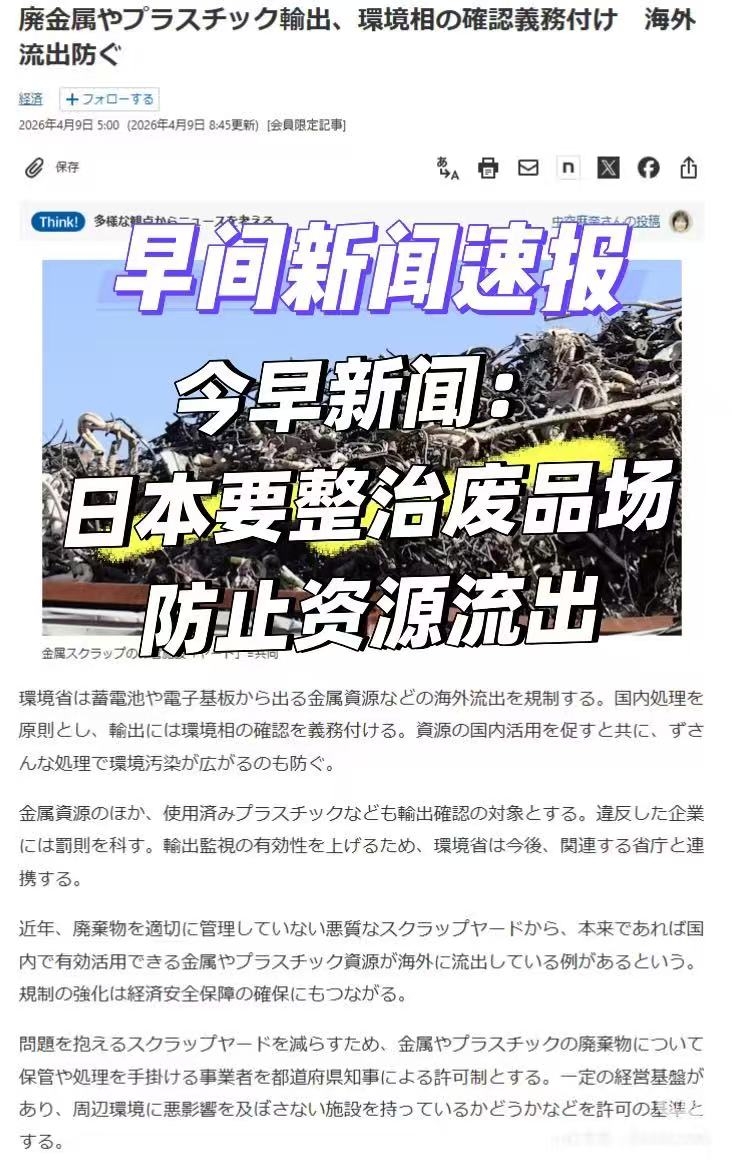 Japan's Waste Disposal Law Amendment: New Metal Resource Control Regulations and Reactions
On April 9, 2026, the Japanese Cabinet officially approved the latest amendment to the Waste Disposal and Public Cleansing Act (commonly known as the "Waste Cleansing Act"). The core of the amendment is to upgrade metal recycling operations from a notification system to a permit system, and to impose a new obligation requiring confirmation from the Minister of the Environment for scrap metal exports.
May 1, 2026 10:27