

16results found for 'Minor metals'
Sort by : |
- Insight into Provincial Profit Landscape: New Release of Zinc Smelting Profit Model by Province [SMM Analysis]
The zinc market in May 2026 is experiencing unprecedented structural pressure. Import zinc concentrate TCs have fallen to -$56.25/dmt, while domestic TCs have dropped to 400 yuan/mt in metal content on a weekly basis.
May 29, 2026 10:41 - Insight into Profit Patterns by Province: New Release of Zinc Smelting Profit Model by Province [SMM Analysis]
[Insight into Provincial Profit Landscape: New Release of Zinc Smelting Profit Model by Province] In May 2026, the zinc market is experiencing unprecedented structural pressure. TCs for imported zinc concentrates have fallen to -$56.25/dmt, while domestic TCs dropped weekly to 400 yuan/mt Zn. Meanwhile, the sulphuric acid export control policy continued to take effect in May, with some 98% smelting acid in south China declining by around 300 yuan/mt, directly impacting an important by-product revenue source for smelters. LME zinc inventory of around 100,000 mt stands in sharp contrast to China's social inventory exceeding 260,000 mt. The pattern of "tight ore and loose ingots" has made smelters the most severely squeezed link in the industry chain......
May 29, 2026 09:33 - Zimbabwe Strengthened Mineral Controls, Minor Metal Sector Rose Over 3%, Yunnan Germanium Industry, Jin Mo Shares Hit Daily Limit [SMM News Flash]
SMM May 28 update: The minor metal sector strengthened on May 28. As of the close on May 28, the minor metal sector rose 3.44%. In terms of individual stocks: Sino-Platinum Metals, Yunnan Germanium Industry, and China Molybdenum hit the daily limit, while China Minmetals Rare Earth, China Tungsten And Hightech, China Northern Rare Earth, and China Rare Earth led the gains. On the news front: According to authoritative local media in Zimbabwe and Xinhua News Agency, the Zimbabwean government recently issued the Mineral Classification and Declaration, explicitly listing lithium and other high-value minerals as "critical minerals" subject to equity and export controls. The critical minerals involved include 14 types: lithium, nickel, cobalt, graphite, copper, rare earth elements, chromium, platinum group metals (PGMs), manganese, antimony, uranium, ruthenium, tungsten, and niobium. The market is focused on the impact of tightening resource-country policies on global supply chains, with sentiment warming for minor metal varieties such as antimony and tungsten. Spot market Tungsten According to SMM pricing, on May 28, the average price of wolframite concentrates (≥65%) was 415,500 yuan/standard tonne (65%WO3 basis), up 1.22% from the previous trading day. Notably, after wolframite concentrates previously experienced a 61.88% decline over more than two months, driven by increased purchasing demand in the tungsten market, tungsten prices saw a rebound over two trading days. Currently, transactions in the tungsten concentrates market have improved, suppliers are bullish and hold back from selling, high-grade ore sees an upward shift in transaction center, while medium and low-grade ore circulates more but price increases appear lackluster. Downstream APT industry operating rates have slightly improved, but with limited new orders in the industry, smelters are cautious in restocking, with only small volumes of spot orders and large orders transacted in the market. Regarding the tungsten outlook, in the short term, driven by orderly inventory destocking, the return of downstream rigid demand, and the formation of pricing consensus among industry leaders, the tungsten market has overall entered a consolidation-at-lows and recovery phase. Going forward, key attention should be paid to the execution of long-term contracts and the pace of end-use demand recovery. According to SMM surveys, downstream cemented carbide alloy enterprises have seen inventory drop to low levels, with expectations of rigid restocking demand, but influenced by the market not yet being fully stabilized, enterprises remain cautious in procurement, generally adopting a small-order purchasing model. If upstream raw material inventory continues to be cleared and supply-demand imbalances are alleviated, tungsten prices are expected to enter a stabilization and consolidation phase in June-July. In the medium and long-term, the gap in Q3 mining quota transitions may lead to a contraction in market supply, coupled with expectations of the traditional September-October peak season, the industrial supply-demand structure will continue to optimize, thereby providing bullish support for tungsten prices. Rare Earths After the rally on May 27, the average price of Pr-Nd oxide on May 28 fell 1.79% from the previous trading day, and inquiries in the rare earth oxide market were sluggish on the 28th. Affected by futures price fluctuations combined with periodic restocking by some major producers, Pr-Nd oxide prices fluctuated frequently this week. Upstream and downstream players continued their stalemate, with suppliers maintaining relatively firm offers overall, while downstream metal producers maintained a strong wait-and-see sentiment and showed low purchase willingness at high prices. Absent other news-driven factors, Pr-Nd oxide is expected to remain in the doldrums in the short term before any significant change in the supply-demand relationship. Institutional Views Huafu Securities noted in its research report dated May 24, when commenting on other minor metals: rare earths performed weakly, while tantalum pentoxide surged during the week. In the rare earth market, end-use demand from downstream magnetic material sectors remained weak, with no large-scale concentrated restocking observed — only sporadic rigid-demand small orders were transacted, and the demand side consistently failed to provide effective support for the market. Market sentiment fluctuated significantly, with frequent tug-of-war between longs and shorts. Overall industry confidence was insufficient, with a notable stalemate between upstream and downstream on offer and bid prices, and significant divergence within the industry regarding the outlook for subsequent market trends. On Friday, the market maintained a wait-and-see attitude, awaiting changes in the magnetic material restocking pace and a recovery in downstream demand. Individual stocks: for antimony, Hunan Gold, Huaxi Nonferrous, and Huayu Mining are recommended; for molybdenum, China Moly, China Gold, and CMOC; for tungsten, Jiaxin International Resources, China Tungsten High-Tech, Xiamen Tungsten, and Zhangyuan Tungsten; for rare earths, China Rare Earth, China Northern Rare Earth, JL MAG Rare-Earth, and Xiamen Tungsten. Kaiyuan Securities' mid-year 2026 investment strategy for the metals sector indicated: Copper: Supply side, most ex-China miners continued to face declining ore grades and recovery rates, with disruption factors persisting (Ivanhoe's Kamoa-Kakula copper mine, Codelco's El Teniente copper mine). Although China's domestic enterprises added incremental capacity, the overall increase was limited. Under optimistic assumptions, global supply growth from 2026 to 2027 may fall below 2%. Demand side, power demand in both China and the U.S. maintained high growth rates in H1, which is expected to contribute marginal incremental copper demand. Kaiyuan Securities believes that the supply-demand structural imbalance for copper will become more pronounced in 2026, supporting a rise in the copper price center. Lithium: Supply side, capital expenditure in the lithium industry contracted and supply discipline gradually took shape. Combined with frequent disruptions, supply elasticity in the lithium industry has declined notably compared to before. Meanwhile, energy storage demand sustained high prosperity, driving gradual improvement in the lithium demand structure and marginal easing of inventory pressure. Lithium prices are expected to see a phased recovery. Lithium enterprises with resource security, low-cost advantages, and integrated layouts are expected to see earnings recovery elasticity outperforming the industry average. Lithium mine and lithium chemicals companies with high resource self-sufficiency rates and strong cost control capabilities are worth watching. Tungsten: As a strategic metal where China holds a dominant position, tungsten ore supply is constrained by resource depletion, environmental protection, and other factors. Combined with the government's total volume control on tungsten ore mining, tungsten ore production release remains limited. Demand side, emerging sectors are boosting tungsten demand, which is expected to provide long-term support for tungsten prices. According to a CITIC Securities research report, the current metals sector valuation remains at a reasonable level, with aluminum, copper, nickel-cobalt-tin-antimony, and gold valuations at relatively low levels, and a valuation rebound is still anticipated. Sector dividends have pulled back slightly, but the projected dividend yields of some individual stocks still exceed 5%. Looking ahead to 2026, liquidity shocks are expected to ease, supply disruptions are expected to occur frequently, and certain downstream sectors are expected to sustain relatively high prosperity. It is recommended to maintain a focus on allocation opportunities in lithium, copper, rare earths, strategic metals, aluminum, and gold sectors. Recommended Reading:
May 28, 2026 20:30 - Xingye Silver&Tin: Q1 Net Profit Surged YoY, Mined Silver Production at 78.95 mt, Mined Tin Production at 777.33 mt
The minutes of Xingye Silver&Tin's investor briefing announced on May 27 show: 1. Question: Mr. Sun! After the commissioning of Yinman Phase II, the plan is to mainly process lead-zinc-silver series ore, and the ore type and grade are expected to show relatively small changes compared to the Phase I lead-zinc system. Simply put, Zone 1 and Zone 4 are important resource replacement areas for Yinman Mining in the future, but currently they still belong to "potential zones" and cannot be directly classified into the "core rich ore" category like Orebody No. 17. Xingye Silver&Tin's response: Thank you for your attention! As of now, Orebody No. 17 is the main orebody that has been proven at Yinman. 2. Question: Hello, could you share the company's outlook on its own resources going forward and its assessment of the future market? Xingye Silver&Tin's response: Thank you for your attention! As an important participant in China's mineral resources sector and one of the world's leading silver-tin polymetallic mining enterprises, the company is firmly optimistic about its strategic layout, resource reserves, and industry prospects. 3. Question: Mr. Sun, over the past two years, the company has continuously pursued project acquisitions with an expanding financing scale. Can talent and technology be guaranteed? Can timely operations and safety be ensured? Xingye Silver&Tin's response: Thank you for your attention! In recent years, the company has prudently conducted project acquisitions and financing activities centered on its core business, with the overall expansion pace being controllable. Currently, the company has a complete talent pipeline and mature core technologies, and has established a standardized operational management and safety and environmental protection-related controls system, which can fully ensure the stable operation of all acquired projects and effectively prevent various risks. 4. Question: Mr. Sun, was your increase in shareholding in 2026 because you are optimistic about the company's several major projects this year? Xingye Silver&Tin's response: Thank you for your attention! Like other small and medium investors of the company, I am firmly optimistic about the company's potential investment value and plan to hold for the long term. 5. Question: @Director, Vice President and Board Secretary Sun Kai. Dear Secretary Sun, the company's Hong Kong IPO prospectus disclosed a 2026 tin production guidance of 5,500 mt, but Q1 production was only 777 mt, annualized at only 3,100 mt, far below the full-year guidance. May I ask: 1) Was the low Q1 production due to the technological transformation ramp-up of Yinman's copper-tin system, equipment commissioning, or low recovery rates? 2) What is the capacity release pace in subsequent quarters, and can the full-year guidance of 5,500 mt be achieved? 3) What are the timetable for reaching full production after technological transformation and the recovery rate improvement targets? Xingye Silver&Tin's response: Thank you for your attention! Based on the principles of comprehensive resource recovery and safe and efficient mining, the company simultaneously mines Orebody No. 17 and other copper-tin orebodies. For the company's production data, please refer to the periodic reports published on the company's designated information disclosure media. 6. Question: After the acquisition of Weiling Co., the company's related resources will inevitably be tilted toward that company. Please terminate the acquisition of Weiling Co. Xingye Silver&Tin's response: Thank you for your attention! Regarding the progress of the Weiling Co. project, please follow the relevant announcements disclosed by the company on designated media. 7. Question: What are the respective positioning of Xingye Silver&Tin A-shares, Xingye Silver&Tin H-shares, and Weiling Co.? Xingye Silver&Tin's response: Thank you for your attention! Regarding the progress of the Weiling Co. project, please follow the relevant announcements disclosed by the company on designated media. 8. Question: Dear Board Secretary, is the Q1 performance sustainable? What are the current capacity and inventory of silver and tin respectively? Xingye Silver&Tin's response: Thank you for your attention! In Q1 2026, the company's mined silver production was 78.95 mt and mined tin production was 777.33 mt. As of the end of Q1 2026, silver inventory was 15.04 mt and tin inventory was 83.67 mt. 9. Question: Is there a preliminary timetable for the Hong Kong listing? Can it be completed before the end of December this year? Among the company's plans, no projects have been implemented in Xinjiang yet. What kind of resources is the company planning for in the Xinjiang segment? Xingye Silver&Tin's response: Thank you for your attention! The company will release progress announcements on designated media in a timely manner based on project developments. Please stay tuned! 10. Question: Dear Board Secretary, how does the company view the sustained growth in silver and tin demand driven by AI and new energy? Tin production was 8,900 mt in 2024, but the 2026 guidance was lowered to 5,500 mt. What is the core reason? What is the pace of subsequent capacity release for the Yinman technological transformation and the Morocco project? Xingye Silver&Tin's response: Thank you for your attention! The materials related to the Hong Kong listing adopt the JORC Code, a technical standard developed by Australia. For example, the JORC Code defines "ore reserves" as the economically mineable part of measured and/or indicated mineral resources. The above standard differs to some extent from China's standards, resulting in certain deviations between the relevant data under planning and actual production and operations. Specific production data shall be subject to the data disclosed in the company's periodic reports. 11. Question: Has the land certificate and construction permit for Yinman Phase II been obtained? Please do not respond with "please follow the relevant announcements disclosed by the company on designated media." Xingye Silver&Tin's response: Thank you for your attention! Yinman Phase II is expected to commence construction on July 1. After construction begins, the company will promptly disclose relevant progress announcements. Please stay tuned! 12. Question: Last year, the company was bullish on silver prices continuing to rise and chose to stockpile. Now silver prices are under pressure and the company did not hedge. Is the company still bullish on silver?The stock price has been continuously under pressure. Will the company proactively manage this? Xingye Silver&Tin replied: Thank you for your attention! As of now, the company has not conducted any futures hedging business. The company's hedging is carried out prudently at appropriate times based on actual production and operations as well as market conditions, with strict control over transaction risks. 13. Question: What is the current tin recovery rate at Yinman? The report for the Hong Kong listing shows a significant decline in grade. Is this in line with the company's current situation? If based on that report, it seems the company does not need to proceed with the Phase II expansion of Yinman, which appears somewhat contradictory. When will all of the company's capacity reach full production? After all capacity reaches full production, what will be the approximate production of silver and tin? Atlantic Tin has a gold exploration right. Could you briefly introduce the situation of that mine? Does the company have any plans to increase its equity stake in Far East Gold in the future? Xingye Silver&Tin replied: Thank you for your attention! The technical standards used in the Hong Kong listing materials are based on the JORC Code formulated by Australia. For example, the JORC Code defines "Ore Reserves" as the economically mineable part of Measured and/or Indicated Mineral Resources. The above standards differ to some extent from China's standards, resulting in certain deviations between the relevant data in the long-term planning and actual production and operations. Specific production data shall be subject to the data disclosed in the company's periodic reports. 14. Question: Hello, Secretary of the Board. The resource volumes and capacity plans for Yinman and Yubang Mining disclosed in the Hong Kong IPO prospectus are lower than the company's previous communication figures. What is the core reason? Is it due to differences in the JORC Code methodology (only including Measured and Indicated Resources, excluding Inferred Resources)? Does it involve resource reductions, grade downgrades, or mining plan adjustments? Is there room for future resource additions or upward revisions? Xingye Silver&Tin replied: Thank you for your attention! The technical standards used in the Hong Kong listing materials are based on the JORC Code formulated by Australia. For example, the JORC Code defines "Ore Reserves" as the economically mineable part of Measured and/or Indicated Mineral Resources. The above standards differ to some extent from China's standards, resulting in certain deviations between the relevant data in the long-term planning and actual production and operations. Specific production data shall be subject to the data disclosed in the company's periodic reports. 15. Question: Mr. Sun, based on the materials disclosed for the company's Hong Kong listing, the company's production of silver and especially tin is significantly lower than previous expectations. Is this estimate, this guidance, the company's true guidance, or a theoretical guidance made by SRK based on their assessment? Does the company plan to issue a medium and long-term guidance that is in line with the company's actual production plans to clarify these expectations?Otherwise, these expectations may have a significant negative impact on the company and noticeably undermine investor confidence. In fact, this is also unfavorable for the company's listing on international capital markets for financing and further development. Xingye Silver&Tin's response: Thank you for your attention! The Hong Kong listing-related materials adopt the JORC Code established by Australia as the technical standard. For example, the JORC Code defines "Ore Reserves" as the economically mineable part of Measured and/or Indicated Mineral Resources. The above standards differ to some extent from China's standards, resulting in certain deviations between the relevant data in the long-term plan and actual production and operations. Specific production data shall be subject to the data disclosed in the company's periodic reports. 16. Question: Mr. Sun, hello. The prospectus explains that there will be discrepancies between the Competent Person's planned mineral processing production schedule and the enterprise's actual situation. Could Mr. Sun please introduce the production plan for silver and tin from 2028 to 2030? Xingye Silver&Tin's response: Thank you for your attention! The Hong Kong listing-related materials adopt the JORC Code established by Australia as the technical standard. For example, the JORC Code defines "Ore Reserves" as the economically mineable part of Measured and/or Indicated Mineral Resources. The above standards differ to some extent from China's standards, resulting in certain deviations between the relevant data in the long-term plan and actual production and operations. Specific production data shall be subject to the data disclosed in the company's periodic reports. 17. Question: Specifically regarding Yinman Mining: according to SRK's data, there will be significant grade decline in the future. In addition, the feed grade differs considerably from the company's disclosures in the 2025 annual report and previous annual reports. Is it necessary to issue a specific announcement to provide an explanation based on the different mining standards? Xingye Silver&Tin's response: Thank you for your attention! The Hong Kong listing-related materials adopt the JORC Code established by Australia as the technical standard. For example, the JORC Code defines "Ore Reserves" as the economically mineable part of Measured and/or Indicated Mineral Resources. The above standards differ to some extent from China's standards, resulting in certain deviations between the relevant data in the long-term plan and actual production and operations. Specific production data shall be subject to the data disclosed in the company's periodic reports. 18. Question: Have the specific construction commencement dates been confirmed for Yinman Phase II, Yubang Phase II, the Morocco tin mine, and the Budun Yingen mine managed by the controlling shareholder? Could you also provide the commissioning and full production timelines? Thank you. Xingye Silver&Tin's response: Thank you for your attention! Yinman Phase II is expected to commence construction on July 1; the Yubang 8.25 million mt/year project is expected to commence construction in Q3; the Atlantic Tin project has obtained all construction permits and is currently carrying out preliminary preparation work including contractor tender and equipment transportation, with construction expected to commence in mid-July; all the above projects are expected to achieve commissioning with feed materials in Q4 2028. The managed company Budun Yingen plans to commence construction in Q4, with production expected to begin in 2029. 19. Question: Director Sun, in a previous institutional survey, you clearly stated that the company's quarterly tin production of 3,600 mt can be achieved on a regular basis. Is there an opportunity to achieve this quarterly target this year? Xingye Silver&Tin's response: Thank you for your attention! Adhering to the principles of comprehensive resource recovery and safe, efficient mining, the company simultaneously mines Orebody No. 17 and other copper-tin orebodies. For the company's production data, please refer to the periodic reports published by the company on designated information disclosure media. 20. Question: Does the company have the right to abandon the acquisition of the relevant equity in Weiling Shares? Xingye Silver&Tin's response: Thank you for your attention! For the progress of the Weiling Shares project, please refer to the relevant announcements disclosed by the company on designated media. 21. Question: Director Sun, in the records of a previous institutional survey, the company responded that Yinman's quarterly tin production of 3,600 mt can be achieved on a regular basis, but it seems this has not been realized subsequently. Is there a possibility of attempting to reach this record this year? Xingye Silver&Tin's response: Thank you for your attention! Adhering to the principles of comprehensive resource recovery and safe, efficient mining, the company simultaneously mines Orebody No. 17 and other copper-tin orebodies. For the company's production data, please refer to the periodic reports published by the company on designated information disclosure media. 22. Question: Is there a plan to spin off minor metals other than silver and tin to Weiling Shares? Xingye Silver&Tin's response: Thank you for your attention! For the progress of the Weiling Shares project, please refer to the relevant announcements disclosed by the company on designated media. 23. Question: Has the matter of acquiring Weiling been terminated? Xingye Silver&Tin's response: Thank you for your attention! For the progress of the Weiling Shares project, please refer to the relevant announcements disclosed by the company on designated media. 24. Question: Has the company already dispatched personnel to take over the production and operations of Jiayu Mining? Xingye Silver&Tin's response: Thank you for your attention! For the progress of the Weiling Shares project, please refer to the relevant announcements disclosed by the company on designated media. 25. Question: After acquiring Weiling Shares, our company will become an AAH (Xingye Weiling H) publicly listed firm. What is the company's positioning for the three listing platforms? Xingye Silver&Tin's response: Thank you for your attention! For the progress of the Weiling Shares project, please refer to the relevant announcements disclosed by the company on designated media. 26. Question: In the company's 2025 annual report, the company stated "solidly advancing the subsequent acquisition and integration of Weiling Shares," but Weiling Shares has been subject to a delisting risk warning. What is the purpose of our acquisition of Weiling? Xingye Silver&Tin's response: Thank you for your attention!For updates on the progress of Weiling shares project, please refer to the relevant announcements disclosed by the company on designated media. Xingye Silver&Tin's Q1 report showed that from January to March 2026, the company achieved operating revenue of 2.13 billion yuan, up 85.32% YoY; net profit attributable to shareholders of the publicly listed firm was 1.338 billion yuan, up 257.32% YoY. As of March 31, 2026, the company's total assets were 19.689 billion yuan, and net assets attributable to shareholders of the publicly listed firm were 10.825 billion yuan. Operating revenue breakdown: From January to March 2026, the proportion of operating revenue from the company's main mineral products to total operating revenue was as follows: ore-derived silver (1.41 billion yuan, 66.21%), ore-derived tin (234 million yuan, 10.99%), ore-derived zinc (228.12 million yuan, 10.71%), ore-derived lead (71.85 million yuan, 3.37%), ore-derived antimony (53.1 million yuan, 2.49%), ore-derived gold (51.02 million yuan, 2.40%), ore-derived iron (44.17 million yuan, 2.07%), ore-derived copper (35.65 million yuan, 1.67%), and ore-derived indium (524,100 yuan, 0.02%). Among them, ore-derived tin and ore-derived silver combined accounted for 77.19% of total operating revenue. Xingye Silver&Tin's Q1 report stated that operating profit for the current period increased 238.16% compared with the previous period, total profit increased 236.36%, and net profit attributable to the parent company's shareholders increased 257.32%. The main reasons were: During the reporting period, the selling prices of the company's main mineral products such as silver and tin rose YoY; Yubang Mining's capacity was gradually released, with ore-derived silver production and sales increasing significantly YoY; and the transfer of 60% equity in Shuangyuan Non-ferrous realized investment income of 321 million yuan. Xingye Silver&Tin's 2025 annual report showed that in 2025, the company achieved operating revenue of 5.555 billion yuan, up 30.09% YoY; total profit of 2.096 billion yuan, up 18.75% YoY; and net profit attributable to shareholders of the publicly listed firm of 1.704 billion yuan, up 11.40% YoY. Xingye Silver&Tin's announcement showed that in 2025, the proportion of operating revenue from the company's main mineral products to total operating revenue was as follows: ore-derived silver (2.176 billion yuan, 39.17%), ore-derived tin (1.65 billion yuan, 29.70%), ore-derived zinc (975.87 million yuan, 17.57%), ore-derived lead (220.95 million yuan, 3.98%), ore-derived iron (180.38 million yuan, 3.25%), ore-derived copper (133 million yuan, 2.39%), ore-derived antimony (100.36 million yuan, 1.81%), ore-derived gold (82.34 million yuan, 1.48%), and ore-derived bismuth (16.67 million yuan, 0.30%). Among them, ore-derived tin and ore-derived silver combined accounted for 68.86% of total operating revenue. Regarding the company's main business and key performance drivers, Xingye Silver&Tin stated in its 2025 annual report: The company is a large mining group primarily engaged in the exploration, mining, and ore processing of non-ferrous metals and precious metals. As of the disclosure date of this report, the company had over 20 subsidiaries, of which 8 were operating mining companies, namely Yinman Mining, Qianjinda Mining, Yubang Mining, Rongguan Mining, Xilin Mining, Rongbang Mining, Ruineng Mining, and Bosheng Mining. Atlas Tin SAS under Atlantic Tin was in the construction phase for the Achmmach tin mine. Tanghe Times Mining was in a suspended construction phase, while Yitong Mining and Yunnan Xigui were in the exploration phase. Hainan Fund was primarily engaged in equity investment management; Xingye Gold (Hong Kong) was primarily engaged in metals and mining trading, corporate M&A, and was responsible for expanding markets outside China and acquiring quality mineral resources ex-China; Hainan Guomao and Tianjin Guomao were primarily engaged in non-ferrous metal mineral product sales and partial raw material procurement; Xingye Ruijin was primarily engaged in process research, technology R&D and upgrading in areas such as exploration, mining and processing, and comprehensive tailings recovery and utilization. Tibet Shannan Antimony Gold, Tibet Xinda Mining, and Xing'an League Fuxingtun Mining served as the company's regional resource integration platforms. During the reporting period, the company successfully acquired 85% equity in Yubang Mining. According to data compiled by the Silver Institute as of the end of 2023, Yubang Mining's monomer silver mine ranked first in Asia and fifth globally. This acquisition further strengthened the company's resource advantages and laid a solid resource foundation for sustainable development. Meanwhile, using its subsidiary Xingye Gold (Hong Kong) as the investment vehicle, the company increased investment in mineral resources outside China and successfully acquired 100% equity in Atlantic Tin. This acquisition was an important step in implementing the company's "going global" strategy. According to the classification standards for large-scale tin mines in the "Standards for Classification of Mineral Resource Reserve Scales" (DZ/T 0400-2022), the Achmmach tin mine owned by Atlantic Tin currently amounts to the equivalent of 5 large deposits. Through this integration of tin ore resources outside China, the company further improved its international tin ore layout and also reserved important strategic resources for long-term development. The company's main performance was derived from non-ferrous metal mining and processing operations. During the reporting period, revenue from non-ferrous metal mining and processing accounted for 99.64% of total operating revenue in 2025. Key factors affecting the operating performance of the mining and processing segment included production and sales volumes of major products, market prices, and costs of non-ferrous metal and precious metal mining and processing operations. Regarding the business plan, Xingye Silver&Tin stated in its 2025 annual report: 2026 is the concluding year of the company's "Second Three-Year" plan. The Board of Directors will closely focus on the theme of high-quality development, fully implement established work objectives, continue to deepen the philosophy of "Trust and Collaboration," and make an all-out push to achieve the closing targets of the "Second Three-Year" plan, with emphasis on the following areas of work: 1. Uphold the bottom line of safety and environmental protection. Using 2026 as the "Year of Safety Management Implementation," the company will comprehensively enforce safety responsibilities, consolidate the achievements of the "Year of Collective Safety Vigilance," strengthen risk anticipation and process control, resolutely prevent all types of safety and environmental protection incidents, and achieve safe, steady, green, and low-carbon development. 2. Advance key project construction at full speed, strengthen full-process management of project budgets, schedules, and quality, and coordinate the implementation of projects including the 2.97 million mt expansion of Yinman Mining, the 8.25 million mt expansion of Yubang Mining, the Morocco project, and the Budun Yingen Mining (under trusteeship) project, ensuring on-schedule completion, reaching full production, and releasing capacity benefits. 3. Continue to intensify exploration and reserve expansion efforts, properly balance production operations with geological exploration, steadily advance exploration of existing mines and surrounding areas, accelerate the conversion and upgrading of resource volumes, and continuously strengthen the resource foundation. 4. Deepen industrial synergy and resource integration. Leveraging the core regional advantages in Inner Mongolia, the company will steadily expand its resource layout outside China; adhering to silver and tin as the main business direction, it will enrich and optimize resource varieties. The company will solidly advance the subsequent acquisition and integration of Weiling shares, actively track quality mineral project opportunities in and outside China, and enhance overall competitiveness through synergistic industrial M&A. 5. Further strengthen institutional enforcement and internal control management, drive the effective implementation of various systems, processes, and control requirements, and enhance the company's refined management capabilities; strengthen enforcement capacity building to ensure production plans, comprehensive budgets, and various work deployments are fully implemented, and promote deep integration of corporate culture with business management. 6. Advance Hong Kong stock listing preparations at full speed, accelerate the establishment of a dual capital market platform at home and abroad, enhance cross-border capital operation capabilities, provide stronger financial support for the company's resource integration and strategy implementation, and drive the company's high-quality sustainable development to new heights. Reviewing the 2025 price performance of spot silver: the average price of SMM 1# silver (Ag99.99%) on December 31, 2025 was 18,430 yuan/kg, compared with 7,440 yuan/kg on December 31, 2024, representing an increase of 10,990 yuan/kg, or 147.71%. Recently, spot silver prices have been fluctuating. On May 27, the morning quote for SMM 1# silver (Ag99.99%) was 18,654–18,684 yuan/kg, with an average price of 18,669 yuan/kg, up 0.54% from the previous trading day. Compared with the average price of 18,430 yuan/kg on December 31, 2025, the price edged up by 239 yuan/kg, a gain of 1.3%. Regarding the outlook for precious metals, some institutions' views are as follows: FXTM Senior Research Analyst Lukman Otunuga stated: "As hopes for a US-Iran peace deal waver, gold prices have pulled back and are approaching the $4,450 support level. In addition, market expectations for a US Fed rate hike are steadily building amid conflict-driven price pressures, which is also exerting further downward pressure on gold prices." "Ultimately, if more signs emerge that price pressures are rising, it could further reinforce market bets that the US Fed will keep interest rates higher for longer, which would expose gold to greater downside risk." (Jin10 Data APP) CITIC Futures stated: Renewed tensions in US-Iran geopolitics have dampened risk appetite, while rising oil prices have reignited inflation concerns and strengthened market bets on a US Fed rate hike within the year, with multiple factors dragging silver prices lower. On one hand, US economic data still showed resilience, with the latest Chicago Fed National Activity Index for April at 0.14, significantly better than the previous reading of -0.15. The US May Conference Board Consumer Confidence Index and Present Situation Index both pulled back from prior readings, but the confidence index still beat market expectations. Combined with renewed US-Iran tensions pushing oil prices higher and sparking inflation concerns, market pricing for a year-end US Fed rate hike has strengthened. On the other hand, spot silver's fundamental drivers remained weak, with London market silver lease rates running at persistently low levels. In the short term, silver is expected to maintain a fluctuating trend, with overall capital interest still relatively low. Attention should be paid to US-Iran negotiation progress and strait navigation resumption. If US-Iran negotiations progress smoothly, this could drive a short-term silver rebound, but interest rate expectations will continue to suppress the trend. If geopolitical tensions escalate again and push oil prices higher, caution is warranted regarding further medium-term suppression of silver's industrial products elasticity and potential supply disruptions. Over the long term, weakening US dollar credibility, safe-haven demand, and investment demand provide solid support for silver prices. (Jin10 Data APP) A CITIC Securities research report noted that the resilience of the global economy is being tested by the Middle East conflict, with a glimmer of hope for the resumption of navigation through the Strait of Hormuz. The US economy may continue to grow mildly but unevenly this year, the pace of the EU's weak recovery is being delayed, and Japan's private-sector demand will inevitably be disrupted by energy shortages. High oil prices are already pushing up global inflation, with headline inflation rates in Europe and the US likely to fluctuate at highs this year, while Japan's headline inflation rate may continue its mild performance. The US Fed may not cut interest rates at all this year, while potential rate hikes by the ECB and BOJ are imminent, and the "unrestrained" fiscal stance of Japanese and European political circles may constitute a source of market risk this year. We maintain our view that US equities will outperform US bonds and that the US dollar index has support, and gold prices are expected to break free from their predicament as tail risks of inflation dissipate. ANZ analyst Kumar, Soni recently stated that inflation expectations, rising US Treasury yield, and a stronger US dollar are unfavourable factors putting gold prices under pressure. These factors will persist until we can clearly determine how long this conflict will last. Gold has fallen more than 14% since the outbreak of war in late February. OANDA Senior Market Analyst Kelvin Wong stated that since early March, the overall trend of the 10-year US Treasury yield has remained in a medium-term upward phase. Therefore, at this juncture, gold bulls may not be as aggressive in pushing prices higher. Gold is expected to continue weakening over the next few trading days, with resistance at $4,645 and support at $4,456. (Jin10 Data) Goldman Sachs stated that central banks are expected to increase gold purchases, helping gold prices rebound by year-end. Analysts Thomas, Lina and Struyven, Daan stated in a research report published on May 15 that the average monthly central bank gold purchases in 2026 are expected to rise to 60 mt. Based on the revised accumulation model, the 12-month average of central bank gold purchases in March reached 50 mt, compared with a previous figure of 29 mt. Citing internal surveys, the analysts noted that central banks have long-term rigid allocation demand for gold, and recent changes in the geopolitical landscape are likely to continue driving countries to accelerate asset diversification. JPMorgan lowered its 2026 average gold price forecast from $5,708 per ounce to $5,243 per ounce. As demand is expected to re-accelerate in H2 2026, the base case still projects gold prices reaching $6,000/ounce by year-end.
May 27, 2026 19:49 - Spot Prices of Tantalum, Tin, and Pr-Nd Rise, Minor Metal Sector Strengthens, Orient Tantalum Industry and China Tungsten High-Tech Lead the Gains [SMM Express]
SMM May 21 News: Spot prices of tin, tantalum, and Pr-Nd oxide rose, and high molybdenum prices helped drive the minor metal sector higher. As of 10:22 on May 21, the minor metal sector was up 2.41%. In terms of individual stocks: Eastern Tantalum and China Tungsten High-Tech gained over 6%, while Haotong Technology, Tin Industry Co., Eastern Zirconium, Jinduicheng Molybdenum, and Huaxi Nonferrous led the gains. This rally was directly driven by improving spot market fundamentals, compounded by a weakening US dollar, strengthening strategic resource attributes, and emerging demand (AI, semiconductors, PV), which continued to fuel market expectations of a tight supply-demand balance in minor metals. Some market capital showed increased willingness to flow in, driving a rebound in the minor metal sector. Spot Market Tantalum The quoted price of tantalum ingot (Ta≥99.95%) on May 20 was 6,600-6,700 yuan/kg, with an average price of 6,650 yuan/kg, up 1.53% from the previous trading day. Recently, the tantalum market reached a turning point, with tantalum prices successfully hitting bottom, stabilizing, and initiating a rebound, with the industry's upward trend gradually becoming clearer. Currently, low-priced supplies within the industry chain are being circulated and cleared at an accelerated pace, quoted prices across all product categories are rising in tandem, and the overall market is steadily improving. Driven by expectations of positive news, some smelters proactively tightened their shipment pace and suspended external quotations. Available low-priced supplies in the market were essentially exhausted, and bullish sentiment among traders and suppliers continued to intensify. Combined with steadily rising upstream tantalum ore raw material costs providing strong support, tantalum oxide and tantalum ingot prices are expected to continue their steady rise going forward. Tin On May 21, the average price of SMM 1# tin rose 3.82% from the previous trading day. As tin prices rose, wait-and-see sentiment in the market intensified, and market transactions were sluggish. Currently, from a fundamental perspective: Supply side, most smelters maintained stable production as their main focus in May; Demand side, downstream purchasing remained cautious, with most purchases made according to order requirements. Rare Earth Spot market, on May 21, supported by demand from major manufacturers' procurement, the average price of Pr-Nd oxide rose 1.81% from the previous trading day. Yesterday afternoon, inquiry and procurement activities from magnetic material enterprises increased significantly, which directly boosted market trading activity. Affected by this, Pr-Nd oxide futures prices stopped falling and recovered today, and some Pr-Nd oxide traders chose to hold back from selling, which in turn pushed up Pr-Nd oxide spot prices as well. However, as downstream inquiry prices were relatively low, actual transaction performance was mediocre. In the short term, driven by the continued increase in downstream inquiry and procurement activities, Pr-Nd product prices are expected to move sideways and hold up well. Institutional Views Guojin Securities pointed out in a research report on May 18: Rare earths: From the beginning of the year to date, the price center has been continuously raised, which we believe is likely highly correlated with supply-side policy documents released from 2024 to 2025, as industry supply-side reform continues to advance. Full-year exports in 2025 were down 1% YoY, while exports since the beginning of 2026 have increased significantly, indicating that ex-China restocking demand remains substantial. The rare earth sector will continue to see dual upgrades in valuation and earnings, and 2026 is also a critical year for key targets to resolve horizontal competition issues. Tin: Guojin Securities believes that tin ingot invisible inventory is gradually drying up, and therefore tin prices are expected to strengthen amid macro liquidity replenishment or technology sector spillover effects. The tin supply-demand pattern is expected to improve over the long term. Molybdenum: Molybdenum concentrates were priced at 5,210 yuan/mtu this period, up 10.50% MoM; ferromolybdenum was priced at 324,000 yuan/mt this period, up 9.46% MoM. Imported ore has been drawn down to a significant extent, and domestic molybdenum prices have stabilized and rebounded. Steel bidding volumes remained robust, with destocking across the industry chain, gradually breaking the deadlock of "volume without price" in molybdenum, and the upward channel has become further confirmed. Molybdenum is also a defense metal, with inventory persistently low, and increased ex-China national defense spending may further boost molybdenum prices. Tantalum: The tantalum industry is expected to benefit from the upward cycle driven by high-end demand boost. Related targets: Eastern Tantalum, Xinjinlu, Jiangwu Equipment. CITIC Securities issued a research report on May 13, stating that in Q1 2025 and Q1 2026, earnings growth in the metals sector generally accelerated, with tungsten, lithium, lead-zinc, and rare earth magnetic materials leading the gains, while aluminum, copper (copper: BK1615 3,885.79, 0.58%), nickel-cobalt-tin-antimony, and gold have performed relatively weakly since the beginning of the year. Current metals sector valuations remain at reasonable levels, with aluminum, copper, nickel-cobalt-tin-antimony, and gold valuations at relatively low levels, and valuation rebounds remain promising. Industry dividends pulled back slightly, but projected dividend yields for some individual stocks still exceed 5%. Looking ahead to 2026, with liquidity shocks easing, supply disruptions occurring frequently, and select downstream sectors sustaining relatively high prosperity, it is recommended to continue focusing on allocation opportunities in lithium, copper, rare earths, strategic metals, aluminum, and gold sectors. Guotai Haitong Securities believes that rare earth prices have been gradually consolidating at lows since 2024, with the slowdown in domestic quota allocation continuing, and while expectations for ex-China rare earth development have been fermenting, actual progress may fall short of expectations. On the demand side, NEVs, home appliances, wind power, and other sectors have maintained the fundamental demand base, while humanoid robots represent a long-term upside option, and the curtain on a supply-demand reversal has already been gradually rising. As a strategic commodity in China, rare earth is expected to see a double boost in both earnings and valuation. Recommended reading:
May 21, 2026 11:28 - 2026 SMM Hong Kong Metals Forum | New Metals Cycle: Prices, Power & Global Wrestling
The 2026 SMM Hong Kong Metals Forum , organized by Shanghai Metals Market (SMM) and sponsored by China Securities International as platinum sponsor, wrapped up successfully at Novotel Hong Kong Century on May 6. With over 300 registrations and 200 on-site attendees, the forum focused on the theme "New Metals Cycle: Prices, Power & Global Wrestling". The event featured keynote speeches by industry experts and SMM analysts, covering base metals, new energy materials, and strategic revaluation of minor and precious metals. Two high-level panel sessions were held, exploring hot topics such as geopolitics, supply-demand fluctuations, CBAM impacts, and market opportunities. It also served as an efficient platform for networking and cooperation across entire industry chains. SMM Opening Address SMM Chairman Adam Fan SMM Chairman Adam Fan stated in the opening address that it was a great honor to gather with elites from all sectors of the industry at this forum. The world is currently at a critical development period, and the exchange of industry ideas is not only an industry necessity but also an inevitable requirement for global development. Adam reviewed the century-long legacy of the London Metal Exchange, which has weathered nearly 150 years of global changes and industry evolution, fully demonstrating that although market structures may change, the fundamental need for risk management and reliable price discovery remains constant. At the same time, Adam candidly acknowledged that global markets are currently mired in a pattern of deep fluctuations. Geopolitical conflicts, supply chain fragmentation, and the compounding crises of energy and food, overlaid with de-globalization and rising trade protectionism, have intensified market uncertainty and inflationary pressures, posing severe challenges to global economic growth and industrial cooperation. Against this backdrop, SMM has steadfastly upheld its mission, refusing to be a bystander to the trend of industry fragmentation, and is committed to serving as a bridge for global industrial connectivity amid a landscape of division. SMM is dedicated to promoting dialogue and exchange, breaking down industry and regional barriers, and bringing together regulators, traders, and producers from around the world to discuss industry development. SMM upholds the principle of information transparency, continuously providing accurate, real-time market data to help the industry see through market fog and clarify market distortions. SMM deepens pragmatic cooperation by building a neutral and professional platform for exchange and matchmaking, driving all parties to pursue collaborative development based on shared interests and transcending political differences. Adam emphasized that information sharing and open collaboration would be leveraged to mitigate market risks and strengthen overall industry resilience, and called on the industry to seize the opportunity of this forum to jointly explore solutions, transforming current challenges into momentum for driving integrated and robust development of the global metals industry. Speech by Platinum Sponsor Wang Guangxue, Member of the Executive Committee of China Securities Co., Ltd. and Chairman of China Securities Futures Co., Ltd. Wang stated that as a vital bridge connecting the capital market and the real economy, China Securities has always been committed to serving the high-quality development of the metals industry. Leveraging the comprehensive financial strengths of CITIC Group, the company has built a full-chain integrated service system covering securities, futures, investment, and research. The company has been deeply engaged in the commodities sector, continuously providing forward-looking research to anticipate market trends, utilizing futures instruments to build robust risk barriers, and empowering industrial upgrading through capital services. It will fully leverage CITIC Group's full-license resource advantages and the strategic value of Hong Kong as an international financial center to continuously strengthen its cross-border comprehensive financial services capabilities. The company aims to tailor integrated risk management and asset allocation solutions at home and abroad for enterprises across the metals industry chain, precisely helping enterprises hedge against price fluctuation risks, and enabling them to operate steadily and advance with high quality in complex market environments. Structural Shifts: Rethinking Commodity Benchmarks in an Era of Persistent Inflation and Rivalry Speaker: Tian Yaxiong, Co-Head of R&D Department, China Securities Futures Tian shared professional research findings and cutting-edge market insights on hot topics including the market outlook for global metals and the deep impact of geopolitics on commodity trends. SMM Industry Analysis: Market Outlook and Pre-seminar Sharing for Base Metals and New Energy Materials (Copper, Aluminum, Nickel, Cobalt, Lithium, and Tin) & How SMM Empowers Your Commodity Trading & Analysis Speakers: Dr. Yanchen Wang, Managing Director of SMM Global UK Ltd.; Thomas Feng, Head of Industry Analysis at SMM Dr. Wang first analyzed the macroeconomic landscape. At the beginning of this year, the manufacturing PMIs of major economies performed quite well, actually exceeding 50%. Without the conflict, demand this year would have been quite strong. However, at the end of February, the US-Iran conflict broke out, and the International Monetary Fund subsequently revised down its global economic growth expectations. He pointed out that China's exports remain one of the three pillars that are still functioning well to date. Regarding automobile consumption, he noted that for the EV market, the positive factor for the auto industry also lies in exports. In Q1 this year, export performance was indeed very strong. If you look at EV exports alone, they actually grew nearly 160% YoY. Driven mainly by growth in global markets, he remains optimistic about the auto industry this year. In Europe, gasoline and diesel prices have risen significantly due to the US-Iran conflict, and EV demand is expected to benefit from this factor. He believes the power sector continues to maintain strong growth. Based on power grid and power generation investment data from the first two months, combined with State Grid Corporation of China's earlier announcement that fixed asset investment during the "15th Five-Year Plan" period is expected to reach 4 trillion yuan, this indicates that electricity demand will drive strong growth. State Grid Corporation of China will build more ultra-high voltage transmission projects, which will undoubtedly support aluminum demand and also copper demand. Aluminum: Wang noted that base metal prices experienced wild swings since the beginning of this year. He also discussed that China's aluminum smelters continued to raise operating rates due to favorable profitability; aluminum demand pulled back in Q1, and high prices drove inventory higher; approximately 950,000 mt of new aluminum smelting capacity in Indonesia may come online in 2026, with some investors watching Angola; and aluminum semis and wheel hub exports maintained growth in Q1. Copper: After copper prices experienced a pullback and adjustment in March, downstream procurement demand in China was rapidly released, providing strong support for copper prices to rebound. Copper prices rose sharply, with the market downplaying geopolitical risks. China's copper cathode demand was robust, and inventory continued to decline. China's copper scrap market was not truly facing a spot shortage issue. The outlook for copper cathode demand is positive. China remains dependent on copper concentrate imports. Spot copper concentrate TCs showed no signs of bottoming out. By-product revenue sustained smelter profits. He also analyzed the DRC sulphuric acid market conditions, the expected slowdown in global refined production growth, and how a refined market supply deficit should support higher copper prices. He also mentioned that the AI industry maintained strong development momentum, bringing new growth momentum to copper demand. Tin: He elaborated from the following perspectives: Myanmar tin production — slow recovery, upward trajectory, 2025-2027E; Indonesia tin ore RKAB quotas — expected to ease slightly in 2026; DRC — major mine production remained stable, but the M23 movement added uncertainty; global tin prices — supply determines the floor, macro factors drive fluctuations; the global tin market is expected to maintain a tight balance, with new mining capacity expected to be concentrated for release in 2028. Thomas Feng shared insights on nickel, cobalt, and lithium: emerging from the trough and entering a new cycle. ►New energy demand landscape: from EV popularization to energy storage deployment. First, he reviewed and provided an outlook on the global NEV market: NEV demand no longer maintains a one-sided high-growth trajectory, but instead exhibits characteristics of regional differentiation, structural divergence, and intensifying cyclical volatility; development paces in China, Europe, and the US have shown notable differences; performance trends of BEVs, PHEVs, and commercial vehicles have diverged; and the impact of inventory and price cycles on industry operations is increasing significantly. Second, in his review and outlook of the global energy storage market, he noted that the global energy storage market will remain concentrated in three key regions: China, the US, and Europe. Driven by 2030 climate goals, emerging markets such as the Middle East, Australia, and Southeast Asia are showing strong growth in demand for large-scale energy storage. Benefiting from cost advantages and improved safety performance, LFP battery market share is expected to continue climbing. ►Lithium: Reshaping the Supply-Demand Pattern in a New Cycle Global lithium carbonate market: shifting from overall surplus to structural tightness, with prices in a post-trough reassessment and recovery phase. Lithium hydroxide supply and demand maintained a tight balance: production on the supply side was driven by demand, the market share of ternary power batteries was squeezed, and room for growth was limited. The concentration of lithium resource supply declined, with marginal growth rates slowing down simultaneously. Significant demand growth drove the continued expansion of resource projects. ►Nickel: Navigating Policy Changes and Narrowing Oversupply Indonesia's nickel ore HPM adjustment: aimed at enhancing the economic value of non-nickel resources. The discussion covered scenario analysis of nickel ore prices following the implementation of the new policy, and the impact analysis of nickel ore benchmark price adjustments on MHP full costs. Indonesia's nickel ore RKAB quota: a tight balance is expected to set the tone for 2026. Global primary nickel is expected to remain in persistent oversupply. Regarding the logic behind refined nickel price trends, it was noted that policy and macro factors jointly amplified price fluctuations, while cost support elevated the long-term price floor. ►Cobalt: Shifting from Surplus to Shortage after the DRC Export Ban——Long-Term Uncertainty Remains Following the DRC policy announcement, cobalt product prices in China rose rapidly. However, high prices suppressed downstream demand, putting prices under pressure. Starting from H2 2025, the Chinese market continued destocking. Amid raw material shortages, enterprises began using MHP and recycled materials as production substitutes. MHP and recycling are expected to continue growing rapidly, effectively bridging the cobalt hydroxide gap. Cost pressure transmitted in both directions: LCO doping/ternary substitution restarted, and consumer cobalt demand is expected to decline by 10%. As persistently high cobalt prices suppress demand, if China secures 90% of the DRC quota, supplemented by MHP and recycling supply, inventory buildup could occur as early as 2026. Panel Discussion: Global Metals Market Outlook——Geopolitics Disruption, Macro Cycles and the Return of Commodity Volatility •Copper and Aluminum Price Rise, 2024-2026 •Precious Metals Storm: Silver Swung Wildly, Gold Hit Record Highs — Interest Rate Cycles, Safe-Haven Demand, and Industrial Logic •Precious Metals and Industrial Metals: Are Commodities Entering a New Cycle •Focus on Critical Minerals: Emerging Region Supply Rise and Policy Shifts, Green Transition Co-Shaping a New Narrative •Chinese Market: The 15th Five-Year Plan Moderator: Yanchen Wang, Managing Director, SMM Global UK Ltd. Panelists: Yahong Tian, Co-Head of R&D, CITIC Futures Henry Van, Head of Industrial Metals Analysis, Trafigura Sharon Ding, Head of China Basic Materials, UBS Justin William Hughes, Commodity Derivatives Distribution, Optiver Xie Shaobo, Head of China, Appian Mining Fund & independent non-executive Director, Zijin Gold International Panelists noted aluminum has great upside—its 10% price rise lags its 4%-5% supply contraction (vs. oil’s 60% price surge on 10% supply drop), with valuation recovery incomplete. They were more optimistic about copper demand, driven by real downstream demand rather than speculation; aluminum semis’ upside is underappreciated due to high oil prices. Long-term, copper and gold are key for mining investment, with scarce high-quality copper mines and solid gold fundamentals. They also discussed US tariffs, China’s metal demand resilience and overseas mining investment. Overseas mining success hinges on resource-to-reserve certainty; West Africa, Latin America, DRC and Zambia are new hotspots, while Australian/Canadian listed miners are undervalued. Enterprises must plan prudently based on risk tolerance. Geopolitical conflicts (e.g., Iran) may trigger energy crises, but current inflation control and China’s high metal consumption share weaken demand impact. Long-term, energy crises will boost electrification, expanding copper/aluminum demand. Investment depends on risk appetite and fundamental grasp. SMM Industry Analysis: Strategic Re-valuation of Minor Precious and Minor Metals in 2026 — The Case of Silver and Tungsten Silver: Market Supply-Demand Balance and Macroeconomic Volatility: Evolution and Shift in Industrial Demand, Particularly Driven by the PV Sector Tungsten: Strategic Status Upgrade - Supply Constraints and High-End Demand Driving the 2026 Price Rally Speaker: Juno Zhu, Senior Analyst of Minor and Precious Metals, SMM Juno shared insights on the strategic revaluation of tungsten and silver. Tungsten: Tungsten prices have surged over 500% since 2025; China holds over 50% of global tungsten reserves, contributes nearly 80% of global production, and possesses a complete industrial value chain; China's tungsten supply constraints in 2025: H1 mining quotas declined 6.45% YoY; global new project stagnation: limited capacity expansion in 2026, with ex-China mine development cycles of 3–5 years; domestic tungsten downstream applications: significant growth in cutting tools and PV tungsten wire in 2025; European market: persistent raw material shortages, with Rotterdam tungsten prices surging since February 2025; China's tungsten product exports: transitioning from primary products to deep-processed products; SMM analysis: the tungsten market supply-demand gap is expected to persist but narrow in 2026; prices are expected to consolidate at highs after overheating cools. Silver: Silver price fluctuations in 2026: an unexpected surge from Q4 2025 to Q1 2026, where frenzied investment demand and capital liquidity completely overshadowed the impact of the industrial off-season. Shift in trade dynamics in Q1 2026: SGE-LBMA premiums reversal and a surge in imports. Demand spike in Q1 2026: the PV industry started with a recovery, and an investment boom generated a phased demand peak. PV market outlook: policy shifts in 2026 are expected to curb demand growth, with overall silver consumption remaining stable. Silver demand outlook for 2026: industrial fundamentals provide support, while investment surges serve as a tactical highlight. Silver supply outlook for 2026: mild annual growth and an expanding secondary supply share are expected to drive a tight balance in the market. Market outlook: short-term trends are expected to revert to industrial fundamentals, while the medium and long-term trajectory is expected to fluctuate at highs driven by safe-haven demand. Panel Discussion: Metals in a Fragmented World: Trading Opportunities in the Age of Instability (Physical Trading and Hedging) •Shifting Liquidity Landscape across LME, CME, and SHFE •Shipping Risks and Sanctioned Metals: Implications for LME Inventory Structure •How European CBAM is Reshaping Global Metals Trade Flows •Is the Metals Market Entering an "Era of Geopolitical Risk Premiums" •Internationalization of SHFE & GFEX: Opportunities and Challenges for Global Investors Moderator: Jean Tang, Commercial Director, SMM Panelist: Anant Jatia, Founder and Chief Investment Officer, Greenland Investment Management Bella Yu, General Manager of Marketing Department, Liyang Unilink E-commerce Co., Ltd. David Wilson, Director of Commodity Strategy, BNP Paribas Duncan Hobbs, Research Director, Concord Resources Nicholas Snowdon, Head of Metals and Mining Research, Mercuria Energy Trading SA Sabrina Qian, Director of Geared broking desk, IFCHOR GALBRAITHS Anant Jatia stated: CBAM represents a major policy shift in Europe's metals sector. It is not merely about raising trade costs, but will profoundly reshape global metal trade flows and pricing logic. CBAM officially took effect in January this year, initially covering categories such as steel and aluminum semis, with its core mechanism incorporating carbon emission intensity costs into Europe's metal pricing system. High-carbon-emission producers will need to bear additional carbon allowance costs, significantly weakening their export competitiveness to Europe, while green capacity powered by clean energy will gain a clear advantage in the European market and capture greater market share. Following the policy's implementation, the landed cost of metals in the European market will rise, sustaining a long-term regional premium similar to the aluminum premium structure in the US market. Compared with the market differentiation among LME-registered brands following CBAM's implementation, what deserves more attention are the entirely new market opportunities it creates. By sourcing low-carbon, high-quality materials, market participants can potentially capture green premiums, while the mechanism will also transform metal trading models and the global trade flow landscape. The panelists also discussed the changing liquidity landscape across LME, CME, and SHFE. They noted that liquidity in the commodity market is becoming increasingly fragmented, with copper and other products now tradable across multiple global futures exchanges. Price discovery is no longer concentrated in a single market, and the traditional pattern of one market leading gains and others following has reversed, with multi-exchange rotation driving price movements becoming the norm. Factors such as geopolitical policies and tariff adjustments have given rise to regional pricing divergence, with price movements in some markets increasingly driven by capital flows and sentiment. Policy and geopolitical events have also significantly affected the spread between futures and spot prices of metals, creating opportunities for cross-market arbitrage. Meanwhile, policies related to critical minerals supply security, regional supply shocks, and geopolitical disruptions have widened the dislocation between regional fundamentals and price signals. The metals market has entered a window of structural arbitrage opportunities, and this trend is expected to persist. Cross-market arbitrage continues to provide liquidity support to exchanges, a phenomenon broadly observed across both industrial and precious metals. In addition, the panelists engaged in in-depth discussions on the differences between exchange liquidity and industrial liquidity, as well as factors influencing metal price trends, including fundamentals, geopolitical developments, energy costs, and commodity transportation costs. Opening Remarks for Coffee Break Xu Tao, CEO of CSCI In his address, Xu Tao stated that Hong Kong serves as a vital hub in the global metals pricing and trading system, playing a key role in the aggregation of LME delivery resources and the internationalization of RMB-denominated commodities. Going forward, China Securities International will continue to leverage its role as a bridge for cross-border business, deepen collaboration with CSC Futures, and provide clients at home and abroad with efficient and professional comprehensive financial services in commodities, contributing to a higher level of opening-up of China's financial markets. Networking (Coffee Break) Acknowledgments The 2026 SMM Hong Kong Metals Forum was successfully held with special thanks to the Platinum Sponsor, China Securities International, for its strong support, as well as sincere gratitude to Liyang Unilink E-commerce Co., Ltd. for its significant contribution to the forum. Going forward, China Securities and China Securities International will continue to leverage the unique geographical and resource advantages of Hong Kong as an international financial center, deepen strategic cooperation with authoritative industry platforms such as SMM, and continuously improve the "onshore + offshore" integrated bulk commodity comprehensive service system, precisely empowering enterprises to seize market opportunities and hedge operational risks, contributing professional expertise to advancing the internationalization of China's bulk commodity market and enhancing the industry's global competitiveness. Liyang Unilink E-commerce Co., Ltd. (formerly Wuxi Stainless Steel Electronic Trading Center) has been engaged in new energy materials and critical metals supply chain services for over 20 years. Through its digital platform and offline service network, the company provides upstream and downstream clients with full-process online services including price negotiation, contract signing, contract execution, payment settlement, cargo delivery, processing, quality inspection, and after-sales services. With transparent pricing, 100% fulfillment guarantee, and strict quality control, it has established stable cooperation with over 30,000 industrial clients. In the field of critical strategic metal resources, Unilink has built a supply chain service system covering 14 critical metal varieties including indium, bismuth, nickel, cobalt, and lithium. Spot delivery volumes of indium and bismuth each account for over 90% of China's consumption. For new energy materials, spot delivery volumes of nickel, cobalt, and lithium on Zhonglian Jin's platform account for 30%, 90%, and 20% of China's consumption respectively, while daily sulfur trading volume exceeds 80,000 mt. Unilink implements a service model of "payment upon delivery, cargo pick-up upon payment," effectively shortening delivery cycles, reducing enterprise operating costs, and helping upstream and downstream clients achieve stable and efficient material scheduling. Zhonglian Jin strictly adheres to national industrial policies and resource management requirements, consistently focusing on serving the real economy, fully ensuring the security and smooth operation of bulk commodity supply chains, and promoting efficient resource allocation. It has ranked among China's Top 500 Service Enterprises and China's Top 20 Growing Internet Enterprises for two consecutive years. With that, the 2026 SMM Hong Kong Metals Forum came to a successful conclusion! Thank you for your help and support for this forum~
May 14, 2026 13:22 - Tianjin Zinc Ingot Spot Premiums/Discounts Remain Sluggish, How Will They Move in the Future? [SMM Analysis]
After the Chinese New Year holiday, premiums in Tianjin remained at a discount throughout February. How will premiums and discounts move going forward?
Feb 28, 2026 14:24 - [SMM Analysis] Indonesian Quartz Sand Emerges as Key Link in China’s PV Glass Supply Chain
In recent years, the PV industry has entered a period of deep adjustment, with module prices continuing to decline, and both upstream and downstream segments of the industry chain facing severe profit compression. Driven by the imperative of "extreme cost reduction," PV glass, a key auxiliary material for PV modules, has imposed increasingly stringent requirements on the cost and quality of upstream raw materials.
Feb 26, 2026 19:38 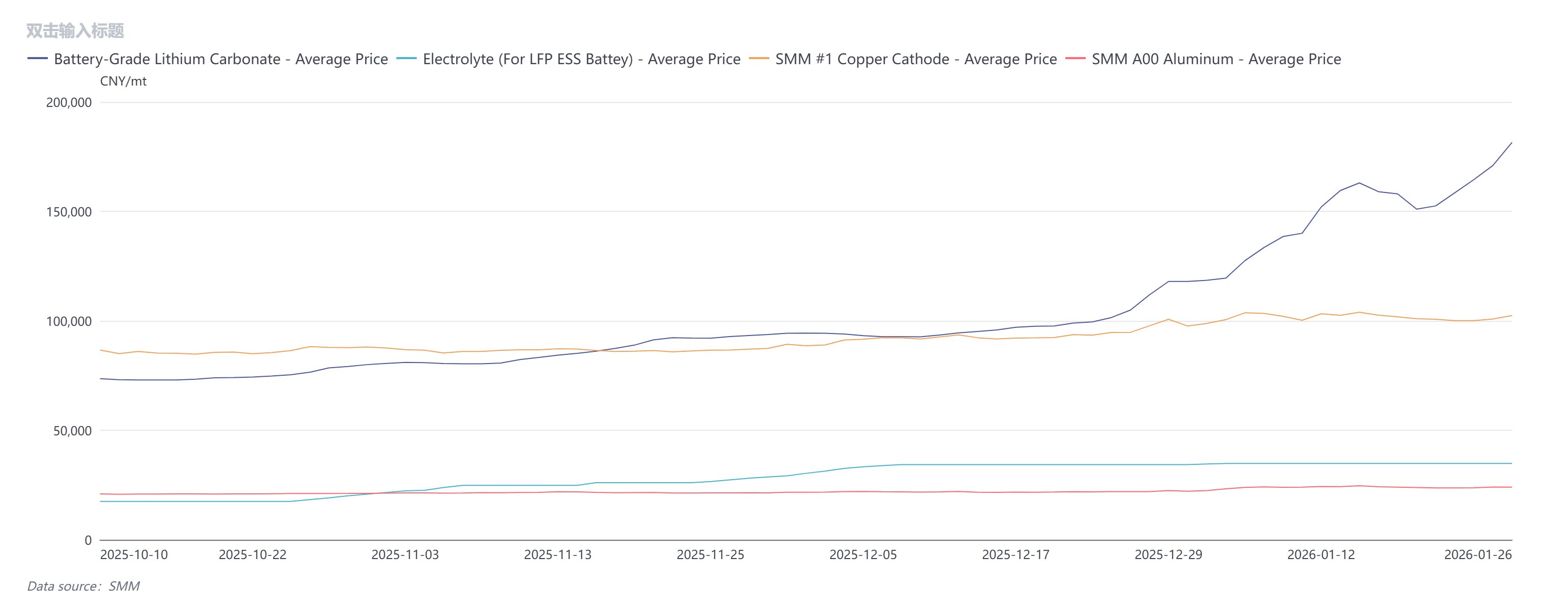 China Huadian Launches 12 GWh Energy Storage Tender, Linked to SMM Lithium Prices
China Huadian launched a 12 GWh energy storage tender for 2026, explicitly requiring ≥314Ah cells. The contract uniquely links pricing to SMM’s lithium carbonate index to manage market volatility. With bids opening February 11, 2026, this tender cements 314Ah technology and SMM benchmarks as the new standard for utility-scale projects.
Feb 6, 2026 14:42- Why Smelters Are Competing for Crude Silver at "Inverted Silver Prices" A Brief Analysis of the Current Crude Silver RC [SMM Analysis]
According to SMM, amid the significant surge in precious metals in 2025, the silver recycling market has seen a sharp rise in activity, with instances of inverted silver prices leading to a rush for crude silver in the market.
Sep 13, 2025 08:55