

45results found for 'Free Trade Agreement'
Sort by : |
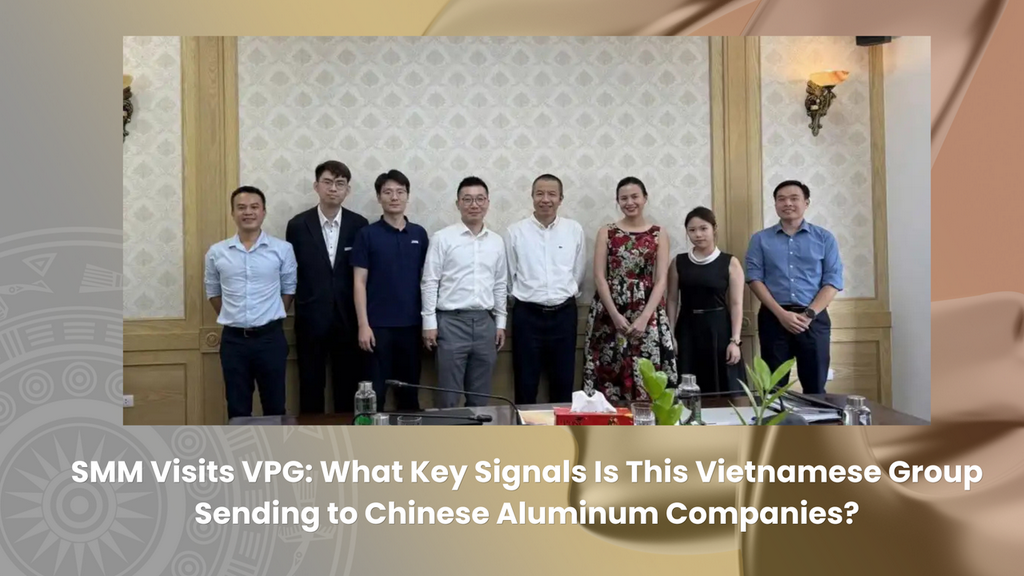 SMM Visits VPG: What Key Signals Is This Vietnamese Group Sending to Chinese Aluminum Companies?
On July 23, 2026, a delegation from Shanghai Metals Market Information Technology Co., Ltd. (SMM) visited VPG (Viet Phuong Group). The delegation included: Logan Lu, CEO of SMM Cason Lou, Director of Aluminum Processing, Marketing Department Lexi Chen, Key Account Manager for Overseas Information Sales Khai Yuen Chin, Senior Overseas Aluminum Analyst The two sides held in-depth discussions on bauxite resource development in Southeast Asia, alumina project development, regional logistics networks, and the development of a Vietnam-based aluminum pricing system. SMM noted that as the global aluminum value chain continues to restructure, China’s alumina market is expected to see sustained demand for overseas resources. Given resource availability and cost considerations, high-quality overseas alumina resources—particularly those from Vietnam and other Southeast Asian markets—are expected to gain greater market potential and competitive advantages. VPG shared updates on the progress of its current projects and said it is actively advancing mineral processing and alumina projects, with Southeast Asia and other international markets set to become key areas of future development. Since 2008, VPG has been engaged in bauxite exploration and development in Sekong Province, Laos, and is currently advancing an integrated industrial project covering bauxite mining, mineral processing, and alumina production. Both sides agreed that establishing an open, transparent, and regionally representative local aluminum pricing system would help improve information transparency and strengthen the international influence of Southeast Asia’s aluminum value chain. They also expressed expectations for deeper cooperation in market research, pricing services, and industry exchanges. What Signals Does SMM’s Visit to VPG Send to Chinese Companies? 01 Vietnam Is Becoming an Important Hub Connecting the Global Aluminum Value Chain In recent years, an increasing number of international companies have viewed Vietnam as an important gateway connecting Southeast Asian resources with global markets. Supported by its established port infrastructure, rapidly expanding manufacturing sector, and growing international trade network, Vietnam is not only benefiting from the relocation of global manufacturing capacity but is also emerging as an important regional hub for the aluminum value chain. For Chinese companies seeking opportunities in Southeast Asia, Vietnam is gradually evolving from an “investment destination” into a “supply chain partner.” 02 Vietnam’s Rapid Market Growth Is Creating New Export Opportunities With free trade agreements such as the EU-Vietnam Free Trade Agreement (EVFTA) taking effect, Vietnam has become a strategic sourcing hub for aluminum products used in the solar industry, including aluminum profiles and PV module frames, with export growth exceeding 20%. EVFTA tariff benefits for EU buyers, together with US Section 301 tariffs, have also encouraged some international buyers to shift sourcing toward Vietnam. Meanwhile, Vietnam aims for electric vehicles to account for 50% of urban vehicles by 2030. As electric vehicles use nearly 30% more aluminum than conventional vehicles, growing EV adoption could generate significant additional aluminum demand. This widening demand gap is expected to create substantial opportunities for aluminum suppliers and exporters. Against this backdrop, SMM AICE is expanding internationally by bringing its conference to Vietnam. The event aims to establish an authoritative platform connecting Chinese aluminum companies with Vietnam and the broader Southeast Asian market, promoting the transition of China-Vietnam aluminum cooperation from “resource complementarity” toward “full-value-chain cooperation and mutual growth.” 03 Future Competition Will Be About Information, Not Just Opportunities Vietnam’s market continues to develop rapidly. At the same time, market rules, policies, cost structures, and pricing mechanisms are constantly evolving. For Chinese companies, identifying projects alone is no longer enough. Timely access to local policies, industry development trends, supply chain changes, and market pricing information is becoming increasingly important. This is also why SMM continues to deepen its presence in the Vietnamese market. Recently, SMM AICE has been conducting intensive visits across Vietnam and the broader Southeast Asian industrial value chain, maintaining close communication with government authorities, industry associations, mining companies, alumina producers, aluminum processors, and other market participants. Through more transparent market intelligence and pricing systems, SMM aims to help global companies better understand market dynamics and reduce decision-making risks. To help more aluminum companies seize emerging opportunities and establish an early presence in the Vietnamese market, SMM AICE Vietnam is coming to Vietnam with a major industry gathering. VPG — Viet Phuong Group Founded in 1996, VPG (Viet Phuong Group) is a well-established diversified investment group in Vietnam, with businesses spanning mining, energy, infrastructure, finance, real estate, and other sectors. Mining is one of the group’s key strategic businesses, with projects involving mineral resources including bauxite, rare earths, and quartz sand. In the aluminum sector, VPG has been engaged in bauxite exploration and development in Sekong Province, Laos, since 2008. The group is currently advancing an integrated project covering bauxite mining, mineral processing, and alumina production. Leveraging Vietnam’s established port infrastructure and regional logistics network, VPG plans to export alumina products to China and other global markets through the Laos–Vietnam cross-border logistics corridor, further integrating into Southeast Asia’s aluminum supply chain. In recent years, the company has continued to advance project development, international cooperation, and market expansion, with the ambition of building a regional aluminum industry platform spanning resource development, alumina production, and international trade. Join the Conversation at SMM AICE 2026 Connect with aluminum producers, processors, traders, manufacturers, certification organisations, industry associations and decision-makers from across Southeast Asia and the global market. Explore aluminum pricing, primary aluminum supply, processing technologies, low-carbon development, CBAM compliance and new opportunities for regional cooperation. ? Ho Chi Minh City, Vietnam ? November 19–20, 2026 Register now: bit.ly/AICE26 and secure your Super Early Bird Pass and save up to USD 200. Register before August 31, 2026.
Aug 3, 2026 16:42- 【SMM Aluminium Flash News】India Says EU FTA Includes CBAM Roadmap to Support Exporters
India said its free trade agreement (FTA) with the European Union includes a dedicated CBAM roadmap to help businesses comply with the EU's Carbon Border Adjustment Mechanism. According to the Commerce Ministry, the agreement provides a framework for future discussions on CBAM flexibility and the recognition of carbon pricing paid in India, helping reduce compliance costs for exporters. The government also plans nationwide outreach programmes to assist SMEs with carbon accounting and verification requirements. The India-EU FTA is expected to be signed in 2026 and could enter into force in 2027.
Aug 3, 2026 16:40 - (SMM Analysis) JSW Steel's Expansion Pipeline Gathers Pace as India Demand Offsets Import Pressures
JSW Steel expects production and sales to strengthen from Q2 FY27 as the expanded Blast Furnace-3 at Vijayanagar ramps up, while reaffirming an aggressive capacity expansion pipeline spanning Dolvi, Odisha, Utkal and Kadapa. Despite the planned BF-3 shutdown, the company reported record first-quarter steel sales of 6.25 million tonnes, supported by resilient domestic demand and a 46% year-on-year increase in exports.
Jul 23, 2026 16:23 - Chile Eyes US$100 Billion in Copper Investment to Expand Refined Copper Production and Diversify Export Markets
Chile plans to attract around US$100 billion in copper investment over the next decade to meet rising demand from artificial intelligence, data centers, power grids and the energy transition, while reducing its reliance on the Chinese market, Foreign Affairs Minister Francisco Pérez Mackenna said. He noted that China will remain a key customer, but Chile aims to diversify its export destinations and invest in expanding refined copper production rather than relying primarily on copper concentrate exports, increasing the value added of its copper industry. Chile has also begun negotiations on a free trade agreement with India and plans to strengthen trade ties with neighboring countries as part of its broader strategy to expand export markets. Against the backdrop of tightening global copper concentrate supply and expanding Chinese smelting capacity, annual concentrate contract negotiations have become increasingly challenging.
Jul 23, 2026 09:37 - [SMM Steel] Intensifying quota competition drives discounted deals, Indian HRC exports CFR Europe continue to fall.
[India] This week, the assessed CFR Europe price for Indian HRC fell 10 USD/tonne to 640 USD/tonne (FOB indications at 560–570 USD/tonne). Although nominal CFR offers remained at 650–660 USD/tonne, actual transaction prices for large orders have been pushed down to 635–640 USD/tonne (small orders quoted at 650 USD/tonne and above). Over the past two weeks, EU clients have ordered a total of around 100,000 tonnes, prompting Indian steel mills to rush shipments; currently, of the EU's total HRC quota of 149,319 tonnes for India, less than 50,000 tonnes remains uncleared, with shipments concentrated in July-August to ensure arrivals at ports from end-August to early September. Additionally, trade with the Middle East has been disrupted by shipping and port congestion, and the detailed rules for sharing quotas under the EU free trade agreement remain uncertain.
Jul 20, 2026 17:51 - [SMM Steel] Export Barriers Intensify Domestic Squeeze; Turkish HRC Breaches 600 USD/tonne Downward
[Turkey] Turkish domestic HRC prices accelerated downward this week as mainstream ex-works offers officially breached the 600 USD/tonne threshold, dropping by 10 USD/tonne to 590 USD/tonne EXW. Meanwhile, export quotes edged down by 5 USD/tonne to 580 USD/tonne FOB. Persistent friction in exporting to Europe has forced many local mills to redirect export volumes back to the home market, intensifying domestic supply pressure. Currently, mainstream mills are primarily booking September production, with select sellers even offering prompt allocations for late-August delivery. Concurrently, Turkish HRC volumes cleared into the EU this quarter have surpassed 370,000 tonnes, far exceeding the formal quarterly quota of 160,574 tonnes. As some importers attempt to re-declare shipments under separate free trade agreement allocations, the final tariff rate remains uncertain. Consequently, mills have begun rushing to secure forward bookings, with a recent export sale to Greece confirmed for October shipment at 580–585 USD/tonne FOB.
Jul 20, 2026 15:52 - [SMM Analysis] Intersolar 2026 Review: Europe’s PV Growth Slows as Policy and Returns Reshape Market Logic
Since the start of the year, growth in the European solar market has slowed markedly. SMM expects total new solar installations in the European market to fall to around 68.5GW in 2026, a year on year decline of about 2 percent. Alongside softening demand, multiple EU level supply chain restriction policies continue to advance, including the Net Zero Industry Act (NZIA), the Industrial Accelerator Act (IAA), and restrictive measures targeting inverters from so called high risk countries.
Jul 3, 2026 16:00 - [SMM Analysis] EU Finalizes Country Quotas for Stainless Steel Imports: South Korea Leads, Indonesia's Surprise Win
New country-by-country quotas reward South Korea's balanced access and Indonesia's hot-rolled position, while Taiwan, China, Vietnam and Turkey face a tighter squeeze once melt-and-pour disclosure rules bite from October 1.
Jul 2, 2026 15:52 - [SMM Analysis] EU Steel Tariff Wall Doubles to 50%: Reconstructing the New Quota System and In-Depth Analysis of 1A HRC
On 1 July 2026, the EU replaced the steel safeguard measures implemented since 2018 with a significantly stricter import quota system—this is not merely a continuation of the old policy, but a complete reconstruction of its underlying logic: the core objective has upgraded from "preventing trade diversion" to "targeted defense against high carbon and excess capacity."
Jul 2, 2026 14:52 - [Turkey's Jan-May Crude Steel Output Rises 6.8%; EU Exports Forecasted to Exceed 3 Million MT]
Turkey's crude steel production grew by 6.8% year-on-year to 16.48 million metric tons (mt) in the first five months of 2026, driven largely by a 19.8% surge in slab production to 6.71 million mt. Despite the output growth, total steel exports fell by 2.9% to 6.13 million mt. Under the EU's new quota regime, Turkey received a specific quota of 2.86 million mt (15.6% of the total) and expects to export over 3.0 million mt to the bloc when including free trade agreement (FTA) volumes. With capacity utilization sitting at a low 63.9% out of its 61.9 million mt total capacity, the Turkish industry urgently needs domestic sourcing mandates and stricter import controls to maintain competitiveness against Far Eastern material.
Jul 2, 2026 11:45