

64results found for 'Electrolytic aluminum'
Sort by : |
- Mixed Raw‑Material Prices; Short‑Term Aluminum Costs Expected to Remain Stable
SMM, August 3 According to SMM data, the average tax-inclusive full cost of the domestic electrolytic aluminum industry rose 0.9% month-on-month in July 2026, while falling 1.7% year-on-year, mainly driven by slight increases in the monthly average price of alumina, prebaked anode prices, and electricity prices during the period. The monthly average SMM A00 spot price in July (June 26 – July 25) stood at RMB 22,977 per tonne, down 4.2% month-on-month. Electrolytic aluminum profit margins narrowed by RMB 1,146 per tonne to RMB 6,999 per tonne, with average profitability up 56.8% year-on-year. Measured by the monthly average price, 100% of domestic operating electrolytic aluminum capacity was in profit in July. By cost component: Alumina: According to SMM data, the monthly average SMM Alumina Index in July (June 26 – July 25) was RMB 2,745 per tonne, up 1.6% month-on-month. Alumina prices fluctuated within a range through the month as inventories continued to accumulate; overseas alumina prices, however, rose on restocking ahead of production restarts and new capacity ramp-ups. Entering August, the alumina market is expected to maintain its current supply structure. Against a backdrop of net imports, there is no sign of an inflection point toward inventory drawdown, but cost support has lifted Guinean sellers' asking prices, lending upward momentum to alumina costs. In the near term, the tug-of-war between cost support and loose supply in the spot alumina market is set to continue. With prices relatively low at the start of the month, the August average price is expected to edge down slightly. Auxiliary materials: In July, rigid demand from electrolytic aluminum underpinned domestic anode consumption, while export demand from Southeast Asia offset reductions in the Middle East, leaving the prebaked anode market relatively steady. Long-term contract procurement prices rose marginally by RMB 30 per tonne month-on-month. In the fluoride salt market, downstream buyers maintained rigid procurement and held off on purchases to push prices lower, leading to declines in procurement prices at major producers. Entering August, with cost support softening and supply continuing to expand, prebaked anode prices are expected to edge down slightly; fluoride salt prices, by contrast, are projected to rise on the back of rigid cost support combined with low operating rates. Overall, auxiliary material costs for electrolytic aluminum are expected to decline slightly in August. Electricity prices: Electricity prices rose modestly month-on-month in July. Entering August, electricity prices are expected to remain broadly stable, and overall power costs for electrolytic aluminum are projected to hold steady. In summary, the weighted average tax-inclusive full cost of SMM's domestic electrolytic aluminum industry rose slightly in July 2026; electrolytic aluminum costs are expected to decline modestly in August, with the average hovering around RMB 15,700–16,100 per tonne.
Aug 7, 2026 17:25 - 【SMM Aluminum Flash News】Shenhuo Reports 151.06% Net Profit Surge in H1 2026, Driven by Higher Coal and Aluminum Prices
On the evening of July 27, Henan Shenhuo Coal & Power Co., Ltd. (hereinafter referred to as "Shenhuo") released its 2026 semi-annual report. In the first half of this year, the company achieved operating revenue of 24.791 billion yuan, a year-on-year increase of 21.35%; net profit attributable to shareholders of the listed company was 4.781 billion yuan, a year-on-year increase of 151.06%. Regarding the reasons for the performance change, Shenhuo stated that during the reporting period, the company's profitability was significantly enhanced due to factors such as the year-on-year increase in the selling price of coal and electrolytic aluminum products and the year-on-year decrease in the price of alumina, the main raw material.
Jul 28, 2026 17:12 - 【SMM Aluminum Flash News】CMCC3's Vietnam Electrolytic Aluminum Project Produces First Batch of Aluminum Ingots
On July 21, the ingot casting workshop of the Vietnam Electrolytic Aluminum Project Department of China Fifteenth Metallurgical Construction Corporation (CMCC3) successfully produced its first batch of aluminum ingots. This achievement marks a significant milestone in the trial production of the casting system. At 3:00 PM that day, as trial production officially commenced, the holding furnace slowly tilted from 0°C to 20°C. The molten aluminum, after being held at this temperature, smoothly entered the casting machine through a chute. After casting, cooling, and demolding processes, aluminum ingots were successfully formed. Subsequently, a robotic arm precisely grasped the ingots and stacked them. The entire production process ran smoothly and efficiently, and the successful production of the first batch of aluminum ingots signifies the complete success of the trial production in the ingot casting workshop. It is reported that to ensure the smooth progress of trial production, the project team conducted comprehensive inspections and repeated confirmations of key aspects such as equipment installation, electrical power supply, instrument debugging, and system linkage, ensuring the safe, stable, and orderly operation of the entire trial production process. The successful production of the first batch of aluminum ingots demonstrates the project team's commitment to its milestone targets and lays a solid foundation for subsequent trial production and full-scale operation.
Jul 28, 2026 17:06 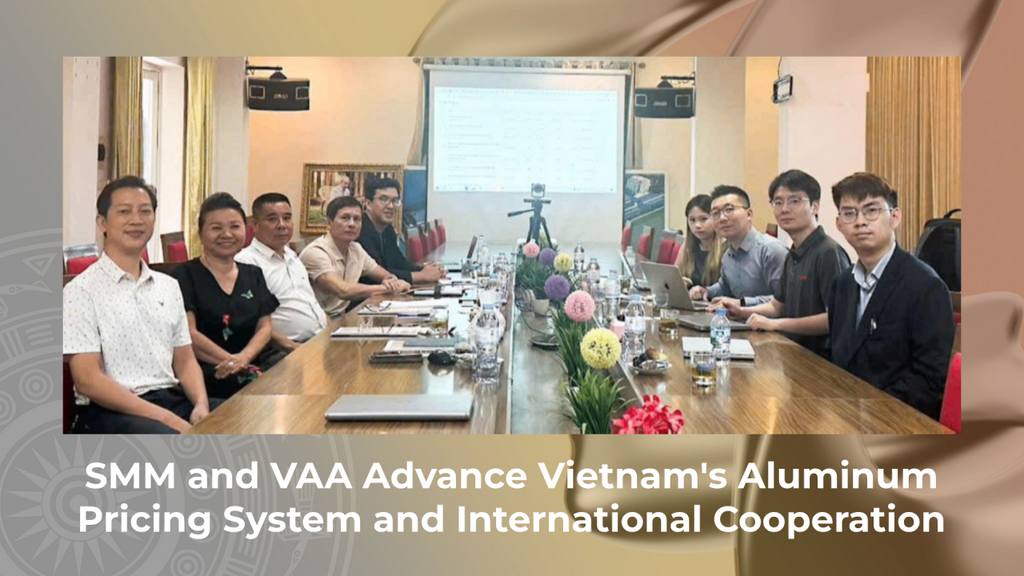 SMM and VAA Advance Vietnam’s Aluminum Pricing System and International Cooperation
Representatives from SMM and the Vietnam Association of Aluminum Profile (VAA) during their meeting in Ho Chi Minh City on July 21, 2026 On July 21, 2026, a delegation from Shanghai Metals Market (SMM) visited the Vietnam Association of Aluminum Profile (VAA) to discuss the development of Vietnam’s aluminum industry, the establishment of a credible local aluminum pricing system, and opportunities for international cooperation. The SMM delegation included: Logan Lu , CEO of SMM Cason Lou , Aluminum Processing Director of the Marketing Department Lexi Chen , Key Account Manager for Overseas Information Sales Khai Yuen Chin , Senior Overseas Aluminum Analyst. They were welcomed by key representatives from VAA, including: Nguyen Minh Ke, President of Vietnam Aluminum Profile Association (VAA) Vu Van Phu, Vice President & Secretary General, VAA, Viet Phap Aluminum Company Le Anh Tuyet, Vice President, VAA; CEO Do Thanh Aluminum Group Nguyen Dung, Chief of Office, VAA Strengthening Transparency in Vietnam’s Aluminum Market During the meeting, SMM and VAA introduced their respective organizations, business activities, and roles within the aluminum industry. The discussion then focused on the development of Vietnam’s aluminum sector, market research and price publication, and potential cooperation surrounding SMM AICE 2026 Southeast Asia Aluminum Conference A key topic was the need for a transparent and internationally recognized aluminum price benchmark in Vietnam. Photo credit: SMM AICE As Vietnam’s aluminum industry continues to expand, the absence of a credible local price reference remains a major challenge for market participants. A reliable benchmark could improve pricing transparency, support more informed commercial decisions, and facilitate cross-border trade. To support this development, SMM officially launched its Vietnam 6063 aluminum billet processing fee and SMM Vietnam 6063 aluminum billet price assessment on July 3, 2026. During the meeting, the SMM team explained the progress of its pricing services in Southeast Asia and addressed VAA’s questions regarding the assessment process. SMM also emphasized the importance of developing a Vietnam aluminum pricing system that reflects local market conditions while gaining recognition from international participants. Official Price Launch at SMM AICE 2026 SMM plans to officially introduce its Vietnam aluminum price and explain the underlying methodology during SMM AICE 2026 Southeast Asia Aluminum Conference , taking place on November 19–20, 2026, in Ho Chi Minh City. The conference will provide a platform for aluminum producers, processors, traders, industry associations, analysts, and other market participants to discuss pricing mechanisms and the broader development of Vietnam and Southeast Asia’s aluminum markets. VAA Chairman Nguyen Minh Ke welcomed SMM’s continued engagement in Vietnam. He highlighted the rapid development of the country’s aluminum industry, particularly following the commissioning of the first phase of a 150,000-ton electrolytic aluminum project, which further strengthens Vietnam’s aluminum value chain. Photo credit: SMM AICE He also noted that the lack of a locally based pricing reference with international credibility has remained a persistent industry challenge. VAA looks forward to deepening its cooperation with SMM and jointly supporting the standardization and international recognition of Vietnam’s aluminum pricing system. Expanding Cooperation Through SMM AICE 2026 SMM and VAA also reached several points of consensus regarding potential cooperation for SMM AICE 2026. VAA expressed its intention to actively consider supporting and participating in the conference. This collaboration could create new opportunities for industry dialogue, information exchange, and stronger connections between Vietnam’s aluminum sector and the wider international market. The visit marks the formal establishment of a cooperative relationship between SMM and VAA. It lays a foundation for future collaboration in aluminum price development, industry information exchange, and international engagement. About the Vietnam Association of Aluminum Profile Established in 2019, the Vietnam Association of Aluminum Profile is one of the country’s most influential aluminum industry organizations. VAA represents nearly 130 member companies involved in aluminum profile manufacturing and trading. Its work focuses on supporting member companies, protecting their legitimate interests, promoting cooperation across the industry, and strengthening the international competitiveness of Vietnam’s aluminum sector. According to VAA, Vietnam’s aluminum profile production reached nearly 1.5 million tonnes in 2024, with an estimated value of USD 4.2 billion, representing year-on-year growth of 14.5%. As the industry continues to grow, cooperation among associations, market information providers, and businesses will become increasingly important in developing stronger market standards and supporting Vietnam’s integration into the global aluminum value chain. Join the Conversation at SMM AICE 2026 Connect with aluminum producers, processors, traders, industry associations, analysts, and decision-makers from across Southeast Asia. Explore the latest market developments, pricing trends, processing technologies, recycling opportunities, and new possibilities for regional cooperation. ? Ho Chi Minh City, Vietnam ? November 19–20, 2026 Register now: bit.ly/AICE26 and secure your Super Early Bird Pass and save up to USD 200. Register before August 31, 2026.
Jul 23, 2026 11:35- 【SMM Aluminum Flash News】Zhongfu Industrial Forecasts 154%-176% Profit Growth in H1 2026
On July 8, Zhongfu Industrial announced that it expects its net profit attributable to owners of the parent company for the first half of 2026 to be between RMB 1.8 billion and RMB 1.95 billion, representing a year-on-year increase of 154.42% to 175.62%. The performance growth is mainly due to cost reduction through collaboration between upstream and downstream industrial chains, high electrolytic aluminum prices, development of high value-added aluminum deep processing products, and the advancement of energy-saving technological transformation projects.
Jul 13, 2026 09:41 - 【SMM Aluminum Flash News】Hongqiao Holdings Forecasts 69.72%-81.04% Net Profit Growth in H1 2026
Hongqiao Holdings announced that it expects its net profit attributable to shareholders of the listed company for the first half of 2026 to be between RMB 15 billion and RMB 16 billion, representing a year-on-year increase of 69.72% to 81.04%. The performance change is mainly due to a significant year-on-year increase in the sales price of electrolytic aluminum, resulting in a significant improvement in the gross profit of related businesses. At the same time, the scale of borrowing has been reduced, leading to a substantial decrease in financial interest expenses. Note: The company's Q2 net profit is expected to be between RMB 8.242 billion and RMB 9.242 billion, while Q1 net profit was RMB 6.758 billion. Based on this, Q2 net profit is expected to increase by 21% to 36% quarter-on-quarter.
Jul 13, 2026 09:40 - 【SMM Aluminum Flash News】Jiaozuo Wanfang Forecasts 118-137% Profit Surge in H1 2026
Jiaozuo Wanfang announced that it expects net profit attributable to shareholders of the listed company for the first half of 2026 to be between RMB 1.17 billion and RMB 1.27 billion, representing a year-on-year increase of 118.35% to 137.01%; net profit after deducting non-recurring gains and losses is expected to be between RMB 1.158 billion and RMB 1.258 billion, representing a year-on-year increase of 116.93% to 135.66%. The performance growth is mainly due to the high price of electrolytic aluminum, the company's strengthened sales management, resulting in year-on-year revenue growth; and the decrease in the purchase price of the main raw material, alumina, the company's optimized procurement strategy and reduced energy consumption, effectively reducing production costs.
Jul 13, 2026 09:38 - H1 Review of Aluminum: Geopolitical Conflict Triggers Production Cuts, High Profits Accelerate New Projects and Restarts
SMM, July 7: In the first half of 2026, geopolitical conflicts in the Middle East emerged as one of the decisive factors affecting electrolytic aluminum prices. Prior to the Middle East events, expectations of a US dollar rate-cut cycle were bullish for non-ferrous metal prices, and overseas electrolytic aluminum prices generally maintained a firm trend in January. However, high aluminum prices suppressed demand, compounded by the impact of the domestic Spring Festival holiday, leading to larger-than-expected domestic aluminum ingot inventory accumulation. In February, domestic and overseas aluminum prices fell in tandem. On February 28, the US-Israel coalition launched a military strike against Iran, officially marking the beginning of the Middle East geopolitical conflict's impact on aluminum prices. Middle East Geopolitical Conflict Triggers Production Cuts; Supply Gap Expectations Drive Up LME Aluminum Prices Affected by the US-Iran conflict, some aluminum smelters in the Middle East experienced production cuts. Combined with the Mozambique aluminum smelter entering shutdown in March, the market expected overseas electrolytic aluminum fundamentals to face a significant supply gap. Boosted by this, overseas aluminum prices continued to climb, with the LME 3M aluminum price reaching a near three-year high of $3,787.5/tonne on June 2. The timeline of production cuts at Middle East and Mozambique aluminum smelters is as follows. In addition, power and other infrastructure in Iran was damaged, making it difficult for local aluminum smelters to sustain production. However, with no official announcements yet, SMM has made its own production cut assessment. As of mid-April, SMM estimated that the total capacity affected by production cuts in the Middle East and Mozambique could reach approximately 3.5–4.0 million tonnes. Under the impact of significant production cuts, overseas electrolytic aluminum fundamentals shifted to a deficit, with total LME aluminum ingot inventory and Japanese port aluminum ingot inventory continuing to decline. As of end-June 2026, LME global aluminum ingot inventory stood at 302,000 tonnes, down 207,000 tonnes from end-2025. As of end-May, Japanese major port electrolytic aluminum inventory was 239,000 tonnes, down 78,000 tonnes from end-2025. Amid expectations of supply tightening, ex-China aluminum premiums strengthened. As of end-June, SMM Japan MJP aluminum ingot spot premium recorded $380/mt, up 123.5% from the end of last year, and SMM Japan Q3 MJP aluminum ingot premium recorded $395/mt, up $309/mt from Q4 2025, a jump of 359.3%. SMM Europe P1020A aluminum ingot duty-paid price recorded $547.5/mt, up 62.2% from the end of last year, while SMM Europe P1020A aluminum ingot duty-unpaid price recorded $470/mt, up 64.9% YoY. SMM US Midwest DDP aluminum premium recorded 110.5¢/lb, equivalent to around $2,435/mt, up 18.2% from the start of the year, an absolute increase of approximately $374.7/mt. Although supply tightened and aluminum ingot destocking took place, downstream purchasing enthusiasm was subdued by high prices, with actual transactions in Asia persistently at a discount to the Japan MJP aluminum ingot premium. Indonesia saw a concentration of new project startups; as new projects continued to ramp up production, supply increased, and since Q2, Indonesia aluminum ingot FOB prices showed a trend of pulling back slightly. As of end-June, SMM FOB Indonesia P0610A average price recorded $270/mt, up 92.9% from the end of last year, but down 8.8% from this year's high of $296/mt. SMM FOB Indonesia P1020A average price recorded $266/mt, up 97.0% YoY, but down 8.6% from this year's high of $291/mt. Aluminum premiums in other regions maintained an overall uptrend. As of end-June, SMM CIF South Korea P1020A average price recorded $342/mt, up 132.7% from the end of last year; SMM FCA South Korea P1020A average price recorded $362/mt, up 119.4% YoY; and SMM CIF Thailand P1020A average price recorded $328/mt, up 120.9% YoY. High Profits Accelerate Electrolytic Aluminum Restarts and New Project Commissioning Under high aluminum prices, electrolytic aluminum companies enjoyed substantial profits. These high profits stimulated some idled capacity to accelerate restarts and also catalyzed more new electrolytic aluminum projects, accelerating their commissioning. In the first half of the year, three electrolytic aluminum smelters resumed idled capacity to varying degrees, and two additional smelters announced plans to restart production in 2026. Details are as follows: San Ciprián smelter in Spain safely completed restart on April 8, with total capacity of approximately 230,000 tonnes/year, representing an increase of approximately 150,000–200,000 tonnes/year compared to 2025 operating capacity. Mount Holly in the United States began restart in April, with plans to reach full capacity by end-June, involving 50,000 tonnes/year of capacity. Grundartangi smelter in Iceland began restart in April, expected to complete restart by end-July, involving 210,000 tonnes/year of capacity. Magnitude 7 Metals planned to restart potline No. 1 cells at its New Madrid aluminum smelter in the United States, with plans to add 75,000 tonnes/year of primary aluminum capacity by end-2026. Norsk Hydro indicated that the Slovalco smelter in Slovakia planned to restart partial primary aluminum production in Q4 2026, involving 75,000 tonnes/year of capacity. Regarding new projects, according to SMM estimates, total planned commissioning capacity for overseas electrolytic aluminum in 2026 is approximately 2.3 million tonnes, of which approximately 700,000 tonnes have been commissioned, with the remaining 1.6 million tonnes expected to be commissioned in the second half of 2026. For details, please follow the "SMM Overseas Electrolytic Aluminum Project Monthly Review" series. Overall, although the Middle East and Mozambique experienced large-scale production cuts in the first half of the year, the acceleration of restarts and new project commissioning partially offset the supply reduction. According to SMM estimates, total overseas electrolytic aluminum production in H1 2026 was 14.397 million tonnes, down 4.1% year-on-year, and total overseas demand was 13.612 million tonnes, down 3.1% year-on-year. Since overseas electrolytic aluminum had a net inflow of approximately 1.234 million tonnes into the domestic market in H1, the overseas electrolytic aluminum deficit in H1 is estimated at approximately 450,000 tonnes. H2 Outlook: Middle East Restarts Combined with New Project Ramp-up Increase Supply, Putting Pressure on Aluminum Prices In June–July, the Middle East geopolitical situation showed no clear signals of further deterioration, and news of restarts emerged from Middle East aluminum smelters that had undergone production cuts. On July 2, EGA announced that its Al Taweelah plant had made progress in restart efforts: anode removal work for all electrolytic cells had been completed; cell cleaning was approximately 90% complete; and over 20% of solidified aluminum blocks inside cells had been cleared. On May 26, the first electrolytic cell was successfully restarted; as of July 2, 89 cells were in operation (out of a total of 1,262 cells), equivalent to approximately 110,000 tonnes of capacity. In addition, Aluminum Bahrain and Qatalum were also expected to gradually begin restarts. With Middle East restarts combined with continued ramp-up of new projects, the global electrolytic aluminum balance is expected to shift toward a surplus by Q4 2026.
Jul 7, 2026 16:48 - Aluminum Capacity Shifts to High-Current Potlines
SMM, June 30 – On June 15, 2026, according to the National Development and Reform Commission (NDRC) website, the NDRC, the Ministry of Industry and Information Technology, the Ministry of Ecology and Environment, the State-owned Assets Supervision and Administration Commission of the State Council, the National Energy Administration, and other departments jointly issued the Notice on Launching a Three-Year Campaign for Energy Conservation and Carbon Reduction Upgrades in Key Industries . The notice's requirements for the electrolytic aluminum industry include: promoting large-scale reduction cells of 500 kA and above, and accelerating the upgrade of prebaked anode cells below 300 kA. SMM has compiled publicly available market information. Excluding idled capacity, as of June 2026, cells of 300 kA and below accounted for 16% of total domestic capacity, of which approximately 1.75 million tonnes of capacity already have publicly announced replacement or upgrade projects. It should be noted that the Notice on Launching a Three-Year Campaign for Energy Conservation and Carbon Reduction Upgrades in Key Industries does not yet mandate compulsory phase-out provisions regarding cell amperage requirements. Domestic electrolytic aluminum production is therefore not expected to be materially affected in the near term. Meanwhile, capacity replacement and upgrade projects across the domestic industry are progressing steadily, with replacement projects surfacing frequently. As of June 30, 2026, a total of 13 electrolytic aluminum capacity replacement projects had been publicly announced, of which 8 are upgrade and retrofitting projects. As of June 2026, capacity equipped with 500 kA and above cells accounted for 12.9% of the total, a share expected to rise further going forward. Of the 13 publicly announced projects, 11 plan to build 500 kA or 600 kA cells, representing 93.1% of total proposed capacity under replacement projects. SMM Commentary: Electrolytic aluminum output is unlikely to see significant near-term disruption. However, as replacement and upgrade efforts continue, power consumption per tonne of domestic electrolytic aluminum production is expected to decline further, helping the industry meet its energy conservation and carbon reduction targets.
Jun 30, 2026 17:14 - 【SMM Aluminum Flash News】SINOMACH Subsidiary Signs $245M Contract for Angola Electrolytic Aluminum Expansion Project
China National Machinery Industry Corporation (SINOMACH) announced that on June 11, 2026, its wholly-owned subsidiary, SINOMACH International Engineering (Jiangsu) Co., Ltd., signed a commercial contract with Huatong Angola Industrial Co., Ltd. at the 17th International Infrastructure Investment and Construction Summit Forum and Exhibition for the Phase II Project (Sections 1-6) of the Huatong Electrolytic Aluminum Production Line in Angola. The contract amount is RMB 1.717 billion, and the project involves the expansion of an annual production line with a capacity of 120,000 tons of electrolytic aluminum. SINOMACH International Jiangsu will provide design, equipment procurement, and installation and commissioning services.
Jun 15, 2026 17:36