

![Aluminum Semis Export Profits Continued to Rise, Recovering to Pre-Rebate-Cancellation Levels [SMM Analysis]](https://imgqn.smm.cn/usercenter/JnyfJ20251217171654.jpg) Aluminum Semis Export Profits Continued to Rise, Recovering to Pre-Rebate-Cancellation Levels [SMM Analysis]
Aluminum Semis Export Profits Continued to Rise, Recovering to Pre-Rebate-Cancellation Levels [SMM Analysis]In Q1 2026, China’s aluminum semis exports showed a pronounced pattern of product-category divergence amid the interplay of three factors: the long-term impact of the cancellation of export tax rebates in December 2024, the divergence in demand structures outside China, and the sudden outbreak of geopolitical conflict in the Strait of Hormuz.....
Mar 31, 2026 23:33- [SMM Analysis] Geopolitical Conflicts Reshape China’s Steel Export Landscape
[SMM Analysis] Steel Export Review: Geopolitical Conflicts Trigger the Reshaping of the Export Landscape In terms of steel billet exports , the main target market in the first two months remained Indonesia. Part of the cargoes was imported by Chinese-funded or joint-venture rolling mills in Indonesia for further processing and use, thereby avoiding Southeast Asia’s import tariffs on finished steel products, while another part was supplied directly to local projects under construction. Meanwhile, Southeast Asia, Africa, and South America formed a solid base of exports. In particular, on the African side, Djibouti, as a core transshipment hub, had been handling a large volume of circulating resources. Turkey, meanwhile, saw a wave of concentrated external purchases due to delays in steel scrap vessel schedules and spot-futures price spread arbitrage. In terms of bar exports , the share to Hong Kong, China declined somewhat from the end of last year, while exports to Singapore overtook it. The main reason was that procurement in Singapore was rigidly driven by local public housing renewal and public infrastructure projects, such as the Greater Southern Waterfront, according to construction periods, with actual end-user consumption remaining relatively stable; whereas Hong Kong, China, as a capital and logistics transshipment hub, saw some earlier speculative re-export orders constrained by offshore exchange-rate fluctuations at the beginning of the year and funding borrowing costs. Traders proactively reduced some speculative exposure for financial risk hedging purposes, which led to a decline in transshipment procurement volume. Looking ahead to March , with the full blockade of the Strait of Hormuz, Iran’s semi-finished products export channels were effectively cut off. Chinese steel billet is expected to absorb these additional export orders arising from geopolitical conflict, and traders and steel mills will also accelerate shipments to markets outside China such as Southeast Asia to gain a larger replacement share. Therefore, total steel billet exports still have room to rise. By contrast, Chinese bar exports mainly rely on short-haul regional shipping routes into the inland areas within Asia, and were subject to extremely limited direct impact from the disruption of long-haul Middle East logistics. Therefore, March shipments are expected to remain stable, supported by rigid-demand restocking within the region. Source: SMM, General Administration of Customs Unlike the strong performance of billets, sheets & plates exports in the first two months were unsatisfactory. The cumulative exports of both cold galvanized and hot-rolled products in January and February declined YoY , with the drop in hot-rolled products being more pronounced. However, it should be noted that before the full suspension of navigation through the Strait of Hormuz at the end of February, logistics channels to the Middle East remained open, which secured a critical delivery window for sheets & plates. Therefore, in terms of HRC exports , Saudi Arabia still firmly ranked first among export destinations with a volume of 348,000 mt , mainly because its large-scale non-oil infrastructure and manufacturing projects in China were still in an intensive construction phase, with strong end-user steel demand, which also prompted local buyers to lock in relatively lower-priced Chinese HRC ahead of shipping disruptions, thereby maintaining its leading position. Pakistan (230,000 mt ), by contrast, saw this mainly due to bottlenecks in domestic supply, creating phased concentrated restocking demand, and according to the SMM survey, most purchases were made by downstream pipe factories. From the perspective of cold galvanized exports , the Southeast Asian market was currently in a stage of rapid development, and macroeconomic expansion had created a huge gap in flat steel products. Thailand in particular (304,000 mt ) was in a concentrated raw material stocking cycle for local downstream auto manufacturers at the beginning of this year, so just-in-time procurement by multiple physical manufacturers directly pushed up local imports. Looking ahead to March , under the dual impact of the Strait of Hormuz blockade and the Ramadan effect, sheets & plates exports to the Middle East core region are expected to face a sharp contraction. SMM shipping data showed that steel arrivals had already declined by more than 900,000 mt. However, under the pressure of elevated destocking in China, this portion of blocked exports is expected to be redirected to Southeast Asia and other alternative markets with “rigid manufacturing demand” for redistribution, thereby offsetting shipment reductions caused by localized logistics disruptions. Therefore, there is no need for excessive concern over total sheets & plates exports in March Source: SMM, General Administration of Customs Copyright and Intellectual Property Statement: This report is independently created or compiled by SMM Information & Technology Co., Ltd. (hereinafter referred to as "SMM"), and SMM legally enjoys complete copyright and related intellectual property rights. The copyright, trademark rights, domain name rights, commercial data information property rights, and other related intellectual property rights of all content contained in this report (including but not limited to information, articles, data, charts, pictures, audio, video, logos, advertisements, trademarks, trade names, domain names, layout designs, etc.) are owned or held by SMM or its related right holders. The above rights are strictly protected by relevant laws and regulations of the People's Republic of China, such as the Copyright Law of the People's Republic of China, the Trademark Law of the People's Republic of China, and the Anti-Unfair Competition Law of the People's Republic of China, as well as applicable international treaties. Without prior written authorization from SMM, no institution or individual may: 1. Use all or part of this report in any form (including but not limited to reprinting, modifying, selling, transferring, displaying, translating, compiling, disseminating); 2. Disclose the content of this report to any third party; 3. License or authorize any third party to use the content of this report; 4. For any unauthorized use, SMM will legally pursue the legal responsibilities of the infringer, demanding that they bear legal responsibilities including but not limited to contractual breach liability, returning unjust enrichment, and compensating for direct and indirect economic losses. Data Source Statement: (Except for publicly available information, other data in this report are derived from publicly available information (including but not limited to industry news, seminars, exhibitions, corporate financial reports, brokerage reports, data from the National Bureau of Statistics, customs import and export data, various data published by major associations and institutions, etc.), market exchanges, and comprehensive analysis and reasonable inferences made by the research team based on SMM's internal database models. This information is for reference only and does not constitute decision-making advice. SMM reserves the final interpretation right of the terms in this statement and the right to adjust and modify the content of the statement according to actual circumstances.
Mar 30, 2026 19:00 - SMM Analysis: China’s Aluminum Wire & Cable Exports Off to Strong Start in 2026 – Positive Outlook Amid Potential Risks
Customs data showed that China’s aluminum wire and cable exports totaled 53,280 mt in January-February 2026, up 37% YoY from January-February last year.
Mar 27, 2026 19:45 - Shipping Disruptions in Hormuz Strait Tighten Sulfuric Acid Supplies, Pushing Prices Up
Disruptions to shipping routes and the Strait of Hormuz are tightening sulfuric acid supplies. The Middle East accounts for about 24% of global sulfur output, with nearly 40% of seaborne sulfur passing through Hormuz. Chile’s main suppliers—China, Peru and South Korea—are affected, pushing spot prices up nearly 20% since early 2026. Chile is advancing domestic smelter projects to reduce import reliance and secure supply.
Mar 27, 2026 14:41 - Impact of Hormuz Blockade on China's Aluminum Wire and Cable Exports to the Middle East [SMM Analysis]
Based on China’s 2025 aluminum wire and cable export data to the Middle East, Saudi Arabia was the largest export destination in the region, with annual exports of 9,426.752 mt, accounting for 31.88 of the Middle East total
Mar 20, 2026 19:48 - [SMM Analysis] Global Tungsten Prices Surge Amid Supply Shortages & Seller-Dominated Market
As of March 16, tungsten prices in China saw a slight correction, with APT quoted at 1.505 million yuan/mt. The market's fear of high prices was released, entering a phase of rational wait-and-see. Outside China, supply remained persistently tight, with the average APT Rotterdam price at $2,200/mtu, while weekly gains in tungsten scrap prices in India and Europe exceeded 25%.
Mar 16, 2026 16:32 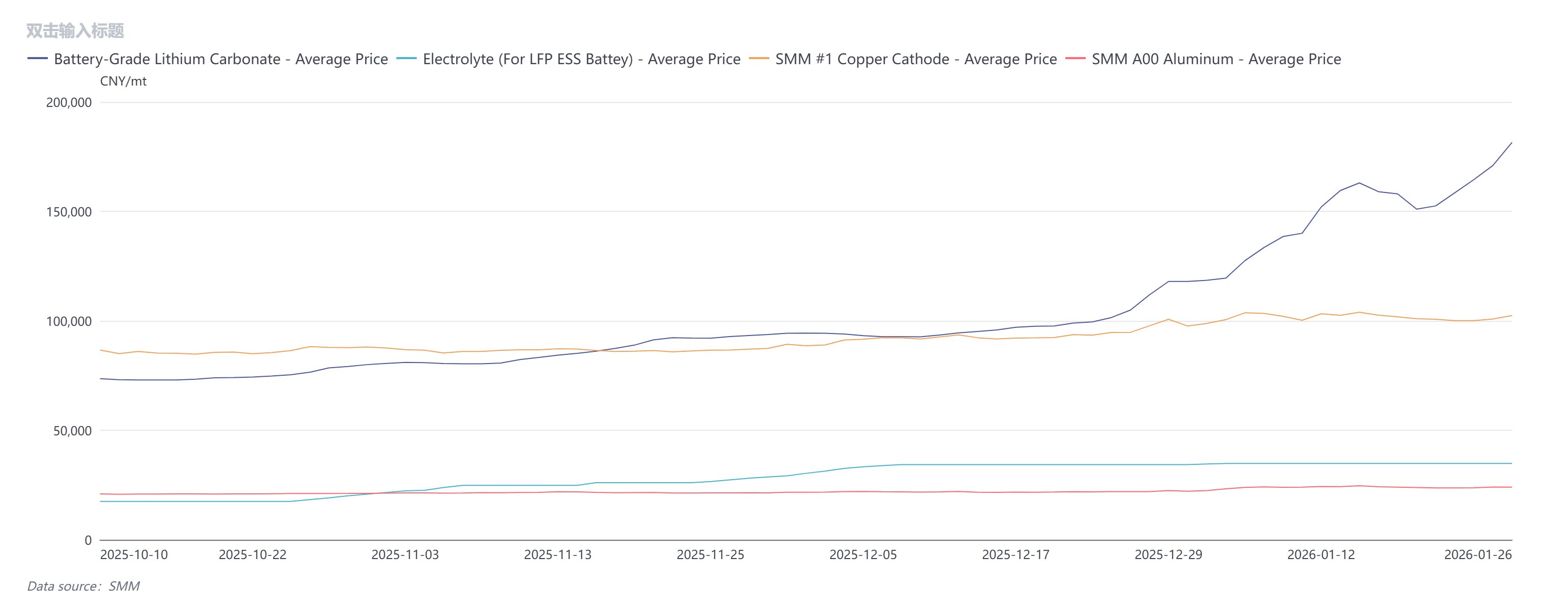 Amidst Middle East Conflicts: What is the Path Forward for China's Energy Storage Exports?
Recent Middle East conflicts have disrupted the region's booming energy storage market, a major destination for Chinese exports. To assess the real impact on Chinese supply chains and project deliveries, we must analyze baseline demand amidst these geopolitical uncertainties.
Mar 9, 2026 17:58- 【SMM Steel】Middle East conflict disrupts EU steel shipments, raising costs and lead times
【SMM Steel】The Middle East conflict is disrupting shipping routes, causing longer delivery times and higher costs for EU steel imports. Buyers expect cargoes to reroute via the Cape of Good Hope, adding 2-4 weeks and raising freight costs. Uncertainty is limiting orders. The delays come as the EU plans tighter import quotas from July 2026. Higher energy and freight costs may push up steel prices.
Mar 6, 2026 16:33 - [SMM Analysis] Persian Gulf Shutdown? The Impact of the U.S.-Iran Conflict on Global Steel Trade
[SMM Analysis] Persian Gulf Shutdown? The Impact of the U.S.-Iran Conflict on Global Steel Trade On February 28, 2026, the conflict between the United States and Iran escalated into a full-scale outbreak, causing a sudden spike in Middle Eastern geopolitical tensions. As a global chokepoint for energy and bulk commodity maritime transport, the Strait of Hormuz has seen shipping disrupted and routes tightened, directly impacting the nerves of the global supply chain. This "Golden Waterway" is not only a lifeline for oil but also a critical strategic corridor for the global steel import and export trade . Once passage is restricted, it will deliver a comprehensive shock to the international steel trade landscape. Amidst the turmoil of war, what disruptions and restructuring will the global steel trade face? SMM's latest research provides an in-depth analysis. In the short term, the U.S.-Iran conflict poses a risk of stalling steel imports and exports in the Persian Gulf region, putting pressure on China's steel exports. Multiple disruptions along Gulf shipping routes have caused significant delays in exporters' orders. According to SMM research, the current Middle East situation has disrupted multiple ports in the Gulf region. Bahrain has suspended port activities, including pilotage services. Jebel Ali Port has halted all operations due to a fire caused by intercepting airstrike debris. Qatar's Ras Laffan and Messaid ports remain operational but with reduced traffic, GPS signal interference, and the government closure of its airspace. Similarly, new orders and shipments for Chinese exporters have also been significantly hindered. Data Source:SMM Impact Assessment of Core Ports within the Strait of Hormuz Should a physical blockade occur at this strategic chokepoint, the five most directly affected key inner-bay ports experiencing “instant logistics paralysis” would be: Port of Bandar Abbas, Port of Khomeini, Port of Jebel Ali, Port of Khalifa, and King Abdullah Port. Simultaneously, a Strait blockade would threaten to disrupt approximately 10% of global seaborne steel trade (primarily semi-finished products and specialty ores) . Iran's production of direct reduced iron (DRI) also holds significant weight in global supply; any disruption could drive up costs for electric arc furnace steelmaking in the Middle East. Data Source: SMM Ferrous Metal Shipping After the blockade, will goods become completely impossible to transport? While maritime routes will indeed come to a near standstill, the flow of goods won't cease entirely. It will simply become extremely costly, slow, and require complex overland transshipment. For instance, strategic alternative ports outside the strait include Sohar Port, Chabahar Port, and Gwadar Port. Data Source: Compiled by SMM based on publicly available information Trade Chokehold Triggered by Insurance Withdrawals Equally severe as the strait blockade is the withdrawal of war risk insurance. Marine insurers Skuld and Gard have announced they will cancel war risk coverage due to escalating tensions in the Middle East. Local feedback from the UAE indicates most insurers refuse to underwrite war risk insurance for the Red Sea. This means traders must bear multiple uncontrollable factors and assume all consequences, which will significantly impact new orders. Summary: The Hormuz Crisis's “Hedging Effect” on China's Steel Market Leads to Short-Term Export Pressure Short-Term Negative Impact (Suppression of Demand and Logistics): The sudden halt in Gulf shipping routes will cause China's total exports to Middle Eastern countries like Saudi Arabia and the UAE to plummet dramatically. Export disruptions may even force resources to flow back into the domestic market, intensifying supply pressure and exerting downward pressure on steel prices. Data Source: SMM, GACC Mid-term outlook: As a major steel supplier, Iran's halted exports will trigger tightening supply of steel billets in Southeast and South Asia. From Construction to Industry: Iran's Steel Export Structure Transformation and the Peak Era Dominated by “Billet” According to data released by the Iranian Steel Producers Association (ISPA), 2025 marked the “peak era” for Iran's steel exports, with its export structure exhibiting an extremely aggressive trend: ① Absolute Dominance of Semi-Finished Products: From March to December 2025, Iran's billet exports reached 4.58 million tons (+37.7% YoY), while slab exports hit 1.54 million tons (+44.6% YoY). This confirms the earlier observation that the current strait blockade will trigger significant “slab panic” among downstream steel mills in Southeast Asia and the Middle East. ② Structural Leap in Flat Products: Finished flat product exports surged from 307,000 tons in the same period last year to 1.03 million tons. Notably, the significant increase in hot-rolled coil (867,000 tons) and coated steel (up 76.7% YoY) indicates Iran's gradual transition from a “construction steel supplier” to an “industrial raw material supplier.” ③ Weakness and contraction in long products: In contrast, exports of finished long products (rebar, wire rod) declined by 9.9%, while structural steel exports plummeted by 27.7%. This trend of “reducing long products while increasing flat products” has, against the backdrop of stalled infrastructure projects, actually heightened the risk of inventory buildup for finished goods. Data Source: ISPA Mid-term positive factors: Cost and substitution support Iran's steel export shortfall of nearly 11 million tons will trigger regional supply tightness, forcing some Southeast Asian and South Asian buyers to shift procurement to China, creating “substitution-driven incremental demand.” Simultaneously, rising crude oil prices may push up costs across the entire industrial chain, providing bottom-up support for steel prices. Although logistics disruptions and project suspensions will suppress export performance in the short term, the reshuffling of the global supply landscape is expected to partially offset the negative impact. Chinese steel may play a key role in filling the global gap. Long-term outlook: Iran's ceasefire may temporarily impact the global steel market Hoarding effect under blockade: Iran's sharply rising mill and port inventory pressures According to the latest global steel statistics report released by the World Steel Association (WSA), Iran's cumulative crude steel production reached 31.8 million tons in 2025, marking a year-on-year increase of approximately 1.4% compared to 2024 and solidifying its position as the world's tenth-largest steel producer. In December 2025, Iran's monthly crude steel output hit 3 million tons, a significant year-on-year increase of 16.2%. This indicates that Iranian steel mills were operating at peak capacity just before the conflict erupted. In January 2026, its crude steel output reached approximately 2.6 million tons, marking a 15.1% year-on-year increase. Against the backdrop of a 6.5% year-on-year decline in global crude steel production during January, Iran demonstrated an “independent trend.” According to SMM research, the high production levels from earlier periods have led to severe inventory backlogs at domestic steel mills. The logistics blockade that began in late February prevented the full shipment of steel produced during this high-output phase out of the Persian Gulf. Consequently, ports and mill warehouses are now stockpiling large quantities of slabs and billets originally intended for export. Once the situation eases, this “low-priced inventory” could flood the market at dumping prices. However, considering Iran's post-ceasefire reconstruction needs and the actual release of these supplies, SMM will continue to monitor developments closely. Copyright and Intellectual Property Statement: This report is independently created or compiled by SMM Information & Technology Co., Ltd. (hereinafter referred to as "SMM"), and SMM legally enjoys complete copyright and related intellectual property rights. The copyright, trademark rights, domain name rights, commercial data information property rights, and other related intellectual property rights of all content contained in this report (including but not limited to information, articles, data, charts, pictures, audio, video, logos, advertisements, trademarks, trade names, domain names, layout designs, etc.) are owned or held by SMM or its related right holders. The above rights are strictly protected by relevant laws and regulations of the People's Republic of China, such as the Copyright Law of the People's Republic of China, the Trademark Law of the People's Republic of China, and the Anti-Unfair Competition Law of the People's Republic of China, as well as applicable international treaties. Without prior written authorization from SMM, no institution or individual may: 1. Use all or part of this report in any form (including but not limited to reprinting, modifying, selling, transferring, displaying, translating, compiling, disseminating); 2. Disclose the content of this report to any third party; 3. License or authorize any third party to use the content of this report; 4. For any unauthorized use, SMM will legally pursue the legal responsibilities of the infringer, demanding that they bear legal responsibilities including but not limited to contractual breach liability, returning unjust enrichment, and compensating for direct and indirect economic losses. Data Source Statement: (Except for publicly available information, other data in this report are derived from publicly available information (including but not limited to industry news, seminars, exhibitions, corporate financial reports, brokerage reports, data from the National Bureau of Statistics, customs import and export data, various data published by major associations and institutions, etc.), market exchanges, and comprehensive analysis and reasonable inferences made by the research team based on SMM's internal database models. This information is for reference only and does not constitute decision-making advice. SMM reserves the final interpretation right of the terms in this statement and the right to adjust and modify the content of the statement according to actual circumstances.
Mar 3, 2026 13:21 - Geopolitics Reshapes Energy Order: New Energy Is No Longer Just a Transition Narrative but a National Security Asset
In times of peace, oil and gas are cost variables; in a war context, traditional energy becomes a security variable. The escalation of conflict in the Middle East at the end of February led to a high opening for oil prices on the first trading day of March. During peacetime, energy prices fluctuate around the supply-demand gap, with the market focusing on production, inventory, and cost curves. However, in a war environment, the market first trades not on production but on deliverability. Whether key shipping routes are open, whether insurance costs soar, and whether sanctions spread, all quickly translate into risk premiums. As a result, oil prices exhibit high fluctuations, even if actual supply has not significantly decreased, as prices are pushed up by delivery uncertainties. Energy thus transforms from a commodity into a strategic resource. As an analyst in the new energy sector, I believe that this change does not simply benefit new energy. Rising oil prices reinforce the logic of electrification, making EVs and renewable energy more economically attractive. However, the macroeconomic uncertainty brought about by war may also dampen consumer and investment confidence. If high oil prices drive inflation and slow growth, overall demand for cars and industry will slow down, and new energy will not be immune. Therefore, the investment logic for new energy is no longer unidirectional, but depends on the balance between substitution effects and macroeconomic contraction effects. A deeper change lies in the fact that capital is beginning to re-evaluate energy security. The traditional oil and gas system is highly dependent on cross-border transportation and continuous fuel supply, with its vulnerabilities lying in shipping and geopolitics. In contrast, wind and PV do not require continuous fuel input during operation, and energy storage can enhance the stability of the power system, giving new energy strategic value in a war environment. They are not only low-carbon tools but also a path to reducing external dependence. The security attributes of new energy are thus being revalued. However, it must be recognized that this security attribute is not absolute. The manufacturing of new energy is highly dependent on critical minerals such as lithium, nickel, and cobalt, with their mining and processing concentrated and heavily reliant on transportation. If upstream resource policies tighten or logistics are disrupted, risks will also propagate through the industry chain. Therefore, the security of new energy is operational security, not supply security. This means that future investment logic will shift from simply pursuing the lowest cost to focusing on supply chain control capabilities and regional diversification. In a war environment, the allocation of risk premiums by capital changes. Transportation premiums, geopolitical premiums, and supply chain concentration premiums all rise. The volatility of traditional energy intensifies; new energy generation assets gain a security bonus; and critical minerals and midstream processing capabilities become new strategic nodes. Efficiency is no longer the sole criterion, with redundancy and controllability becoming important components of the valuation system. Deglobalization and supply chain restructuring may push up the cost center of the industry, but they also enhance the strategic position of assets. In this context, the value of energy storage and power grid assets stands out. If conflicts persist, the core goal of the energy system will shift from cost optimization to system resilience. Distributed energy, microgrids, and energy storage have insurance-like attributes, and their value becomes more evident in extreme scenarios. Even if high raw material prices increase project costs, an elevated policy priority may still provide long-term support. Over the past five to ten years, the narrative of the energy transition has largely focused on new energy as a tool for decarbonization to ensure sustainable development of the planet. However, geopolitical tensions in the last two to three years have redefined new energy as part of the energy security framework. Within new energy, it is not just the power generation assets that are being repriced, but also energy storage and the power grid. 1) In a war environment, the core issue of the energy system shifts from efficiency to resilience During peacetime, the goal of the energy system is to maximize efficiency: lowest cost, highest utilization rate, and optimal allocation. Cross-border trade and centralized power generation have made the global energy structure highly globalized and scaled. War exposes the vulnerabilities of such a system. Maritime transport routes, natural gas pipelines, tanker insurance, key ports, and large power plants can all become risk nodes. At this point, the system's priority is no longer efficiency but resilience – the ability to maintain basic operational capacity under shocks. Energy storage and the power grid are at the core of a resilient system. 2) Energy storage: from an arbitrage tool to system insurance In normal circumstances, the value of energy storage mainly comes from electricity arbitrage, ancillary services, and peak load regulation, with its return on investment depending on fluctuations in electricity prices and policy subsidies. However, in a wartime context, the value of energy storage is redefined. It is no longer merely an economic optimization tool but a guarantee of power system stability. Energy storage can provide emergency support during fuel supply disruptions or grid shocks, preventing the power system from collapsing due to a single point of failure. This means that energy storage assets have insurance-like attributes. When system risks rise, capital's risk appetite for these assets increases. Even if high raw material prices drive up project costs, there may still be stronger policy support because of the rising strategic value. The valuation logic of energy storage thus transitions from "IRR-driven" to "system safety premium." 3) Power grid: an undervalued strategic hub The impact of war on the energy system often first manifests in the transmission and distribution network. Centralized energy structures rely on a few key periods, and once damaged, the impact is widespread. Therefore, power grid upgrades and digitalization have become the focus of secure investments. Enhancements in smart grids, regional interconnections, grid redundancy, and distributed access capabilities can significantly strengthen the system's resilience to shocks. The investment logic for power grid assets becomes clearer in a wartime context: it is not only infrastructure but also the backbone of national energy security. In the long term, power grid upgrades will be a necessary prerequisite for the expansion of new energy. The fluctuations in new energy generation require more robust transmission, distribution, and dispatching capabilities. When risk environments rise, countries are more inclined to accelerate grid construction to reduce dependence on external energy. 4) Distributed Energy and Microgrids: The Strategic Significance of Decentralization While centralized energy systems are efficient, they are also highly vulnerable. Although distributed PV, community energy storage, and microgrids are relatively small in scale, they possess the capability for independent operation. In a war context, distributed energy has two advantages: first, it reduces the risk of single-point failures; second, it decreases reliance on cross-border fuel transportation. The strategic value of such assets is being re-evaluated in high-risk environments. 5) Deep Changes in Investment Logic The rising value of energy storage and power grids means that new energy investments no longer solely revolve around installation growth and cost reduction, but rather around system security and supply chain control. Key changes include: a. Capital is more focused on localized manufacturing and supply chain diversification; b. The weight of security in investment decisions has increased; c. The cost center may shift upward in stages, but the strategic premium has risen. The valuation system of the new energy industry is transitioning from a growth premium to a strategic premium. What opportunities and risks does geopolitics bring to China's new energy industry? 1) China's Energy Security Structure: From Import Dependence to Electrification Advantage China has long been one of the world's largest crude oil importers, with persistent energy security issues. In a wartime environment, oil price fluctuations and transportation risks increase, directly affecting energy costs and macro expectations. However, unlike before, China has established the most complete new energy manufacturing system globally. The high integration of the PV, wind, energy storage, battery, and EV industry chains gives China a manufacturing and scale advantage during the energy transition. In a war context, this advantage is beginning to translate into security attributes: an increase in electrification means a reduction in dependence on external fuels; an increase in new energy installations means a more resilient energy structure. Thus, China's new energy system has the potential for alternative security. 2) Energy Storage and Power Grid: China's Most Strategic Assets If the war becomes protracted, the core of the energy system will no longer be power generation capacity itself, but system stability. China's layout in energy storage and power grid gives it a relative advantage at this stage. In terms of energy storage, China possesses the world's largest battery manufacturing capacity and cost advantages. Under the logic of energy security, energy storage is no longer solely about economics, but has become an important tool for ensuring the stability and emergency response capability of the power system. At the policy level, there may be an emphasis on increasing the proportion of energy storage in the power system. Regarding the power grid, China has developed the world's largest ultra-high voltage transmission network and grid construction capabilities. The increased redundancy and interconnectivity of the grid help to absorb more new energy installations while enhancing the system's resilience against shocks. In a high-risk environment, investment in the grid may accelerate. This means that, under the security logic, China's energy storage and power grid assets have structural strategic premiums. 3) Critical Minerals and Supply Chain: Advantages and Risks Coexist China has advantages in the new energy manufacturing sector, but still relies on overseas layouts for upstream resources. The supply chains for critical minerals such as lithium, nickel, and cobalt are highly internationalized, and wars or geopolitical risks may amplify policy and logistics uncertainties. For China's new energy industry chain, the real challenge lies not in the manufacturing end, but in the stability and cost fluctuations of the resource end. The trend of supply chain deglobalization may push up the cost center, compressing profit margins. The core of future competition will shift from scale expansion to resource control capabilities and the diversification of global layouts. 4) New Energy Vehicles: China's Structural Advantages and Short-term Fluctuations The impact of the war environment on new energy vehicles also has a dual nature. On one hand, rising oil prices reinforce the economic advantages of EVs. In a context of high oil prices, the cost advantages of using EVs become even more evident, which is conducive to increasing the penetration rate among end-users. China has the world's largest EV capacity and supply chain system, with scale and cost advantages. On the other hand, high oil prices may suppress consumer confidence through inflation and macroeconomic uncertainty. If the war continues for a long time, global economic growth may slow down, putting overall car demand under pressure. Although new energy vehicles have a substitution logic, they cannot be completely independent of the macro cycle. Therefore, the short-term performance of China's new energy vehicle industry will depend on the relative strength of the substitution effect and macroeconomic drag. 5) Long-term Structure: Re-stratification of Strategic Assets In the era of energy security, the competitiveness of China's new energy system will be more reflected in three aspects: First, manufacturing scale and cost control capabilities; Second, the system support capacity of the power grid and energy storage; Third, the diversification of upstream resources and supply chain layout. War has accelerated the stratification of the global energy system. Traditional energy bears higher fluctuation risks; new energy power generation and power grid assets gain a safety premium; critical minerals become the focal point of geopolitical competition. For China, the new energy industry is no longer just an engine for growth but also a part of the energy security system. The investment logic will shift from pure growth rate and subsidies to strategic position and supply chain stability. Overall, as energy transitions from a cost variable to a security variable, the strategic value of China's new energy system rises, but it also faces higher supply chain risks and global competitive pressures. Energy storage and the power grid are becoming the core of system stability; new energy vehicles benefit under the substitution logic, but one must be wary of macro cycles; critical minerals will determine the cost center and industrial profit margins. In an era where war reshapes the energy order, stability is more important than growth. SMM New Energy Analyst Yang Le 13916526348
Mar 2, 2026 10:42