

433results found for 'processing fee'
Sort by : |
- Domestic Magnesium Ingots Weaken, Market Consolidates at Low Level Amid Sluggish Trading Activity
【SMM Magnesium Weekly Review】This week, domestic magnesium ingots trended weaker overall. As of press time, the mainstream quotation in major producing areas stood at 15,800-15,900 yuan/ton, up 100 yuan/ton week-on-week, while the offshore FOB quotation also weakened in tandem. The domestic market as a whole is consolidating at a low level, with smelting costs forming a bottom support that limits significant downside, yet producers' reluctance to sell has eased somewhat, leading to the emergence of low-priced supplies. Downstream players and traders face insufficient orders, with cautious purchasing sentiment, resulting in generally sluggish trading activity. In terms of foreign trade, overseas summer holidays have not yet concluded, leading to sparse inquiries for offshore goods and evident price suppression from overseas buyers. The supply channel of upstream dolomite has shifted, with ample supply, keeping raw material prices stable. Downstream magnesium powder and magnesium alloys moved weaker in tandem with magnesium ingots; magnesium alloys are seeing weak supply and demand both, with processing fees under pressure. In the short term, magnesium ingots lack upward momentum, and the market is expected to maintain a narrow range oscillation pattern.
Aug 6, 2026 17:06 - Weekly aluminum ingot destocking magnitude contracts, under the tug-of-war between longs and shorts in macro fundamentals, the aluminum price is expected to consolidate on a strong note in the short term [SMM Aluminum Weekly Review]
[SMM Aluminum Weekly Review: Weekly Aluminum Ingot Destocking Pace Shrinks; Amid Macro and Fundamental Tug-of-War Between Longs and Shorts, Aluminum Prices Expected to Consolidate on a Strong Note in the Short Term]
Aug 6, 2026 17:00 - Cost Support Stabilizes Magnesium Ingot Bottom, Weak Domestic and Overseas Demand Keeps Market Consolidating [SMM Magnesium Weekly Review]
[SMM Magnesium Weekly Review: Cost Support Keeps Magnesium Ingot Bottom Firm; Weak Domestic and Overseas Demand Keeps the Market Consolidating] This week, domestic magnesium ingot prices drifted lower overall. 99.90% magnesium ingot in Fugu and Shenmu was quoted at 15,950-16,050 yuan/mt, down 350 yuan/mt from the previous week. After the holiday, market pessimism spread. Smelters sold actively, while downstream made only just-in-time procurement. Amid strong supply and weak demand, prices continued to grind lower. The average FOB price at Tianjin port was $2,365/mt. Domestic smelters were unable to hold prices firm, and FOB offers were lowered accordingly. As the summer break approached outside China, new orders were scarce, and foreign trade transactions were sluggish. Dolomite cost support was limited. Magnesium powder and magnesium alloy weakened in tandem. Downstream off-season demand weakness dragged on the market. In the short term, magnesium ingot prices are likely to consolidate on a subdued note.
Aug 6, 2026 15:54 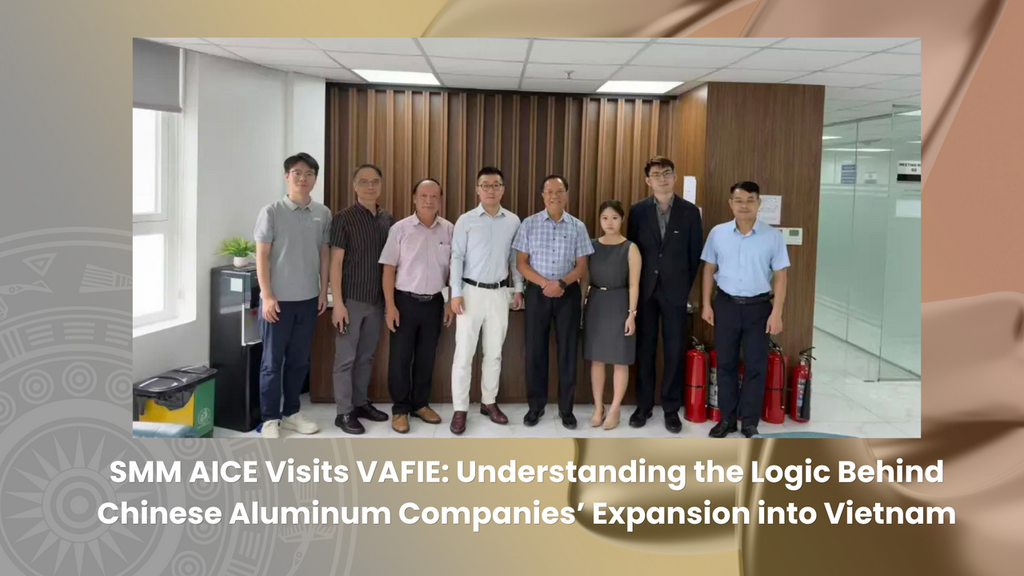 SMM AICE Visits VAFIE: Understanding the Logic Behind Chinese Aluminum Companies’ Expansion into Vietnam
On July 24, 2026, a delegation from Shanghai Metals Market (SMM) visited the Vietnam Association of Foreign-Invested Enterprises (VAFIE). The delegation included: Logan Lu, CEO of SMM Cason Lou, Director of Aluminum Processing, Marketing Department Lexi Chen, Key Account Manager for Overseas Information Sales Khai Yuen Chin, Senior Overseas Aluminum Analyst The delegation held in-depth discussions with VAFIE representatives on Vietnam’s investment environment, cooperation with local investment promotion authorities, business resource connections, and potential collaboration on industry forums. VAFIE noted that it has actively participated in international forums and exhibitions related to Vietnam’s aluminum industry in recent years. As an important organization connecting the Vietnamese government, local industrial parks, and international investors, VAFIE has extensive government and corporate resources in areas including bauxite development, alumina projects, aluminum processing and manufacturing, and related industrial investment promotion. It is also committed to supporting regional economic development and industrial growth across Vietnam. SMM introduced its continued engagement in Vietnam and the broader Southeast Asian market, including its work on developing local pricing systems, conducting industry research, organizing international forums, and connecting companies with relevant business resources. Since July 3, 2026, SMM has launched a series of new price assessments covering Southeast Asian 6063 aluminum billet processing fees and CIF Southeast Asia premiums and discounts. Among them, the Vietnam 6063 Non-Homogenized Aluminum Billet Processing Fee and related price assessment have officially been launched. Both sides agreed that, as Vietnam’s manufacturing sector and foreign investment continue to expand, Chinese and Vietnamese companies have significant potential for cooperation in industrial development, project investment, market intelligence, and international exchanges. They also expressed their intention to pursue deeper cooperation in the future. Understanding the Logic Behind Chinese Aluminum Companies’ Expansion into Vietnam 01 Companies Need More Than Customers — They Need a Local Gateway In recent years, an increasing number of Chinese aluminum companies have turned their attention to Vietnam. Some are exploring opportunities in industrial parks, some are seeking aluminum processing projects, while others are establishing local supply chains. However, after entering the Vietnamese market, many companies discover that finding customers is not necessarily the greatest challenge. The real difficulty lies in identifying a reliable local platform that can connect them with government authorities, regional resources, and suitable project opportunities. In the past, Chinese aluminum companies considering expansion into Vietnam mainly asked: Are operating costs low enough? Which part of Vietnam is most suitable for our business? Today, their priorities are changing: Does the local government support the project? Who can help us turn the plan into a successful local operation? For Chinese aluminum companies, those that establish strong local connections earlier will be better positioned to capture opportunities arising from Vietnam’s industrial upgrading and the restructuring of regional supply chains. 02 Competition Is Not Only About Finding Opportunities — It Is About Execution As more Chinese aluminum companies begin expanding into Vietnam, the country’s policy environment, approval procedures, project licensing requirements, and local investment promotion rules are also evolving. Future competition will not simply depend on who identifies an opportunity first. It will increasingly depend on which companies possess stronger local networks, more accurate policy insights, and more efficient project execution capabilities. This is also a key reason why SMM AICE continues to deepen its presence in Vietnam. Through ongoing visits to companies, industry associations, and government institutions across Vietnam and Southeast Asia, SMM AICE aims to establish more transparent market intelligence, industry research, and international exchange platforms. These efforts are designed to help Chinese aluminum companies assess the Vietnamese market more accurately, reduce decision-making risks, and improve their ability to implement projects successfully. To help more Chinese aluminum companies gain an early advantage and capture emerging opportunities in Vietnam, SMM AICE Vietnam is coming with a major industry gathering. At the conference, SMM will officially launch the SMM Vietnam Aluminum Price and provide a detailed explanation of its pricing methodology. Join the Conversation at SMM AICE 2026 Connect with aluminum producers, processors, traders, manufacturers, certification organisations, industry associations and decision-makers from across Southeast Asia and the global market. Explore aluminum pricing, primary aluminum supply, processing technologies, low-carbon development, CBAM compliance and new opportunities for regional cooperation. ? Ho Chi Minh City, Vietnam ? November 19–20, 2026 Register now: bit.ly/AICE26 and secure your Super Early Bird Pass and save up to USD 200. Register before August 31, 2026.
Aug 5, 2026 10:38- [SMM Cobalt Lithium Morning Meeting Summary] Raw Material Prices Diverge, While Industrial Demand Maintains Structural Support
[SMM Cobalt & Lithium Morning Call: Raw Material Prices Diverge, Industry Demand Maintains Structural Support] This week, industry chain prices showed divergence. Lithium ore, lithium chemicals, nickel chemicals and cobalt products were overall under pressure. Downstream procurement remained focused on long-term contract cargo pick-ups and essential restocking, and the market still held expectations of increasing supply and price declines in the long term. Cathode material side, ternary system prices pulled back along with raw material costs, while LFP and iron phosphate strengthened slightly, supported by order growth and cost support. Anode and separator markets held stable overall, and electrolyte moved up, driven by rising additive and solvent prices. Demand from energy storage, commercial vehicles and markets outside China maintained good performance, supporting continued growth in the industry's production schedules, but recovery on the consumption side remained relatively slow.
Aug 4, 2026 10:08 - Nuode Reports 113.33% Revenue Growth, Turns Profitable with H1 Net Income of 103M Yuan
Nuode (600110) disclosed its semi-annual report on July 30. H1 revenue was 6.433 billion yuan, up 113.33% YoY;net profit attributable to shareholders of the publicly listed firm was 103 million yuan, versus a loss of 72.4329 million yuan in the same period last year, marking a turnaround to profitability YoY; basic earnings per share was 0.0598 yuan.During the reporting period, the supply-demand pattern of the lithium battery copper foil industry experienced a complete reversal:outdated low-end capacity continued to exit the market, the rollout of new capacity in the industry slowed down, and combined with the surge in demand from both power batteries and energy storage, copper foil processing fees bottomed out. Leveraging its differentiated product portfolio of ultra-thin lithium battery copper foil and high-end electronic copper foil, the company successfully achieved a turnaround to profitability, with overall profitability improving significantly QoQ and YoY.
Aug 2, 2026 00:48  Warehouse Withdrawals Pull Back While Destocking Accelerates, the Logic of China’s Aluminum Ingot Destocking Changing?
As of July 30, China’s aluminum ingot inventory in major consumption areas stood at 953,000 mt. Cumulative destocking from the YTD high of 1.465 million mt in early May has reached 512,000 mt (-35%), with an additional accelerated destocking of 53,000 mt this week, breaking below the 1 million mt threshold as expected. However, the directional divergence between warehouse withdrawals and inventory has raised concerns...
Jul 31, 2026 23:53- Warehouse withdrawals pull back, but destocking accelerates — Is China's aluminum ingot destocking logic changing? [SMM Analysis]
As of July 30, China's major consumption regions reported aluminum ingot inventory of 953,000 mt, having cumulatively destocked 512,000 mt (-35%) from the year's high of 1.465 million mt in early May. Within the week, destocking accelerated further by 53,000 mt, as expected falling below the 1 million mt mark. However, the directional divergence between warehouse withdrawals and inventory drew attention: weekly warehouse withdrawals pulled back to 127,700 mt, losing the advantage of being at a high for the same period in the past four years. The core driving force of this destocking round has shifted from "demand and warehouse withdrawal boost" in June to "supply contraction + slowdown in shipment pace": the proportion of liquid aluminum rose to 78.3% in July, with casting ingot volume down 15.1% YoY; a sharp drop in arrivals in South China pushed Foshan's premium wider by 50 yuan/mt in a single week to 115 yuan/mt; SMM believes...
Jul 31, 2026 23:30 - LFP Industry Faces Supply Bottlenecks as Demand Surges, Cathode and Iron Phosphate Capacities Strained
Since July, demand across the LFP industry chain has continued to rise, but the supply-side response has lagged. The most notable feature of the current market is that supply tightness is rapidly transmitting from downstream to upstream, creating a cascading inversion of "battery cell production schedule > LFP cathode production schedule > iron phosphate production schedule."
Jul 31, 2026 19:11 - [SMM Analysis] LFP Material Demand Continued to Rise in July, with Supply-Demand Imbalance Emerging in the Industry Chain
[SMM Analysis] The demand along the LFP industry chain continues to rise, but the response from the supply side is significantly lagging. The most notable feature of the current market is that supply tightness is rapidly transmitting from the bottom up, forming a cascading inversion of "battery cell production schedule > LFP cathode production schedule > iron phosphate production schedule," with the slow release of LFP capacity and the iron phosphate industry segment having become the most prominent bottleneck in the entire chain.
Jul 31, 2026 18:47