

423results found for 'aluminum market'
Sort by : |
- Domestic and overseas aluminum diverge and consolidate to repair, Middle East tensions ease disrupting aluminum price risk premium [SMM Aluminum Morning Meeting Minutes]
[Aluminum Divergence Consolidation Recovery Inside and Outside China; Middle East Tensions Ease, Disturbing Aluminum Price Risk Premium] Overall, recent improvement on the macro front, interest rate hike expectations remaining on hold and easing the marginal constraints on the nonferrous metals sector, along with the continued rise in the proportion of liquid aluminum in China, have supported aluminum prices. However, the continued rollout of long-term aluminum capacity outside China, weak traditional end-use demand in China during the traditional off-season, and disturbances from Middle East geopolitical uncertainties are expected to result in aluminum prices consolidating on a strong note.
Aug 5, 2026 09:32 - Aluminum Inventory Buildup Combined with Forward Capacity Commissioning, Geopolitical Premium Supports Aluminum Price with Limited Rebound Space [SMM Aluminum Morning Meeting Minutes]
[Aluminum Inventory Buildup and Long-Term Capacity Commissioning; Geopolitical Premium Underpins Aluminum Price Rebound with Limited Room] Overall, the macro front has improved recently. The marginal constraint on the non-ferrous metals sector from expectations for US Fed interest rate hikes staying put has weakened. The proportion of liquid aluminum in China has continued to rise, and the geopolitical risk premium in the Middle East persists. These factors have jointly underpinned aluminum prices, and short-term market confidence has recovered somewhat. However, long-term aluminum capacity continues to come online outside China, traditional end-use demand in China remains weak during the traditional off-season, coupled with fluctuating expectations for US Fed interest rate hikes outside China and ongoing uncertainties in the Middle East geopolitical situation. Aluminum prices are expected to consolidate on a strong note, but upside resistance remains.
Aug 4, 2026 08:49 - PBOC Releases Easing Signals, Aluminum Price Upside Room Limited Amid Supply-Demand and Geopolitical Game [SMM Aluminum Morning Meeting Minutes]
[Central Bank Sends Easing Signals; Supply-Demand and Geopolitical Games Limit Aluminum Price Upside Room] Our comprehensive assessment shows that the macro front has improved recently, with the marginal constraints of interest rate hike expectations on the nonferrous metals sector continuing to ease. The proportion of liquid aluminum in China has kept rising. China’s central bank will implement accommodative monetary policies, step up counter-cyclical adjustments, and redouble efforts to expand domestic demand to steer the economy toward sustained, more favorable, and broader-based development. The persistent geopolitical risk premium in the Middle East has jointly underpinned aluminum prices, significantly boosting short-term market confidence. However, the ongoing commissioning of long-term aluminum capacity outside China, the recent softness in traditional end-use demand in China, combined with the repeated shifts in expectations for US Fed interest rate hikes and the uncertainties triggered by geopolitical turmoil in the Middle East, continue to exert certain pressure on the upside room for aluminum prices.
Aug 3, 2026 09:51 ![[SMM Analysis] Southeast Asia Aluminum Scrap Market Remains Range-Bound; ADC12 Stays Under Pressure, CBAM in Focus](https://imgqn.smm.cn/production/admin/votes/imageslvDRc20240314085754.png) [SMM Analysis] Southeast Asia Aluminum Scrap Market Remains Range-Bound; ADC12 Stays Under Pressure, CBAM in Focus
[SMM Analysis] Southeast Asia Aluminum Scrap Market Remains Range-Bound; ADC12 Stays Under Pressure, CBAM in FocusThe SEA secondary aluminum market remained mixed this week. Aluminum scrap prices were largely stable, while ADC12 remained under pressure due to weak downstream demand. Buying activity stayed cautious, although UBC scrap held firm on tighter supply and steady recycling demand. Market attention also shifted to the EU's Carbon Border Adjustment Mechanism (CBAM), with growing focus on carbon reporting, recycled content, and supply chain traceability as compliance requirements continue to evolve.
Jul 31, 2026 10:37- Expectations for US Fed interest rate hikes ease marginally, aluminum's continuous destocking underpins the market [SMM Aluminum Morning Briefing]
[Marginal Easing in Expectations for US Fed Rate Hikes, Continued Aluminum Destocking Underpins Market] Based on a comprehensive assessment, the macro front has improved recently; marginal constraints from rate hike expectations on the nonferrous metals sector continue to ease; the proportion of liquid aluminum in China keeps rising; the Middle East geopolitical risk premium continues to accumulate, while aluminum ingot destocking continues in China, collectively underpinning aluminum prices; and market confidence has strengthened markedly in the short term. However, the continuous rollout of long-term aluminum capacity outside China, weak traditional end-use demand in China, coupled with recurring expectations for US Fed rate hikes overseas and disturbances from uncertainties in the Middle East geopolitical situation, still exert some pressure on the upside room for aluminum prices. In the short term, aluminum prices consolidate on a strong note.
Jul 31, 2026 09:32 - Two Major Factors Boost Market Confidence, Short-Term Aluminum Prices Consolidate on a Strong Note [SMM Aluminum Price Weekly Review]
[SMM Aluminum Price Weekly Review: Two Major Factors Boosted Market Confidence, Short-Term Aluminum Price Maintained Consolidation on a Strong Note]
Jul 30, 2026 19:17 - The disturbance from expectations for US Fed interest rate hikes, coupled with the continuous destocking of China's social inventory, leads to aluminum prices maintaining a short-term consolidation pattern [SMM Aluminum Morning Minutes]
[Disturbances from Expectations for US Fed Interest Rate Hikes Combined with Continuous Destocking of China’s Social Inventory; Aluminum Prices to Maintain Consolidation Pattern in the Short Term] Overall, the continuous geopolitical risk premium in the Middle East, combined with continuous destocking of domestic aluminum ingots, jointly underpins aluminum prices. However, the continuous commissioning of long-term aluminum capacity outside China, weak traditional end-use demand in China, together with disturbances from recurrent overseas expectations for US Fed interest rate hikes and uncertainty in the Middle East geopolitical situation, exert significant pressure on the upside room for aluminum prices. In the short term, aluminum prices are expected to maintain a consolidation pattern.
Jul 30, 2026 09:44 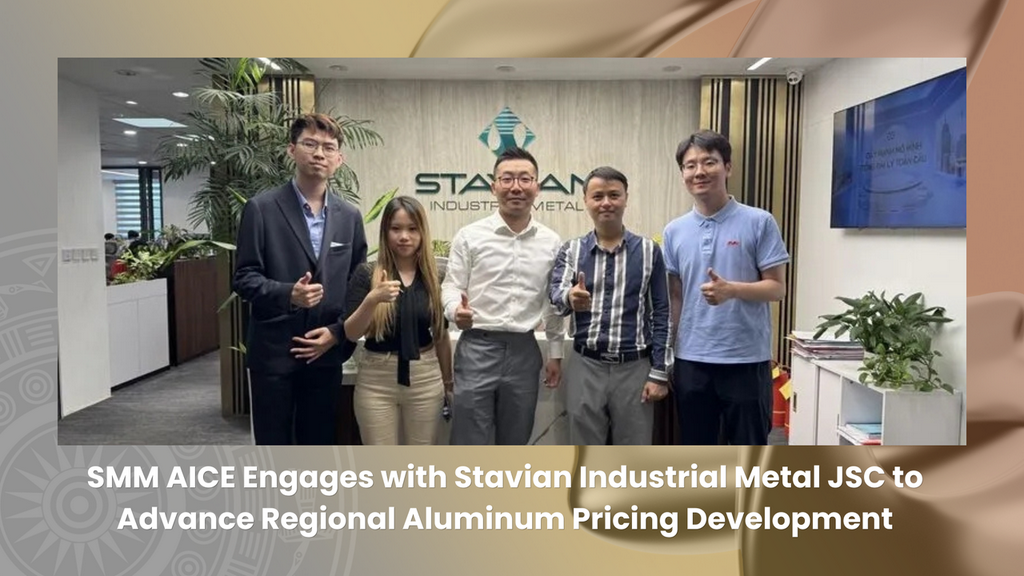 SMM AICE Engages with Stavian Industrial Metal JSC to Advance Regional Aluminum Pricing Development
On July 22, 2026, a delegation from Shanghai Metals Market Information Technology Co., Ltd. (SMM) held in-depth discussions with representatives of Stavian Industrial Metal JSC. The participants included: SMM Logan Lu, CEO of SMM Cason Lou, Director of Aluminum Processing, Marketing Department Lexi Chen, Key Account Manager for Overseas Information Sales Khai Yuen Chin, Senior Overseas Aluminum Analyst Stavian Industrial Metal JSC James (Nguyen Danh Vinh), Deputy Director of International Business Alex (Bui Trung Kien), International Business Representative The two sides exchanged views on the global aluminum market, the development of Vietnam’s aluminum industry, market information services, and the establishment of a regional pricing system, reaching broad consensus on several areas for future cooperation. Focusing on Southeast Asia and Exploring the Evolving Global Aluminum Industry Landscape SMM noted that in recent years, it has continued to expand its sourcing and sales network across Southeast Asia, establishing stable supply-chain connections in Vietnam, Thailand, Malaysia, Indonesia, and other markets. Its business covers multiple metal categories, including aluminum, steel, and copper, while the company continues to explore emerging market opportunities across Southeast Asia. At the SMM AICE 2026 Southeast Asia Aluminum Industry Conference, to be held in Ho Chi Minh City on November 19–20, SMM will officially launch the SMM Vietnam Aluminum Price and provide a detailed explanation of its pricing methodology. Against the backdrop of global supply-chain restructuring, evolving logistics patterns, and deepening regional trade, market demand for high-quality, in-depth, and timely market intelligence and reliable price references continues to rise. To address these needs, SMM has established a global presence across price assessments, market research, databases, consulting services, and international conferences. Its services cover major markets including China, Southeast Asia, Europe, the Americas, and Africa, providing professional market intelligence and data services to participants across the global industrial value chain. Advancing Vietnam’s Pricing System to Support Regional Industry Development SMM noted that aluminum trading in Southeast Asia still commonly references LME prices and the MJP Premium. However, as Vietnam’s manufacturing sector expands rapidly and domestic consumption continues to grow, demand is increasing for regional price benchmarks that better reflect local supply-and-demand fundamentals. Since July 3, 2026, SMM has officially launched the Vietnam 6063 Non-Homogenized Aluminum Billet Processing Fee and the SMM Vietnam 6063 Non-Homogenized Aluminum Billet Price , with both assessments updated daily on each trading day. (Resources come from the SMM official website) In recent years, SMM has continued to develop its global pricing system while accelerating its presence in Southeast Asia. By engaging directly with participants across the industrial value chain and establishing local price data collection networks, SMM is continuously improving its Vietnam market price assessment framework and providing the regional market with more open, transparent, and impartial price references. Representatives from Stavian Industrial Metal JSC expressed strong recognition of this direction and shared insights into the rapid development of Vietnam’s market in recent years. They noted that Vietnam’s aluminum trading volume continues to expand alongside growing domestic demand. Establishing a regional pricing system that more accurately reflects local market conditions would help improve transparency across the industrial value chain and support the healthy and sustainable development of the market. Stavian Industrial Metal JSC Founded in 2021, Stavian Industrial Metal JSC is a member of Stavian Group, one of Vietnam’s major multinational industrial groups. The company specializes in the trading, supply-chain management, processing and manufacturing, and industrial investment of industrial metals including aluminum, steel, copper, and zinc. Its business network spans more than 100 countries and regions worldwide, with the goal of becoming a leading integrated industrial metals service platform in Southeast Asia. In recent years, Stavian has continued to increase investment in Vietnam’s domestic industrial sector, gradually expanding beyond traditional metals trading into industrial investment and advanced manufacturing. Its key areas of development include: Industrial Park Development Stavian Group’s industrial park platform is advancing the development of green industrial parks in Vietnam, with major projects including industrial parks in Thai Nguyen Province and Hung Yen Province. These projects aim to attract industries including electronics manufacturing, machinery manufacturing, supporting industries, logistics, and food processing. They also incorporate ESG principles such as green energy, circular economy practices, and wastewater reuse, supporting Vietnam’s manufacturing upgrade and facilitating foreign investment projects. Green Metals Development The company is actively developing supply chains for green aluminum, green steel, and recycled metals while promoting the use of low-carbon metal materials. Carbon management and ESG principles have also been integrated into the company’s corporate strategy, with the goal of becoming a leading green metals distributor and carbon services provider in Southeast Asia. Major Industrial Cooperation Projects In recent years, Stavian has established strategic partnerships with major Vietnamese enterprises including Viet Hai Group and Dai Dung Group. These partnerships cover areas such as shipbuilding, steel structure engineering, machinery manufacturing, new energy infrastructure, and industrial projects, enabling the companies to jointly participate in major industrial and infrastructure developments across Vietnam. As one of Vietnam’s rapidly growing industrial metals companies, Stavian Industrial Metal JSC plays an important role in supporting the country’s manufacturing upgrade and strengthening its domestic industrial metals supply chain. It has also emerged as a representative local enterprise within Vietnam’s aluminum and broader industrial metals industry. Join the Conversation at SMM AICE 2026 Connect with aluminum producers, processors, traders, manufacturers, certification organisations, industry associations and decision-makers from across Southeast Asia and the global market. Explore aluminum pricing, primary aluminum supply, processing technologies, low-carbon development, CBAM compliance and new opportunities for regional cooperation. ? Ho Chi Minh City, Vietnam ? November 19–20, 2026 Register now: bit.ly/AICE26 and secure your Super Early Bird Pass and save up to USD 200. Register before August 31, 2026.
Jul 29, 2026 09:25- US-Iran Conflict Reignites, Disrupting Commodities; Geopolitical Premium Helps SHFE Aluminum Shoot Up on Heavy Volume [SMM Aluminum Morning Briefing]
[US-Iran Conflict Renews Disruption to Commodities; Geopolitical Premium Boosts SHFE Aluminum to Surge with Heavy Volume] Overall, the persistent Middle East geopolitical risk premium, combined with continued destocking of domestic aluminum ingots, jointly underpins aluminum prices; however, the continuous launch of overseas aluminum forward capacity, weak traditional end-use demand in China, along with repeated shifts in overseas expectations for US Fed interest rate hikes and uncertainties in the Middle East geopolitical situation, exert notable pressure on the upside room for aluminum prices. In the short term, aluminum prices maintain a consolidation pattern.
Jul 29, 2026 09:04 - 【SMM Aluminum Flash News】Norsk Hydro Warns of Deepening Aluminum Supply Gap Amid Gulf Tensions
On Friday, July 24, Norsk Hydro, a major European aluminum producer, said that the global aluminum market supply gap would deepen if shipping restrictions in the Strait of Hormuz continued. In an interview, Hydro CEO Eivind Kallevik stated that shipping conditions in this key waterway have deteriorated since the resumption of hostilities between the US and Iran, hindering the import of raw materials and the export of metals from the Persian Gulf region. Kallevik said the conflict in Iran has forced smelters in the Middle East, which account for nearly one-tenth of global aluminum production, to seek alternative logistics routes, while producers in other regions are increasing output. However, he indicated that if the conflict prolongs, the market supply gap will exceed the company's current estimate of 900,000 tons. "The situation is clearly deteriorating rapidly, and the longer the situation in the Gulf region continues, the more naturally the global market supply tension will intensify," Kallevik said.
Jul 28, 2026 17:19