

354results found for 'UBC'
Sort by : |
- [SMM Analysis] Imported Aluminum Scrap Rebounds; Southeast Asia Scrap Stable, ADC12 FOB Edges Higher
The Southeast Asian secondary aluminum market remained broadly stable this week. Aluminum scrap prices moved within a narrow range, while ADC12 domestic prices were largely unchanged and FOB offers edged higher on firm raw material costs. Meanwhile, imported aluminum scrap prices in China continued to rebound as import margins improved, with several cargoes reportedly scheduled to arrive in mid-August, providing additional support to market sentiment.
Aug 7, 2026 18:13 - Tungsten Spot Weak in Off-Season, Policy Expectations in China and Overseas Drive Sentiment Warming
【SMM Tungsten Analysis】 SMM August 6: On August 5, major Chinese tungsten enterprises released their long-term contract prices for the first half of August, among which the price for 55% wolframite concentrates was set at 412,000 yuan/mt, up 1,000 yuan/standard tonne from the second half of July, and the APT long-term contract price was simultaneously raised by 1,000 yuan/mt to 606,000 yuan/mt.
Aug 7, 2026 09:10 - Tight supply supports the rise in germanium prices, the minor metal sector strengthens, Yunnan Germanium and China Tungsten High-Tech lead the gains [SMM Flash]
SMM August 6 News: Germanium ingot in the spot market, driven by tight raw material supply, saw its price edge up slightly; leading tungsten enterprises slightly raised their long-term contract quotations. Meanwhile, the US Department of Commerce's Bureau of Industry and Security (BIS) on August 6, 2026, formally published in the Federal Register the interim final rule "Allocation Order and Additional Requirements for Recyclable Critical Minerals and Materials," under the Defense Production Act (DPA) and a presidential determination on July 30, 2026, imposing mandatory domestic sales controls on two types of critical recycled minerals: shredded tungsten scrap and lithium battery black mass. The rule will take effect on August 27, 2026, and remain valid until August 27, 2027, intensifying concerns about tight tungsten raw material supply outside China. As of now, activity in domestic spot tungsten transactions has shown some rebound, and the transaction center for spot tungsten ore orders has edged up slightly. Secondary market sentiment heating up boosted the minor metal sector, which collectively strengthened. As of the close on August 6, the minor metals sector rose by 2.08%. In terms of individual stocks: Yunnan Germanium surged over 8%, while China Tungsten High-Tech, Xianglu Tungsten, Xiamen Tungsten, Haotong Technology, and Orient Tantalum led the gains. Spot Market Germanium Order to View SMM Historical Metal Spot Prices Germanium is a strategic rare metal with a highly concentrated global supply structure. The ongoing implementation of domestic resource controls and frequent geopolitical disruptions outside China, combined with the normal enforcement of export control policies, have collectively reinforced supply tightening expectations. Currently, low-priced supply in the market is scarce, and downstream just-in-time procurement must accept high-priced materials, causing germanium ingot prices to edge up on August 6. Meanwhile, overall stable demand from end-use industries has provided support for the continuous rise in germanium prices this year. Tungsten Order to View SMM Historical Metal Spot Price Trends Currently, the tungsten ore market is operating steadily. A large tungsten enterprise slightly raised its long-term contract quotation, providing some support to market confidence. Meanwhile, the US Department of Commerce's Bureau of Industry and Security (BIS) on August 6, 2026, formally published in the Federal Register the interim final rule "Allocation Order and Additional Requirements for Recyclable Critical Minerals and Materials," under the Defense Production Act (DPA) and a presidential determination on July 30, 2026, imposing mandatory domestic sales controls on two types of critical recycled minerals: shredded tungsten scrap and lithium battery black mass. The rule will take effect on August 27, 2026, and remain valid until August 27, 2027, which has escalated market concerns about tight tungsten raw material supply outside China. As of now, activity in domestic spot tungsten transactions has shown some rebound, and the transaction center for spot tungsten ore orders has edged up slightly. On the domestic front, the market is reassessing the impact of the "Opinions of the National Mine Safety Administration on Standardizing Construction Teams for Metal and Non-Metallic Mine Mining (Stripping)" on the non-coal mining industry. The document requires that by May 1, 2027, for underground mines and by May 1, 2028, for open-pit mines, one of two options must be chosen: ① establish an in-house mining team; ② engage in compliant integrated contracting; fragmentary subcontracting and layered transfers are prohibited, and labor dispatch is strictly banned. Mines failing to complete rectification by the deadline will be ordered to suspend production for rectification. Domestic tungsten mines are primarily underground, with the vast majority of wolframite extracted through underground mining, and some scheelite extracted through both open-pit and underground methods. In tungsten-rich regions such as Jiangxi and Hunan, a large number of small and medium tungsten mines have long been highly dependent on external contracted mining teams. The implementation of the new regulation will impose tangible constraints on tungsten ore supply, production costs, and the operations of small and medium mines. Recently, the spot tungsten ore market has started to become more active, with traders actively entering the market, while downstream smelters continue to maintain a wait-and-see sentiment. Overall, market sentiment has eased amid frequent mining policies and intensive safety inspections in Yunnan, Jiangxi, and Henan. Supply-side disruptions have increased, and if demand shows mild entry, the tungsten market is expected to see a turnaround. Institutional Voices Guojin Securities research report believes: Tantalum: Global tantalum resource supply is highly concentrated and frequently disrupted, while development of AI servers and advanced semiconductor manufacturing is expected to continue driving demand growth in tantalum capacitors, tantalum targets, and other areas. Against the backdrop of ongoing supply constraints and gradual demand release, the tantalum market is expected to shift from supply-driven to supply-demand resonance, pushing the tantalum price center further upward. Related equities: Oriental Tantalum, Guotai Group, Ximei Resources, Xinjinlu, Jiangwu Equipment. Minmetals Securities research report points out: Germanium accounts for 60% of applications in optical communications and satellite photovoltaics, making it an "AI computing power + space energy" metal. With its excellent refractive index control capability and radiation resistance, germanium has become a critical material for AI data center optical interconnects and low-earth orbit satellite photovoltaic systems. Looking at changes in demand structure, from 2020 to 2026, downstream germanium consumption grew from 160 mt to 240 mt, with optical communications' share rising to 40% and satellite photovoltaics' share to 20%, together accounting for 60% of total downstream demand. It is expected that 90% of demand growth contributions in 2027 will come from two high-boom sectors: AI hardware and satellite photovoltaics. Caitong Securities research report shows: With the explosive demand for AI computing power, the market size of indium phosphide, used as a chip substrate material, will continue to expand. Indium resources are scarce and subject to policy restrictions, and product prices have entered an upward channel. High-purity red phosphorus is a critically important semiconductor base material with high purification technology barriers. Against the backdrop of accelerated AI application deployment driving related infrastructure construction, the indium phosphide substrate industry chain is expected to see dual opportunities from demand growth and domestic substitution. Investors are advised to follow related enterprises with resource and technology advantages in indium phosphide, indium, and high-purity red phosphorus. Datong Securities research report shows that minor metals have embarked on an independent upward trend, with supply tightening and strategic attributes driving a valuation re-rating. The rare earth sector is front-running expectations of new regulations, with Myanmar ore imports disrupted and Pr-Nd oxide seeing tight spot supply and soaring prices. In tungsten and antimony, declining ore grades combined with environmental protection-driven production restrictions have widened supply gaps, while demand from photovoltaics and cemented carbides remains firm even in the off-season, with inventories at low levels. AI computing power and the communications industry are driving demand for gallium and germanium, and coupled with export control policies, overseas stockpiling has widened price spreads between Chinese and overseas markets. Scarce resources and financial attributes resonate, and the sector continues to attract capital favor.
Aug 6, 2026 19:18 - Zimbabwe Earmarks Chrome-Producing Regions for Dedicated Ferrochrome Hubs as H1 Mining Revenue Nears US$5.8 Billion
[SMM Express] Zimbabwe's Ministry of Mines and Mining Development used its three-day Mid-Term Strategic Planning Review Workshop in Kadoma this week to confirm that the country's mining sector generated approximately US$5.73 billion in export earnings during H1 2026 — gold contributing US$3.2 billion and other minerals a further US$2.53 billion through the Minerals Marketing Corporation of Zimbabwe — putting the sector on track to exceed 2025's record US$8.6 billion full-year total. Mines Minister Dr Polite Kambamura used the occasion to announce that government will establish regional beneficiation hubs aligned to each area's mineral endowment, with chrome-producing districts specifically earmarked to specialize in ferrochrome and chromium alloy production, while iron ore regions are directed toward steel. The announcement reinforces the trajectory already visible in Zimbabwe's chrome sector this year: a February 2026 ban on exporting unbeneficiated minerals, combined with policy requiring chrome mining titles above 100 hectares to be tied to ferrochrome furnace development, has been steadily pushing production and investment toward smelting rather than raw ore shipment. Formalizing that push into designated regional hubs — rather than leaving beneficiation to individual operator discretion — signals Harare intends to treat chrome-specific value addition as a structural, geography-based policy rather than a company-by-company negotiation. With the Chamber of Mines projecting 10% sector growth for 2026 and full-year export earnings potentially reaching US$7.5–11 billion, the coming months should show whether the hub concept translates into concrete furnace investment in Zimbabwe's chrome belt or remains, for now, a stated policy direction.
Aug 5, 2026 23:50 - 【SMM Flash】Middle East August Sulfur Contract Prices Released
KPC has set the August Kuwait Sulphur Price (KSP) at $865/mt FOB, down by $85/mt from the July KSP of $950/mt; QatarEnergy has kept its August Qatar Sulphur Price (QSP) unchanged at $890/mt FOB from July; ADNOC has kept its August official selling price (OSP) for the Indian subcontinent unchanged at $1,000/mt FOB Ruwais from July.
Aug 5, 2026 18:01 - New Mine Safety Regulations Tighten, Heating Up Supply Disruptions in Tungsten Concentrates Market
[Tungsten Express] SMM August 5 News: Today, the tungsten concentrate market remained stable, as the market re-evaluated the impact of the "Opinions of the National Mine Safety Administration on Regulating Excavation (Stripping) Construction Teams for Metal and Non-metal Production Mines" on the non-coal mining industry. The document requires that underground mines, by May 1, 2027, and open-pit mines, by May 1, 2028, choose one of two options: ① establish an in-house excavation team; ② outsource to a compliant integrated contractor; prohibit fragmented subcontracting and multi-level subcontracting; ban labor dispatch underground; and mines that fail to complete rectification by the deadline will be ordered to suspend production for rectification. China's tungsten mines are primarily underground (most wolframite mines are underground, while some scheelite mines are open-pit or underground). The main producing regions of Jiangxi and Hunan have a large number of small and medium-sized tungsten mines that have long heavily relied on external excavation subcontracting teams, imposing substantial constraints on the supply side, cost side, and the survival of small and medium-sized mines. Meanwhile, in the past two days, trading in the tungsten concentrate spot market began to turn active, with traders entering actively. Yesterday, a mine in Guangdong auctioned low-grade ore, and all 156 standard tonnes were sold. Downstream smelters remained cautious, awaiting guidance from today's long-term contract prices. Overall, the market was stimulated by frequent mining policies and intensive safety inspections in Yunnan, Jiangxi, Henan, and other regions, easing market sentiment, while supply-side disruptions intensified. If demand enters the market moderately, the tungsten market will see a turnaround.
Aug 5, 2026 10:57 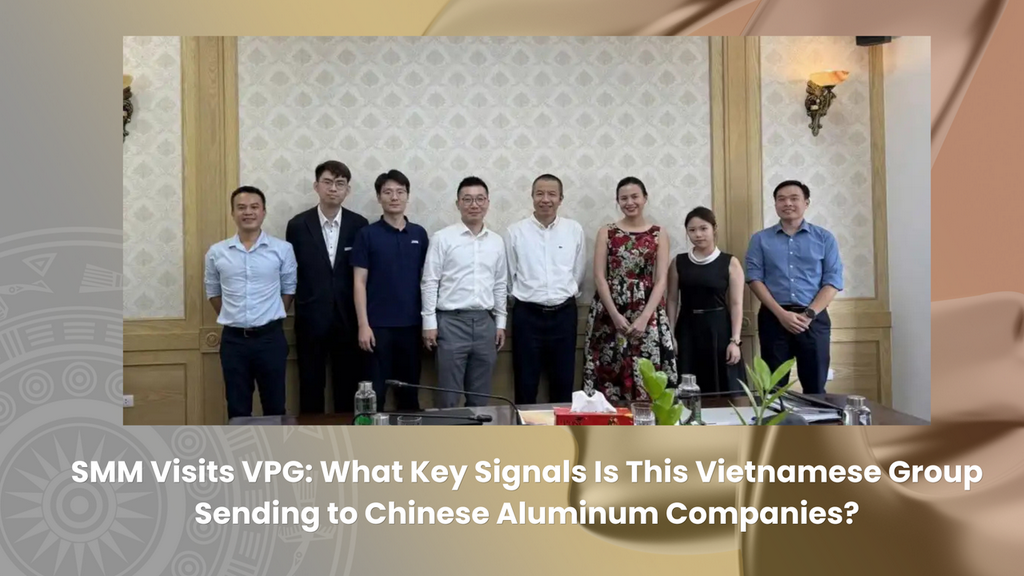 SMM Visits VPG: What Key Signals Is This Vietnamese Group Sending to Chinese Aluminum Companies?
On July 23, 2026, a delegation from Shanghai Metals Market Information Technology Co., Ltd. (SMM) visited VPG (Viet Phuong Group). The delegation included: Logan Lu, CEO of SMM Cason Lou, Director of Aluminum Processing, Marketing Department Lexi Chen, Key Account Manager for Overseas Information Sales Khai Yuen Chin, Senior Overseas Aluminum Analyst The two sides held in-depth discussions on bauxite resource development in Southeast Asia, alumina project development, regional logistics networks, and the development of a Vietnam-based aluminum pricing system. SMM noted that as the global aluminum value chain continues to restructure, China’s alumina market is expected to see sustained demand for overseas resources. Given resource availability and cost considerations, high-quality overseas alumina resources—particularly those from Vietnam and other Southeast Asian markets—are expected to gain greater market potential and competitive advantages. VPG shared updates on the progress of its current projects and said it is actively advancing mineral processing and alumina projects, with Southeast Asia and other international markets set to become key areas of future development. Since 2008, VPG has been engaged in bauxite exploration and development in Sekong Province, Laos, and is currently advancing an integrated industrial project covering bauxite mining, mineral processing, and alumina production. Both sides agreed that establishing an open, transparent, and regionally representative local aluminum pricing system would help improve information transparency and strengthen the international influence of Southeast Asia’s aluminum value chain. They also expressed expectations for deeper cooperation in market research, pricing services, and industry exchanges. What Signals Does SMM’s Visit to VPG Send to Chinese Companies? 01 Vietnam Is Becoming an Important Hub Connecting the Global Aluminum Value Chain In recent years, an increasing number of international companies have viewed Vietnam as an important gateway connecting Southeast Asian resources with global markets. Supported by its established port infrastructure, rapidly expanding manufacturing sector, and growing international trade network, Vietnam is not only benefiting from the relocation of global manufacturing capacity but is also emerging as an important regional hub for the aluminum value chain. For Chinese companies seeking opportunities in Southeast Asia, Vietnam is gradually evolving from an “investment destination” into a “supply chain partner.” 02 Vietnam’s Rapid Market Growth Is Creating New Export Opportunities With free trade agreements such as the EU-Vietnam Free Trade Agreement (EVFTA) taking effect, Vietnam has become a strategic sourcing hub for aluminum products used in the solar industry, including aluminum profiles and PV module frames, with export growth exceeding 20%. EVFTA tariff benefits for EU buyers, together with US Section 301 tariffs, have also encouraged some international buyers to shift sourcing toward Vietnam. Meanwhile, Vietnam aims for electric vehicles to account for 50% of urban vehicles by 2030. As electric vehicles use nearly 30% more aluminum than conventional vehicles, growing EV adoption could generate significant additional aluminum demand. This widening demand gap is expected to create substantial opportunities for aluminum suppliers and exporters. Against this backdrop, SMM AICE is expanding internationally by bringing its conference to Vietnam. The event aims to establish an authoritative platform connecting Chinese aluminum companies with Vietnam and the broader Southeast Asian market, promoting the transition of China-Vietnam aluminum cooperation from “resource complementarity” toward “full-value-chain cooperation and mutual growth.” 03 Future Competition Will Be About Information, Not Just Opportunities Vietnam’s market continues to develop rapidly. At the same time, market rules, policies, cost structures, and pricing mechanisms are constantly evolving. For Chinese companies, identifying projects alone is no longer enough. Timely access to local policies, industry development trends, supply chain changes, and market pricing information is becoming increasingly important. This is also why SMM continues to deepen its presence in the Vietnamese market. Recently, SMM AICE has been conducting intensive visits across Vietnam and the broader Southeast Asian industrial value chain, maintaining close communication with government authorities, industry associations, mining companies, alumina producers, aluminum processors, and other market participants. Through more transparent market intelligence and pricing systems, SMM aims to help global companies better understand market dynamics and reduce decision-making risks. To help more aluminum companies seize emerging opportunities and establish an early presence in the Vietnamese market, SMM AICE Vietnam is coming to Vietnam with a major industry gathering. VPG — Viet Phuong Group Founded in 1996, VPG (Viet Phuong Group) is a well-established diversified investment group in Vietnam, with businesses spanning mining, energy, infrastructure, finance, real estate, and other sectors. Mining is one of the group’s key strategic businesses, with projects involving mineral resources including bauxite, rare earths, and quartz sand. In the aluminum sector, VPG has been engaged in bauxite exploration and development in Sekong Province, Laos, since 2008. The group is currently advancing an integrated project covering bauxite mining, mineral processing, and alumina production. Leveraging Vietnam’s established port infrastructure and regional logistics network, VPG plans to export alumina products to China and other global markets through the Laos–Vietnam cross-border logistics corridor, further integrating into Southeast Asia’s aluminum supply chain. In recent years, the company has continued to advance project development, international cooperation, and market expansion, with the ambition of building a regional aluminum industry platform spanning resource development, alumina production, and international trade. Join the Conversation at SMM AICE 2026 Connect with aluminum producers, processors, traders, manufacturers, certification organisations, industry associations and decision-makers from across Southeast Asia and the global market. Explore aluminum pricing, primary aluminum supply, processing technologies, low-carbon development, CBAM compliance and new opportunities for regional cooperation. ? Ho Chi Minh City, Vietnam ? November 19–20, 2026 Register now: bit.ly/AICE26 and secure your Super Early Bird Pass and save up to USD 200. Register before August 31, 2026.
Aug 3, 2026 16:42- [SMM PV News] New Breakthrough in Perovskite–Organic Tandem Solar Cell Research
The team led by Academician Li Yongfang and Researcher Meng Lei at the Institute of Chemistry, Chinese Academy of Sciences, recently successfully fabricated high-performance perovskite–organic tandem solar cells, achieving a steady-state photoelectric conversion efficiency of 28.04% and marking a key step toward practical application. The result has been published in the international academic journal *Nature*. Perovskite–organic tandem solar cells are constructed by stacking a wide-bandgap perovskite subcell and a narrow-bandgap organic subcell in series, allowing them to absorb sunlight across different wavelength bands and thus break the efficiency limit of single-junction solar cells. The efficiency improvement of such cells has long been hindered by issues such as large voltage loss in the wide-bandgap perovskite front subcell and insufficient stability. To address the efficiency challenge, the research team proposed a “full-stage regulation” strategy, designing and introducing photoconvertible additive molecules that promote uniform mixing of perovskite components, bind more firmly to the perovskite surface, and effectively suppress phase segregation under illumination.
Aug 3, 2026 11:43 - Cost-driven price strength, heatwave holidays drag demand, ADC12 gains capped [Aluminum Scrap and Secondary Aluminum Weekly Review]
[Scrap Aluminum and Secondary Aluminum Weekly Review: Cost-Driven Price Strengthening, High-Temperature Holiday Drags Demand, ADC12 Gains Constrained] This week, ADC12 market prices first stabilized and then rose. SMM ADC12 prices held steady at 24,000 yuan/mt early in the week, were raised for two consecutive days mid-week driven by costs, and stood at 24,200 yuan/mt as of Thursday, up 200 yuan/mt from last Thursday. The cost side remained the core driver of this week's price increase.
Jul 31, 2026 14:13 - [SMM Cobalt Morning Meeting Minutes] New Energy Industry Chain Demand Differentiation, Market Awaits Gradual Recovery in Peak Season
This week, the industry chain exhibited a diverging pattern, with upstream raw material and cobalt salt prices weakening while midstream and downstream material prices remained relatively stable. Trading in refined cobalt, intermediate products, cobalt sulphate, cobalt chloride, Co3O4, and cobalt powder was generally sluggish. Downstream buyers mostly maintained just-in-time procurement, as off-season demand was insufficient, and inventory pressure along with low-priced supply continued to weigh on market prices. Although some miners and smelters, supported by high-cost inventory, still intended to hold prices firm, traders and recycling companies became more active in selling, and the decline in the cost of refined cobalt reverse dissolution further strengthened market expectations of pushing for lower prices. In the short term, related product prices still face downward pressure. Ternary cathode precursor, ternary cathode material, and LCO prices remained stable overall. Leading ternary cathode precursor companies performed well in export orders, and domestic production schedules recovered somewhat, but small and medium-sized enterprises were still affected by the off-season. Demand for ternary cathode materials from the EV sector stayed at a high level; some battery cell enterprises stockpiled in advance, and August orders are expected to be stable with slight growth. Consumer-side demand remained mediocre. Affected by sluggish end-use demand and substitution by ternary cathode materials, LCO production and sales remained low, further narrowing enterprises' profit margins. Subsequent market recovery will still depend on the restocking pace in mid-to-late August and the release of demand during the September-October peak season.
Jul 31, 2026 10:43