

54results found for 'Technical standards'
Sort by : |
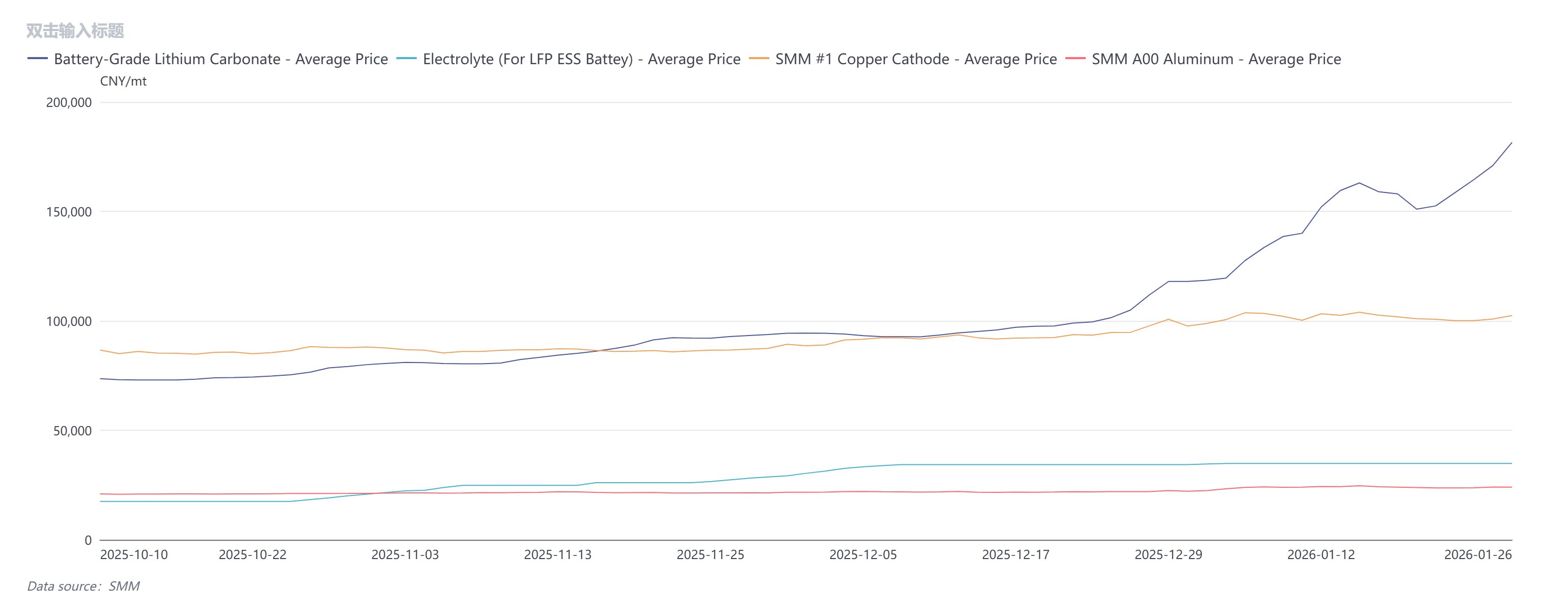 China Huadian Launches 12 GWh Energy Storage Tender, Linked to SMM Lithium Prices
China Huadian launched a 12 GWh energy storage tender for 2026, explicitly requiring ≥314Ah cells. The contract uniquely links pricing to SMM’s lithium carbonate index to manage market volatility. With bids opening February 11, 2026, this tender cements 314Ah technology and SMM benchmarks as the new standard for utility-scale projects.
Feb 6, 2026 14:42- Li Auto, Shell forge strategic partnership to drive global expansion, innovation in energy solutions
The agreement marks the beginning of an in-depth, full-chain partnership encompassing lubricant supply and services, joint technology development, brand collaboration, and global market expansion.
Jun 17, 2025 22:54 - XCMG Signs Mining Equipment Cooperation Agreement with BHP
[XCMG and BHP Sign Global Framework Agreement on Mining Equipment Supply] On June 10, XCMG and BHP, a globally renowned resources company, signed a global strategic cooperation framework agreement in Xuzhou. Based on the highly aligned concepts of technological innovation and sustainable development between the two parties, they jointly embarked on a new era of strategic cooperation in the field of green and intelligent mining. According to the framework agreement, the two parties will engage in in-depth cooperation across multiple dimensions, including joint equipment R&D, full life cycle management, and the construction of localized service systems. XCMG will fully leverage its professional strengths in the R&D and manufacturing of large-scale mining equipment, collaborating with BHP to explore and develop green and intelligent mining equipment that meets the highest international technical standards, safety specifications, and sustainable development requirements. Together, they will build a new generation of mining operation systems that are safe, efficient, and environmentally friendly.
Jun 17, 2025 09:00 - [SMM Analysis] Automakers' Payment Terms Shortened to 60 Days, Ushering in Major Changes in the Automotive Supply Chain
Since the "Regulation on Ensuring Payments to Small and Medium-sized Enterprises" officially came into effect on June 1, 2025, the automotive industry has responded swiftly. Seventeen mainstream automakers, including GAC, FAW, Dongfeng, and BYD, have publicly committed to uniformly shortening the payment terms for suppliers to within 60 days. This seemingly simple adjustment to payment terms is actually reshaping the underlying logic of the automotive supply chain. Especially for upstream battery cell manufacturers, its impact has gone beyond the level of capital turnover, touching the core lifeline of industrial development.
Jun 16, 2025 13:42 - Decoding the Integration of Domestic and Foreign Trade: Foreign Trade Enterprises Remain Enthusiastic About Expanding Domestic Sales; How to Overcome the Bottlenecks and Pain Points?
"Through the 'China's Premium Foreign Trade Products Nationwide Tour,' we discovered that the domestic market potential is greater than expected," said a staff member from the marketing department of Tianjin Hanjiang Technology Co., Ltd. to a Cailian Press reporter. Recently, the 4th China-CEEC Expo & International Consumer Goods Fair (hereinafter referred to as the CEEC Expo) was held in Ningbo, Zhejiang. Cailian Press noted that this year's CEEC Expo featured a dedicated zone for the "China's Premium Foreign Trade Products Nationwide Tour," showcasing over 100 high-quality foreign trade products such as smart home appliances, helping export enterprises expand into the domestic market. Currently, nearly a month has passed since China and the U.S. issued the Geneva Joint Statement and agreed to a 90-day tariff window period. Beyond accelerating export shipments, foreign trade companies remain enthusiastic about expanding domestic sales. Recently, the Ministry of Commerce held a regular press conference, where spokesperson He Yongqian stated that efforts will be made to successfully organize the "China's Premium Foreign Trade Products Nationwide Tour," facilitating procurement collaborations between associations, supermarkets, e-commerce platforms, and export enterprises, and encouraging more companies in sectors like automobiles, home appliances, and home furnishings to join the "trade-in" policy. He Yongqian emphasized deepening the pilot program for integrated domestic and foreign trade to enhance companies' capabilities in operating across both markets and better address external risks and challenges. Faced with an external environment marked by increasing complexity, severity, and uncertainty, China's vast domestic market serves as a strong backing for export enterprises. The commerce authorities are taking multi-faceted measures to support companies in exploring diversified international markets while helping them better leverage the domestic market to effectively cope with external shocks and challenges. Industry experts believe that more companies are realizing that integrated domestic and foreign trade operations are not merely about clearing inventory but represent a crucial means to expand development space, reshape market competitiveness, and meet the inevitable requirements for building a new development paradigm and promoting high-quality growth. Leveraging the "China's Premium Foreign Trade Products Nationwide Tour," Export Enterprises Maintain Strong Interest in Expanding Domestic Sales Recently, the "2025 Shandong Foreign Trade Premium Products Shopping Season" and the "China's Premium Foreign Trade Products Nationwide Tour" Shandong Station event kicked off at the Shandong International Convention and Exhibition Center, where over 400 export enterprises participated in exhibitions and sales, sparking a consumption boom. To further assist export enterprises in tapping into the vast domestic market, the Shandong Department of Commerce unveiled the "Five Empowerment Actions" plan, covering policy, mechanism, channel, financial, and brand support, to smoothen domestic sales channels for export enterprises and stabilize foreign trade while boosting consumption. Wang Lei, Director of the Shandong Department of Commerce, stated during the event that efforts will focus on key industries such as electronics, home appliances, and home furnishings, guiding retailers participating in the consumer goods trade-in policy to actively engage with export enterprises and include eligible products in the policy support scope. A reporter from Cailian Press learned from the Department of Commerce of Shandong Province that, in order to effectively respond to changes in the international trade environment and accelerate the integration of domestic and foreign trade, the Department of Commerce, in collaboration with relevant departments, will fully organize and implement the "Five Major Initiatives" to empower foreign trade enterprises to expand domestic sales. Among these initiatives is the guidance for merchants involved in the trade-in of consumer goods, focusing on key industries such as electronics, appliances, home furnishings, and interior decoration, to actively connect with export enterprises and include products that meet standard requirements within the scope of policy support. Tianjin Hanjiang Technology Co., Ltd. has long been engaged in toll processing of small home appliances such as blenders and air fryers for European and American markets. Affected by fluctuations in overseas orders, the company is currently actively exploring the domestic market through the "China Tour for High-Quality Foreign Trade Products" campaign, and has seen a significant increase in orders in the first quarter of this year. A person in charge of the company's marketing department told a reporter from Cailian Press that through the "China Tour for High-Quality Foreign Trade Products" campaign, they have discovered that the domestic market has greater potential than expected. With the government providing the platform and enterprises taking the lead, the team now studies live-streaming e-commerce and community marketing every day, indicating that the path of transitioning from foreign trade to domestic sales is the right one. The Anhui leg of the "China Tour for High-Quality Foreign Trade Products" campaign was also recently launched. The event unveiled 100 new consumption scenarios, Anhui Province's boutique tourism routes, the economic situation of Anhui's first stores, and measures to assist foreign trade enterprises in expanding domestic sales. There were also 75 featured booths set up on-site, with simultaneous sales promotions organized for Anhui's high-quality foreign trade products, time-honored brands, popular online goods, and high-quality products from the Yangtze River Delta region, fostering a consumer-friendly atmosphere. The Hunan leg of the "China Tour for High-Quality Foreign Trade Products" campaign attracted over 600 exhibitors from more than 20 provinces and 15 countries, as well as over 2,000 domestic and foreign buyers. It is reported that in order to further stimulate the development momentum of the integration of domestic and foreign trade, Hunan Province will focus on cultivating 50 "Three Same" brand enterprises and 100 "Three Same" brand products this year. Shifting Focus: Foreign Trade Enterprises' Marketing Strategies Begin to Change Against the backdrop of increasing uncertainties in the external environment, China has taken the "China Tour for High-Quality Foreign Trade Products" campaign as a breakthrough point to accelerate the integrated development of domestic and foreign trade and assist foreign trade enterprises in exploring the domestic market. However, multiple challenges still need to be overcome during the promotion process. One of these challenges is the change in business strategies. China Pet Products Co., Ltd., located in Shandong, is a well-established pet food export enterprise. In recent years, with changes in the external environment and the rapid growth of the domestic pet market, China Pet Products has also shifted its focus to the domestic market, launching brands such as WANPY, LEADING TREATS, and ZEAL. "Our current marketing focus is definitely on the domestic market," a new media marketing staff member from the WANPY brand told a reporter from Cailian Press. "In the past, we mainly engaged in toll processing for pet food exports, which was primarily B2B business. Compared to the past, the biggest characteristic of the domestic market is the shift from B2B to B2C. For us, this change is significant. The company used to be very low-key in the domestic market, but now it recruits many liberal arts graduates like me. Xiaohongshu (Little Red Book) is our battlefield." Benefiting from the growth of its domestic business, China Pet Products Co., Ltd. achieved revenue of 4.465 billion yuan in 2024, up 19.15% YoY, and net profit attributable to shareholders of the parent company of 394 million yuan, up 68.89% YoY. A reporter from Cailian Press learned that the commerce department is introducing multiple measures to help foreign trade enterprises overcome challenges in expanding domestic sales. For example, in Shandong, a reporter from Cailian Press learned from the Shandong Provincial Department of Commerce that it is implementing a channel empowerment initiative, guiding large commercial chain enterprises to leverage their channel advantages, connecting with foreign trade enterprises, opening rapid response channels for qualified products, establishing dedicated "Premium Foreign Trade Products" sections and counters to enable rapid product listing and sales. In terms of online channels, a series of activities such as the "Premium Foreign Trade Products Cloud Shopping in Qilu" e-commerce promotion, national key e-commerce platforms entering foreign trade industrial belts, and "Premium Foreign Trade Products" selection and matching events have been launched. The "Shandong Premium Foreign Trade Products Pavilion" has been established to deliver more high-quality foreign trade products to the domestic market at e-commerce speed. Zhi Peiyuan, Vice President of the Investment Committee for Publicly Listed Firms of the Investment Association of China, suggested that in terms of digital tool application, foreign trade enterprises can leverage big data analysis on e-commerce platforms to understand consumer demand and purchasing behavior, enabling precise product selection and marketing. They can also optimize internal management processes and improve operational efficiency by utilizing Enterprise Resource Planning (ERP) systems. Zhan Junhao, a renowned strategic positioning expert and founder of Fujian Huace Brand Positioning Consulting, said in an interview with a reporter from Cailian Press that e-commerce platforms broaden sales channels for premium foreign trade products through traffic support and the establishment of dedicated sections, while offline exhibitions provide platforms for product display and exchange. In the future, an integrated online-offline model could be explored, such as combining 3D virtual exhibition halls with local sample rooms, or inviting internet celebrities to live-stream production processes while simultaneously launching promotional sections on platforms. Relevant Departments Promote Standard Alignment to Facilitate Export-to-Domestic Sales Transition Compared to changes in business strategies, standard discrepancies pose another challenge. There are certain differences between domestic and overseas standards, ranging from technical and quality standards for export products to inspection, quarantine, certification, and accreditation. When export products are redirected to the domestic market, how to comply with domestic market standards and obtain domestic certifications remains a challenge for many foreign trade enterprises. Shenzhen Xinshui Technology Co., Ltd., which has long exported Bluetooth headsets to European and US markets, decided to expand into the domestic market this year due to tariff fluctuations. "In the past, our products were mainly targeted at the European and US markets, meeting international certification standards such as CE and FCC. However, after shifting to the domestic market, we found significant differences in technical standards and certification processes between domestic and overseas markets. For example, domestic requirements for radio model approval (SRRC) and 3C certification (CCC) for Bluetooth headsets are not fully compatible with EU standards, which posed some compliance challenges for us in the initial stages," said Li Bing, the marketing manager of the company, to reporters. Li Bing told reporters that in order to quickly adapt to the domestic market demand, the company actively collaborated with domestic testing institutions to localize its products, including optimizing RF parameters and adjusting battery safety designs, to ensure compliance with GB national standards. Meanwhile, the company is also exploring the "same production line, same standards, same quality" model, enabling products for both domestic sales and exports to be produced under the same quality system, ensuring compliance and enhancing consumer trust. Cailian Press reporters learned that relevant departments are conducting surveys on the alignment of standards and certifications for foreign trade products, organizing comparisons between domestic and international standards to enhance consistency, removing bottlenecks for the domestic sales of export products, and creating a softer environment that better promotes the integration of domestic and foreign trade. For instance, in Shandong, Cailian Press reporters learned that the Shandong Provincial Department of Commerce has improved and refined the three-level (provincial, municipal, and county) collaborative linkage mechanism, dynamically investigating the situation of products facing export barriers. For key export enterprises, it has adopted a "one enterprise, one policy" approach, developing targeted support plans categorized by issue, and strengthening policy support and service guarantees to address difficulties and bottlenecks in market access, standard alignment, brand certification, and channel development. Zhu Keli, Executive Director of the China Information Industry Association and Founding Dean of the Guoyan New Economy Research Institute, said in an interview with Cailian Press reporters that resolving the deep-seated contradictions in transitioning from foreign trade to domestic sales requires the construction of a dual-circulation operating system. For example, the industrial product cross-border e-commerce platform being piloted in Suzhou is worth learning from. It disassembles the surplus capacity of export enterprises into customizable modules, allowing domestic buyers to combine their needs like assembling Lego blocks. This not only digests surplus capacity but also stimulates innovation among small and medium-sized enterprises. More importantly, it bridges the standard systems for domestic and foreign trade. The "same production line, same standards, same quality" certification promoted by Qingdao Customs enables products from a single production line to freely switch between international market access and domestic quality inspection labels. In the future, the cross-border industrial enclave model could be explored, encouraging platforms to establish demonstration bases for transitioning from foreign trade to domestic sales in bonded zones, leveraging cross-border e-commerce data chains to achieve global inventory sharing. This is the fundamental solution to addressing trade barriers.
Jun 10, 2025 08:37 - [SMM Hydrogen Energy Policy Express] National Energy Administration: Focus on Technological Innovation and International Cooperation to Accelerate Breakthroughs in China's Hydrogen Energy Industry
As the core carrier of the energy transition, the development of the hydrogen energy industry hinges on the in-depth drive of technological innovation and the broad expansion of global cooperation. Recently, the National Energy Administration released the "China Hydrogen Energy Development Report (2025)", highlighting that in 2024, China's hydrogen energy industry made significant progress in technological breakthroughs and international collaboration, entering a critical phase of sustained technological innovation, strengthened pilot demonstrations, and breakthroughs in industrial scale. I. Technological Innovation: From Breakthroughs in the Entire Value Chain to Building Industrial Competitiveness (I) Hydrogen Production Technology: From "Grey Hydrogen Dominance" to "Green Hydrogen Breakthrough" In the field of hydrogen production from renewable energy, China has formed a large-scale cluster advantage. By the end of 2024, the production capacity of hydrogen from renewable energy exceeded 120,000 mt. The commissioning of electrolytic water hydrogen production projects in Kuqa, Xinjiang, and Ningdong, Ningxia, marked the gradual industrial demonstration and verification of alkaline electrolyzer technology. Meanwhile, substantial breakthroughs were achieved in the key technologies of proton exchange membrane (PEM) electrolyzers, and pilot-scale seawater electrolysis hydrogen production units were put into trial operation, providing innovative solutions for the supply of offshore green hydrogen in coastal areas. Relevant technologies are expected to drive down the production costs of green hydrogen continuously, gradually approaching the economic inflection point for competing with grey hydrogen. (II) Storage and Transportation Technology: Building a Multi-Modal Storage and Transportation System of "Gas-Liquid-Solid" In the field of high-pressure gaseous hydrogen storage and transportation, 70 MPa Type IV hydrogen storage cylinders have achieved mass production. Hydrogen-blended natural gas pipelines have undergone demonstration operations in Inner Mongolia and Ningxia, verifying the feasibility of retrofitting existing natural gas pipelines for hydrogen blending. In liquid hydrogen storage and transportation, a 5 mt/day hydrogen liquefaction system has been successfully launched, with technical indicators approaching international advanced levels. Solid hydrogen storage and transportation technologies are advancing in parallel, with the hydrogen storage density of magnesium-based hydrogen storage materials continuously improving, and demonstration applications have been carried out in scenarios such as forklifts and drones. These breakthroughs have formed a multi-modal storage and transportation technology system of "gas-liquid-solid", which will effectively reduce hydrogen transportation costs and lay the foundation for optimizing regional hydrogen energy dispatch in the near term and cross-regional resource allocation in the long term. (III) Application Technology: Diverse Scenarios Spur Business Model Innovation In the industrial sector, hydrogen-based shaft furnace direct reduced iron (DRI) technology has achieved CO2 emission reductions of over 70% per ton of steel. The Ningdong Green Hydrogen Coupled Coal-to-Synthetic Ammonia Project in Ningxia has achieved 100% green electricity-supplied hydrogen. In the transportation sector, the driving range of fuel cell heavy-duty trucks has exceeded 1,000 kilometers, and a 2,400 kW hydrogen-powered shunting locomotive has completed a 10,000 mt loading test, marking the maturity of technology in the heavy-haul transportation sector. In the energy sector, megawatt-class pure hydrogen gas turbines have completed full-machine tests, and the efficiency of solid oxide fuel cell (SOFC) cogeneration systems continues to improve, providing efficient solutions for distributed energy and power grid peak shaving. Innovations in related applications have not only expanded the market space for hydrogen energy but also driven its transformation from an industrial raw material to a diversified energy carrier. (IV) Innovation Ecosystem: Dual-Driven by Platform Empowerment and Patent Layout At the national level, relying on platforms such as the "Hydrogen Energy Technology" key project and the Innovation Consortium for Green Hydrogen Production, Storage, and Transportation by Enterprises, China has continuously increased investment in scientific research, promoting breakthroughs in key technologies such as high-proportion consumption of renewable energy, off-grid and fluctuating operation of electrolyzers, efficient conversion of green hydrogen, and hydrogen-ammonia combustion. In local practices, innovation carriers in regions such as the Beijing-Tianjin-Hebei, Yangtze River Delta, and Pearl River Delta have accelerated the commercialization of technologies, achieving breakthroughs in patent layouts in areas such as hydrogen production equipment and fuel cells. Standardization efforts have also advanced in tandem, with the release of multiple energy industry standards, gradually establishing an innovation closed-loop of "technology R&D - pilot-scale maturation - standard certification." II. International Cooperation: From "Import and Absorption" to "Collaborative Expansion" (I) Project Collaboration: Building a Global Green Hydrogen Supply Chain Along the "Belt and Road" Initiative, Chinese enterprises have undertaken the engineering design and equipment supply for multiple landmark hydrogen energy projects, continuously expanding the electrolyzer equipment market. In regional cooperation, China and France have planned to jointly construct a demonstration project for a green energy-integrated offshore smart energy island featuring "wind, solar, hydrogen, and storage" in Dongtai, Jiangsu Province. Chinese and German institutions, relying on the "Governmental International S&T Innovation Cooperation" key project under the National Key R&D Program, have explored low-carbon development of green energy and mutual recognition of standards. These projects have not only facilitated the export of technologies and equipment but also promoted the establishment of a global hydrogen energy supply chain. (II) Technological Synergy: Breaking Through Global Common Technological Bottlenecks In terms of core technology breakthroughs, China and France have jointly conducted research on the safety technology for transoceanic liquid hydrogen transportation, addressing challenges in process control and risk identification for the maritime transport of liquid hydrogen tank containers. China and Germany have collaborated to develop hydrogen internal combustion engine power generation technology, providing a new path for distributed energy. Relevant enterprises from China, Japan, and South Korea have achieved cooperation in the field of fuel cells, promoting deep integration of the industrial and supply chains. In the formulation of international standards, China has contributed "Chinese solutions" to multiple international standards, including the "Test Methods for Power Performance of Fuel Cell Electric Vehicles," driving the shift in technological discourse power from "following" to "keeping pace." (III) Equipment Trade: Building a Global Manufacturing Hub With a complete industry chain, China has become the world's largest exporter of electrolyzers, accounting for nearly half of the international market share. In the field of hydrogen refueling station equipment, domestically produced 70MPa hydrogen dispensers have passed relevant EU certifications and entered the market. Hydrogen storage vessels have provided key equipment for hydrogen energy projects in countries such as Australia and Chile. More notably, Chinese enterprises are transitioning from single equipment exports to a general contracting model of "technology + engineering + services," providing full-chain solutions for "production, storage, transportation, and utilization," driving the integrated go-global efforts of domestic equipment, materials, and engineering services, and establishing an international brand of "China's hydrogen energy manufacturing." III. Addressing Challenges: Strategic Anchors for Future Development Technological innovation is the core driving force for the development of the hydrogen energy industry, and international cooperation is the inevitable path to expand development space. The hydrogen energy industry is at a historical juncture of "technological breakthroughs" and "global layout." However, on the whole, the global hydrogen energy industry is still immature. China needs to overcome obstacles such as the commercialization of hydrogen energy technological achievements, the synergy of innovation resources, and the coordination of policy and market to support hydrogen energy technological innovation and high-quality industrial development. First, strengthen "scenario-oriented" technological breakthroughs. Targeting the three main battlefields of industry, transportation, and energy, carry out targeted R&D to continuously reduce application costs. Drive technological innovation through scenario demands and form a virtuous cycle of "R&D - demonstration - iteration." Second, build a "dual circulation" cooperation pattern. In terms of "bringing in," innovate the international hydrogen energy talent mechanism and introduce top overseas teams. In terms of "going global," rely on the Belt and Road Initiative to establish a hydrogen energy partnership network, export China's technical standards and project management experience, set up overseas R&D centers, and achieve localized technological innovation. Third, improve the policy empowerment and market synergy mechanisms. Incorporate hydrogen energy into the planning of the "new-type energy system," innovate the priority consumption mechanism for green hydrogen, and promote the realization of green value. Optimize the market access mechanism and promote the improvement of hydrogen energy project management policies in various regions. Through precise policy empowerment, reduce the risks of market entities and accelerate the industrial scaling-up process. Through technological innovation breakthroughs and international cooperation expansion, China's hydrogen energy industry has entered a critical stage of development. In the future, it is necessary to drive technology with scenarios and empower the market with policies to promote hydrogen energy as the core pillar of energy transformation and contribute China's wisdom and solutions to the global energy transformation.
Jun 5, 2025 14:18 - Jiangsu Xingcheng New Materials Co., Ltd. Helps Create the "2026 China Copper Alloy Materials Sourcing Guide"
As a critical material in fields such as aerospace, integrated circuits, and high-speed rail transportation, high-end copper alloys have increasingly prominent strategic significance. Despite China's copper semis production and consumption ranking first globally for consecutive years, with a self-sufficiency rate of 96% for general copper semis, high-end copper alloy products still heavily rely on imports. To address this "chokepoint" challenge, SMM recently launched an initiative for industrial resource integration. Collaborating with upstream and downstream enterprises in the industry chain, as well as research institutions, it meticulously compiled the "2026 China Copper Alloy Materials Sourcing Guide" , aiming to advance the localisation process of high-end copper alloy materials and facilitate the transition from a "major material producer" to a "leading material powerhouse." Jiangsu Xingcheng New Materials Co., Ltd. actively participated in the joint compilation of the sourcing guide as a partner, jointly promoting the healthy and rapid upgrading of China's copper alloy materials industry chain. Jiangsu Xingcheng New Materials Co., Ltd. , located in Xinghua City, Jiangsu Province, renowned as the "Land of Fish and Rice," is a private technology enterprise integrating the R&D, production, processing, and sales of alloy products. It has been recognized as a high-tech enterprise and a specialized, sophisticated, unique, and innovative enterprise. Situated in the Diduozhen Industrial Concentration Zone, the company has a registered capital of 58 million yuan, a factory area spanning over 20,000 m², and a total investment of several hundred million yuan. It produces 10,000 mt of various high-precision copper alloy materials annually. Currently, it employs over a hundred staff members, with technical and managerial personnel accounting for approximately 30% of the workforce. Over the years, the company has consistently adhered to the principle of "pursuing development through technology and survival through quality," continuously optimizing its products. Simultaneously, it emphasizes the recruitment and nurturing of various professional and technical talents, establishing a high-caliber R&D team. It increases investment in training to enhance employee quality and adopts modern management concepts to provide the driving force for the company's development. The company strictly adheres to the ISO9001 quality management standard and upholds the quality policy of "building Xingcheng with quality and achieving the future with innovation." In its future development, it will continue to provide superior products to domestic and foreign customers with an honest and pragmatic approach. The company is a professional enterprise primarily engaged in the R&D and production of copper-based alloy materials, boasting a professional technical service team. It has been successively recognized as a national high-tech enterprise, a national-level technology-based small and medium-sized enterprise, a provincial specialized, sophisticated, unique, and innovative small giant enterprise, a provincial enterprise technology center, and a provincial private technology enterprise, among others. It offers high-quality materials and after-sales services to customers. Main products: copper strip, copper foil, copper plate, copper billet, copper wire, etc. The company maintains a substantial inventory throughout the year, providing high-precision slitting, film coating, electroplating, and other services. It possesses various precision detection instruments, and its production standards comply with technical standards such as European, Japanese, and American standards. Main equipment: melting furnace, milling machine, annealing furnace, cold rolling mill, slitting machine, laminating machine, etc.; equipment for quality detection: microhardness tester, high-temperature test chamber, conductivity meter, surface roughness tester, salt spray test chamber, tensile elongation machine, direct-reading spectrometer, etc. Product Introduction Cultural Philosophy Contact Information Wang Minglong 138 0142 3955 Click here to get the "2026 China Copper Alloy Material Procurement Guide" for free SMM Contact Person Huang Yizhe 139 5899 2666 huangyizhe@smm.cn
Jun 3, 2025 14:12 - SAIC-GM-Wuling rolls out 3 millionth NEV globally, strengthens Indonesian presence
On May 23, SAIC-GM-Wuling celebrated the production of its 3 millionth new energy vehicle (NEV) globally at a ceremony held at its Indonesian plant.
May 26, 2025 21:05 - 【SMM analysis】2025 Lithium Battery Recycling Industry Policy Analysis
The 2025 lithium battery recycling policies emphasize a dual logic of "regulation + incentives". By raising technical thresholds, strengthening full-lifecycle management, and increasing fiscal support, the policies aim to transition the industry from fragmented competition to high-quality development. Subsidies and relaxed import/export conditions are expected to alleviate long-term economic imbalances in the recycling sector.
May 25, 2025 23:29 - [SMM Analysis] Overview of the Latest Policies on Lithium Battery Recycling in 2025: Several Key Periods Worth Noting
According to SMM analysis, the core logic of the lithium battery recycling policy in 2025 is "regulation + incentives". By raising technical barriers, strengthening full life cycle management, and increasing financial support, the industry will be driven to shift from extensive competition to high-quality development. Meanwhile, by providing subsidies and liberalizing import and export conditions, the long-term inverted pricing phenomenon in the current recycling industry can be mitigated to a certain extent.
May 24, 2025 23:20