

45results found for 'MJP'
Sort by : |
 Q3 MJP Hits Record High as Mounting Pressure Weighs on SE Asian Aluminium Billet Transactions in July【SMM Analysis】
As of July 24, premiums for 6063 aluminium billet across major Southeast Asian markets remained broadly stable throughout July, with no adjustments recorded for four consecutive weeks. The ex-works premium for homogenised 6063 aluminium billet in Cambodia averaged $300/mt, while premiums for homogenised billet in Malaysia and Thailand both stood at $262.5/mt. The ex-works premium for non-homogenised 6063 aluminium billet in Thailand was assessed at $222.5/mt, compared with $205/mt in Vietnam. Meanwhile, the CIF Thailand premium for Chinese exports of non-homogenised 6063 aluminium billet was assessed at a range of minus $100/mt to plus $100/mt, with a midpoint of $0/mt. In terms of price movements, premiums for homogenised 6063 aluminium billet in Thailand and Malaysia had already retreated from their previous highs in June compared with May, before stabilising in July. However, stable premiums did not indicate an improvement in market demand. The 2026 Q3 MJP was settled at $395/mt, up $43.50/mt, or approximately 12.4%, from $351.50/mt in Q2, reaching a historical high. As reference prices for Southeast Asian aluminium billet are generally calculated based on the LME Official Cash Settlement, MJP and the applicable premium, the higher MJP further raised the overall procurement cost of locally produced billet and weighed on downstream purchasing interest. At the same time, Chinese aluminium billet exports continued to compete with locally produced material in Southeast Asia. In Thailand, for example, the CIF premium for Chinese non-homogenised 6063 aluminium billet was assessed at minus $100/mt to plus $100/mt, substantially below the ex-works premium of $222.5/mt for locally produced non-homogenised billet. Although the delivery terms and detailed cost structures of the two types of material are not directly comparable, Chinese export cargoes continued to hold a clear price advantage on a delivered basis. According to SMM market research, some Chinese export cargoes consisted of remelted secondary aluminium billet, which carries relatively lower production costs. Other cargoes were processed from imported materials before being re-exported, resulting in a cost structure different from that of conventional export trade. Supported by these cost advantages, purchases of Chinese aluminium billet in Southeast Asia increased, placing additional pressure on orders received by local billet producers. However, as aluminium billet and aluminium ingot are classified under the same aggregated HS code in existing customs statistics, it is currently difficult to quantify billet export growth separately. The assessment is therefore primarily based on feedback collected through SMM market research. On the supply side, renewed tensions in the Middle East continued to disrupt shipping routes between Asia and Europe in July, affecting exports of Southeast Asian aluminium billet to the European market. Some cargoes originally intended for Europe were redirected to domestic and neighbouring regional markets, further increasing the volume that needed to be absorbed within Southeast Asia. On the demand side, growth in local billet consumption remained insufficient to fully absorb both the surplus supply from Southeast Asian producers and the additional material arriving from China. Under the combined pressure of intensifying supply competition, elevated procurement costs and weak end-user demand, overall trading activity in the Southeast Asian aluminium billet market remained subdued in July. Although premiums across major markets had not declined further, buyers slowed their procurement pace and showed stronger bargaining intentions. Looking ahead, Southeast Asian locally produced aluminium billet premiums are unlikely to gain significant upward momentum in the short term, as the Q3 MJP remains elevated, Chinese export cargoes continue to retain a price advantage, and the region’s ability to divert supply to the European market remains constrained. The high MJP will continue to support overall billet prices. However, unless local consumption improves materially, pressure to absorb regional supply is likely to persist, while market transactions are expected to remain weak. To align with buyers’ target transaction levels and compete with the price advantage of Chinese billet exports, some Southeast Asian billet sellers may need to lower their premiums, offer concessions on MJP pricing, or adopt more flexible pricing arrangements based on the prevailing spot MJP to facilitate transactions.
Jul 31, 2026 15:56- Q3 MJP Hits Historic High, July Southeast Asian Aluminum Billet Market Transactions Weaken under Combined Supply-Demand Pressure [SMM Analysis]
As of July 24, the premium for 6063 aluminum billets in major Southeast Asian markets remained stable throughout July, with no adjustments for four consecutive weeks. Among them, the local ex-works premium average for 6063 homogenized aluminum billets in Cambodia was $300/mt; the local ex-works premiums for 6063 homogenized aluminum billets in Malaysia and Thailand were both $262.5/mt; the local ex-works premium for 6063 non-homogenized aluminum billets in Thailand was $222.5/mt; and the local ex-works premium for 6063 non-homogenized aluminum billets in Vietnam was $205/mt. The assessed range for CIF premium of 6063 non-homogenized aluminum billets exported from China to Thailand remained between -$100 and +$100/mt, with a midpoint of $0/mt. From a price trend perspective, the premiums for 6063 homogenized aluminum billets in Thailand and Malaysia pulled back in June from their highs in May, and the price center temporarily stabilized after entering July. However, the stability of premiums did not indicate an improvement in market demand. The MJP for Q3 2026 settled at $395/mt, up $43.5/mt from $351.5/mt in Q2, an increase of approximately 12.4%, remaining at a historically high level. As the all-in reference price for Southeast Asian aluminum billets is mainly composed of the LME spot settlement price, MJP, and premium, the rise in MJP further drove up local procurement costs for billets, somewhat dampening downstream purchase willingness. Meanwhile, China's exported aluminum billets continued to compete with locally produced billets in Southeast Asia. Taking the Thai market as an example, the CIF premium range for 6063 non-homogenized aluminum billets exported from China was -$100 to +$100/mt, significantly lower than the ex-works premium of $222.5/mt for locally produced non-homogenized billets in Thailand. Although the delivery terms and specific cost structures of the two supply sources are not entirely identical, Chinese export cargoes still held a strong competitive advantage in terms of landed price. According to SMM market surveys, some Chinese export cargoes consisted of secondary aluminum remelt billets with relatively low production costs, while others were produced under a processing trade with supplied materials before being exported, offering relatively competitive overall trade costs. Driven by price differences, purchases of Chinese aluminum billets in Southeast Asian markets increased, squeezing orders from local producers. As aluminum billets and ingots share a combined HS code in existing customs statistics, it is currently difficult to separately quantify the supply growth of billets through import and export data, and relevant assessments are mainly based on SMM survey feedback. Supply side, in July, the situation in the Middle East tightened again, continuing to affect shipping on Asia-Europe routes, and the shipment of Southeast Asian aluminum billets to the European market was somewhat restricted. Some cargoes that had originally planned to be exported to Europe were instead diverted for sale in the local Southeast Asian and surrounding markets, further increasing regional supply absorption pressure. Demand side, the growth in local aluminum billet consumption in Southeast Asia is limited, not enough to fully absorb the supply diverted back to the local market by local producers and the new supply from China. Weighed down by intensified supply competition, high procurement costs, and weak end-use demand, overall deals in the Southeast Asian aluminum billet market were subdued in July. Although premiums in various regions have not yet seen further declines, actual procurement pace slowed down, and buyers' willingness to bargain increased. Looking ahead to the near term, with Q3 MJP staying high, Chinese exports continuing to maintain a price advantage, and limited diversion capacity of the European market, the premium for locally produced aluminum billet in Southeast Asia is expected to still lack clear upward momentum. High MJP will continue to support the all-in price of aluminum billet, but if local consumption does not show significant improvement, the pressure to digest regional supply may persist, and market transactions are expected to remain in the doldrums. To get closer to buyers' target transaction levels and cope with the price competition from Chinese exported aluminum billet, some billet sellers in Southeast Asia may need to either lower premiums, make concessions on MJP pricing, or adopt more flexible pricing methods such as spot MJP to facilitate deals.
Jul 31, 2026 15:54 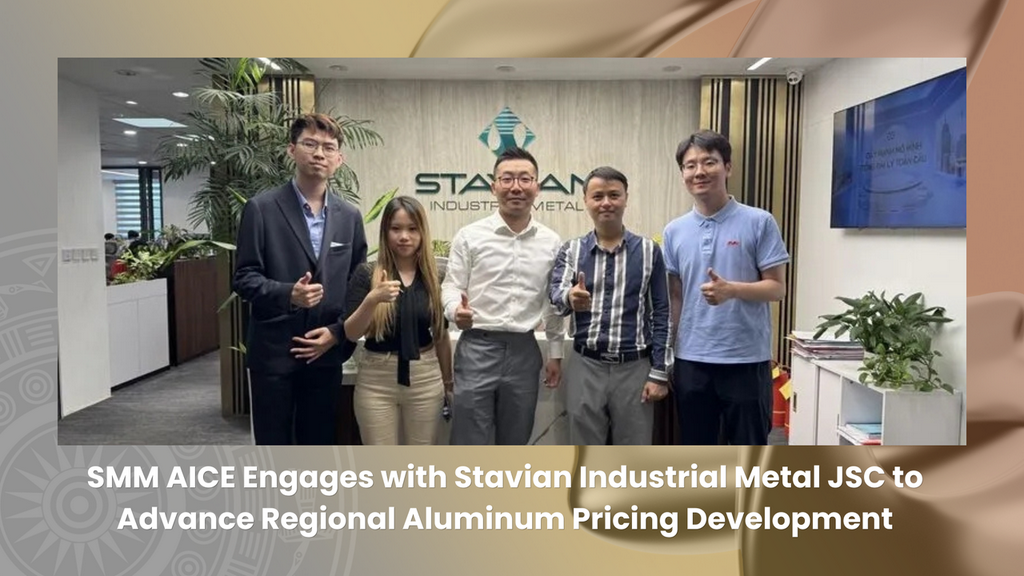 SMM AICE Engages with Stavian Industrial Metal JSC to Advance Regional Aluminum Pricing Development
On July 22, 2026, a delegation from Shanghai Metals Market Information Technology Co., Ltd. (SMM) held in-depth discussions with representatives of Stavian Industrial Metal JSC. The participants included: SMM Logan Lu, CEO of SMM Cason Lou, Director of Aluminum Processing, Marketing Department Lexi Chen, Key Account Manager for Overseas Information Sales Khai Yuen Chin, Senior Overseas Aluminum Analyst Stavian Industrial Metal JSC James (Nguyen Danh Vinh), Deputy Director of International Business Alex (Bui Trung Kien), International Business Representative The two sides exchanged views on the global aluminum market, the development of Vietnam’s aluminum industry, market information services, and the establishment of a regional pricing system, reaching broad consensus on several areas for future cooperation. Focusing on Southeast Asia and Exploring the Evolving Global Aluminum Industry Landscape SMM noted that in recent years, it has continued to expand its sourcing and sales network across Southeast Asia, establishing stable supply-chain connections in Vietnam, Thailand, Malaysia, Indonesia, and other markets. Its business covers multiple metal categories, including aluminum, steel, and copper, while the company continues to explore emerging market opportunities across Southeast Asia. At the SMM AICE 2026 Southeast Asia Aluminum Industry Conference, to be held in Ho Chi Minh City on November 19–20, SMM will officially launch the SMM Vietnam Aluminum Price and provide a detailed explanation of its pricing methodology. Against the backdrop of global supply-chain restructuring, evolving logistics patterns, and deepening regional trade, market demand for high-quality, in-depth, and timely market intelligence and reliable price references continues to rise. To address these needs, SMM has established a global presence across price assessments, market research, databases, consulting services, and international conferences. Its services cover major markets including China, Southeast Asia, Europe, the Americas, and Africa, providing professional market intelligence and data services to participants across the global industrial value chain. Advancing Vietnam’s Pricing System to Support Regional Industry Development SMM noted that aluminum trading in Southeast Asia still commonly references LME prices and the MJP Premium. However, as Vietnam’s manufacturing sector expands rapidly and domestic consumption continues to grow, demand is increasing for regional price benchmarks that better reflect local supply-and-demand fundamentals. Since July 3, 2026, SMM has officially launched the Vietnam 6063 Non-Homogenized Aluminum Billet Processing Fee and the SMM Vietnam 6063 Non-Homogenized Aluminum Billet Price , with both assessments updated daily on each trading day. (Resources come from the SMM official website) In recent years, SMM has continued to develop its global pricing system while accelerating its presence in Southeast Asia. By engaging directly with participants across the industrial value chain and establishing local price data collection networks, SMM is continuously improving its Vietnam market price assessment framework and providing the regional market with more open, transparent, and impartial price references. Representatives from Stavian Industrial Metal JSC expressed strong recognition of this direction and shared insights into the rapid development of Vietnam’s market in recent years. They noted that Vietnam’s aluminum trading volume continues to expand alongside growing domestic demand. Establishing a regional pricing system that more accurately reflects local market conditions would help improve transparency across the industrial value chain and support the healthy and sustainable development of the market. Stavian Industrial Metal JSC Founded in 2021, Stavian Industrial Metal JSC is a member of Stavian Group, one of Vietnam’s major multinational industrial groups. The company specializes in the trading, supply-chain management, processing and manufacturing, and industrial investment of industrial metals including aluminum, steel, copper, and zinc. Its business network spans more than 100 countries and regions worldwide, with the goal of becoming a leading integrated industrial metals service platform in Southeast Asia. In recent years, Stavian has continued to increase investment in Vietnam’s domestic industrial sector, gradually expanding beyond traditional metals trading into industrial investment and advanced manufacturing. Its key areas of development include: Industrial Park Development Stavian Group’s industrial park platform is advancing the development of green industrial parks in Vietnam, with major projects including industrial parks in Thai Nguyen Province and Hung Yen Province. These projects aim to attract industries including electronics manufacturing, machinery manufacturing, supporting industries, logistics, and food processing. They also incorporate ESG principles such as green energy, circular economy practices, and wastewater reuse, supporting Vietnam’s manufacturing upgrade and facilitating foreign investment projects. Green Metals Development The company is actively developing supply chains for green aluminum, green steel, and recycled metals while promoting the use of low-carbon metal materials. Carbon management and ESG principles have also been integrated into the company’s corporate strategy, with the goal of becoming a leading green metals distributor and carbon services provider in Southeast Asia. Major Industrial Cooperation Projects In recent years, Stavian has established strategic partnerships with major Vietnamese enterprises including Viet Hai Group and Dai Dung Group. These partnerships cover areas such as shipbuilding, steel structure engineering, machinery manufacturing, new energy infrastructure, and industrial projects, enabling the companies to jointly participate in major industrial and infrastructure developments across Vietnam. As one of Vietnam’s rapidly growing industrial metals companies, Stavian Industrial Metal JSC plays an important role in supporting the country’s manufacturing upgrade and strengthening its domestic industrial metals supply chain. It has also emerged as a representative local enterprise within Vietnam’s aluminum and broader industrial metals industry. Join the Conversation at SMM AICE 2026 Connect with aluminum producers, processors, traders, manufacturers, certification organisations, industry associations and decision-makers from across Southeast Asia and the global market. Explore aluminum pricing, primary aluminum supply, processing technologies, low-carbon development, CBAM compliance and new opportunities for regional cooperation. ? Ho Chi Minh City, Vietnam ? November 19–20, 2026 Register now: bit.ly/AICE26 and secure your Super Early Bird Pass and save up to USD 200. Register before August 31, 2026.
Jul 29, 2026 09:25- Global Primary Aluminum Spot Premiums Decline Amid Weak Demand and High Supply
The global overseas primary aluminum spot market faced overall downward pressure this week, with spot premiums in Japan, Southeast Asia, South Korea and the US all falling week-on-week. The Asian market was weighed down by weak downstream purchasing sentiment amid the traditional consumption off-season. Ample circulating supply stemming from concentrated cargo arrivals in the US compounded the bearish sentiment. Meanwhile, the LME curve briefly flipped into a Backwardation (B) structure this week. Elevated capital costs prompted traders to step up sell-downs, pushing spot offers lower across regions and dragging down transaction benchmarks. I. Weekly Comparison of Key Global Spot Premiums II. Regional Spot Transaction & Market Commentary (I) Asian Market: Sluggish Off-Season Buying, Wide Disparity Between Long-Term Benchmark QMJP and Spot Prices Japan Market Japan’s spot market remained sluggish this week, with downstream buyers only placing sporadic orders to meet immediate operational needs and no large-scale restocking activities. The Q3 QMJP benchmark price was set at USD 395/mt, sharply diverging from actual spot transaction prices ranging from USD 330–350/mt, resulting in steep discounts against the quarterly benchmark across the market. Southeast Asia, South Korea and Indonesia Spot premiums in Thailand and South Korea retreated in tandem as traders showed strong willingness to offload inventories. Overseas end-user demand for Indonesian primary aluminum stayed muted, while downstream players remained reluctant to accept high prices, driving down local ex-factory offers and concluded transaction prices. Across Asian trading channels, the temporary Backwardation structure on the LME aluminum curve, paired with higher capital costs and inventory pressure, encouraged holders to cut offers to liquidate stocks. Coupled with feeble downstream demand, spot prices faced additional downward pressure. (II) US Market: Concentrated Cargo Arrivals from Multiple Regions Weigh on Premiums Easier spot prices in Europe previously diverted some Canadian aluminum ingots to the US, alongside a portion of Indonesian primary aluminum shipments. Concentrated cargo arrivals boosted market supply substantially. Despite rigid underlying demand in the US, the surge in available supply kept DDP premiums under mild week-on-week downward pressure. III. Core Macro Drivers Shaping Overseas Spot Markets End-User Demand: Off-Season Drags on Asian Buying Sentiment Southeast Asia and Japan entered their traditional demand off-season. Downstream fabricators only purchased materials on an as-needed basis without proactive stockpiling, and market acceptable price levels kept sliding, leaving spot transactions without solid support. Trading Flows: High Capital Costs Fuel Traders’ Inventory Liquidation The temporary Backwardation structure on the LME aluminum curve lifted holding costs for metal traders. Most market participants opted to cut prices to sell stocks and recover capital, flooding the market with available material and further depressing spot premiums. IV. Brief Market Outlook In the near term, the off-season in Asia is far from over, and traders retain strong incentives to liquidate inventories, which will keep overseas primary aluminum spot premiums subdued. Market participants will closely monitor the commissioning timeline of Indonesian aluminum projects and restocking activities among overseas downstream manufacturers going forward.
Jul 17, 2026 15:52 - Weekly Overseas Primary Aluminum Premiums Broadly Lowered on Sluggish Off-Season Demand
The overseas spot primary aluminum market faced overall downward pressure this week, with premiums falling across all regions. Driven by multiple factors including the traditional overseas consumption off-season, fading concerns over tight global aluminum supply, weak end-user spot demand, and pressure from trade arbitrage, spot aluminum quotations in major overseas regions kept sliding amid muted trading activity. In terms of pricing performance, premiums in core overseas markets generally declined week-on-week compared with last Friday, July 3. The US Midwest DDP primary aluminum premium edged down from 110.25 US cents per pound to 109.75 US cents per pound, remaining under bearish pressure. Asian markets trended lower in tandem: CIF Thailand P1020A dropped from USD 345/MT to USD 335/MT; FCA Korea P1020A fell from USD 366/MT to USD 335/MT; CIF Korea P1020A retreated from USD 350/MT to USD 319/MT; Japan MJP ingot spot premiums plunged sharply from USD 380/MT to USD 355/MT. Spot premiums across Asian overseas aluminum markets cooled off markedly. Regional Breakdown The Japanese spot market stayed broadly weak, with end manufacturers only restocking for immediate operational needs without bulk pre-purchases. As market expectations of tight global aluminum supply continued to ease, buyers became increasingly reluctant to accept higher offers. Meanwhile, arbitrage trades emerged during the week: traders accumulated spot cargoes at low prices and captured spreads against long-term contracts, further weighing down spot transaction prices and dragging Japan’s spot rates lower. The US market also faced headwinds amid its traditional consumption off-season and feeble downstream end-user demand. With overseas primary aluminum restarts and new capacity set to ramp up in the second half of the year, expectations of looser supply gained traction. Downstream buyers remained cautious with purchasing, accepting lower prices and pushing regional premiums downwards. South Korea and Thailand saw synchronized softening in market conditions with subdued buying sentiment and consistent cuts to market offers. Traders are eager to liquidate inventories, yet downstream purchasers slow down procurement with minimal buying interest. Lopsided bargaining power pushed offer prices steadily lower, exerting continuous downward pressure on regional premiums. Outlook Overall, overseas aluminum markets are stuck in the seasonal consumption off-season, alongside growing expectations of ample global aluminum supply. Lacking solid support from physical demand and robust buying interest, overseas spot primary aluminum premiums are likely to maintain weak volatile momentum in the short run, with further downside risks lingering.
Jul 10, 2026 19:01 - SHFE and LME Aluminum Prices Stabilize and Rebound in Tandem, China Destocking Strengthens Price Bottom Support [SMM Aluminum Morning Meeting Summary]
[SHFE and LME Aluminum Prices Stabilize and Rebound Synchronously; China Destocking Solidifies Price Bottom Support] Amid intertwined bullish and bearish factors, overseas bullishness from the US dollar and bearishness from supply and geopolitics offset each other. After an earlier excessive decline, LME aluminum’s downward momentum has slowed, and it will mainly consolidate at lows for repair in the short term. Supported by rapid destocking, China’s aluminum price is unlikely to underperform LME aluminum. The SHFE and LME markets may see slight divergence, making a unilaterally weak trend difficult to sustain.
Jul 8, 2026 09:35 - H1 Review of Aluminum: Geopolitical Conflict Triggers Production Cuts, High Profits Accelerate New Projects and Restarts
SMM, July 7: In the first half of 2026, geopolitical conflicts in the Middle East emerged as one of the decisive factors affecting electrolytic aluminum prices. Prior to the Middle East events, expectations of a US dollar rate-cut cycle were bullish for non-ferrous metal prices, and overseas electrolytic aluminum prices generally maintained a firm trend in January. However, high aluminum prices suppressed demand, compounded by the impact of the domestic Spring Festival holiday, leading to larger-than-expected domestic aluminum ingot inventory accumulation. In February, domestic and overseas aluminum prices fell in tandem. On February 28, the US-Israel coalition launched a military strike against Iran, officially marking the beginning of the Middle East geopolitical conflict's impact on aluminum prices. Middle East Geopolitical Conflict Triggers Production Cuts; Supply Gap Expectations Drive Up LME Aluminum Prices Affected by the US-Iran conflict, some aluminum smelters in the Middle East experienced production cuts. Combined with the Mozambique aluminum smelter entering shutdown in March, the market expected overseas electrolytic aluminum fundamentals to face a significant supply gap. Boosted by this, overseas aluminum prices continued to climb, with the LME 3M aluminum price reaching a near three-year high of $3,787.5/tonne on June 2. The timeline of production cuts at Middle East and Mozambique aluminum smelters is as follows. In addition, power and other infrastructure in Iran was damaged, making it difficult for local aluminum smelters to sustain production. However, with no official announcements yet, SMM has made its own production cut assessment. As of mid-April, SMM estimated that the total capacity affected by production cuts in the Middle East and Mozambique could reach approximately 3.5–4.0 million tonnes. Under the impact of significant production cuts, overseas electrolytic aluminum fundamentals shifted to a deficit, with total LME aluminum ingot inventory and Japanese port aluminum ingot inventory continuing to decline. As of end-June 2026, LME global aluminum ingot inventory stood at 302,000 tonnes, down 207,000 tonnes from end-2025. As of end-May, Japanese major port electrolytic aluminum inventory was 239,000 tonnes, down 78,000 tonnes from end-2025. Amid expectations of supply tightening, ex-China aluminum premiums strengthened. As of end-June, SMM Japan MJP aluminum ingot spot premium recorded $380/mt, up 123.5% from the end of last year, and SMM Japan Q3 MJP aluminum ingot premium recorded $395/mt, up $309/mt from Q4 2025, a jump of 359.3%. SMM Europe P1020A aluminum ingot duty-paid price recorded $547.5/mt, up 62.2% from the end of last year, while SMM Europe P1020A aluminum ingot duty-unpaid price recorded $470/mt, up 64.9% YoY. SMM US Midwest DDP aluminum premium recorded 110.5¢/lb, equivalent to around $2,435/mt, up 18.2% from the start of the year, an absolute increase of approximately $374.7/mt. Although supply tightened and aluminum ingot destocking took place, downstream purchasing enthusiasm was subdued by high prices, with actual transactions in Asia persistently at a discount to the Japan MJP aluminum ingot premium. Indonesia saw a concentration of new project startups; as new projects continued to ramp up production, supply increased, and since Q2, Indonesia aluminum ingot FOB prices showed a trend of pulling back slightly. As of end-June, SMM FOB Indonesia P0610A average price recorded $270/mt, up 92.9% from the end of last year, but down 8.8% from this year's high of $296/mt. SMM FOB Indonesia P1020A average price recorded $266/mt, up 97.0% YoY, but down 8.6% from this year's high of $291/mt. Aluminum premiums in other regions maintained an overall uptrend. As of end-June, SMM CIF South Korea P1020A average price recorded $342/mt, up 132.7% from the end of last year; SMM FCA South Korea P1020A average price recorded $362/mt, up 119.4% YoY; and SMM CIF Thailand P1020A average price recorded $328/mt, up 120.9% YoY. High Profits Accelerate Electrolytic Aluminum Restarts and New Project Commissioning Under high aluminum prices, electrolytic aluminum companies enjoyed substantial profits. These high profits stimulated some idled capacity to accelerate restarts and also catalyzed more new electrolytic aluminum projects, accelerating their commissioning. In the first half of the year, three electrolytic aluminum smelters resumed idled capacity to varying degrees, and two additional smelters announced plans to restart production in 2026. Details are as follows: San Ciprián smelter in Spain safely completed restart on April 8, with total capacity of approximately 230,000 tonnes/year, representing an increase of approximately 150,000–200,000 tonnes/year compared to 2025 operating capacity. Mount Holly in the United States began restart in April, with plans to reach full capacity by end-June, involving 50,000 tonnes/year of capacity. Grundartangi smelter in Iceland began restart in April, expected to complete restart by end-July, involving 210,000 tonnes/year of capacity. Magnitude 7 Metals planned to restart potline No. 1 cells at its New Madrid aluminum smelter in the United States, with plans to add 75,000 tonnes/year of primary aluminum capacity by end-2026. Norsk Hydro indicated that the Slovalco smelter in Slovakia planned to restart partial primary aluminum production in Q4 2026, involving 75,000 tonnes/year of capacity. Regarding new projects, according to SMM estimates, total planned commissioning capacity for overseas electrolytic aluminum in 2026 is approximately 2.3 million tonnes, of which approximately 700,000 tonnes have been commissioned, with the remaining 1.6 million tonnes expected to be commissioned in the second half of 2026. For details, please follow the "SMM Overseas Electrolytic Aluminum Project Monthly Review" series. Overall, although the Middle East and Mozambique experienced large-scale production cuts in the first half of the year, the acceleration of restarts and new project commissioning partially offset the supply reduction. According to SMM estimates, total overseas electrolytic aluminum production in H1 2026 was 14.397 million tonnes, down 4.1% year-on-year, and total overseas demand was 13.612 million tonnes, down 3.1% year-on-year. Since overseas electrolytic aluminum had a net inflow of approximately 1.234 million tonnes into the domestic market in H1, the overseas electrolytic aluminum deficit in H1 is estimated at approximately 450,000 tonnes. H2 Outlook: Middle East Restarts Combined with New Project Ramp-up Increase Supply, Putting Pressure on Aluminum Prices In June–July, the Middle East geopolitical situation showed no clear signals of further deterioration, and news of restarts emerged from Middle East aluminum smelters that had undergone production cuts. On July 2, EGA announced that its Al Taweelah plant had made progress in restart efforts: anode removal work for all electrolytic cells had been completed; cell cleaning was approximately 90% complete; and over 20% of solidified aluminum blocks inside cells had been cleared. On May 26, the first electrolytic cell was successfully restarted; as of July 2, 89 cells were in operation (out of a total of 1,262 cells), equivalent to approximately 110,000 tonnes of capacity. In addition, Aluminum Bahrain and Qatalum were also expected to gradually begin restarts. With Middle East restarts combined with continued ramp-up of new projects, the global electrolytic aluminum balance is expected to shift toward a surplus by Q4 2026.
Jul 7, 2026 16:48 - Mid-year review of aluminum outside China: Geopolitical conflicts trigger production cuts, surging aluminum prices accelerate new projects and production resumptions [SMM Analysis]
SMM, July 7: In H1 2026, the Middle East geopolitical conflict became one of the decisive factors affecting aluminum prices. Before the Middle East conflict, expectations of a US dollar interest rate cut cycle were bullish for non-ferrous metal prices. In January, aluminum outside China generally held up well. High aluminum prices suppressed demand, and combined with the impact of the Chinese New Year holiday in China, domestic aluminum ingot inventory buildup exceeded expectations. In February, aluminum prices both in and outside China pulled back in tandem. On February 28, the US-Israeli coalition launched a joint military strike on Iran, officially kicking off the impact of the Middle East geopolitical conflict on aluminum prices. The Middle East geopolitical conflict triggered production cuts in the Middle East, and expectations of a large supply deficit pushed up LME aluminum prices. Affected by the US-Iran conflict, some aluminum plants in the Middle East cut production, and combined with the Mozambique aluminum plant entering a shutdown in March, the market expected that the overseas aluminum market would face a large fundamental deficit. Boosted by this, overseas aluminum prices climbed continuously, with the LME 3M aluminum price reaching a near three-year high of $3,787.5/mt on June 2. The timeline of production cuts at Middle Eastern and Mozambique aluminum plants is as follows: In addition, Iran's domestic power and other infrastructure were damaged, and aluminum plant production is expected to be unsustainable. However, there is no clear announcement at present, and SMM has made an assessment of production cuts. As of mid-April, SMM estimated that the total capacity affected by production cuts in the Middle East and Mozambique could reach around 3.5-4 million mt. Under the impact of significant production cuts, the overseas aluminum market shifted to a deficit, with total LME aluminum ingot inventory and Japanese port aluminum ingot inventory declining continuously. As of the end of June 2026, LME global aluminum ingot inventory registered 302,000 mt, down 207,000 mt from the end of last year. As of end-May, primary aluminum inventory at major Japanese ports stood at 239,000 mt, destocking by 78,000 mt from the end of last year. Amid expectations of supply tightening, regional premiums for overseas aluminum strengthened. As of end-June, SMM Japan MJP aluminum ingot spot premium registered $380/mt, up 123.5% from the end of last year; SMM Japan Q3 MJP aluminum ingot premium registered $395/mt, up $309/mt from Q4 2025, an increase of 359.3%. SMM Europe P1020A aluminum ingot duty-paid premium registered $547.5/mt, up 62.2% from the end of last year; SMM Europe P1020A aluminum ingot duty-unpaid premium registered $470/mt, up 64.9% from the end of last year. SMM US Midwest DDP aluminum premium registered 110.5¢/lb, equivalent to around $2,435/mt, up 18.2% from the start of the year, with an absolute increase of approximately $374.7/mt. Although supply tightened and aluminum ingot destocking occurred, high prices dampened downstream purchase enthusiasm, and actual transactions in Asia were continuously at a discount to the Japan QMJP aluminum ingot premium. New investments in Indonesia were concentrated, and as new projects continued to ramp up production, supply increased. From Q2, Indonesia aluminum ingot FOB prices showed a slight pullback trend. As of end-June, the average SMM FOB Indonesia P0610A price stood at $270/mt, up 92.9% from the end of last year but down 8.8% from this year’s high of $296/mt; the average SMM FOB Indonesia P1020A price stood at $266/mt, up 97.0% from the end of last year but down 8.6% from this year’s high of $291/mt. In other regions, aluminum premiums maintained an overall uptrend. As of end-June, the average SMM CIF South Korea P1020A price stood at $342/mt, up 132.7% from the end of last year; the average SMM FCA South Korea P1020A price stood at $362/mt, up 119.4% YoY; the average SMM CIF Thailand P1020A price stood at $328/mt, up 120.9% YoY. High Profits Accelerate Aluminum Production Resumptions and New Project Startups Under high aluminum prices, aluminum enterprises enjoyed considerable profits. These high profits stimulated some idled capacity to accelerate production resumptions and also gave rise to more new aluminum projects, speeding up their startup. In H1, three aluminum smelters restored idle capacity to varying degrees, while another two aluminum smelters announced plans to resume production in 2026. Details are as follows: Spain’s San Ciprián smelter safely completed its restart on April 8, with a total capacity of approximately 230,000 mt/year, representing an increase of about 150,000-200,000 mt/year compared to its 2025 operating capacity. Mount Holly in the US began production resumptions in April and plans to reach full capacity by end-June, involving 50,000 mt/year of capacity. Iceland’s Grundartangi smelter started resuming production in April and is expected to complete the process by end-July, involving 210,000 mt/year of capacity. Magnitude 7 Metals plans to restart potline 1 at the New Madrid aluminum smelter in the US, aiming to add 75,000 mt/year of primary aluminum capacity by the end of 2026. Norway’s Hydro stated that the Slovalco smelter in Slovakia plans to restart part of its primary aluminum production in Q4 2026, involving 75,000 mt/year of capacity. For new projects, according to SMM estimates, total planned new aluminum capacity outside China in 2026 is about 2.3 million mt, of which approximately 700,000 mt has already been commissioned, and the remaining 1.6 million mt is expected to be commissioned in H2 2026. More details can be followed in the “SMM Monthly Review of Aluminum Projects Outside China” series. In summary, although the Middle East and Mozambique experienced large-scale production cuts in H1, the acceleration of production resumptions and newly commissioned projects partly offset the supply reduction. According to SMM calculations, total aluminum production outside China in H1 2026 was 14.397 million mt, down 4.1% YoY, and total demand outside China was 13.612 million mt, down 3.1% YoY . As 1.234 million mt of aluminum from outside China is expected to have net inflows into China in H1, overall, the aluminum deficit outside China in H1 is estimated at around 450,000 mt . H2 Outlook: Production resumptions in the Middle East combined with the ramp-up of newly commissioned projects will increase supply and put pressure on aluminum prices. In June-July, as the geopolitical situation in the Middle East showed no clear signs of further deterioration, aluminum smelters in the region that had cut or suspended production began to report resumptions. On July 2, EGA announced progress in the resumption of operations at its Al Taweelah plant. The removal of anodes from all pots has been completed; pot shell cleaning is about 90% complete; and over 20% of the solidified aluminum blocks in the pots have been cleared. On May 26, the first pot was successfully restarted; as of July 2, 89 pots were in operation (out of a total of 1,262 pots), equivalent to a capacity of approximately 110,000 mt. In addition, Alba and Qatalum are also expected to gradually resume production. With production resumptions in the Middle East and the ongoing ramp-up of newly commissioned projects, the global aluminum balance is expected to shift to a surplus in Q4 2026. [Data Source Statement: All data beyond publicly available information is derived by SMM based on public information, market communication, and SMM's internal database models, and is for reference only, not constituting any decision-making advice.] Data source: SMM (Guo Mingxin 021-20707919)
Jul 7, 2026 16:14 - H1 2026: The Aluminum Market Doesn't Care Why You Built It
Every major aluminum player made a rational bet in H1 2026, Indonesia's smelter wave, the US's Inola project, India's Adani-IHC deal, Alcoa's South32 buy, the Gulf's post-strike rebuild, none of it needing the Middle East war to justify itself, though the war's price spike (LME to $3,546, premiums to multi-year highs) accelerated all of it at once.
Jul 6, 2026 17:39 - Outside China Macro Bullishness vs. Supply Bearishness, Domestic Destocking Supports SHFE Aluminum Bottom [SMM Aluminum Morning Meeting Minutes]
[Overseas Macro Bullishness Battles Supply Bearishness, China's Destocking Supports SHFE Aluminum Bottom] On the domestic front, bullish factors are prominent. The proportion of liquid aluminum has continued to rise. Over the past week, aluminum ingot warehouse withdrawals hit a four-year high, and the pace of inventory destocking has accelerated significantly, forming support for the bottom of SHFE aluminum. Amid the interplay of bullish and bearish factors, overseas, the bullish impact of the US dollar and the bearish forces from supply and geopolitics offset each other. After its earlier excessive decline, LME aluminum's downward momentum has slowed, and in the short term, it is mainly consolidating at lows for repair; domestically, supported by rapid destocking, the probability of underperforming LME aluminum is low. The SHFE and LME markets may show slight divergence, and a sustained unilateral weak trend is unlikely.
Jul 6, 2026 09:51