

3028results found for 'Ltd.'
Sort by : |
- Beilv Aluminum Plans $1.5M Tech Upgrade for 200,000mt Light Alloy Production in Yangxin County
Beilv Aluminum Technology Co., Ltd. in Yangxin County, Binzhou City, plans to build a technological transformation project for an annual output of 200,000 mt of light alloy materials. The total investment of the project is 10 million yuan, and it is currently in the stage of public notice for the draft environmental impact report.
Aug 7, 2026 21:50 - Chalco Shanxi Launches 9-Month West Stockyard Enclosure Project for Green, Safe Development
On July 24, the West Stockyard Enclosure Renovation Project of the alumina refinery of Chalco Shanxi New Materials Co., Ltd. officially entered the construction phase. The project is an inevitable choice and pragmatic measure for the enterprise to base itself on a green development strategy and consolidate the foundation of safety production, and it is also a key project for the factory area to strengthen environmental protection and promote safe, green, and high-quality development. The West Stockyard Enclosure Shed project has a construction period of 9 months. Based on the surrounding conditions of the construction site, it plans to enclose an area of about 18,360 m², and will construct supporting facilities including a spray dust suppression system, a lighting and power distribution system, as well as outdoor road hardening works and a vehicle wash platform.
Aug 7, 2026 21:50 - Jiangxi Mingjin to Relocate and Expand Aluminum Wire Rod Production Capacity to 15,000 mt Annually
Jiangxi Mingjin New Materials Co., Ltd. plans to build a relocation project with an annual processing capacity of 15,000 mt of aluminum wire rod products. The project is currently in the public notice stage for proposed approval of its environmental impact report, with the notice period running from August 6, 2026 to August 10, 2026. Jiangxi Mingjin New Materials Co., Ltd. plans to invest 26 million yuan to construct the relocation project for an annual processing capacity of 15,000 mt of aluminum wire rod products at Plant No. 7-2, Fubei Nonferrous Metals Industrial Park, Fubei Industrial Zone, Linchuan Economic Development Zone, Fuzhou City, Jiangxi Province. The project will lease existing factory buildings for production and mainly construct production workshops, raw material areas, finished product areas, offices, etc., ultimately forming a production scale of annual processing of 15,000 mt of aluminum wire rod products.
Aug 7, 2026 21:49 - Wanji Aluminum's 580,000 MT Project in Xinjiang Advances with Foundation Completion
Recently, the foundation construction of the 580,000 mt aluminum project of Wanji Aluminum (Xinjiang) Co., Ltd. has been fully completed. The above-ground concrete structure is 70% complete, and the steel structure is 60% complete. Efforts are now being made to sprint towards key periods, creating prerequisites for the entry and installation of process equipment.
Aug 7, 2026 21:47 - WHES cordially invites you to participate in the 2026 SMM (15th) Silicon Industry Summit
WHES Technology Co., Ltd. — Leader in Digital and Intelligent Industrial and Commercial ESS Solutions
Aug 7, 2026 17:23 - Beijing Yuzhi Environmental Protection Technology Co., Ltd. cordially invites you to attend the 2026 SMM (15th) Silicon Industry Summit.
Beijing Yuzhi Environmental Protection Technology Co., Ltd. is an environmental protection company covering the entire chain of R&D, production, engineering, services, and waste agent disposal.
Aug 7, 2026 16:43 - Nandan Zhenghua Nonferrous Metals Company Invites You to the 2026 SMM Lead & Zinc Annual Conference
“ In the critical period of global energy transition and the reshaping of the manufacturing landscape, the lead-zinc industry chain is undergoing profound structural adjustments. Upstream mine resources remained tight continuously, smelting and processing profits were under pressure, while downstream application fields represented by batteries and galvanizing faced opportunities and challenges from new technology iterations and green low-carbon transformation. Against this backdrop, collaboration and price risk management across the industry chain are more important than ever before. SMM deeply insights into industry needs and dedicates to creating a unique industry conference. This conference will focus on downstream applications and long-term contract supply-demand matching, aiming to build a high-end communication platform integrating macro outlook, price analysis, and long-term contract negotiations. The conference will not only analyze in depth the market trends of lead, zinc, precious metals, copper, tin, antimony, bismuth, and other associated metals, but also innovatively set up a long-term contract supply-demand negotiation meeting as a highlight, striving to help clients seize market opportunities in 2027 and foster business cooperation through precise data services and practical agenda design. In the golden autumn of October, we sincerely invite leading enterprises and elites of the lead-zinc industry chain from China and overseas to gather together, to have open exchanges and seek common development in a relaxed and pleasant negotiation atmosphere! Nandan County Zhenghua Non-Ferrous Metals Company will attend this grand event, discussing industry development trends with industry peers and jointly promoting the lead-zinc industry to a new height. Click on the to register immediately, and join us to witness and participate in this significant and far-reaching industry event, creating a new chapter of brilliance together! Nandan County Zhenghua Non-Ferrous Metals Company was founded in 2000, with a history of over 20 years. Located at Xiaoping Tun, Daping Village, Chehe Town, Nandan County (within Hechi-Nandan Non-Ferrous Metal New Material Industrial Park), the company is mainly engaged in non-ferrous metal rolling and processing. It completed construction of a lead-antimony smelting production process using the advanced "oxygen-enriched bottom side-blowing bath smelting-oxidation-reduction fuming triple furnace—smelting flue gas double conversion and double absorption acid-making" technology to process antimony-lead concentrates, gold-antimony ore, and comprehensively recover gold, silver, copper, and bismuth, and has a complete antimony industry chain deep processing enterprise. Designed total metal capacity is 45,000 mt/year, including antimony ingot (10,000 mt/year), antimony trioxide (10,000 mt/year), lead ingot (25,000 mt/year), silver ingot (100 mt), gold ingot (2 mt), sulfuric acid (60,000 mt), and comprehensive recovery of other valuable metals. Total investment is 850 million yuan, covering a total area of 172 mu. The company has obtained certifications for quality management system, environmental management system, occupational health and safety management system, and energy management system from the national quality certification center, and has been rated as a Guangxi S&T enterprise, high-tech enterprise, specialized and sophisticated enterprise, enterprise technical center, gazelle enterprise, and national-level green factory. Zhenghua Nonferrous Metals Co., Ltd. has a group of experienced and skilled management personnel, technical personnel, and operators, forming an excellent management team with high enforcement capability. The company has departments such as Office, Production Department, Safety and Environmental Protection Department, Finance Department, Operations Department, Logistics Department, Engineering Department, and Electrical and Mechanical Section, with over 400 employees, including 60 professional and technical personnel. Over the years, with the care and support from Party committees and governments at all levels, peers in the industry, and people from all walks of life, Zhenghua Company has been committed to the concepts of safe production, circular economy, green development, honest operation, and win-win cooperation, dedicated to serving users wholeheartedly, committed to gathering talents and building a first-class management team, and striving to advance towards the goal of "10 billion Zhenghua". Contact Information zhenghuayelian@163.com Long Press to Scan and Sign Up Now 2026 SMM Lead-Zinc Annual Conference
Aug 7, 2026 15:53 - Tender for Procurement of Gansu Sintering Coal and Gansu Semi Coke for Injection by Pangang Vanadium in August 2026
1. Procurement Conditions The procurement project for Pangang Vanadium’s August 2026 Gansu sintering coal and Gansu injection semi coke (PGWZMYHHD260806309341) has the purchaser as Pangang Group Materials Trading Co., Ltd. The project’s funding comes from self-raising, and the project has met the procurement conditions. An open single-round negotiation is now being conducted. 2. Project Overview and Procurement Scope 2.1 Project Name: Procurement of Pangang Vanadium’s August 2026 Gansu Sintering Coal and Gansu Injection Semi Coke 2.2 Procurement Failure Transferred to Other Procurement Method: Transfer to Direct Procurement 2.3 For the procurement content, scope, and scale of this project, please refer to the attachment "Material List Attachment.pdf". 3. Bidder Qualification Requirements 3.1 Joint venture bidding is not allowed for this procurement. 3.2 The bidder must meet the following qualification requirements for this procurement: (1) Production-type business license (2) Distribution-type business license 3.3 The bidder must meet the following registered capital requirements for this procurement: Production-type registered capital: 5 million yuan or above Distribution-type registered capital: 5 million yuan or above 3.4 The bidder must meet the following performance requirements for this procurement: The bidder must provide performance records of similar projects from January 1, 2023 to the bid deadline (copies of contracts are required) and scanned copies of VAT invoices for the relevant performance. 3.5 The bidder must meet the following capability requirements, financial requirements, and other requirements for this procurement: Financial requirements: The registered capital of the bidder for this project shall not be less than 5 million yuan, and multiple winners are allowed for this project. The registered capital of production-type suppliers and distribution-type suppliers shall not be less than 30% of the amount of the bid section or quantity (excluding tax); Capability requirements: Refer to the attachment (if needed) Other requirements: (1) Scanned copy of business license (or duplicate); (2) Scanned copy of tax registration certificate (or duplicate) (except for those with three-in-one certificates); (3) Scanned copy of organization code certificate (or duplicate) (except for those with three-in-one certificates). (4) New suppliers (those who have not provided copies of Pangang contracts from January 1, 2023 to the bid deadline in the performance requirements are deemed as new suppliers) must provide a sample qualification report issued by Pangang’s technical quality department or other state-owned testing unit within 3 months prior to the bid deadline. 3.6 For projects that must be tendered in accordance with the law, the bids of dishonest persons subject to enforcement are invalid. 4. Acquisition of Procurement Documents 4.1 All bidders who intend to participate, please log in to the Ansteel Smart Tender and Bid Platform at http://bid.ansteel.cn to download the electronic procurement documents from 10:00, August 7, 2026 to 10:00, August 10, 2026 (Beijing time, the same hereinafter). Click to view tender details:
Aug 7, 2026 15:30 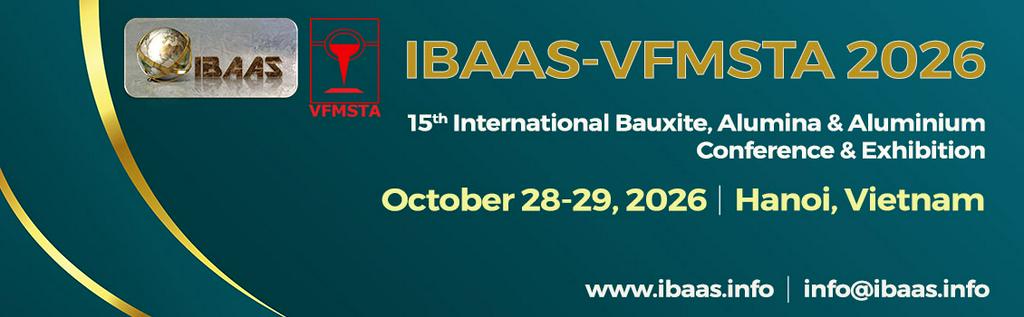 IBAAS–VFMSTA 2026: A New International Platform for Vietnam's Aluminium Industry
As Vietnam accelerates investments in its bauxite, alumina and aluminium sectors, the country is preparing to host its first international event dedicated exclusively to the industry. The 15 th International Bauxite, Alumina and Aluminium Conference & Exhibition ( IBAAS–VFMSTA 2026 ) will take place on October 28–29, 2026 , at the Hanoi University of Science and Technology , bringing together global stakeholders to discuss the future of the aluminium value chain in one of Asia's fastest-growing markets. Jointly organized by the International Bauxite, Alumina & Aluminium Society (IBAAS) and the Vietnam Foundry & Metallurgy Science and Technology Association (VFMSTA) , the conference is expected to become a key platform for technology exchange, business development and international collaboration. The technical programme has already generated considerable interest, with around 50 abstracts submitted by researchers and industry professionals from across the world. The sessions will address topics ranging from bauxite mining and alumina refining to aluminium smelting, downstream manufacturing, recycling, sustainability, digital transformation, critical minerals and next-generation process technologies. The event has also attracted participation from leading international organizations. China Nonferrous Metal Industry's Foreign Engineering and Construction Co., Ltd. (NFC) , Shanghai Metals Market (SMM) and the Shenyang Aluminium & Magnesium Engineering & Research Institute (SAMI) have confirmed their participation, highlighting the conference's growing international profile. On the exhibition front, PLA Process Analysers (Australia) and JGHECEPT Co., Ltd. (China) are among the early exhibitors that will showcase advanced technologies and engineering solutions for the aluminium industry. With Vietnam possessing one of the world's largest bauxite resources and expanding its alumina, aluminium and critical minerals industries, the conference is expected to create significant opportunities for producers, engineering and EPC companies, equipment manufacturers, technology suppliers, researchers, investors and downstream users. Alongside technical sessions, delegates will benefit from an international exhibition, business networking programmes and industrial visits designed to encourage partnerships and investment. Registrations, sponsorship opportunities, exhibition bookings and technical paper submissions are currently open. Companies/Organizations interested in participating can obtain further information by contacting info@ibaas.info or visiting www.ibaas.info .
Aug 7, 2026 15:03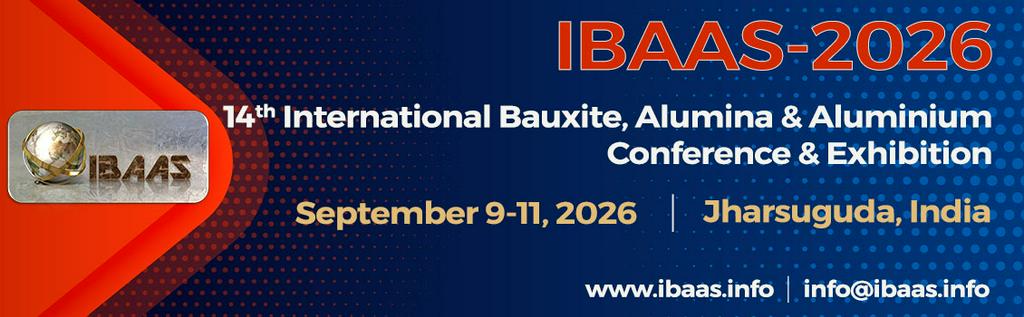 IBAAS 2026 Draws Strong Global Industry Response; Vedanta Joins as Platinum Sponsor
Jharsuguda, India: The 14 th International Bauxite, Alumina & Aluminium Conference & Exhibition (IBAAS 2026) is witnessing an exceptional response from the global aluminium fraternity, reaffirming its position as one of the industry's most significant international knowledge-sharing and business networking platforms. Scheduled to be held from September 9–11 2026 at Mayfair Hotels & Resorts, Jharsuguda, Odisha , the event is expected to attract about 350 delegates representing over 120 global companies and organizations . The conference has already received around 100 technical papers from experts, researchers and industry professionals, reflecting strong global interest in the latest developments across the bauxite, alumina and aluminium value chain. Technical discussions will focus on emerging themes such as artificial intelligence in aluminium manufacturing, digitalization, green aluminium, decarbonization, bauxite residue utilization, recycling, circular economy, sustainable alloys, and value recovery from industrial wastes . Adding further momentum to the event, Vedanta , India's leading aluminium producer, has confirmed its participation as the Platinum Sponsor , underscoring its commitment to innovation and sustainable growth in the aluminium sector. Pradhan Associates Pvt. Ltd. (PAPL) has joined as the Silver Sponsor , while Vincent Electronics and GEA Process Engineering India Pvt. Ltd. will serve as the Lunch Sponsors . FLSmidth Private Limited, India , has confirmed its participation as the Conference Dinner Sponsor , and EPIQ Machinery has extended its support as the event's Supporter . The exhibition has also attracted leading technology providers and equipment manufacturers from across the globe. Confirmed exhibitors include PLA Process Analysers (Australia), Riedhammer GmbH, JASH Process Equipment Pvt. Ltd., Achint Chemicals, Indfab Projects Private Limited , and the Vedanta Group , among others. With participation continuing to grow, the exhibition will showcase cutting-edge technologies, advanced process solutions and innovative services for the global aluminium industry. IBAAS 2026 will also feature the IBAAS ESG Awards 2026 , organized in collaboration with CETIZION Verifica . Following the success of the 2024 and 2025 editions, the awards recognize outstanding achievements in environmental sustainability, social responsibility and corporate governance across the global aluminium industry. Registrations are now open, and applications are already being received from companies worldwide. ( www.ibaas.info/esg-awards ) With strong international participation, an impressive technical programme and growing support from leading industry organizations, IBAAS 2026 is set to become one of the most influential global gatherings for the bauxite, alumina and aluminium industry, reinforcing India's role as a key destination for technological innovation, sustainable development and international collaboration. For sponsorship opportunities, exhibition bookings or any further information about IBAAS 2026, interested companies may contact info@ibaas.info or visit www.ibaas.info .
Aug 7, 2026 14:57