

1630results found for 'Hope社工库查询某个人名下所有车辆信息.唯一的摩乐乐社工库手机号社工库✔️chalacha.shop'
- This Week’s Key Overseas Lithium News (3.9-3.13) [SMM New Energy Overseas Weekly News]
[CleanTech Is About to Sign a 40-Year Operating Contract With the Chilean Government for the Laguna Verde Lithium Project] CleanTech Lithium, an Anglo-Australian company, is about to sign a 40-year contract with the Chilean government to develop the Laguna Verde lithium project in the Atacama Region, enabling it to advance extraction of this mineral at one of the salt lakes opened to the private sector. After reaching agreement with the Ministry of Mining on the terms of the Special Lithium Operating Contract (CEOL), Chile’s Office of the Comptroller General is now expected to approve the document in Q2 2026. CleanTech, its subsidiary Atacama Salt Lakes, and minority shareholders that are among the consortium members established to advance the Laguna Verde project have begun celebrating this new phase, as it provides greater certainty for their investment. [Rio Tinto Begins Commercial Lithium Exports From the Rincon Project] Rio Tinto’s milestone achievement in commencing commercial lithium exports from the Rincon project marked a pivotal moment for the global lithium market. Miners are currently contending with the complex interplay of resource scarcity, geopolitical tensions, and the accelerating popularization of EVs. The traditional supply-chain dependencies that have defined battery materials sourcing for decades are being reshaped by new producers launching commercial operations in previously underexplored regions. These developments signify not merely a slight increase in capacity, but a fundamental shift in how critical minerals move from extraction sites to manufacturing hubs, with implications far beyond quarterly production data. Rio Tinto’s commercial lithium exports from the Rincon project reflected its prudent positioning in one of the world’s most fiercely contested mining regions for this mineral. Following the suspension of the Jadar project in Serbia in 2025, the company shipped 200 mt of battery-grade lithium carbonate from Buenos Aires to Shanghai in March 2026, marking the official start of operations at its core South American lithium asset. The timing of this market entry reflected broader industry dynamics across the Lithium Triangle. Argentina’s regulatory environment has increasingly favoured large-scale international mining operations. In addition, the Rincon project is located in Salta Province, placing Rio Tinto within a geographic cluster that contains significant global lithium resources across Argentina, Chile, and Bolivia. [The Geothermal Plant Behind Europe’s Lithium Push] The town of Landau in der Pfalz, near the French-German border, has long been at the heart of the local winemaking industry. The region is also home to the Upper Rhine Valley brine fields, which contain Europe’s largest lithium resources and have now made it a hub for Europe’s push to advance EV development. The planned integrated geothermal-lithium extraction plant forms part of renewable energy producer Vulcan Energy’s ambition to build a carbon-neutral EV supply chain in Europe. The project will use geothermal wells to extract lithium-rich brine from depths of up to 5 kilometers. The high-temperature brine will be pumped to the surface, where lithium will be extracted before being transported to a plant. There, the lithium will be converted through electrolysis into lithium hydroxide monohydrate (LHM). The brine will then be reinjected underground, while LHM will be delivered to offtakers, including automaker Stellantis, which owns automotive brands such as Citroen and Peugeot. [Liontown's Interim Loss Widens as It Bets on a Recovery in Lithium Prices] Australia's Liontown said on Thursday that its loss widened in H1 due to a non-cash accounting charge, and added that it is evaluating potential expansion options for its Kathleen Valley mine as lithium prices are expected to rise. The miner of this raw material used in EV batteries has been seeing an initial price recovery after nearly two years of weakness. Previously, EV adoption was slower than generally expected, resulting in oversupply. Liontown said in its December quarter report that prices improved, with the selling price reaching $900/mt, up 28% from the previous quarter. As its flagship project transitioned to underground mining, the company sold 190,000 mt of spodumene, a lithium raw material, in H1. Source: https://www.investing.com
Mar 13, 2026 17:16 - Operating Rates Rebounded as Expected, but New Orders Showed Divergence [SMM Enamelled Wire Market Weekly Review]
Supported by a relatively large volume of orders taken last week and a full production schedule, the operating rate of the enamelled wire industry increased WoW this week (March 6–March 12).....
Mar 12, 2026 14:55 - Strong Cost Support Remained; Ferrous Metals May Hold Up Well in the Short Term [SMM Steel Industry Chain Weekly Report]
This week, ferrous metals rebounded from the bottom. At the start of the week, coking coal and coke led the futures higher, mainly driven by rising crude oil prices in the overseas market, which pushed the energy and chemicals sector stronger accordingly; mid-week, both the U.S. and Iran signaled a more relaxed stance toward war, easing geopolitical tensions, while coal prices fell in tandem, weakening the cost-side logic, and ferrous metals fluctuated at highs; in the latter half of the week, worsening short-term liquidity issues in BHP's iron ore port inventory triggered stronger iron ore prices in the overseas market, while the Middle East situation remained volatile, reinforcing cost support and pushing ferrous metals higher again. In the spot market, supported by futures, end-user and arbitrage purchase sentiment both improved WoW this week......
Mar 13, 2026 18:30 - [SHFE Tin Contract Hovered Around 390,000 Amid Tug-of-War Trading, Traditional Consumption Season Performed Slightly Below Expectations] SMM Tin Midday Commentary
[SMM Tin Midday Commentary: SHFE Tin Contract Fluctuated Near 390,000, Traditional Consumption Season Performed Slightly Below Expectations]
Mar 11, 2026 11:56 - [SMM Hot Topic] Space-Based PV: When “Computing Power Goes to Space” Meets the Energy Revolution, Is It a Bubble or the Future?
◼ At the beginning of 2026, Musk’s SpaceX plan for 100 GW of annual space PV capacity ignited the A-share market, with multiple concept stocks rising by more than 30 in a single month. At the same time, however, earnings previews from leading PV companies generally showed losses for 2025, and industry fundamentals remained in a deep winter. Behind the stark divergence between the speculative frenzy around the Musk-SpaceX concept and the earnings trough, is the market overly expecting a “second growth curve,” or is this a genuine signal of industrial transformation? ◼ As the global PV industry moves from rapid expansion into a new stage of rational development, its value has gone beyond that of clean energy alone: Against the backdrop of explosive growth in AI computing power driving massive electricity demand, compounded by energy security anxiety triggered by geopolitical conflict in the Middle East, developing PV may become a core strategic choice for countries to achieve their “dual-carbon” goals, build autonomous and controllable energy systems, and reduce electricity costs for end-users. ◼ Since the escalation of the U.S.-Iran conflict at the end of February, the world’s four major benchmark crude oil prices have entered a rapid upward trajectory. Before the outbreak of the conflict, oil prices had remained broadly stable; however, starting on March 2, as the fighting expanded and spread to the Persian Gulf, oil prices immediately entered a sharp uptrend. Note: Shanghai crude oil prices are converted based on the settlement-date exchange rate of 1:0.15. Source: Public information, SMM. ◼ Although the impact borne by different regions varies due to differences in energy mix, geopolitical location, and policy response, the surge in imported crude oil costs driving a broad rise in energy prices has become a common challenge facing all countries. Europe is a case in point. Although Europe’s direct dependence on Middle Eastern crude oil was not high, at only about 5 according to data from energy market intelligence firm Kpler, it remained highly dependent on the region for refined products such as diesel and aviation kerosene, as well as liquefied natural gas. Disruptions in the Strait of Hormuz caused by the conflict directly pushed up Europe’s terminal energy prices—fuel prices at gas stations across the region surged, and natural gas prices broke above EUR 60 per megawatt hour on the 9th, reaching a new high since 2022. The continued rise in energy prices is bound to transmit into broader areas of the economy, increasing overall inflationary pressure and once again underscoring the importance of building secure and controllable energy systems. Accelerating the Clean Transition of the Global Energy Mix, the PV Industry Advances Toward High-Quality Development ◼ The International Energy Agency (IEA) forecasts that, despite economic pressure, global electricity demand momentum remains strong in 2025, with growth rates in 2025 and 2026 expected to be 3.3% and 3.7%, respectively. Data from 2020 to 2025 showed that the global power market followed a trajectory of continued overall growth alongside structural transition toward cleaner energy , with the share of renewable energy sources such as solar rising significantly, although fossil fuels still accounted for the dominant share. ◼ According to the IEA’s Net Zero Emissions Scenario, solar power’s share in the energy mix is expected to rise from less than 2% at present to 12% in 2035 and 28% in 2050. This means PV installations are still far from reaching their ceiling, with substantial room for future growth. ◼ The past five years marked a critical period in which the global PV market shifted from rapid expansion toward rational development. The IEA forecasts that total global new PV installations over the next five years will reach about 3.68 TW, accounting for nearly 80% of new renewable energy additions over the same period, and are expected to become the world’s largest renewable energy source by the end of 2030. This is mainly due to its widening economic advantages—by 2024, the cost of solar PV power generation had already fallen 41% below the cheapest fossil fuel alternative, and these cost advantages are driving rapid growth in both PV installations and power generation share. Source: IEA, public information, SMM. ◼ As a key carrier of PV installations, especially the backbone of utility-scale power plants, solar panel mounting bracket installations are expected to maintain annual average growth of 5%-6% alongside installation growth. Specifically, to achieve annual average new PV installations of 500-600 GW, corresponding module demand is estimated at about 550-700 GW based on the capacity ratio. Assuming a conventional 1:1 module-to-bracket configuration, the annual average installation scale of brackets required for utility-scale PV plants alone would reach at least 250-300 GW. Source: public information, SMM. Escalating Challenges Reshape the Development Logic of the Global PV Market ◼ The PV industry is undergoing resonating internal and external pressures. Internally, the global economic slowdown has become intertwined with social issues, while the industry itself has entered a rational development stage after rapid expansion, making slower installation growth a certain trend. Externally, global trade frictions continue to intensify, with the US, Europe, and other regions erecting nearly insurmountable cost gaps through barriers such as anti-dumping and countervailing duties as well as local content requirements. Challenge 1: Global Trade Frictions and Escalating Trade Barriers ◼ In recent years, countries have introduced a series of policies to build PV trade barriers and reshape the global competitive landscape of the industry. The US imposed “double anti-” duties of as much as 3,403.96% on PV products from four Southeast Asian countries, South Africa raised module tariffs to 10%, and Brazil increased out-of-quota tariffs sharply from 9.6% to 25% through a quota system. Market access requirements for PV in India and Türkiye have also become increasingly stringent. Meanwhile, new supply chain control rules represented by the EU’s Net-Zero Industry Act (NZIA) have extended trade barriers deeper into the industry chain. By setting red lines on “third-country dependence,” they have established quantitative standards for supply chain restructuring. This series of changes has reshaped the competitive dimensions of the international PV industry and significantly raised the threshold for PV product imports and exports. Source: public information, SMM. Challenge 2: New Dynamics in the PV Market, with Incentive and Restrictive Policies Coexisting Source: public information, SMM. Outside China Enterprises Pursue Multi-Dimensional Breakthroughs Through Internal and External Efforts ◼ The practices of solar panel mounting bracket enterprises in the US, India, and other countries show that the key to coping with policy shifts overseas lies in combining “service-oriented” and “high-value” strategies. First, vertically extending from single-equipment sales to a service ecosystem covering the entire life cycle. Second, deepening horizontally by continuously optimizing business structure and extracting value from higher value-added segments. Solution 1: Launch Dedicated Plans Closely Aligned with Government Policies and Local Demand ◼ The global PV industry has now entered a new stage deeply reshaped by both market forces and policy. The growth logic of enterprises is shifting from the past single dimension of relying on technology iteration and cost declines to multi-dimensional competition closely integrating complex policy environments with localized demand. Against this backdrop, the key to corporate success lies in accurately interpreting policy intentions and launching development plans aligned with both market and policy. Tata Power Renewable Energy Limited (TPREL) precisely aligned with India’s “PM Surya Ghar: Muft Bijli Yojana” and launched the dedicated “solar for every home” plan while continuing to provide customized PV solutions. In Q1 FY2026, it added 220 MW of new rooftop PV installations, surging 416% YoY. TPREL also actively responded to local manufacturing policies by establishing 4.3 GW of solar cell and module capacity, ensuring supply while avoiding import tariffs. Through the synergy of “policy response + local capacity + customized services,” TPREL has effectively translated policy dividends into market competitiveness and steadily consolidated its leading position in India’s PV market. Solution 2: Use Acquisitions as a Link to Integrate Resources and Extend from Single Products to the Entire Industry Chain ◼ Competition in the global PV industry has fully escalated into a contest of entire industry chain system integration capabilities, and enterprises’ growth engines are shifting from past reliance on advantages in a single segment to a new model of providing integrated solutions through resource integration. In 2025, Nextracker used acquisitions as the core to integrate resources across the full chain, successively acquiring foundation engineering firms such as Solar Pile International and Ojjo, module supporting firms such as Origami Solar, and electrical system firms such as Bentek, thereby building a full-chain product matrix spanning structural, electrical, and digital solutions. Its performance continued to surge, with revenue rising from $1.9 billion in FY2023 to $3.4 billion in the trailing twelve months ended September 2025. It ultimately announced its transformation into a comprehensive energy solutions provider by renaming itself Nextpower, targeting revenue of more than $5.6 billion in FY2030. This strategy enabled its successful transformation from a single-product supplier into an entire industry chain service provider, solidifying its leading position in the global market. Solution 3: Optimize Business Structure ◼ Trade protectionism in the current PV market continues to intensify, with various trade barriers being layered on one after another. In response to this challenge, PV enterprises can achieve the dual objectives of “compliant operations” and “market retention” through business structure optimization. To avoid the equity constraints on FEOC under the US OBBB Act, Canadian Solar Inc. initiated a US business restructuring with its controlling shareholder CSIQ: it established two new joint ventures to separately manage PV and energy storage businesses, with its own stake set at 24.9% to precisely meet compliance requirements. At the same time, it transferred out 75.1% equity in three overseas plants supplying the US market, receiving a one-off consideration of 352 million yuan. This move enabled Canadian Solar Inc. to retain earnings from the US market through dividends and rental income. In the first three quarters of 2025, it achieved net profit of 990 million yuan, while large-scale energy storage shipments rose 32% YoY. After the adjustment, it focused on strengthening its advantages in non-US markets and successfully stabilized its global business layout with a compliant structure, providing a typical model for the industry in addressing trade barriers. ◼ For Chinese enterprises, in the face of trade frictions and overseas capacity gaps, they need to break through via three paths—“building plants near core markets, reducing costs and improving efficiency through technological innovation, and coordinating both within and outside the industry chain”— by pursuing localized deployment in Southeast Asia, Mexico, and other regions to avoid frequent trade frictions; promoting standardized production and high-end product R&D to enhance competitiveness; and building a “China + overseas” dual-circulation supply chain to stabilize costs. However, overseas expansion still faces challenges such as land and environmental protection costs, talent shortages, and supply chain fluctuations, requiring enterprises to conduct sound risk assessments, leverage policy support, and improve overseas investment service systems. Only by deeply integrating scientific capacity deployment, technological innovation, and industry chain coordination can the mounting bracket industry upgrade from “Made in China” to “Globally Intelligent Manufacturing” and achieve long-term development under the “dual carbon” goals. New Requirements Under the 15th Five-Year Plan, New Topics for PV Enterprises ◼ In a global market full of uncertainties, the consistency and strength of domestic policy have provided fertile ground for the growth of China’s solar panel mounting bracket enterprises. The newly released 15th Five-Year Plan further clarified China’s path for energy and industrial development. On the one hand, the construction of a new-type power system centered on consumption capacity has been listed as a priority task, and green manufacturing and full life cycle management have been formally incorporated into the assessment system. On the other hand, technological self-reliance and self-strengthening together with new quality productive forces have replaced scale competition as the main line of the new development stage. This series of changes signals that the country is driving a profound shift from “competing on capacity” to “competing on system value,” with the core goal of achieving autonomous and controllable energy structure. It is estimated that after the Two Sessions, various departments will successively roll out detailed plans to promote the full implementation of the blueprint. ◼ Key implementation measures include: 1) establishing a “dual controls” system for total carbon emissions and carbon intensity, while improving incentive and restraint mechanisms; 2) vigorously developing non-fossil energy and promoting the efficient use of fossil energy, while strengthening the construction of a new-type power system to ensure stable supply of green electricity; 3) applying both “addition and subtraction” by fostering green and low-carbon industries and promoting energy conservation and carbon reduction in key industry; 4) in addition, accelerating the green transformation of production and lifestyles to consolidate the foundation for green development. ◼ From the perspective of regional development layout, during the 15th Five-Year Plan period, China’s PV industry will show characteristics of regional coordination: north-west China will become the strategic focus by virtue of its natural endowments, exporting electricity through cross-provincial green electricity trading and other means to achieve two-way matching between energy resources and power load; eastern regions, by contrast, will focus on local consumption by high-energy-consuming industries and zero-carbon industrial parks. Source: public information, SMM. ◼ SMM forecasts that China’s new PV installations are expected to reach 208 GW in 2025 and continue growing at an annual average rate of 9% over the next five years, exceeding 292 GW by the end of the 15th Five-Year Plan period. Utility-scale PV will remain dominant, with its installation share staying above 50%. Based on the same logic, we estimate that China’s PV installation market will maintain annual incremental growth of at least 100-120 GW. Source: public information, SMM. ◼ Focusing on China’s steel consumption market for solar panel mounting brackets, SMM estimates that annual steel consumption in China’s PV mounting bracket sector will average about 4-4.5 million mt from 2026 to 2030, accounting for about 30% of total steel consumption in the PV industry over the same period (based on 2026 data). Note: only installation demand for utility-scale PV mounting brackets is included, excluding distributed steel structures, replacement from existing asset depreciation, and exports. Source: public information, SMM. SMM Ferrous Consulting Based on its understanding of the global steel industry chain and regional markets, as well as its strong industry database and network resources, SMM is committed to providing clients with consulting services across the upstream, midstream, and downstream industry chain. Services include market supply and demand research and forecasts, market entry strategies, competitor cost research, and more, covering end-use industry from iron ore, coal, coke, and steel. SMM Ferrous has successfully served more than 300 Fortune Global 500 companies, China Top 500 companies, central state-owned enterprises, state-owned enterprises, publicly listed firms, and start-ups. Data Source Statement: Except for public information, all other data are processed and derived by SMM based on public information, market communication, and SMM’s internal database models, and are for reference only and do not constitute decision-making advice. *This report is an original work and/or compilation work exclusively created by SMM Information & Technology Co., Ltd. (hereinafter referred to as “SMM”), over which SMM lawfully enjoys copyright, protected by the Copyright Law of the People’s Republic of China and other applicable laws, regulations, and international treaties. Without written permission, it may not be reproduced, modified, sold, transferred, displayed, translated, compiled, disseminated, or otherwise disclosed to any third party or licensed to any third party for use in any form. Otherwise, upon discovery, SMM will pursue legal liability for infringement by legal means, including but not limited to claims for breach of contract liability, disgorgement of unjust enrichment, and compensation for direct and indirect economic losses. All content contained in this report, including but not limited to news, articles, data, charts, images, audio, video, logos, advertisements, trademarks, trade names, domain names, layout designs, and any or all other information, is protected by the Copyright Law of the People's Republic of China, the Trademark Law of the People's Republic of China, the Anti-Unfair Competition Law of the People's Republic of China, and other relevant laws and regulations, as well as applicable international treaties relating to copyright, trademark rights, domain name rights, proprietary rights in commercial data and information, and other rights, and is owned or held by SMM and its relevant rights holders. Without prior written permission, no organization or individual may reproduce, modify, use, sell, transfer, display, translate, compile, disseminate, or otherwise disclose the above content to any third party or permit any third party to use it in any form whatsoever. Otherwise, upon discovery, SMM will pursue legal action to hold the infringing party liable, including but not limited to requiring the assumption of liability for breach of contract, disgorgement of unjust enrichment, and compensation for direct and indirect economic losses. The English translation of the above text is:
Mar 12, 2026 14:16  Trading Logic for Zinc Fundamentals Amid the Middle East Conflict: Risk Identification and Opportunity Capture
[Zinc Fundamental Trading Logic Amid the Middle East Conflict: Risk Identification and Opportunity Capture] Global geopolitical conflicts have continued unabated, and news of the recent Middle East conflict has emerged frequently. What impact will this have on the zinc industry? This article provides an analysis from both fundamental and market perspectives:
Mar 10, 2026 21:43- Post-Holiday Demand Continues to Recover; March Copper Plate/Sheet and Strip Operating Expectations Improve
According to SMM, the operating rate of the copper plate/sheet and strip industry was 41.98% in February 2026, down 28.04 percentage points MoM and down 14.49 percentage points YoY. Among them, the operating rate of large enterprises was 47.35%, that of medium-sized enterprises was 35.28%, and that of small enterprises was 31.80%.
Mar 9, 2026 14:23 - In March, the daily average hot-rolled production schedule at steel mills pulled back MoM
According to SMM’s latest tracking, the total planned volume of cold-rolled commercial products for this month across 31 mainstream cold-rolled coil steel mills was 4.073 million mt, up 257,500 mt from last month’s actual production of cold-rolled commercial products, an increase of 6.7%.
Mar 9, 2026 17:45 - Macro Sentiment Shift and Tight-Balance Game, Price Center May Move Downward [SMM Tin Morning Meeting Minutes]
[SMM Morning Meeting Minutes: Macro Sentiment Shift and Tight-Balance Game; the Price Center May Move Lower]
Mar 9, 2026 08:55 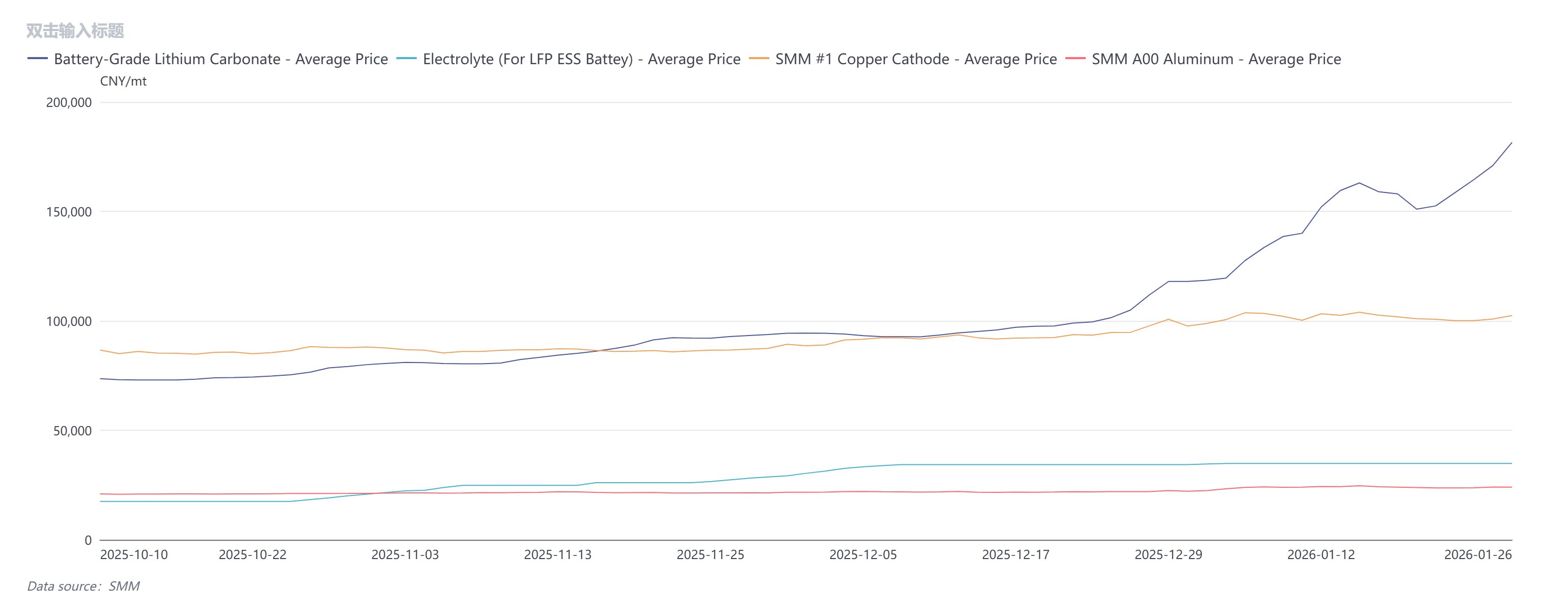 Amidst Middle East Conflicts: What is the Path Forward for China's Energy Storage Exports?
Recent Middle East conflicts have disrupted the region's booming energy storage market, a major destination for Chinese exports. To assess the real impact on Chinese supply chains and project deliveries, we must analyze baseline demand amidst these geopolitical uncertainties.
Mar 9, 2026 17:58