

198results found for 'CBAM'
Sort by : |
- Zhu Xiao, R&D Director at Liaoning Xiangyu Aluminum, Attended ASCC to Discuss the Performance Iteration Direction of 6-Series Aluminum Alloy in the Automotive Field
Against the backdrop of ongoing automotive lightweighting, aluminum alloys are rapidly expanding into more application scenarios such as structural body parts, battery packs, and chassis systems. Among them, 6-series aluminum alloys, which combine strength, formability, corrosion resistance, and lightweighting advantages, have become one of the key directions for automotive aluminum development. As NEVs raise higher requirements for vehicle safety, driving range, and manufacturing efficiency, the market is posing new challenges to the overall performance of 6-series aluminum alloys. How can the balance between material strength and toughness be further improved? How can formability, joining performance, and service reliability be balanced? How can the new demands brought by the continuous upgrading of automotive manufacturing processes be met? These questions are becoming a key focus for the automotive materials industry... Against the backdrop of the continuous upgrading and iteration of automotive aluminum alloy materials, we are honored to have invited Dr. Zhu Xiao, R&D Director of Liaoning Xiangyu Aluminum Co., Ltd., to attend the SMM (8th) Automotive Supply Chain Conference and deliver a keynote speech titled —— " Performance Iteration Direction of 6-Series Aluminum Alloys in the Automotive Sector ," combining industrialization implementation experience to share solutions for the R&D, process optimization, and mass production of next-generation 6-series aluminum materials tailored for NEV complete vehicles. Dr. Zhu Xiao is a senior engineer, a high-end manufacturing talent recognized by the MIIT, and a high-end industrial talent under Liaoning Province's "Xing Liao Ying Cai" program. He is primarily responsible for the development of new products, new technologies, and new processes at Xiangyu Aluminum, the application of engineering technologies, science and technology projects, and intellectual property-related work . Over the past five years, he has led five national and provincial-level scientific research projects, including those under the National Key R&D Program and Provincial Science and Technology Major Projects, won the Liaoning Province Science and Technology Progress First Prize twice, obtained over 50 nationally authorized patents, and published more than 30 papers, achieving multiple technological breakthroughs in the forming and product processing of high-end aluminum alloy materials . Focusing on automotive lightweight material upgrades, secure this practical knowledge-sharing session, and explore with top aluminum material R&D experts the opportunities for the iterative development of 6-series aluminum alloys. Conference Agenda Overview The conference spans two days, featuring one main forum + three sub-forums + an automaker end-user procurement networking session + an automaker cost and new technology exchange meeting , each session packed with highlights. September 10, Full Day – Main Forum ▶ Main Forum & Automotive Globalization Session ▶ Lightweight Materials Session: Aluminum, Magnesium, Steel ▶ Commercial Vehicle Session: Battery, Intelligence, Lightweighting September 11, Morning ▶ Sub-forum 1: Automotive & Robotics Collaborative Forum ▶ Sub-forum 2: Automotive Chassis Development Forum ▶ Sub-forum 3: Automotive Lightweighting & High-End Steel Innovation Forum September 11, Afternoon ▶ Automaker Procurement Supply-Demand Networking Session (Scroll down for details) ▶ Automaker Cost Communication & New Technology Seminar Full Agenda September 10 – Main Forum & Automotive Globalization Session 9:00-9:15 Opening Remarks 09:15-09:40 Development Trends of China's Automotive Industry During the 15th Five-Year Plan Period Guest Speaker: Xu Haidong, Deputy Secretary-General, CAAM 9:40-10:30 Roundtable Dialogue: The Next Five Years of the Automotive Supply Chain – Going Global, Low Carbon, and Intelligence · Opportunities and risks of Chinese enterprises establishing factories overseas (Southeast Asia, Europe, Mexico) · Impact of carbon border taxes (CBAM) on aluminum/steel exports and response strategies · How AI and digitalization can assist with metal material R&D and supply chain management Companies to be Invited (TBD): Lizhong Group Jintuo Technology NIO Volkswagen 10:30-10:50 Coffee Break & Exhibition Tour 10:50-11:10 Under the Overlay of "Involution" and "Going Global": Changes and Strategic Choices in the Automotive Industry Companies to be Invited (TBD): SAIC, Chery 11:10-11:30 Redefining Materials for the Next-Generation Vehicle Platform: The Material Selection Logic for 2030 Car Models Companies to be Invited (TBD): NIO, XPeng Motors, Xiaomi Automobile 11:30-12:00 Safety First, Materials as the Foundation – The Metal Material Logic in the Design of Power Battery Safety Systems Guest Speaker: Jia Shuyuan, Battery Assembly Design Lead Engineer, R&D Institute, Dongfeng Motor Group Corporation 12:00-13:30 Lunch Buffet September 10 – Lightweight Materials Session: Aluminum, Magnesium, Steel 13:30-13:50 Applications and Development Trends of Composite Materials in NEV Lightweighting Guest Speaker: Shen Weidong, Senior Director, Professor-Level Senior Engineer, SAIC Volkswagen Automotive Co., Ltd. 13:50-14:10 The Limited Volume of the Magnesium Alloy Industry – Can It Really Open the Automotive Market? Companies to be Invited (TBD): Shanxi Regal 14:10-14:30 New Opportunities for Magnesium Alloys in NEVs: Motor Housings, Electronic Control Cases, Instrument Panel Frames Presenting Company: Mao Mingzhi, Meridian Lightweight Technologies Co., Ltd. 14:30-14:50 Performance Iteration Direction of 6-Series Aluminum Alloys in the Automotive Sector Guest Speaker: Zhu Xiao, R&D Director, Liaoning Xiangyu Aluminum Co., Ltd. 14:50-15:10 Innovative Applications and Solutions of High-Strength and Tough Special Steel in Automotive Chassis Safety Components Companies to be Invited (TBD): Ansteel 15:10-15:30 Steel Auto Body and Integrated Solutions Companies to be Invited (TBD): Great Wall Motor, Rizhao Steel 15:30-15:45 Coffee Break September 10 – Commercial Vehicle Sustainable Development Session: Battery, Intelligence, Lightweighting 15:45-16:05 Commercial Vehicle Market Analysis and Outlook Invited: Lu Huaping, Secretary General, National NEV Commercial Vehicle Ecological Joint Committee (Commercial Vehicle Alliance) 16:05-16:25 BYD Commercial Blade Battery Fast Recharge Technology and Ecosystem Development Guest Speaker: Dr. Deng Qingming, Director, Global Commercial Vehicle Business Center Solutions, BYD Battery 16:25-16:45 Commercial Vehicle Battery Technology and Core Component Development To be Invited (TBD): REPT Battero Energy Co., Ltd. 16:45-17:05 Lightweight Material Technology and Development Trends for Commercial Vehicles To be Invited (TBD): Dongfeng Commercial Vehicle Co., Ltd. September 11 – Automotive & Robotics Collaborative Forum 9:20-9:40 Shared Supply Chain: When Automotive Parts Companies Build Robots – Downward Disruption or a World Apart? Guest Speaker: Huang Li, Senior Vice President, Huizhou Desay SV Automotive Electronics Co., Ltd. 9:40-10:00 Scenario Applications of Embodied AI Robots in Automotive Manufacturing Guest Speaker: Zhang Chaopeng, Embodied AI Robot Expert 10:00-10:20 Current Status and Outlook of High-Performance Aluminum Alloys in Humanoid Robot Applications Guest Speaker: Cheng Hanming, President, Hongjin New Materials Group Research Institute 10:20-10:40 Mid-Session Break 10:40-11:00 From Automotive to Embodied AI: Supply Chain Synergy and New Paradigm Leap Driven by Common Technology Origins Guest Speaker: Lei Xiong, General Manager, Ningbo Joyson Lingxi Intelligent Technology Co., Ltd. 11:00-11:20 Convergent Innovation and Industrialization Implementation Pathways for Automotive and Embodied Robotics Guest Speaker: Yang Shaoping, Purchasing Director, Humanoid Robot (Shanghai) Co., Ltd. 11:20-11:40 Lightweighting Challenges and Material Selection Analysis for Automotive & Humanoid Robots Guest Speaker: Huang Jiaqi, Material Expert, lron Humanoid Robot 11:40-12:00 AI Robots – Frontier Technology and Outlook for Robotics Guest Speaker (TBD): Chen Weidong, Tenured Professor and Doctoral Supervisor, School of Automation and Perception, Shanghai Jiao Tong University; Executive Vice Dean, Medical Robotics Research Institute, Shanghai Jiao Tong University September 11 – Automotive Chassis Development Forum 9:00-9:30 The Process Route Debate: From Casting to Extrusion for Aluminum Alloy Subframes Companies to be Invited (TBD): ZF Friedrichshafen AG, Bosch 9:30-10:00 Exploring Integrated Die-Casting Chassis: Beyond the Rear Floor, How Far Can Chassis Structural Parts Be Integrated? Companies to be Invited (TBD): Seres Automobile, Guangdong Hongtu, ZEEKR, GAC Huadi 10:00-10:30 Application Prospects of Electromagnetic Thermal Control Technology in Large Integrated Die-Castings Guest Speaker: Renowned Industry Expert 10:30-11:00 The Way Forward for Integrated Die-Casting: From "Expansion" to a "Rational" Perspective Companies to be Invited (TBD): GAC Group, LK Group 11:00-11:30 Domestic Substitution of Aluminum Forgings for Chassis: Mass Production and Performance Validation of Steering Knuckles and Control Arms Presenting Company: Hangzhou Rima Precision Forging Co., Ltd. 11:30-12:00 The Deep Change of Skateboard Chassis on Vehicle Development Models: From "One Car, One Chassis" to "One Chassis, Multiple Cars" Companies to be Invited (TBD): Volkswagen September 11 – Automotive Lightweighting and High-End Steel Innovation Forum 09:00–09:30 Synergistic Development of Vehicle Corrosion Protection, Dual Carbon Goals, and Cost Reduction – Compliant Application of Green Coatings and Low-Carbon Automotive Steel Companies to be Invited (TBD): Institute for Carbon Neutrality in Steel, University of Science and Technology Beijing 09:30–10:00 Innovation in High-Performance Body-in-White Steel Technology and Vehicle Manufacturing Implementation Presenting Company: Zhang Honghong, Deputy General Manager, Suzhou Pressler Technology Co., Ltd. 10:00–10:30 Fatigue Performance Optimization and Long-Life Durability Technology for High-End Special Steel in New Energy Vehicles Presenting Company: Baowu Jufei Special Steel Co., Ltd. 10:30–11:00 Building a Multi-Dimensional Lightweight Material Selection System for Complete Vehicles and Multi-Material Collaborative Application Companies to be Invited (TBD): CITIC Pacific Group 11:00–11:30 Vehicle Engineering Adaptation and On-the-Ground Application of Advanced Joining Technologies for Automotive Steel and Dissimilar Metals/Heterogeneous Materials Companies to be Invited (TBD): Shougang Group Research Institute of Technology, Ansteel Iron & Steel Institute 11:30–12:00 Upgrading of High-Purity Special Steel Smelting Processes and Material Applications for Core Components of Electric Drive Systems Companies to be Invited (TBD): Dongbei Special Steel, Fushun Special Steel, Beijing Jianlong Heavy Industry Group September 11 – Automaker Procurement Supply-Demand Networking Session 13:30–16:00 Procurement Networking Session + Going Global Networking Session September 11 – Automaker Cost Communication and New Technology Seminar 15:00–16:00 Automaker Cost Communication and New Technology Seminar
Jul 23, 2026 17:38 - (SMM Analysis) JSW Steel's Expansion Pipeline Gathers Pace as India Demand Offsets Import Pressures
JSW Steel expects production and sales to strengthen from Q2 FY27 as the expanded Blast Furnace-3 at Vijayanagar ramps up, while reaffirming an aggressive capacity expansion pipeline spanning Dolvi, Odisha, Utkal and Kadapa. Despite the planned BF-3 shutdown, the company reported record first-quarter steel sales of 6.25 million tonnes, supported by resilient domestic demand and a 46% year-on-year increase in exports.
Jul 23, 2026 16:23 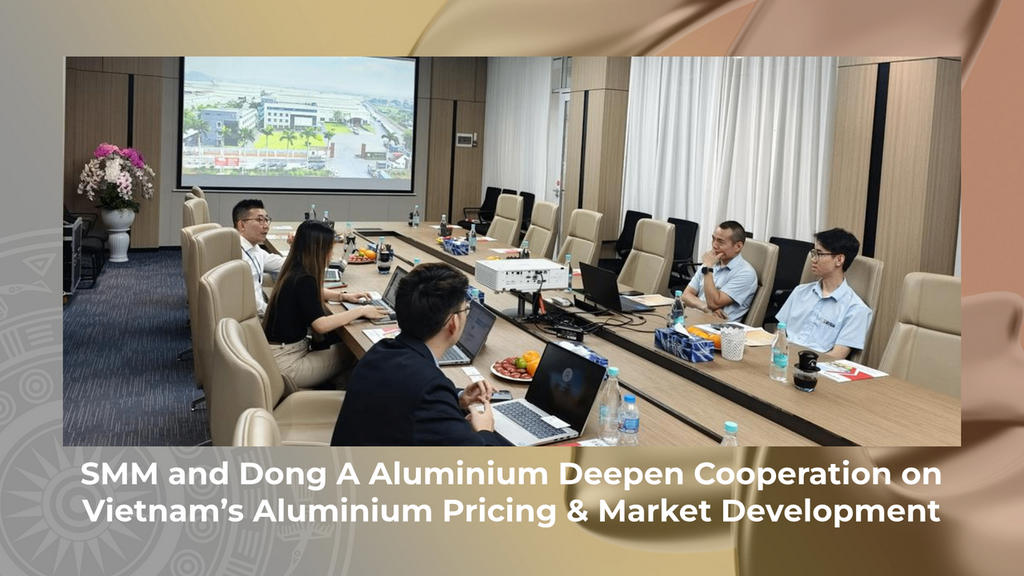 SMM Visits Dong A Aluminum to Jointly Explore Vietnam's Aluminum Pricing and Market Development
On July 22, 2026, a delegation from SMM Information & Technology Co., Ltd. (SMM) visited Dong A Aluminum Company Limited and was warmly received by Deputy General Manager Cao Jiawang and Procurement Manager Chen Jiejun. The two sides held in-depth exchanges on topics including the development of Vietnam's aluminum price system, corporate procurement status and pricing models, trends in the aluminum processing industry, and cooperation for the SMM AICE 2026 Southeast Asia (Vietnam) Aluminum Conference. The SMM delegation included: Logan Lu , CEO of SMM Cason Lou , Director of Aluminium Processing, Marketing Department Lexi Chen , Key Account Manager for Overseas Information Sales Chin Khai Yuen , Senior Overseas Aluminium Analyst They were welcomed by key representatives from Dong A Aluminum, including: Cao Jiawang , Deputy General Manager Chen Jiejun , Procurement Manager Focusing on Procurement Practices: Coexistence of Multiple Pricing Models During the meeting, Dong A Aluminum elaborated on its current procurement status and price usage model. As one of the largest aluminum semis exporters in Vietnam, Dong A Aluminum's procurement system has both international and local characteristics, forming a flexible but complex pricing mechanism. Dong A Aluminum stated that the Vietnamese market currently lacks a locally recognized price reference system with international credibility, and enterprises face challenges such as inconsistent pricing benchmarks and scattered price information in actual operations, hoping that SMM can promote the standardization of Vietnam's aluminum price system. SMM introduced that since July 3, 2026, SMM has officially launched the Vietnam 6063 (non-homogenized) aluminum billet processing fee and SMM Vietnam 6063 (non-homogenized) aluminum billet price point, updated on a daily basis on each trading day. Meanwhile, SMM plans to officially release the SMM Vietnam aluminum price and elaborate on the methodology at the SMM AICE 2026 Southeast Asia (Vietnam) Aluminum Conference to be held in Ho Chi Minh City from November 19 to 20. Dong A Aluminum expressed high attention to this, believing that the launch of SMM Vietnam aluminum price is expected to provide enterprises with a more transparent and authoritative pricing reference, reduce transaction costs, and improve market efficiency. Discussing Industry Trends: Opportunities and Challenges in the Aluminum Processing Industry The two sides also exchanged views on the current status of Vietnam's aluminum processing industry. As a member of a Singapore-based holding group system, Dong A Aluminum has a total investment of over $200 million and an annual comprehensive capacity of 150,000 mt. In 2025, the company's Phase III expansion project was officially completed and put into operation, with six new aluminum extrusion lines installed, bringing the total number of extrusion lines to 25. The company has now established a wide sales network across the country, and its products are popular in multiple international markets such as the US, Australia, Canada, Europe, and Japan. Dong A Aluminum noted that with the commissioning of Vietnam's first aluminum project (Phase I with an annual capacity of 150,000 mt), the Vietnamese aluminum industry chain is accelerating to complete the last link. The increase in local primary aluminum supply will bring new procurement options and cost optimization opportunities for aluminum processing enterprises. At the same time, the imminent implementation of the Carbon Border Adjustment Mechanism (CBAM) and the adjustments to tariff policies in key export markets such as the US have also imposed higher requirements on enterprises' market layout and pricing strategies. The two sides also reached a consensus on cooperation for the SMM AICE 2026 Southeast Asia (Vietnam) Aluminum Industry Conference. Dong A Aluminum indicated that it would actively consider participating in the conference to jointly promote the internationalization of the aluminum market in Vietnam and Southeast Asia. This visit further deepened the communication and mutual trust between SMM and Vietnam's leading aluminum processing enterprises. It provided important first-hand information for market research and data collection on the Vietnamese aluminum pricing system and injected new momentum into the standardization of aluminum pricing in Vietnam. About Dong A Aluminum Dong A Aluminum Co., Ltd. is located in Tan Dan Industrial Park, Le Dai Hanh Ward, Haiphong City, Vietnam. It is an aluminum products producer with high industry reputation and relatively large production scale in Vietnam. The company is a member of a Singapore-based holding group, with a total investment exceeding $200 million and an annual comprehensive capacity of 150,000 mt. It is also one of the largest exporters of aluminum semis in Vietnam. The company owns a modern factory covering an area of nearly 120,000 m², equipped with intelligent and advanced production lines. It has established a fully automated, closed-loop production process covering aluminum ingot storage, melting and casting, extrusion, spraying, anodizing, wood grain treatment, deep processing, and finished product assembly. The company fully applies an intelligent ERP management system to achieve automated management of the entire production and operation process. Currently, the company has 25 extrusion lines with tonnages ranging from 600 mt to 4,500 mt. In 2025, the Phase III expansion project was officially completed and put into operation, successfully entering the list of Vietnam's Top 500 enterprises. With a development direction of becoming a comprehensive aluminum application solution provider, Dong A Aluminum's products are widely used in construction, home furnishings, electronics and power, solar energy, and other fields, and it continues to expand the application of aluminum semis in machinery equipment, precision parts, and the automotive industry. As of now, Dong A Aluminum has established an extensive sales network nationwide, with over 800 dealers, and actively exports to multiple international markets including the US, Australia, Canada, Europe, and Japan. Facing the future, Dong A Aluminum always adheres to the development philosophy of "innovation as the core, quality as the foundation, and service as the commitment," continuously optimizes its production system, upgrades its technological strength, and actively promotes Vietnam's aluminum industry onto the global industrial landscape. Join the Conversation at SMM AICE 2026 Connect with aluminum producers, processors, traders, industry associations, analysts, and decision-makers from across Southeast Asia. Explore the latest market developments, pricing trends, processing technologies, recycling opportunities, and new possibilities for regional cooperation. ? Ho Chi Minh City, Vietnam ? November 19–20, 2026 Register now: bit.ly/AICE26 and secure your Super Early Bird Pass and save up to USD 200. Register before August 31, 2026.
Jul 23, 2026 15:07- [SMM Stainless Steel Flash] Brussels Plans Extra Fee on CBAM Certificate Purchases, Adding to SME Burden
The European Commission has opened a consultation — closing August 6 — on the purchase and repurchase of CBAM certificates through a new central platform. The draft proposes a fee of EUR 0.05 per CBAM certificate purchased, approximately 16 times the transaction fee charged by the EEX for EU emissions allowances, with no cost breakdown or justification provided. Based on approximately 440 million tonnes of CO2 embedded in CBAM-covered imports, the fee would generate around EUR 22 million annually — effectively charging companies for the act of paying a legally mandated tax. The certificate buyback process is equally restrictive: only one application per year is permitted, corrections or withdrawals are not allowed once submitted, and the administration retains up to 42 days for processing. Critics note that the administration reserves correction rights for itself while denying them to declarants, and that SMEs will effectively pay twice — once for the carbon tax and again for the bureaucracy that collects it.
Jul 23, 2026 13:30 - SMM Visits Xingfa Aluminium’s Vietnam Factory to Jointly Explore Establishment of Vietnam Aluminium Pricing Benchmark
A delegation from Shanghai Metals Market (SMM) paid a visit to Xingfa Aluminium's Vietnan factory — Xingfa Vietnam, on July 20, 2026, and both sides engaged in-depth discussions covering the aluminum pricing mechanism in Vietnam, building international credibility, and coordinated industrial development. The delegation includes Logan Lu, SMM CEO, Kexin Lou, Director of Aluminum Fabrication, Lexi Chen, Key Account Manager for Overseas Information Sales, and CHIN KHAI YUEN, Senior Overseas Aluminum Analyst. Pushing for the Establishment of Globally Recognized Aluminum Price Benchmark in Vietnam During the visit, both sides analysed the current pricing landscape in Vietnam’s aluminum market. At present, Vietnam lacks internationally recognized aluminum price benchmark of its own. Foreign trades are mostly settled in US dollars based on LME plus MJP premiums, while domestic deals convert USD prices into Vietnamese Dong. Local players, including Chinese, Japanese, South Korean and Vietnamese enterprises, typically conclude contracts via LME + premium/discount pricing or fixed-price agreements before currency conversion. This fragmented pricing structure raises transaction costs and hinders the internationalisation of Vietnam’s aluminum sector. SMM noted that developing a widely accepted Vietnam aluminum pricing benchmark is critical to boosting pricing transparency and facilitating cross-border trade, and ranks high on SMM’s work agenda. To this end, SMM will conduct extensive surveys on major aluminum manufacturers in Vietnam, including Xingfa. SMM will officially launch the SMM Vietnam Aluminum Prices alongside a detailed methodology briefing at the SMM AICE 2026 Southeast Asia (Vietnam) Aluminum Conference in Ho Chi Minh City on 19–20 November . The two parties also exchanged views on primary aluminum supply and demand across Southeast Asia and the impacts of CBAM on the aluminum industry. In particular, CBAM and international carbon certification have emerged as core concerns for global aluminum participants. SMM will host a dedicated session at the AICE 2026 Southeast Asia (Vietnam) Aluminum Conference and invite international experts to share their insights. Deepening Southeast Asian Footprint: SMM Accelerates Market Rollout in Vietnam Since the beginning of this year, SMM has accelerated the establishment of its price service system in the Southeast Asian market. As of July 3, 2026, SMM has added a series of Southeast Asian 6063 aluminum billet processing fee price points and CIF Southeast Asia premium price points, with the Vietnam 6063 (non-homogenized) aluminum billet processing fees and price points already officially launched. In addition, the Vietnam Metal Recycling Forum (VMRF) visited SMM's headquarters in Shanghai on July 10, where the two parties reached multiple cooperation agreements on recycled metals industry chain services. Through localized collaboration and international resource integration, SMM is providing more accurate and authoritative data support for the aluminum industry chain in Vietnam and Southeast Asia. During this visit to Xingfa, the two parties reached multiple consensuses on aluminum price data collection, marketing promotion, and industry event organization. SMM stated that it will invite more international participants—including representatives from the Middle East, Indonesia, Malaysia, RUSAL, and Australian aluminum smelters—to jointly participate in the development of Vietnam aluminum pricing, promoting regional market integration. This survey has further deepened the strategic cooperation between SMM and Xingfa Aluminium and has also injected new momentum into the standardization and internationalization of Vietnam's aluminum pricing system. About Xingfa Aluminium Founded in 1984, Guangdong Xingfa Aluminium Co., Ltd. is a leading large-scale enterprise specialising in aluminum extrusion products in China. In 2011, Guangxin Holdings Group acquired a stake in Xingfa Aluminium, pioneering mixed ownership between state-owned and private capital within China’s aluminum extrusion sector and ushering in a new phase of steady expansion. Xingfa now operates nine production bases. In China, seven modern facilities are located in Sanshui and Nanhai (Foshan), Foshan Precision Manufacturing, Yichun (Jiangxi), Chengdu (Sichuan), Qinyang (Henan) and Huzhou (Zhejiang). Its global production network covers Australia and Vietnam, with growing scale advantages. Xingfa focuses on R&D, production and sales of aluminum extrusions across building and industrial segments. Its construction aluminum extrusions are widely used in high-end architectural curtain walls and system windows. While consolidating its core business, the company has expanded vigorously into industrial aluminum products, developing high-performance items such as new energy vehicle battery trays, crash beams and bus body components. Its products serve diverse sectors including rail transit, new energy vehicles, photovoltaics and electronics. Xingfa is further extending advanced aluminum processing technology into emerging areas such as energy storage and computing infrastructure. In recent years, Xingfa Aluminum has adhered to the principle that manufacturing is the foundation, fully leveraging its leading and driving role as the “chain leader” enterprise in Guangdong’s 100-billion-level high-end aluminum extrusion industry chain. Focusing on breakthroughs in key core technologies, it has promoted the industry chain and value chain towards the mid-to-high end. The company has successively received numerous honors, including the National Manufacturing Single Champion Enterprise, National Intellectual Property Demonstration Enterprise, National Technological Innovation Demonstration Enterprise, National Enterprise Technology Center, and National Green Factory. In 2025, Xingfa Aluminium ranked 475th in the Top 500 Chinese Manufacturing Enterprises, 147th in the Top 500 Guangdong Enterprises, and 32nd in the Top 500 Guangdong Manufacturing Enterprises. Join the Conversation at SMM AICE 2026
Jul 23, 2026 10:32 - 【SMM Aluminum Flash News】EU Proposes 46% Electrification Target by 2040, Revises ETS and Extends CBAM Free Allowances
The European Commission has proposed raising the EU's electrification rate to 46% by 2040 alongside reforms to the EU Emissions Trading System (EU ETS). The proposal includes an Industrial Decarbonization Bank backed by over EUR 100 billion and plans to slow the phase-out of free emissions allowances for CBAM-covered sectors until 2038. The Commission also plans to allocate an additional EUR 6 billion in free allowances between 2026 and 2030, aiming to strengthen industrial competitiveness while accelerating decarbonization.
Jul 22, 2026 15:06 - [SMM Stainless Steel Flash] EU ETS Reform: Protecting Big Steel's Balance Sheets While SMEs Bear the Burden
The EU Commission's latest ETS reform proposal (COM(2026) 616), presented as a competitiveness measure, adds further layers of funds, investment conditions, and reporting obligations on top of already complex ETS and CBAM rules without meaningful simplification. Free allocation for CBAM sectors is extended to 2038, while historic certificate surpluses accumulated by the steel industry remain entirely untouched — allowing European producers to meet current obligations with previously free-allocated certificates while importers must provide upfront CBAM capital. SMEs appear in funding programs but receive no exemptions or reserved quotas. The case of Saarstahl illustrates the asymmetry: the company benefits simultaneously from historic ETS surpluses, extended free allocation, decarbonisation subsidies, CBAM border protection, and steel tariffs, with over half of its EUR 4.6 billion hydrogen investment publicly funded. Meanwhile, Germany's 2026 industrial electricity price of around 16.7 cents/kWh has returned to 2014 levels, undermining the steel industry's persistent claims that energy costs are the sector's primary burden.
Jul 21, 2026 09:44 ![2026 China Aluminum Extrusion Industry H1 Review & H2 Outlook [SMM analysis]](https://imgqn.smm.cn/usercenter/wsCPG20251217171653.jpg) 2026 China Aluminum Extrusion Industry H1 Review & H2 Outlook [SMM analysis]
2026 China Aluminum Extrusion Industry H1 Review & H2 Outlook [SMM analysis]In H1 2026, China’s aluminum extrusion industry ran under three clear traits: feeble domestic demand recovery, overseas demand sliding first then bouncing back, and a sharp split between booming and sluggish product segments.
Jul 17, 2026 18:01- [SMM Steel Import and Export Data Analysis] June Exports Stay High: Will Steel Exports Face Downward Pressure in July?
On July 14, data from the General Administration of Customs showed that China exported 10.32 million mt of steel in June 2026, down 21,000 mt MoM or 0.2% MoM. Cumulative exports from January to June reached 54.874 million mt, down 5.6% YoY. In June 2026, China imported 441,000 mt of steel, down 10,000 mt MoM or 2.2% MoM. Cumulative imports from January to June were 2.696 million mt, down 11.3% YoY. Table 1: Overview of Steel Imports and Exports, January-June Source: SMM Steel Exports Remained High in June According to SMM's June export production schedule survey, planned HRC export volume for the month stood at 1.05 million mt, slightly lower than actual exports in May, with a relatively limited decline. Meanwhile, SMM export order data showed that steel export orders remained high in mid-April, laying the foundation for high steel exports in May-June. Table 2: China’s Total Steel Exports Source: SMM Steel Imports Stayed Low in June On the import side, steel imports in June were 441,000 mt, down MoM. January-June cumulative imports were 2.696 million mt, down 11.3% YoY. Net steel exports reached 52.178 million mt. Short-Term Steel Export Outlook 1. Global Manufacturing Declined MoM; Domestic New Export Orders Recovered Marginally According to J.P. Morgan global PMI data, the global manufacturing PMI stood at 52.2 in June 2026, still in expansion territory but with momentum slowing for a second consecutive month, mainly due to earlier stockpiling to avoid Middle East shipping risks, while preventive stockpiling demand waned in June. In addition, end-use consumer goods demand in Europe and the US was weak, global export orders fell below the 50 mark, and the ASEAN composite PMI dropped 1 point MoM, with regional sentiment cooling significantly. China's manufacturing new export orders index at 50.1% in June, up 1.5 percentage points MoM, pointed to a marginal recovery in external demand. 2. Supply Outside China Rose MoM; Overall Supply Pressure Intensified Global crude steel production fell 0.3% YoY to 157.9 million mt in May 2026. In China, against a severe backdrop of finished steel destocking falling short of expectations and losses, steel mills proactively brought forward maintenance plans to defensively control output. Excluding China, production in the rest of the world rose 28.8% YoY. The Asian market was unusually resilient, with India's crude steel production recording 14.1 million mt. Meanwhile, Vietnam's production surged 27.2% YoY, driven not by a stress response to trade barriers but by downstream manufacturing entering a concentrated stockpiling phase, coupled with genuine demand from infrastructure projects rushing to meet deadlines ahead of the monsoon season. In contrast, production in the Middle East plunged 19.4% YoY in May, with previous war damage from geopolitical conflicts and wartime energy controls remaining an invisible and heavy ceiling suppressing production resumptions in the region. Production regions in Europe and the US (the US up 9.2% YoY, Germany up 7.3% YoY) maintained relatively active operating rates, supported by new-type data center infrastructure and anticipatory moves to preempt regional trade barriers such as the EU's Carbon Border Adjustment Mechanism (CBAM). It is reported that the Middle East recently started offering billet exports and concluded deals. Meanwhile, increased production in India, Vietnam and others also put some pressure on domestic exports. Figure 1: Global Crude Steel Production by Region Source: SMM 3. Price Advantage Narrowed Significantly; Pressure on Export Orders Intensified As of July 16, 2026, HRC export quotations (FOB) for India, Turkey, and the CIS were $510/mt, $408/mt, and $530/mt, respectively, while China's HRC export quotation (FOB) was $493/mt. Currently, China's HRC export quotations are $17/mt, $115/mt, and $37/mt lower than those countries. China's steel export price advantage narrowed significantly MoM from June. The overseas market remained in the off-season, and low-price export promotion remained the main channel for them to relieve domestic pressure. In China, prices remained relatively firm supported by costs. The price spread between Chinese and overseas markets narrowed markedly, intensifying pressure on export orders. Figure 2: HRC Quotations in Major Global Markets Source: SMM 4. Export Orders Remained at Low Levels in May-June; A Sudden Increase Is Difficult According to SMM's latest steel mill export order schedule, planned HRC exports for this month totaled 1.059 million mt, up 5.2% MoM from actual exports last month. SMM's steel export order data showed that due to the ongoing overseas off-season and consecutive overseas price declines, steel export orders in May-June declined significantly MoM from the previous period. Figure 3: SMM Steel Export Order Volumes Source: SMM 5. Anti-Dumping Cases with Impact Increased in June New anti-dumping related cases in China increased in June, involving products such as steel pipes, coated sheets, cold-rolled, stainless steel, hot-rolled, and medium-thickness plates. Details of the cases and their impact volumes are shown in the table below. Table 3: New Anti-Dumping Cases in June Source: SMM Overall, against the backdrop of the overseas off-season coupled with a narrowing price advantage, the weakness in earlier export orders may gradually be reflected in export data. SMM expects that actual steel exports in July will face some downward pressure. However, as overseas prices continue to pull back and hit bottom, some new procurement demand may be released. Figure 4: Steel Exports and Forecast, 2024-2026 Source: SMM Source Declaration: All data other than publicly available information is processed by SMM based on public information, market communication, and SMM's internal database models, and is for reference only and does not constitute any decision-making advice. Note: This article is original content of this official account. If you need to reprint, whitelist, or cooperate, please contact us. Without permission, no one may reprint, modify, use, sell, transfer, display, translate, compile, disseminate, or otherwise disclose the above content to any third party or permit any third party to use it. Otherwise, Shanghai Metals Market (SMM) will pursue legal liability for infringement, including but not limited to claiming contractual breach of contract liability, disgorgement of unjust enrichment, and compensation for direct and indirect economic losses. Scan to Get Free Information
Jul 17, 2026 14:40 - [EU moves to soften carbon market rules to protect industrial competitiveness]
The European Commission plans to overhaul its Emissions Trading System on July 17 to balance climate targets with economic interests. The draft proposal extends carbon allowances into the 2040s and grants an extra €6 billion in free permits to heat producers, fuel users, and CBAM-covered businesses beyond 2034. It also recommends slowing the mandatory annual 4.3% emissions cut by lowering the linear reduction factor. In return, member states must use carbon revenues to fund local green technologies, international offset projects, and cleaner energy transitions.
Jul 16, 2026 16:10