

4177results found for '파워볼 전용 사이트 승부벳 st1313.top 코드8899 슬롯머신 종%E'
- [SMM Nickel Midday Review] On March 10, nickel prices rebounded as four Indonesian HPAL nickel plants suspended production
SMM Nickel News, March 10: Macro and Market Updates: (1) US President Trump: The war has basically ended, and he is considering controlling the Strait of Hormuz; it is “still a long way off” from deploying US ground troops to Iran, and it is too early to talk about seizing Iran’s oil. (2) Russian President Putin and US President Trump held a phone call that day, focusing on the Middle East situation related to Iran and the progress of negotiations on the Ukraine issue. Spot Market: On March 10, SMM #1 refined nickel prices rose by 2,700 yuan/mt from the previous trading day. In terms of spot premiums, the average for Jinchuan #1 refined nickel was 6,650 yuan/mt, down 600 yuan/mt from the previous trading day; the range for domestically mainstream brands of electrodeposited nickel was -300-400 yuan/mt. Futures Market: After the morning open, the most-traded SHFE nickel 2605 contract plunged straight away, hitting a low of 132,000 yuan/mt, then rebounded sharply. As of the morning close, it was quoted at 137,240 yuan/mt, up 0.87%. In the morning session, nickel prices rebounded on news that four Indonesian high-pressure acid leaching (HPAL) nickel plants were forced into a full shutdown due to a landslide accident in February. In the short term, the most-traded SHFE nickel contract price is expected to move sideways within the 130,000-140,000 yuan/mt range.
Mar 10, 2026 11:27 - Slow Social Inventory Drawdown; Lead Prices Remained in the Doldrums [SMM Lead Morning Meeting Minutes]
Futures: Overnight, LME lead opened at $1,940/mt and stayed relatively strong during the Asian session, hitting a high of $1,942/mt. Entering the European session, it pulled back to hover near the intraday moving average before sliding to an intraday low of $1,927.5/mt. It edged up slightly before the close and finally settled at $1,931/mt, down $15/mt, or 0.77%. Overnight, the most-traded SHFE lead 2604 contract opened at 16,710 yuan/mt. After rising early to a high of 16,750 yuan/mt, it turned lower and weakened, staying under pressure around 16,700 yuan/mt and moving sideways. It rose slightly late in the session and finally closed at 16,720 yuan/mt, down 35 yuan/mt from yesterday, or 0.21%. On the macro front: US President Trump said at a press conference that the US military action against Iran would end “soon,” but “not” within this week. To address market turbulence caused by the military action and to stabilise international oil prices, Trump announced the cancellation of some oil-related sanctions. National Bureau of Statistics (NBS): In February 2026, the national CPI rose 1.3% YoY. On average in January–February, the national CPI increased 0.8% from the same period a year earlier. The work report of the Standing Committee of the National People’s Congress in 2026 disclosed this year’s legislative “construction blueprint”. Centered on accelerating the building of a strong financial country, China will formulate the Financial Law and the Financial Stability Law this year, and revise the Law of the People’s Bank of China and the Law on Banking Supervision and Administration, to build the top-level design of financial rule of law. Spot fundamentals: In the Shanghai market, Chihong lead was quoted at discounts of -100~0 yuan/mt against the SHFE lead 2604 contract. After SHFE lead probed lower and then rebounded, suppliers quoted in line with the market. As delivery approaches, circulating cargoes increased in Jiangsu, Zhejiang, Shanghai. In addition, cargoes self-picked up from production site at primary lead smelters were mostly shipped at discounts, while some suppliers showed significant divergence in shipments. Mainstream producing areas offered ex-works quotations at discounts of 50 yuan/mt to premiums of 100 yuan/mt against the SMM #1 lead average price. Circulating cargoes in the secondary lead market were limited, and smelters held prices firm for shipments. Secondary refined lead was quoted ex-works at discounts of 50 yuan/mt to premiums of 25 yuan/mt against the SMM #1 lead average price. Meanwhile, quotations for imported crude lead increased. Downstream enterprises showed strong wait-and-see sentiment, with relatively scattered procurement, and spot order market transactions showed no obvious improvement for now. Inventory: As of March 6, LME lead inventory stood at 283,875 mt, down 1,025 mt from the previous day; as of March 9, SMM social inventory of lead ingots across five regions continued to rise. Lead price forecast for today: After the Chinese New Year holiday factor faded, both supply and demand for lead ingots increased, but even if secondary lead enterprises delayed resuming operations, lead ingot inventories at smelters were still being digested slowly. With delivery of the SHFE lead 2603 contract approaching, and considering that the spread between futures and spot prices has recently stayed above 200 yuan/mt, suppliers in the spot market showed strong willingness to transfer inventory and ship to delivery warehouse, gradually moving smelter plant inventories to delivery warehouses. Social inventory of lead ingots is expected to continue rising in the short term, and lead price expectations are expected to remain in the doldrums.
Mar 10, 2026 09:00 - [SMM Analysis] High Inventories: Are Rising Spot Premiums in Multiple Regions an Illusion?
As of March 9, SMM recorded total social inventory of copper cathode in major regions of China at 578,900 mt, up 1,700 mt from last week and up 70,400 mt from February 24, reaching a historical high. Over the same period, spot premiums for SMM #1 copper cathode gradually recovered from premium -260 yuan/mt on February 27 to parity on March 10. Overall, this upswing in spot premiums was mainly driven by the approach of delivery, under which the contango price spread between nearby and next-month contracts stayed around 300 yuan/mt; suppliers held prices firm and withheld sales, while about half of the material was converted into warrants and locked in, jointly tightening circulating supply. Observing the inventory accumulation pace, from the week of March 2 to March 9, inventories in three key regions increased by 14,400 tons, a growth of 2.65%. This marks a significant slowdown compared to the average weekly increase of approximately 45,000 tons during the period from February 5 to February 26. The deceleration in inventory buildup provided room for improvement in premiums. Current inventory accumulation primarily stems from two factors: First, the continued arrival of imported copper. According to SMM research, a substantial volume of imported copper continues to arrive recently, and it is expected that arrivals will not see a significant decline in March. The steady inflow of imported materials provides a continuous supply supplement to the domestic market and is a crucial support for maintaining high total inventory levels. The actual situation of imported arrivals in April remains to be confirmed, requiring close attention to customs data at month-end and changes in port clearance pace. Second, some cargoes are being delivered into bonded/warehouse warrant stocks. According to the electrolytic copper spot purchasing and selling sentiment indices for the Shanghai region recorded by SMM, the purchasing sentiment index rose from 2.08 on February 24 to 2.78 on March 10, while the selling sentiment index increased from 2.09 to 2.90 over the same period. Some downstream players have limited acceptance of current copper prices, maintaining a procurement strategy focused on immediate needs, resulting in selling sentiment slightly outpacing purchasing sentiment. Based on SMM's communications with enterprises: Upstream Producer 1: Recent consumption is relatively good, with daily sales around 2,000 tons. Upstream Producer 2: Currently produced electrolytic copper is primarily for export. Domestic inventories are low, so there's no rush to sell. Unwilling to sell when discounts are excessive. Trader 1: Quotations in the Changzhou market are higher than in Shanghai, mainly because locally available circulating cargoes are mostly warrants. Under the current spread structure, holders have high flexibility in selling – they can choose to sell or hold. Trader 2: The market is not short of supply; there are still a large number of warrants in warehouses awaiting digestion. However, due to the delivery mechanism, the incentive to sell depends on the premium level. Only when the premium exceeds the cost of capital will there be a strong willingness to liquidate. Downstream User 1: Recent orders are relatively robust. When copper prices fell on March 9, we already replenished inventories at the low point. Current raw material inventory can sustain operations until March 15. There are no immediate plans for further procurement; subsequent needs will primarily be met through long-term contract drawdowns. Downstream User 2: The recent spot premium has been quite firm, mainly due to the spread between months. Without such a high monthly spread, the premium would definitely not reach this level. In summary, this round of recovery in spot premiums is driven by multiple factors: First, the approach of delivery and the widening monthly spread strengthened holders' willingness to support prices. With delivery approaching, the Contango spread between months remains around 300 yuan/ton. Holders are underpinning prices, reluctant to sell, and strongly inclined to deliver stocks into warrants. Second, the inventory structure further amplified the tightness of available circulating supply. Taking Jiangsu as an example, out of 118,000 tons of social inventory, 94,000 tons were futures warrants. This portion is locked in delivery warehouses, making it difficult to form effective supply in the short term, leading to a phase of relative tightness in spot market circulating cargoes. According to SMM, some downstream companies in Jiangsu struggled to source materials in the market and opted to procure using the SMM Flat Copper Price average as a benchmark with minor adjustments. Third, the comprehensive resumption of work by downstream enterprises released procurement demand. After the Lantern Festival, downstream processing enterprises in Jiangsu, Zhejiang, and Shanghai entered a full resumption phase. Surveys indicate that companies in the battery materials sector maintain high operating rates. Copper foil processors reported that downstream battery manufacturers sustain high operating rates, with March production schedules already showing characteristics of the peak season. Copper tube companies, supported by peak season stocking from the air conditioning industry, have operating rates exceeding pre-holiday levels. Although the recovery pace in the wire & cable and copper rod sectors is relatively slow, overall procurement demand has significantly improved compared to the first week after the holiday. Fourth, the decline in copper prices activated downstream restocking intentions. Recently, Shanghai copper futures prices retreated somewhat, stimulating downstream enterprises to purchase at dips. Previously suppressed by high copper prices, downstream players mostly maintained a cautious just-in-time procurement strategy, resulting in generally low raw material inventory levels. After the price pullback, some companies took the opportunity to replenish stocks, boosting spot transaction activity.
Mar 10, 2026 17:14 - Silicon Metal Prices Recovered Somewhat; Module Prices Remained Temporarily Stable [SMM Silicon-Based PV Morning Meeting Minutes]
[SMM Silicon-Based PV Morning Meeting Minutes: Silicon Metal Prices Recovered Slightly; Module Prices Temporarily Stable] Over the weekend, N-type recharging polysilicon was quoted at 45-53 yuan/kg, the N-type polysilicon price index stood at 48.21 yuan/kg, and granular polysilicon was quoted at 43-45 yuan/kg. Polysilicon prices remained temporarily stable over the weekend. Bearish market sentiment was strong, with limited transactions this weekend. The market focused on subsequent order signings and operating dynamics of top-tier enterprises.
Mar 9, 2026 11:47 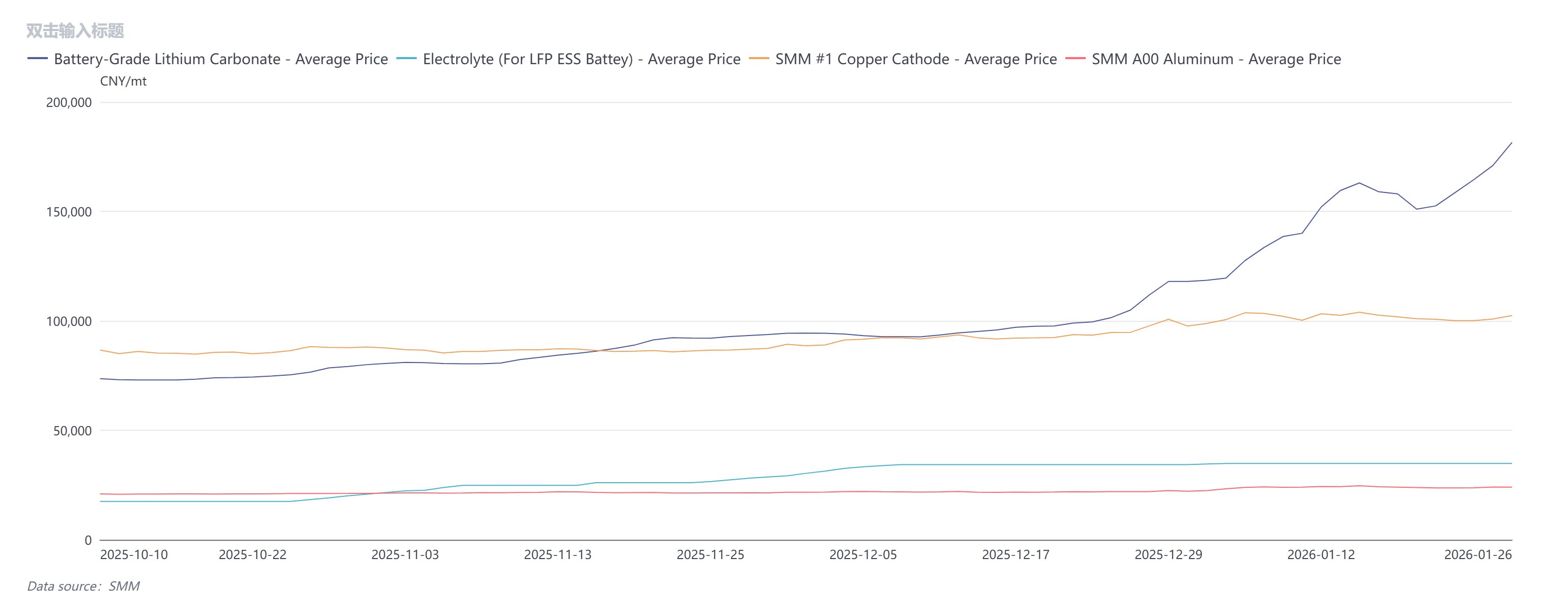 Amidst Middle East Conflicts: What is the Path Forward for China's Energy Storage Exports?
Recent Middle East conflicts have disrupted the region's booming energy storage market, a major destination for Chinese exports. To assess the real impact on Chinese supply chains and project deliveries, we must analyze baseline demand amidst these geopolitical uncertainties.
Mar 9, 2026 17:58- Where Gold & Oil Prices Go Next
It’s now been officially one week since combined U.S. and Israeli forces started striking locations within Iran.
Mar 9, 2026 09:45 - [SMM Hot Topic Analysis] Can the Iron Ore Price Dam Hold Under Heavy Supply Pressure?
I. Supply-Demand Pattern Shift Puts Iron Ore Prices on a Downtrend In 2021, driven by inflation expectations from global quantitative easing, frequent supply-side disruptions in Brazil and Australia, resilient demand in China, and strong speculative sentiment, iron ore prices hit a record high of $219.77/mt in July that year, with Platts’ annual average price as high as $160/mt ; they then entered a prolonged downtrend. In 2025, the annual average iron ore price was $102, down about 36% from the 2021 average. Source: SMM Iron ore prices have continued to fall in recent years, mainly due to the global project investment boom spurred by high prices before 2021. After 2024, multiple large iron ore projects worldwide entered a concentrated commissioning phase, and the market’s supply-demand pattern shifted from tight to loose, with the supply-demand gap widening from -12 million mt to 46 million mt. Meanwhile, China has implemented crude steel production cuts since 2022, significantly curbing iron ore demand. Coupled with persistent weakness in real estate, an overall downturn in the steel industry, and an overseas economic slowdown, among other factors, iron ore demand declined markedly. Entering 2025, a rebound in China’s steel exports drove iron ore demand to increase slightly, while capacity in emerging steel-producing countries such as Southeast Asia was gradually released, narrowing the supply-demand gap somewhat. Over the long term, however, iron ore supply is still on a growth trend, market expectations remain bearish, and prices are pressured to set new lows repeatedly. Source: SMM (the forecast assumes an extreme balance under normal commissioning of new mines and no voluntary production cuts by mines) II. Mine Costs Form a Solid Bottom Support for Iron Ore Prices From the global iron ore cost curve, about 90% of global mine cash cost is no higher than $85/mt, and about 93.8% is no higher than $90/mt. International mining giants represented by FMG, BHP, Rio Tinto, and Vale have costs far below those in China and other non-mainstream countries, forming the main body on the left side of the cost curve in the chart—low and relatively flat—which explains their strong cost competitiveness and earnings resilience in the global market. At present, the $85-90 cost line is the lifeline for the vast majority of mines; once prices remain below this range for an extended period, high-cost capacity will be forced to exit, thereby supporting prices. China’s iron ore mines due to low raw ore grade and high underground mining costs, among other reasons, currently have a nationwide per-mt processing cost of about 595 yuan/mt, equivalent to around $85 . Its costs have long been at the high end globally, serving as the "anchor point" and "ceiling" of the cost curve. The high cost and low production of China's domestic iron ore mines have led the steel industry to heavily rely on imports for raw materials, and fluctuations in international ore prices directly impact the profit stability of the domestic steel industry. Therefore, promoting domestic resource supply, investing in low-cost overseas resources, and developing steel scrap recycling are crucial for the strategic security of China's steel industry. Data source: SMM III. The global iron ore supply has long been characterized by a landscape dominated by the "Big Four" mines, supplemented by "non-mainstream" mines. Currently, the iron ore production industry is highly concentrated, primarily following a pattern dominated by the "Big Four" mines, supplemented by "non-mainstream" mines. Australia and Brazil have long contributed over half of the global iron ore production. Australia, leveraging advantages such as high resource concentration, low mining costs, and stable supply, firmly holds its position as the world's largest producer and exporter; while Brazil is renowned for its high-grade ore and is the world's second-largest iron ore exporter. Data source: SMM The "Big Four" mines, consisting of Rio Tinto, BHP, FMG, and Vale, have long dominated global iron ore supply, accounting for approximately 70% of global production. Data source: SMM The Rise of Emerging Mines Promoting the Multipolar Development of Global Iron Ore In recent years, India has actively promoted domestic mining development, leading to a significant increase in production; since 2023, its iron ore production has surpassed that of China, and it shows a continuous expansion trend, maintaining an annual growth rate of 7%, gradually becoming a new force in regional supply growth. Emerging enterprises such as India's National Mineral Development Corporation (NMDC) and South Africa's Anglo American are gradually expanding capacity, enhancing their influence in the international market. Meanwhile, countries such as Russia, Kazakhstan, Iran, and regions in Africa are also actively developing domestic iron ore resources, seeking to increase their voice in regional markets, driving the global iron ore supply landscape from high concentration towards gradual multipolar development. Data source: SMM IV. Australia Firmly Holds the Top Spot, India Becomes a New Growth Engine From the perspective of major producing countries, Australia still firmly ranks first globally, with iron ore production of approximately 900 million mt in 2025, accounting for one-third of the global total, and maintaining a stable annual growth rate of about 2%. Brazil ranks second; after the 2019 dam collapse, production once fell sharply. Although it has recovered somewhat over the past two years, the increase has been relatively limited. China’s production scale is relatively large, but due to frequent safety incidents and the continued impact of the environmental protection-driven production restriction policy, production has not increased but instead declined in recent years. By contrast, India, as an emerging producer, has seen production rise steadily over the past decade, and is expected to post an increase of about 7% by 2030. Source: SMM V Over the next three years, the world will usher in a new peak in mine commissioning In addition to supply from existing mines, there are currently multiple large-scale iron ore projects under construction worldwide, with the number of mines expected to be commissioned in 2026 at six, mainly located in Africa and Brazil. Representative projects include Vale’s northern expansion “S11D +20mtpa,” the northern block of Guinea’s Simandou iron ore project, and the Nimba iron ore project. 2026 will be the year with the most concentrated new supply over the next three years. With the northern block of Simandou officially commencing production, the overall capacity ceiling of the mining area will, with capacity ramp-up, rise to 120 million mt, becoming the core incremental source of global iron ore supply over the next five years. From 2027 to 2028, projects expected to commence production will mainly come from China, including the Xi’an Mountain iron ore mine and the Honggenan iron ore mine, adding about 25 million mt of iron ore supply to the domestic market. Overall, as emerging producers continue to release capacity, and traditional suppliers such as Australia and Brazil consolidate their export advantages through expansion projects, the global iron ore supply structure will become more diversified. A new cycle of capacity release has gradually begun, and the loose supply landscape is expected to continue deepening over the next several years. Source: SMM Simandou Project Commissioning Reshaping the Global Iron Ore Supply Landscape Among the many new projects, Africa’s Simandou iron ore is particularly noteworthy. The mine is expected to reach annual capacity of 120 million mt, and the ore’s average grade exceeds 65%, providing the market with a high-grade, high-quality option beyond Australia and Brazil, and becoming an important variable in the recent contest over the global iron ore supply landscape. In terms of project progress, the Simandou iron ore project has entered a substantive shipment phase; as logistics corridors are gradually opened up, the mining area’s substantive impact on global supply will gradually become evident. Source: SMM Nearly 400 million mt of Capacity Release by 2030, Global Iron Ore Market Faces Impact With the entry of emerging producers, iron ore supply is beginning to diversify. Projects led by Simandou iron ore are breaking the industry landscape and taking the iron ore market into a new stage. Looking ahead to the next five years, global iron ore capacity is expected to see a wave of concentrated releases, with incremental supply mainly coming from two major regions: Africa and Australia . Leveraging the development of new high-grade mines such as Simandou, Africa is reshaping the global supply landscape; meanwhile, Australia, relying on its existing capacity base and ongoing expansion projects, is further consolidating its export-dominant position. Overall, the global iron ore supply landscape is evolving toward greater diversification and a looser market. Source: SMM VI Simandou High-Quality Iron Ore Enters the Market; Global Iron Ore Enters an Era of “Quality Upgrading” As some older mines gradually enter a period of resource depletion , coupled with the fact that many newly commissioned projects are dominated by mid- to low-grade ore, the average global iron ore grade shows a downward trend from 2025 to 2026 . However, as high-grade mines such as Simandou are commissioned one after another, the share of high-grade ore supply is expected to increase, and is projected to drive a rebound in the overall global iron ore grade in 2027. Source: SMM VII “Green Steel” Reshapes the Global Crude Steel Production Landscape From a policy perspective, the low-carbon transition represented by “green steel” is profoundly reshaping the global crude steel production landscape . Whether in China or Europe, carbon neutrality has become the core theme for the future development of the steel industry. Therefore, whether it is China’s ongoing capacity replacement policy or the EU’s Carbon Border Adjustment Mechanism (CBAM) that is about to be fully implemented , both clearly indicate that the global steel industry is accelerating its transition toward low-carbon and green development. Achieving carbon neutrality across the entire industry chain is no longer an isolated task for a single link, but must rely on close upstream-downstream coordination and deep integration of technological pathways. Source: SMM Technology Reshaping: Green Iron Supply + Green Production Demand Against the broader backdrop of carbon neutrality, merely maintaining the current supply-demand structure dominated by iron ore can no longer meet future low-carbon requirements. The deeper need of industry transformation lies in reconstructing metallurgical processes: resource-rich countries—such as Australia and Brazil, traditional major iron ore exporters—need to fully leverage their renewable energy endowments and mineral advantages, shifting from simply exporting iron ore to producing high-grade, low-carbon-footprint direct reduced iron (DRI) or hot briquetted iron (HBI) and other high value-added intermediate products. By shipping this clean-energy-driven “green DRI” to steel consumption hubs and integrating it with local green electric arc furnace (EAF) processes, it can effectively replace the traditional “blast furnace–converter” long process, thereby substantially reducing carbon emissions at the source. This multinational collaborative model of “high-quality resources + green energy + short-process” is not only a critical measure to address trade barriers such as the Carbon Border Adjustment Mechanism, but also an essential pathway to build a new global green steel supply chain and drive deep decarbonization across the industry. Data source: SMM Rising Share of Electric-Furnace Steelmaking, Stronger Substitutability of Steel Scrap, Squeezing Iron Ore Demand Driven by carbon-neutrality targets, the steel industry, as a major source of carbon emissions in the industrial sector, has drawn close attention for its emissions-reduction pathway. Among these, the traditional long-process route centered on “blast furnace–converter,” due to its heavy reliance on coke and iron ore, is regarded as a primary source of carbon emissions and has therefore become a key focus of regulation and retrofitting in various countries. By contrast, the short-process route represented by “steel scrap–electric furnace,” with a significantly lower carbon-emissions intensity, is being favoured by an increasing number of countries. This structural shift has driven the share of electric-furnace steelmaking in global crude steel production to continue rising. Data source: SMM From an economic perspective, the substitution relationship between steel scrap and pig iron is typically measured by the price spread. Generally, after factoring in steelmaking costs and losses, pig iron costs should be about 100-150 yuan/mt higher than steel scrap prices ; this range is viewed as the cost-performance equilibrium band: if steel scrap prices are lower than pig iron costs by more than this threshold, steel scrap is more economical; otherwise, pig iron has a more pronounced advantage. In 2025, the average price spread between pig iron and steel scrap was 122 yuan/mt, lower than the 2024 average of 211.8 yuan/mt, and also largely within the cost-performance equilibrium band. By contrast, the 2024 spread was significantly above the upper limit of the equilibrium band, indicating that steel scrap offered a more prominent cost-performance advantage at that time. After the spread narrowed in 2025, the economic advantage of steel scrap weakened somewhat. As a result, in the short term, there is limited room for China to increase the share of electric-furnace steelmaking; overall, it remains at a relatively low level and still lags far behind the global average. This also reflects that, at the current stage, cost factors still impose a substantive constraint on the choice of smelting process routes. Data source: SMM Taken together, the blast furnace–converter long-process route will remain the dominant model for global steel production over the next five years, but the shares of electric furnaces and steel scrap usage will increase year by year; in the long run, this trend will suppress iron ore demand, causing it to weaken gradually. Data source: SMM VIII Global Total Iron Ore Demand in 2030 to Be About 2.4 Billion mt, with Gradual Shifts in Global Flows As China began encouraging domestic steel mills to develop overseas markets while adjusting the domestic industry chain’s transformation toward producing high value-added products needed by the manufacturing sector, global crude steel production began to rebound gradually. Data Source: SMM From the perspective of the global demand structure, although crude steel production outside China is entering a new round of development, with capacity expansion particularly notable in regions such as India and Southeast Asia, a considerable portion of the incremental increase comes from electric furnace processes, providing limited substantive boost to iron ore demand. Meanwhile, as the world’s largest iron ore consumer, China’s crude steel production has entered a downward trajectory, constituting the primary source of demand-side reductions. Overall, overseas increments are unlikely to fully offset China’s reductions. It is expected that by 2030, total global iron ore demand will be approximately 2.4 billion mt, with overall growth trending toward a slowdown. Compared with the mild growth on the demand side, the supply side remains in a phase of continuous expansion. The oversupply landscape will become an important factor that suppresses ore prices over the long term. Data Source: SMM SMM will continue to track the impact of changes in iron ore supply and demand on prices. Comments are welcome—scan the code to follow us! Data Source Statement: Except for publicly available information, all other data are processed and derived by SMM based on publicly available information, market communication, and SMM’s internal database models, for reference only and not constituting decision-making advice. Scan the code to access information for free
Mar 9, 2026 14:39 - Lead-Acid Battery Market Rebounds; Producers and Dealers Restock as Needed [SMM Lead-Acid Battery Market Weekly Review]
This week, the lead-acid battery market basically resumed normal trading. After logistics recovered, dealers gradually restocked as needed. Both the e-bike and automotive battery markets showed post-holiday restocking momentum, but lead prices struggled to rise, and selling prices in the battery wholesale market remained unchanged for the time being. In addition, on the producer side, lead-acid battery enterprises gradually resumed lead ingot procurement after the holiday. However, due to lead ingots stored before the holiday or long-term contract pre-sales, downstream enterprises had limited short-term replenishment purchases of spot orders, and the improvement in trading activity in the spot lead market was also limited.
Mar 6, 2026 16:27 - Center of the Most-Traded SHFE Tin Contract Shifted Higher, Only a Small Number of Rigid-Demand Deals Were Concluded in the Spot Market in the Morning [SMM Tin Midday Review]
[SMM Tin Midday Review: The Center of the Most-Traded SHFE Tin Contract Moved Higher; Only a Small Volume of Rigid-Demand Transactions Were Concluded in the Spot Market This Morning]
Mar 6, 2026 12:04 - [SMM Analysis] NCM Price Retreat Fails to Fuel Much Buying Appetite
This week, ternary material prices edged slightly downward. From a raw material perspective, nickel sulfate, cobalt sulfate, and manganese sulfate prices remained relatively stable with no significant fluctuations. The primary downward pressure on prices came from lithium sulfates: spot prices of lithium carbonate and lithium hydroxide saw notable declines in early week, weakening the cost support for ternary materials. Despite the pronounced decline in lithium sulfate prices early this week, ternary cathode material manufacturers showed relatively limited restocking interest. There are two main reasons for this: First, prior to the price adjustment, most cathode manufacturers had already finalized March orders with downstream battery cell makers and are currently in the order delivery phase , maintaining relatively sufficient raw material inventories. Second, manufacturers generally maintain a " buy on rising, not on falling " mentality, viewing this adjustment primarily as short-term volatility influenced by international situations, with no expectation of sustained lithium sulfate price declines. In terms of pricing, although lithium carbonate futures prices experienced adjustments, cathode manufacturers' quotations did not see significant declines, mainly because their raw material costs remain higher than current futures prices . Spot market transactions were also quite subdued this week, with market activity dominated by long-term contract supplies. On the demand side, the EV market showed seasonal recovery, but downstream customers' order fulfillment pace remained slow due to Q1 new energy vehicle sales falling short of expectations . In contrast, e-mobility and consumer electronics markets saw relatively notable growth, primarily driven by some consumer batteries facing "export rush" demand , leading to forward order placements.
Mar 5, 2026 14:27