

12711results found for 'trend'
Price
News
- Hongjin New Materials Invites You to the SMM (3rd) Global Recycled Metals Industry Peak Forum
Leveraging the dual-carbon strategy and the broader trend of circular economy development, China's secondary metal industry leads the world in scale, while also facing numerous development challenges. To help enterprises seize industry policy and market opportunities and address industry development issues, SMM will hold the 2026 SMM Global Secondary Metal Industry Summit Forum & Secondary Aluminum Melting and Casting Technology Forum in Ningbo, Zhejiang, July 16-17, 2026 , a landmark event — 2026 SMM Global Secondary Metal Industry Summit Forum & Secondary Aluminum Melting and Casting Technology Forum . Wuhan Hongjin Metal Aluminum Co., Ltd. sincerely invites you to join us in witnessing and building an international platform for exchange, cooperation, resource sharing, and collaborative innovation, contributing to the construction and improvement of a global resource circular utilization system and driving the global green economic transition. Click the to register now. Booth No.: E6 Hongjin New Materials Group has been deeply engaged in the cast aluminum alloy sector for 30 years and is a leader with over 10 billion yuan in revenue, integrating R&D, production, and services. The Group has established 10 modern production sites and 2 provincial-level new materials research institutes worldwide, with green low-carbon aluminum alloy capacity exceeding 1.2 million mt in 2025. We are committed to providing aluminum alloy ingots, direct molten aluminum supply, and one-stop lightweight solutions. Our independently developed large-scale integrated die-casting heat-treatment-free aluminum alloy is ready for mass production. Our products are widely used in cutting-edge fields such as NEVs and 5G communications, and we are a designated supplier for top 100 automakers including Tesla, BYD, and BBA, as well as Google and Amazon. Hongjin New Materials is fully committed to green and low-carbon practices, "casting the future" together with global partners. I. Enterprise Strengths 1.5 million mt+ : Annual green low-carbon aluminum alloy capacity in 2025 10 billion + : Annual Group revenue 10 Major Sites : Based in China (south China/central China/east China), with expansion outside China 2 Major Institutions : Two provincial-level new materials research institutes II. Core Products and Services Providing you with one-stop lightweight solutions from materials to processes: Core Services : Premium aluminum alloy ingot supply | Direct molten aluminum supply | Integrated melting and holding services Specialty Patented Materials : High thermal conductivity, high electrical conductivity, high strength and toughness, and high wear-resistant aluminum alloys Industry Frontier : Large-scale integrated die-casting heat-treatment-free aluminum alloy (approved by OEMs, ready for mass production) Full Grade Coverage Standard Series : Mainstream grades including ADC12, A380, A356, ALSI10MNMG, etc. Exclusive Patented Series : HJ Series (HJ03-16), HCS09, HS330, and many other proprietary grades. III. World-Class Partner Network Products are widely used in core sectors including automotive, new energy, low-altitude economy, and 3C electronics. Globally Renowned Automakers : BMW, Mercedes-Benz, Audi, Volkswagen, General Motors, Toyota, Honda, Nissan New Energy Pioneers : Tesla, BYD, NIO, XPeng, Xiaomi, Geely Technology and Ecosystem Giants : CATL, DJI, Inovance ( Designated qualified supplier for Google and Amazon ) IV. Green, Low-Carbon, and Quality Commitment Safeguarding your supply chain security with the highest international standards: System Certifications : IATF 16949, ISO 9001 / 14001 / 45001 / 50001:2018 Green Development : Completed carbon footprint and greenhouse gas verification, deeply engaged in advancing ESG and ASI (Aluminium Stewardship Initiative) initiatives. Contact Information Sales Center: Hongbang Team - Sales Director - Yang Zhenjiang 139 2263 2929 South China Team - Sales Director - He Chijia 138 2754 9148 East China Team - Sales Director - Han Yaobin 159 5327 5580 Central China Team - Sales Director - Li Hongwei 136 1832 5655 Website: SMM Conference Contact Zhou Shiyang Mobile: 17278238856 Email:
Jun 30, 2026 17:00 - Pr-Nd Oxide Prices Show Slight Fluctuations Amid Low Market Confidence and Weak Demand
This week, Pr-Nd oxide prices exhibited slight fluctuations. At the beginning of the week, the weak trend from last week continued; by mid-week, due to futures market price fluctuations and periodic restocking by some large enterprises, market inquiry activity picked up, leading to a slight increase in Pr-Nd oxide prices. However, overall market confidence remained insufficient, with downstream buyers being quite cautious in restocking, and actual trading volume did not increase significantly. As for the medium-heavy rare earth sector, it is currently in the demand off-season, and market inquiry activity remained sluggish. Some traders chose to sell inventory at lower prices, which kept dysprosium oxide and terbium oxide prices under pressure. Looking ahead, although downstream enterprises have relatively low raw material inventory levels, due to persistently weak orders, these enterprises have relatively small interest in stockpiling more raw materials. In the short term, market inquiries and procurement activities are expected to remain weak, and the overall price trend of rare earth oxides is likely to maintain a fluctuating trend with a downward bias.
May 31, 2026 23:10 - NBS: Manufacturing PMI Stood at 50% in May, with Overall Business Production and Operations Remaining Stable
Data from the National Bureau of Statistics (NBS) showed that in May, the manufacturing PMI stood at 50.0%, down 0.3 percentage points MoM. The composite PMI output index was 50.5%, up 0.4 percentage points MoM, indicating that overall business production and operations in China remained in expansion. The non-manufacturing business activity index was 50.1%, up 0.7 percentage points MoM, with the non-manufacturing prosperity level rebounding. China's PMI Performance in May 2026 I. China's Manufacturing PMI Performance In May, the manufacturing PMI stood at 50.0%, down 0.3 percentage points MoM, sitting at the threshold level. By enterprise size, the PMI for large enterprises was 51.1%, up 0.9 percentage points MoM, above the threshold; the PMIs for medium and small enterprises were 48.6% and 48.5% respectively, down 1.9 and 1.6 percentage points MoM, both below the threshold. By sub-indices, among the five sub-indices constituting the manufacturing PMI, the production index was above the threshold, while the new orders index, raw material inventory index, employment index, and supplier delivery time index were all below the threshold. The production index was 51.2%, down 0.3 percentage points MoM, but still above the threshold, indicating that manufacturing production activity remained in expansion. The new orders index was 49.9%, down 0.7 percentage points MoM, indicating that the prosperity level of manufacturing market demand pulled back somewhat. The raw material inventory index was 48.6%, down 0.7 percentage points MoM, indicating a decline in the inventory of major raw materials in manufacturing. The employment index was 48.6%, down 0.2 percentage points MoM, indicating that the prosperity level of manufacturing employment pulled back somewhat. The supplier delivery time index was 49.2%, down 0.3 percentage points MoM, indicating that the delivery time of manufacturing raw material suppliers continued to lengthen MoM. II. China's Non-manufacturing PMI Performance In May, the non-manufacturing business activity index was 50.1%, up 0.7 percentage points MoM, with the non-manufacturing prosperity level rebounding. By sector, the construction business activity index was 48.8%, up 0.8 percentage points MoM; the services business activity index was 50.3%, up 0.7 percentage points MoM. Within the services sector, industries such as railway transportation, telecommunications, broadcasting, television and satellite transmission services, and insurance all had business activity indices in the relatively high prosperity range of above 55.0%; industries such as air transportation and real estate had business activity indices below the threshold. The new orders index was 45.0%, up 0.7 percentage points from the previous month, indicating that the non-manufacturing market demand improved. By sector, the construction new orders index was 43.5%, up 1.9 percentage points from the previous month; the services new orders index was 45.3%, up 0.5 percentage points from the previous month. The input price index was 52.2%, up 0.5 percentage points from the previous month, indicating that the overall input prices for non-manufacturing business operations continued to rise. By sector, the construction input price index was 53.7%, down 1.2 percentage points from the previous month; the services input price index was 52.0%, up 0.8 percentage points from the previous month. The selling price index was 48.8%, up 0.7 percentage points from the previous month, indicating that the decline in overall selling prices of non-manufacturing enterprises narrowed. By sector, the construction selling price index was 48.6%, down 0.4 percentage points from the previous month; the services selling price index was 48.9%, up 1 percentage point from the previous month. The employment index was 45.6%, up 0.1 percentage points from the previous month, indicating that employment conditions in non-manufacturing enterprises improved slightly. By sector, the construction employment index was 41.4%, up 1.8 percentage points from the previous month; the services employment index was 46.4%, down 0.1 percentage points from the previous month. The business activity expectations index was 54.8%, up 0.1 percentage points from the previous month, indicating that non-manufacturing enterprises' confidence in market development strengthened. By sector, the construction business activity expectations index was 51.5%, up 1 percentage point from the previous month; the services business activity expectations index was 55.4%, unchanged from the previous month. III. China Composite PMI Output Index In May, the composite PMI output index was 50.5%, up 0.4 percentage points from the previous month, indicating that China's overall enterprise production and business activities remained in expansion. Composite PMI Output Index Remained in Expansion in May — Interpretation of China's PMI for May 2026 by Huo Lihui, Chief Statistician of the Service Industry Survey Center, National Bureau of Statistics (NBS) On May 31, 2026, the Service Industry Survey Center of the NBS and the China Federation of Logistics and Purchasing released China's PMI. Huo Lihui, Chief Statistician of the Service Industry Survey Center of the NBS, provided an interpretation of the data. In May, the manufacturing PMI was 50.0%, down 0.3 percentage points from the previous month; the non-manufacturing business activity index and the composite PMI output index were 50.1% and 50.5% respectively, up 0.7 and 0.4 percentage points from the previous month. China's overall economic output remained in expansion. I. Manufacturing PMI at the Threshold In May, the manufacturing PMI stood at 50.0%, indicating that overall business production and operations remained stable. (i) Enterprise production maintained expansion. The production index was 51.2%, above the threshold, as manufacturing production activities continued to expand; the new orders index was 49.9%, suggesting that market demand somewhat slowed down. By sector, the production and new orders indices for industries such as pharmaceuticals, railway, shipbuilding, aerospace equipment, and computer, communications, and electronic equipment were all above 53.0%, with both production and demand sides of these industries remaining relatively active; the two indices for industries such as petroleum, coal, and other fuel processing, chemical fibers, rubber and plastic products, and non-metallic mineral products remained below the threshold, with both supply and demand sides still showing insufficiency. (ii) New momentum continued to develop favorably. The PMIs for high-tech manufacturing and equipment manufacturing were 52.9% and 52.1%, respectively, up 0.7 and 0.3 percentage points from the previous month, both remaining consistently above the threshold. In particular, the PMI for high-tech manufacturing had stayed in expansion territory for 16 consecutive months, with related industries maintaining strong growth and the leading role of new momentum continuing to emerge; the PMIs for consumer goods industries and high energy-consuming industries were 49.7% and 47.1%, respectively, down 1 and 0.8 percentage points from the previous month, with market activity somewhat weakening. (iii) Large enterprise PMI remained consistently above the threshold. The PMI for large enterprises was 51.1%, up 0.9 percentage points from the previous month, staying in expansion territory throughout the year, as large enterprises sustained a favorable production and operation trend; the PMIs for medium and small enterprises were 48.6% and 48.5%, respectively, with business conditions pulling back. (iv) Price indices fluctuated at high levels. The raw material purchase price index and the ex-factory price index were 60.5% and 51.9%, respectively, both pulling back 3.2 percentage points from the previous month but remaining at relatively high levels in recent periods. Both indices stayed in expansion territory for five consecutive months, as overall market price levels in manufacturing continued to rise. By sector, the two price indices for industries such as textiles, chemical fibers, rubber and plastic products, and ferrous metals smelting and rolling processing remained above 55.0% for three consecutive months, with overall purchase and sales price levels in related industries continuing to rise. II. Non-manufacturing Business Activity Index Rose above the Threshold In May, the non-manufacturing business activity index was 50.1%, up 0.7 percentage points from the previous month, as the non-manufacturing business conditions rebounded. (i) The services business activity index rose into expansion territory. The services business activity index was 50.3%, up 0.7 percentage points from the previous month, with market activity in the services sector somewhat improving. By industry, the business activity indices for industries such as railway transportation, telecommunications, radio, television and satellite transmission services, and insurance were all above the relatively high prosperity range of 55.0%, with rapid growth in total business volume; the business activity indices for industries such as air transportation and real estate were below the critical point, indicating relatively low prosperity levels in these industries. In terms of market expectations, the service sector business activity expectations index was 55.4%, remaining in the relatively high prosperity range, indicating that most service sector enterprises held generally optimistic expectations for near-term market development. (2) The construction sector business activity index rebounded. The construction sector business activity index was 48.8%, up 0.8 percentage points from the previous month, with improved prosperity levels. In terms of market expectations, the construction sector business activity expectations index was 51.5%, up 1 percentage point from the previous month, indicating that construction enterprises' confidence in future industry development recovered somewhat. 3. Composite PMI Output Index Continued to Expand In May, the composite PMI output index was 50.5%, up 0.4 percentage points from the previous month, indicating that China's enterprise production and business activities generally maintained expansion. The manufacturing production index and non-manufacturing business activity index, which constitute the composite PMI output index, were 51.2% and 50.1%, respectively.
May 31, 2026 21:26 - Cost Side Diverges and Weakens, Aluminum Fluoride Lacks Support and Remains Slightly Under Pressure [SMM Analysis]
Overall market trading activity was sluggish. At month-end, the market maintained a steady posture, watching for the outcome of the new round of aluminum fluoride tender prices. However, as the raw material side showed signs of easing, prices are expected to be slightly under pressure next month. Going forward, close attention should continue to be paid to dynamic changes on the raw material cost side, as well as marginal adjustments in the procurement pace of downstream aluminum enterprises.
May 31, 2026 17:06 - Shanxi Xinhui Activated Carbon Co., Ltd. Made a Grand Appearance at the 2026 SMM Battery Technology Industry Conference
Driven by the dual forces of global energy structure transformation and the "dual carbon" goals, battery technology is evolving from a traditional power storage medium into a core engine reshaping transportation, consumer electronics, and even the energy internet. From fundamental breakthroughs in materials science to the industrialisation of cutting-edge technologies such as solid-state and sodium-ion batteries, the battery industry is in a period of technological explosion with intense competition. This conference brings together the world's top scholars, industry chain leaders, and capital forces, aiming to break down barriers between "industry, academia, research, and application." We will delve into key topics including high energy density, ultimate safety, ultra-fast charging technology, and recycling, jointly charting a new blueprint for green, efficient, and sustainable energy. Shanxi Xinhui Activated Carbon Co., Ltd. will attend this grand event to discuss industry development trends with industry peers and jointly drive battery technology to new heights. Click to register now, witness and participate in this extraordinary and far-reaching industry event together, and co-create a brilliant new chapter! Client-centred service! Problem-solving as our principle! Professional, focused, and true to our original aspiration! Shanxi Xinhui Activated Carbon Co., Ltd. (hereinafter referred to as "the Company") was established in 2008, with its headquarters in Taiyuan, Shanxi Province. Its subsidiaries are located in Datong and Xinjiang. It is a private enterprise integrating new-type activated carbon material research and application, production and manufacturing, and sales and services. Its business falls under Shanxi Province's key industry chain — the carbon-based new materials industry chain. As a National High-tech Enterprise, a model of Shanxi Province's specialised, refined, distinctive, and innovative small and medium-sized enterprises, and a municipal-level enterprise technology centre of Taiyuan, the Company has always adhered to the philosophy of innovation-driven development and possesses strong technical R&D capabilities in the activated carbon industry. The Company sets annual product R&D directions and has obtained 36 patents to date, including 1 design patent, 2 published invention patents, 12 granted invention patents, and 21 utility model patents. The Company's independently developed activated carbon features a well-developed specific surface area, well-developed pore structure, high adsorption capacity, fast adsorption speed, good mechanical strength, and the ability to be repeatedly regenerated and recycled. It is widely used in domestic drinking water, industrial wastewater, fine chemicals, and hydrometallurgy. Product Introduction 1 Granular Activated Carbon 2 Powdered Activated Carbon 3 Columnar Activated Carbon 4 Honeycomb Activated Carbon 5 High-efficiency Purification System Long press 2026 SMM Battery Technology Conference
May 31, 2026 16:49 - IKOI S.p.A Invites You to the 2026 SMM (7th) Silver Industry Chain Innovation Conference
Against the backdrop of accelerating global energy transition and digital economy development, silver—a strategic metal possessing both industrial and financial attributes—is witnessing profound transformation across its industry chain. On one hand, emerging sectors such as PV, NEV, and 5G communications are driving continuously climbing demand for silver, propelling the industry toward higher value-added and greener upgrades; on the other hand, resource constraints, technological barriers, and market fluctuations are imposing higher demands on industry chain resilience, urgently requiring innovation-driven coordinated development across the entire chain. Dual Drivers of Policy and Market Under China's "dual carbon" goals and the global ESG investment wave, the silver industry faces pressing needs for green production, circular utilization, and low-carbon technologies. The NDRC's "14th Five-Year Plan for Circular Economy Development" explicitly calls for strengthening the circular utilization of precious metal resources, while international silver price fluctuations and geopolitical risks are compelling enterprises to enhance supply chain autonomy and controllability. Against this backdrop, the Silver Industry Chain Innovation Conference has emerged, aiming to build a collaborative platform integrating government, industry, academia, research, and end-use applications, to address industry pain points, and to lead the industry toward high-end, intelligent, and internationalized advancement. Innovation Needs and Industry Pain Points Technological Breakthroughs: Silver purification processes, nano-silver material applications, and scrap recycling technologies urgently need breakthroughs to meet the demand for high-purity, low-cost silver in emerging fields such as PV silver paste and flexible electronics. Industry Chain Coordination: Information barriers exist across mining, smelting and processing, and end-use applications segments, requiring digital tools to achieve optimized resource allocation and risk sharing. Green Transformation: Traditional smelting processes are energy-intensive and highly polluting, necessitating the promotion of clean production technologies and circular economy models in response to global carbon neutrality commitments. Market Expansion: Silver's application potential in frontier fields such as hydrogen energy and quantum computing has yet to be fully explored, requiring strengthened cross-industry collaboration and standard-setting. Conference Objectives and Value Themed "Silver Chain Innovation · Intelligent Creation for the Future," this conference brings together global silver industry chain leaders, research institutions, financial institutions, and policymakers for in-depth dialogue around three core topics: technological R&D, supply chain optimization, and market expansion. Through releasing industry white papers, establishing innovation alliances, and signing major projects, the conference aims to drive the silver industry's transformation from "resource dependence" to "technology leadership," providing critical material support for the global energy revolution and digital economy. IKOI S.p.A will attend this grand event to discuss industry development trends with industry peers and jointly propel the silver industry to new heights. Click to register now. Join us to witness and participate in this extraordinary and far-reaching industry event, and together create a brilliant new chapter! IKOI, established in 1977, is a global leader in pyrometallurgical processes for precious metal refineries, mints, and jewelry markets. Currently, it has 3 major product lines: COMPACT integrated fully automatic gold and silver ingot casting systems, FCC FLAMELESS CASTING CHAMBER® fully automatic delivery bar systems, and the acid-free separation technology ALS system that physically separates gold and silver. IKOI's vision is to create safe, efficient, and green precious metal processing methods. IKOI's mission is to bring innovative and sustainable technologies to the precious metal industry. Contact Information Ni Yong 187 0185 9684 Long press to scan the QR code to register now 2026 SMM (7th) Silver Industry Chain Innovation Conference
May 31, 2026 10:21
Announcements
- Data[SMM Announcement] Notice on the Official Launch of SMM Lithium Ore/Concentrate Port Inventory Data
Notice on the Official Launch of SMM Lithium Ore/Concentrate Port Inventory Data
DataMay 18, 2026 18:43 Announcement on Data Adjustment of SMM Steel Indirect Export Model
DataMay 18, 2026 17:50To strengthen visibility into lithium carbonate inventory trends and expand market data coverage, we have implemented a significant upgrade to our existing data system.
DataMay 13, 2026 11:15
Events
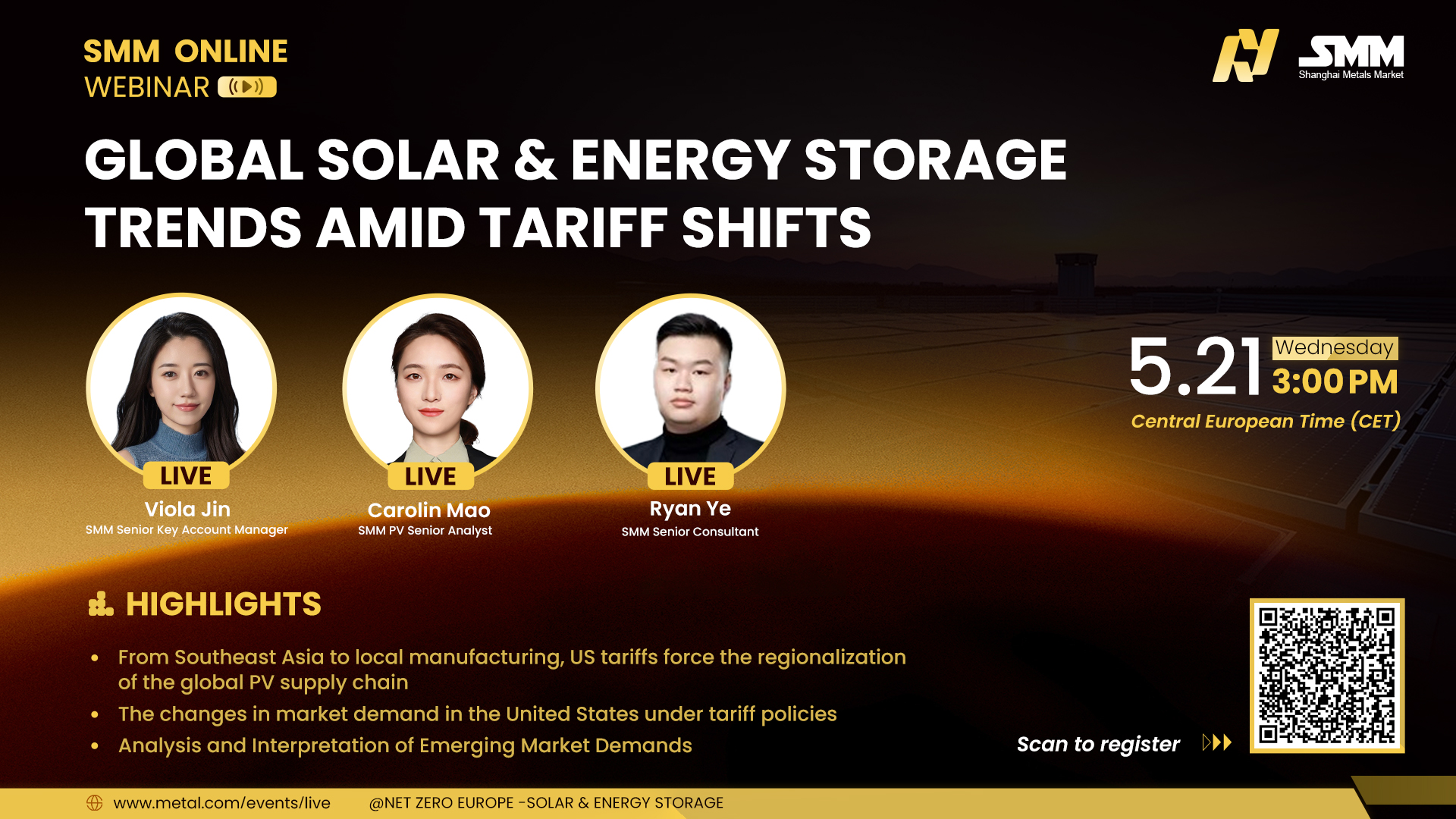 WebinarMay 21, 21:00 - 23:59 (GMT+8)
 WebinarMar 26, 16:00 - 23:59 (GMT+8)
 WebinarAug 27, 17:00 - 23:59 (GMT+8)