

226results found for 'quartz sand'
Price
News
- Silicon Metal Price Center Narrowly Firmer, Wafer Range Highs Edge Up Slightly [SMM Silicon-Based PV Morning Meeting Summary]
[SMM Silicon-Based PV Morning Meeting Summary] Silicon metal: Yesterday, SMM oxygen-blown #553 silicon in east China was at about 9,100-9,200 yuan/mt, and #441 silicon was at about 9,200-9,400 yuan/mt, with the price center edging up WoW. In the futures market, the most-traded contract showed strength, with the most-traded SI2609 contract consolidating near 8,600 yuan/mt. Futures prices rose, which, combined with silicon enterprises’ reluctance to sell at low prices, reduced cheap supply in the silicon market. Suppliers’ offer centers firmed, while downstream users remained largely in a wait-and-see sentiment, resulting in subdued trading. Wafers: Market prices were 0.798-0.827 yuan/piece for 18X wafers, 0.896-0.915 yuan/piece for 210RN wafers, and 1.097-1.113 yuan/piece for 210N wafers. The upper end of the wafer price range inched up. Yesterday afternoon, a leading specialized wafer enterprise also suspended quoting, planning to increase prices by over 10%. As of now, three enterprises have stopped quoting or suspended shipments.
Aug 12, 2026 09:23 - Under the Wave of Electronic Cloth Capacity Expansion, Platinum’s New Golden Track [SMM Analysis]
AI-Driven Electronic Fabric: From Supporting Material to Computing Power Base Electronic fabric (electronic-grade glass fiber cloth) is the core reinforcing substrate for copper clad laminate (CCL), which ultimately goes into printed circuit boards (PCB). In the past, electronic fabric was mostly used as a supporting material, but as AI servers dramatically raise requirements for PCB layer count, signal speed, and stability, low-dielectric (Low-Dk) and ultra-low-loss electronic fabric has become a rigid demand, upgrading electronic fabric into a core foundational material for computing and communication infrastructure. This demand boost has led to tighter supply and rising prices. Taking the operating data disclosed by industry leader Honghe Technology as an example, the average price of electronic-grade glass fiber cloth climbed from 4.51 yuan/meter in Q1 2025 to 9.78 yuan/meter in Q1 2026, a YoY increase of 116.85%. 2026 Expansion Panorama: An "Electronic Fabric Arms Race" Driven by AI demand, publicly listed firms across the industry chain densely disclosed electronic fabric project construction and capacity deployment plans in 2026, with capital expenditure intensity at a high level in recent years. Based on public information alone, the newly planned capacity of top-tier players is already considerable: China Jushi's electronic fabric sales reached 1.062 billion meters in 2025, ranking first in the industry; Jushi alone has announced approximately 570 million meters in new planned capacity over the past two months. Many enterprises are currently operating at full production and full sales. Glass Fiber Drawing and Pt-Rh Bushings The birth of electronic fabric begins at an ultra-high temperature of around 1600°C: raw materials like quartz sand and pyrophyllite are melted into molten glass, which flows through an alloy bushing precisely formulated with platinum and rhodium, streaming out from thousands of micron-scale nozzles. Pulled by high-speed drawing machines, it is stretched into glass fibers finer than human hair (down to below 9 microns). This bushing is the key component of a glass fiber production line and the entry point for platinum demand: Irreplaceability : In a 1300–1600°C molten glass environment, ordinary metals would rapidly oxidize, corrode, or even melt; only Pt-Rh alloy possesses the combined ability to withstand high temperatures, resist molten glass erosion, and conduct electrical heating for temperature control. Perpetual Consumable Attribute : Bushings undergo continuous wear under high-temperature scouring, with a service life of about 1–1.5 years (shorter for standard bushings; dispersion-strengthened bushings can reach 12–18 months), resulting in very strong repurchase demand. In 2025, the total in-service Pt-Rh bushing inventory across the industry reached 85.7 mt , with over 10,000 bushings in operation. Capital Expenditure Threshold : For a 100-kt level direct roving production line, the investment in Pt-Rh alloy alone has risen from approximately 200 million yuan to about 450 million yuan; each ton of electronic yarn produced requires about 6,300–6,900 yuan in Pt-Rh bushing input. Demand Volume : The global glass fiber industry has an annual platinum demand of approximately 700,000 ounces (about 21.8 mt). The platinum circulation volume involved in the full life cycle of bushings in China exceeds 3.5 million ounces (approximately 109 mt). The annual feed volume for bushing manufacturers doubled over the past five years. In 2025, the total global volume of platinum-rhodium bushings in service was approximately 85.7 mt, with over 10,000 bushings in operation. The bushing lifespan is about 1–1.5 years, requiring maintenance or replacement for over 10,000 units annually. China accounts for over 60% of global glass fiber capacity, making it the largest consumer market; correspondingly, the majority share of the in-service stock is concentrated in domestic production lines. Overall, electronic cloth has become another clear demand growth pole for platinum, following hydrogen energy. Platinum-rhodium alloy is the core consumable for glass fiber tank furnace drawing bushings. Establishing new production lines requires a substantial one-time initial feed, while ongoing volatilization losses during production constitute a continuous net consumption. This round of high-end PCB capacity expansion, driven by AI computing power, boosts both volume and price for electronic cloth, accelerating capacity deployment for ultra-thin and low-dielectric specialty cloth. This, in turn, leads to a dual increase in new bushing procurement and full-production loss, providing marginal growth for industrial platinum demand. In terms of scale, the overall demand of the glass fiber sector remains smaller than that of autocatalysts, but it exhibits high prosperity elasticity and strong linkage with the AI industry chain, representing a structural growth point on the platinum demand side that cannot be overlooked. Currently, the core pricing of platinum is still dominated by macro factors, mineral supply, and autocatalyst demand, while electronic cloth mainly amplifies the supply-demand tight balance expectations at the margin.
Aug 7, 2026 15:05 - Silicon Metal Futures Price Center Rises, PV Upstream Sector Wait-and-See Sentiment Strong [SMM Silicon-Based PV Morning Meeting Minutes]
[SMM Silicon-based PV Morning Meeting Minutes] Silicon metal: Yesterday, SMM east China oxygen-blown #553 silicon was around 9,000-9,100 yuan/mt, and #441 silicon was near 9,200-9,300 yuan/mt. The most-traded futures contract was disturbed by supply-side production cut news and PV anti-involution bullish sentiment, causing the most-traded silicon metal futures contract to trend stronger. Silicon enterprises' quotes were generally stable, with a strong willingness to sell. Watch for the impact of variables on short-term price spikes, with resistance above focused on silicon enterprises' willingness to sell. Polysilicon: N-type recharging polysilicon was quoted at 31.6-33.5 yuan/kg. Currently, most manufacturers continue to hold back from selling, market transactions are very few, but expectations for price hikes are relatively common. Some forward traders received higher quotes, with some prices even exceeding 40 yuan. However, this is limited to forward traders. Spot trading is currently basically at a standstill, awaiting the outcome of today's meeting.
Aug 5, 2026 09:10 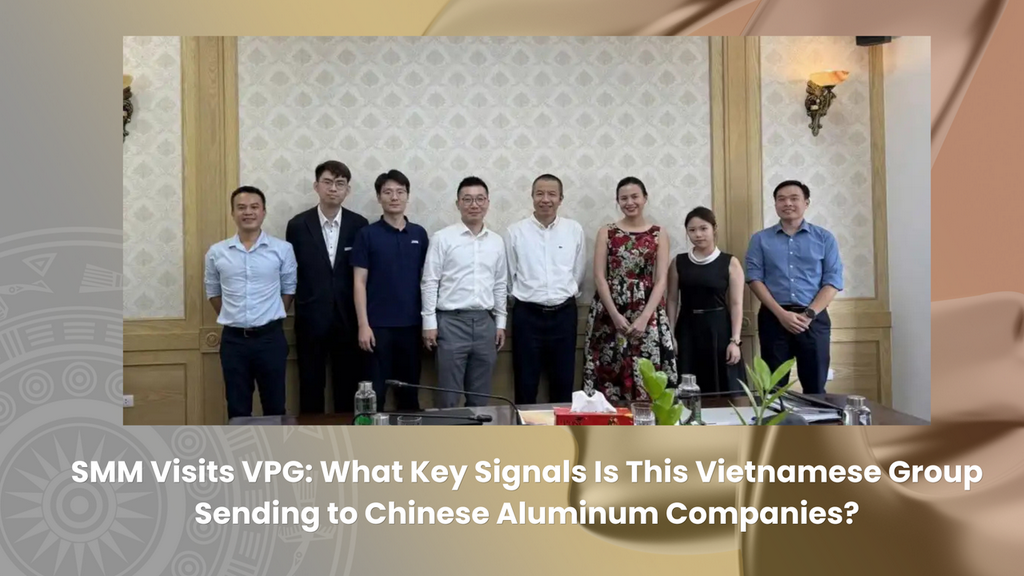 SMM Visits VPG: What Key Signals Is This Vietnamese Group Sending to Chinese Aluminum Companies?
On July 23, 2026, a delegation from Shanghai Metals Market Information Technology Co., Ltd. (SMM) visited VPG (Viet Phuong Group). The delegation included: Logan Lu, CEO of SMM Cason Lou, Director of Aluminum Processing, Marketing Department Lexi Chen, Key Account Manager for Overseas Information Sales Khai Yuen Chin, Senior Overseas Aluminum Analyst The two sides held in-depth discussions on bauxite resource development in Southeast Asia, alumina project development, regional logistics networks, and the development of a Vietnam-based aluminum pricing system. SMM noted that as the global aluminum value chain continues to restructure, China’s alumina market is expected to see sustained demand for overseas resources. Given resource availability and cost considerations, high-quality overseas alumina resources—particularly those from Vietnam and other Southeast Asian markets—are expected to gain greater market potential and competitive advantages. VPG shared updates on the progress of its current projects and said it is actively advancing mineral processing and alumina projects, with Southeast Asia and other international markets set to become key areas of future development. Since 2008, VPG has been engaged in bauxite exploration and development in Sekong Province, Laos, and is currently advancing an integrated industrial project covering bauxite mining, mineral processing, and alumina production. Both sides agreed that establishing an open, transparent, and regionally representative local aluminum pricing system would help improve information transparency and strengthen the international influence of Southeast Asia’s aluminum value chain. They also expressed expectations for deeper cooperation in market research, pricing services, and industry exchanges. What Signals Does SMM’s Visit to VPG Send to Chinese Companies? 01 Vietnam Is Becoming an Important Hub Connecting the Global Aluminum Value Chain In recent years, an increasing number of international companies have viewed Vietnam as an important gateway connecting Southeast Asian resources with global markets. Supported by its established port infrastructure, rapidly expanding manufacturing sector, and growing international trade network, Vietnam is not only benefiting from the relocation of global manufacturing capacity but is also emerging as an important regional hub for the aluminum value chain. For Chinese companies seeking opportunities in Southeast Asia, Vietnam is gradually evolving from an “investment destination” into a “supply chain partner.” 02 Vietnam’s Rapid Market Growth Is Creating New Export Opportunities With free trade agreements such as the EU-Vietnam Free Trade Agreement (EVFTA) taking effect, Vietnam has become a strategic sourcing hub for aluminum products used in the solar industry, including aluminum profiles and PV module frames, with export growth exceeding 20%. EVFTA tariff benefits for EU buyers, together with US Section 301 tariffs, have also encouraged some international buyers to shift sourcing toward Vietnam. Meanwhile, Vietnam aims for electric vehicles to account for 50% of urban vehicles by 2030. As electric vehicles use nearly 30% more aluminum than conventional vehicles, growing EV adoption could generate significant additional aluminum demand. This widening demand gap is expected to create substantial opportunities for aluminum suppliers and exporters. Against this backdrop, SMM AICE is expanding internationally by bringing its conference to Vietnam. The event aims to establish an authoritative platform connecting Chinese aluminum companies with Vietnam and the broader Southeast Asian market, promoting the transition of China-Vietnam aluminum cooperation from “resource complementarity” toward “full-value-chain cooperation and mutual growth.” 03 Future Competition Will Be About Information, Not Just Opportunities Vietnam’s market continues to develop rapidly. At the same time, market rules, policies, cost structures, and pricing mechanisms are constantly evolving. For Chinese companies, identifying projects alone is no longer enough. Timely access to local policies, industry development trends, supply chain changes, and market pricing information is becoming increasingly important. This is also why SMM continues to deepen its presence in the Vietnamese market. Recently, SMM AICE has been conducting intensive visits across Vietnam and the broader Southeast Asian industrial value chain, maintaining close communication with government authorities, industry associations, mining companies, alumina producers, aluminum processors, and other market participants. Through more transparent market intelligence and pricing systems, SMM aims to help global companies better understand market dynamics and reduce decision-making risks. To help more aluminum companies seize emerging opportunities and establish an early presence in the Vietnamese market, SMM AICE Vietnam is coming to Vietnam with a major industry gathering. VPG — Viet Phuong Group Founded in 1996, VPG (Viet Phuong Group) is a well-established diversified investment group in Vietnam, with businesses spanning mining, energy, infrastructure, finance, real estate, and other sectors. Mining is one of the group’s key strategic businesses, with projects involving mineral resources including bauxite, rare earths, and quartz sand. In the aluminum sector, VPG has been engaged in bauxite exploration and development in Sekong Province, Laos, since 2008. The group is currently advancing an integrated project covering bauxite mining, mineral processing, and alumina production. Leveraging Vietnam’s established port infrastructure and regional logistics network, VPG plans to export alumina products to China and other global markets through the Laos–Vietnam cross-border logistics corridor, further integrating into Southeast Asia’s aluminum supply chain. In recent years, the company has continued to advance project development, international cooperation, and market expansion, with the ambition of building a regional aluminum industry platform spanning resource development, alumina production, and international trade. Join the Conversation at SMM AICE 2026 Connect with aluminum producers, processors, traders, manufacturers, certification organisations, industry associations and decision-makers from across Southeast Asia and the global market. Explore aluminum pricing, primary aluminum supply, processing technologies, low-carbon development, CBAM compliance and new opportunities for regional cooperation. ? Ho Chi Minh City, Vietnam ? November 19–20, 2026 Register now: bit.ly/AICE26 and secure your Super Early Bird Pass and save up to USD 200. Register before August 31, 2026.
Aug 3, 2026 16:42- Polysilicon Awaits Cost Meeting Plan, Module Prices Stabilize Supported by Willingness to Protect Profits [SMM Weekly Review]
[SMM Weekly Review: Polysilicon Awaits Cost Meeting Plan, Module Prices Stabilize on Profit-Protection Willingness] This week, China's module prices showed signs of stabilizing. Due to the poor financial performance of some enterprises in mid-year, with companies in a continuous state of losses, the sentiment of competing on price to sell began to wane, shifting from previously rushing shipments to now prioritizing profit protection. Module prices began to show stability. However, affected by the pace of warehouse withdrawals of low-efficiency modules, low-price orders still existed in the market, and distributed prices were relatively divergent. On the centralized side, recent project tenders were scarce, and demand recovery was slower than expected.
Jul 30, 2026 13:31 - Silicon Metal Market Center Stagnant and Weak, Polysilicon Mainly Takes Wait-and-See Approach toward Future Market [SMM Silicon-based PV Morning Meeting Summary]
[SMM Silicon-Based PV Morning Brief] Silicone: The transaction price of the most-traded contract is 11,800-12,000 yuan/mt, with an average price of approximately 11,900 yuan/mt. Currently, most monomer enterprises received some pre-sale orders when market prices were low earlier, providing support that has led some monomer enterprises to suspend quoting, pending resumption after the industry conference in August. Wafer: Market prices for 18X wafers are 0.8-0.824 yuan/piece, for 210RN wafers are 0.896-0.926 yuan/piece, and for 210N wafers are 1.1-1.128 yuan/piece. The 210R price is still slightly softening, while the low end of the price range for other wafer dimensions remains relatively firm. Going forward, the potential for another sharp decline in wafer prices is expected to be relatively small.
Jul 29, 2026 09:03