

10564results found for 'price'
Price
News
- Weekly Brief Review of the Lead Concentrates Market (July 27–31, 2026) [SMM Lead Concentrates Weekly Review]
This week, the weekly Pb50 domestic TC was flat at 150 yuan/mt Pb, and the weekly Pb60 imported TC was flat at -$170/dmt. During the week, enterprises were mainly negotiating TCs for the next month. Based on current negotiations, concentrates rich in associated metals are expected to edge down, while standard concentrates are expected to see relatively small changes. This is mainly because profits from minor metals such as sulphuric acid and silver have become the primary support for ore-derived lead smelting profits. During the week, it was heard that lead concentrates containing silver and antimony with separate valuation were transacted at a TC of -450 yuan/mt Pb. Meanwhile, some lead concentrates were sold together with zinc concentrates, with the lead concentrates containing copper, gold, and silver, settling at a TC of -200 yuan/mt Pb. Some high-silver concentrates with a small amount of unvalued copper were transacted at a TC price of -3,700 yuan/mt Pb. In July, some domestic mines reduced or halted production due to safety and environmental protection inspections and the rainy season. Production is expected to recover in August, while domestic ore-derived lead smelters are anticipated to undergo maintenance in late August. It is expected that there will be limited room for further declines in domestic lead concentrate TCs in August. On the imported concentrates side, port lead concentrate inventory stood at a relatively high level of over 30,000 mt, and with the ratio at low levels, mainstream transaction prices for imported concentrates remained unchanged, mainly steady.
Jul 31, 2026 14:56 - [SMM PV News Flash]
According to SMM, the upward momentum of PV-grade EVA market quotes started to slow this week, with trader offers mostly concentrated at 10,500 yuan/mt. Downstream acceptance of the price increase was limited, also affected by the recent halt in ethylene price gains on the raw material side and the switch of some units to PV-grade EVA production.
Jul 31, 2026 14:46 - [SMM Analysis] China Aluminum Billet: Inventory Declines, Prices Rebound, Processing Fees Drop
According to SMM statistics, on July 30, aluminum billet inventory in major consuming regions in China stood at 119,500 mt, down 2,500 mt from last Monday and down 1,500 mt from last Thursday. The inventory ended its two-week buildup trend and shifted to slight destocking. On a YoY comparison basis, inventory was 27,500 mt lower than the same period in 2025, 9,700 mt lower than in 2024, but 40,600 mt higher than in 2023.
Jul 31, 2026 14:42 - [SMM Steel] Indonesia's Billet Price is Going Downward but Slowly Will Going Up
[Indonesia] Indonesia’s billet price decreases by 5 USD/tonne from 460 USD/tonne FOB to 455 USD/tonne FOB. This is due to sluggish demand and the growth of construction project happening in Indonesia is slow. However, due to the low price, the prediction of the demand is rising as the foreigner & traders will see Indonesia’s price is tempting while the supply remains the same.
Jul 31, 2026 14:36 - Hongchen Metal Trading Co., Ltd. Invites You to SMM (16th) Tin Industry Chain Conference 2026
"Tin" Leading the Future: Industrial Transformation and Value Reshaping in a New Cycle Conference Background Currently, the global tin industry is at a historic turning point, traditional cyclical logic has been completely broken, and its strategic value has been fully underscored. In 2026, the tin market is presenting an unprecedentedly complex pattern and profound transformation: 1. Supply-Demand Pattern Undergoes Profound Restructuring, Strategic Attributes Elevated to Unprecedented Levels The global static reserve-to-production ratio of tin resources is only 14 years, with scarcity becoming increasingly pronounced. The supply side faces "triple pressures": Myanmar's production resumptions have been repeatedly disrupted, Indonesia's policies continue to tighten, and geopolitical risks in the DRC remain elevated. Resource constraints have become the new normal. Meanwhile, the demand structure is undergoing a fundamental shift, and tin has become a strategic resource linking traditional manufacturing and the digital future. 2. Price System Breaks Through Historical Highs, Industry Ecosystem Faces Restructuring In early 2026, SHFE tin prices broke through 470,000 yuan/mt, hitting an all-time high. This price breakthrough is not only a manifestation of supply-demand imbalance, but also a symbol of the value revaluation of the tin industry. Traditional trade models, risk management systems, and supply chain collaboration methods all urgently need innovative breakthroughs. 3. Technology-Driven and Green Transformation Foster a New Symbiotic Ecosystem Digital and intelligent technologies are deeply empowering the tin industry chain, the global green transition requires the tin industry to upgrade toward low-carbon and circular economy, recycled tin recovery and green smelting processes become the necessary path. All segments of the industry chain must shift from competition to collaboration, building an open, resilient, and innovative symbiotic system. Against this backdrop, August 19-21, 2026 in Changsha, Hunan held 2026 SMM (16th) Tin Industry Chain Conference will gather global industry elites to explore together. Hongchen Metals Trading Co., Ltd. will attend this grand event, discuss industry development trends with industry peers, and jointly promote the tin industry to new heights. Click to register now to attend, jointly witness and participate in this extraordinary and far-reaching industry event, and co-create a brilliant new chapter! Founded in April 2012, Hongchen Metals Trading Co., Ltd. is headquartered in Beijing, with representative offices in Shanghai, Yunnan, Tianjin, Hong Kong, and Thailand. After years of development, the company has built a comprehensive metals trading platform integrating import and export trade and domestic sales. Our core business focuses on tin ore, tungsten ore, tantalum-niobium ore, tin ingot, and other non-ferrous metals, earning broad recognition in and outside China. The company has an experienced trading and research team that has accumulated deep expertise and experience in non-ferrous metals industry operations, market price trends, trading and business execution, and has built strong upstream and downstream industry chain resources and warehousing and logistics networks, with business spanning major non-ferrous metal producing and consuming regions globally. Upholding the "integrity-based, service first" business philosophy, the company consistently serves every client with a professional, dedicated and responsible attitude. Looking ahead, Hong Kin Metals will deepen strategic collaboration with global partners, further expand its business scope in import and export trade and the integration of futures and physicals, while strengthening internal operational efficiency, continuously enhancing industry expertise and enriching resources in and outside China, striving to become a first-class non-ferrous metal trading service provider in the industry. Hong Kin Metals was established in April 2012, with its headquarters in Beijing. It has also set up representative offices in Shanghai, Yunnan, Tianjin, Hong Kong and Thailand. After years of development, the company has built a comprehensive metal trading platform integrating import and export trade and domestic sales. Our business focus on tin, tungsten, tantalum and other non-ferrous metals, and has gained wide recognition in both domestic and international markets. The company has accumulated profound expertise and experience on market price trends, transactions and operations in the metals industry with an experienced trading and research team. We have established a strong upstream and downstream industrial chain resources, warehousing and logistics network, with operations in major non-ferrous metals producing and consuming regions around the world. Hong Kin Metals adhering to the "integrity-based, service first" business philosophy, has always been professional, conscientious, responsible attitude to serve every customer. Hong Kin Metals will deepen the strategic cooperation with global partners, further expand the business scope of trading, enrich China and the global resources, and strive to be as a first-class trading company in the industry. Contact Cui Juan 18501019852 Mo Naiyun 15300056805 Long press and scan to register now 2026 SMM (16th) Tin Industry Chain Conference
Jul 31, 2026 14:27 - 2026 H1 China copper foil industry import and export market analysis [SMM analysis]
[SMM Analysis: Import and Export Market Analysis of China's Copper Foil Industry in H1 2026] According to data from the General Administration of Customs, China's cumulative copper foil exports in January–June 2026 were 39,700 mt, up 72.83% YoY; cumulative copper foil imports in January–June were 45,100 mt, up 12.17% YoY, with import growth significantly lower than export growth...
Jul 31, 2026 14:26
Announcements
SMM will launch a new price for Battery-grade Nickel Sulphate, CIF China, USD/wmt, starting August 7, 2026.
PriceJul 30, 2026 18:07SMM announces the discontinuation of updates and new data for non-oriented silicon steel FOB price points and database, due to strategic adjustments and to maintain price accuracy
PriceJul 29, 2026 11:16SMM plans to add the SMM FOB Middle East Sulfur price point starting from August 7, 2026 (Friday).
PriceJul 29, 2026 09:43
Events
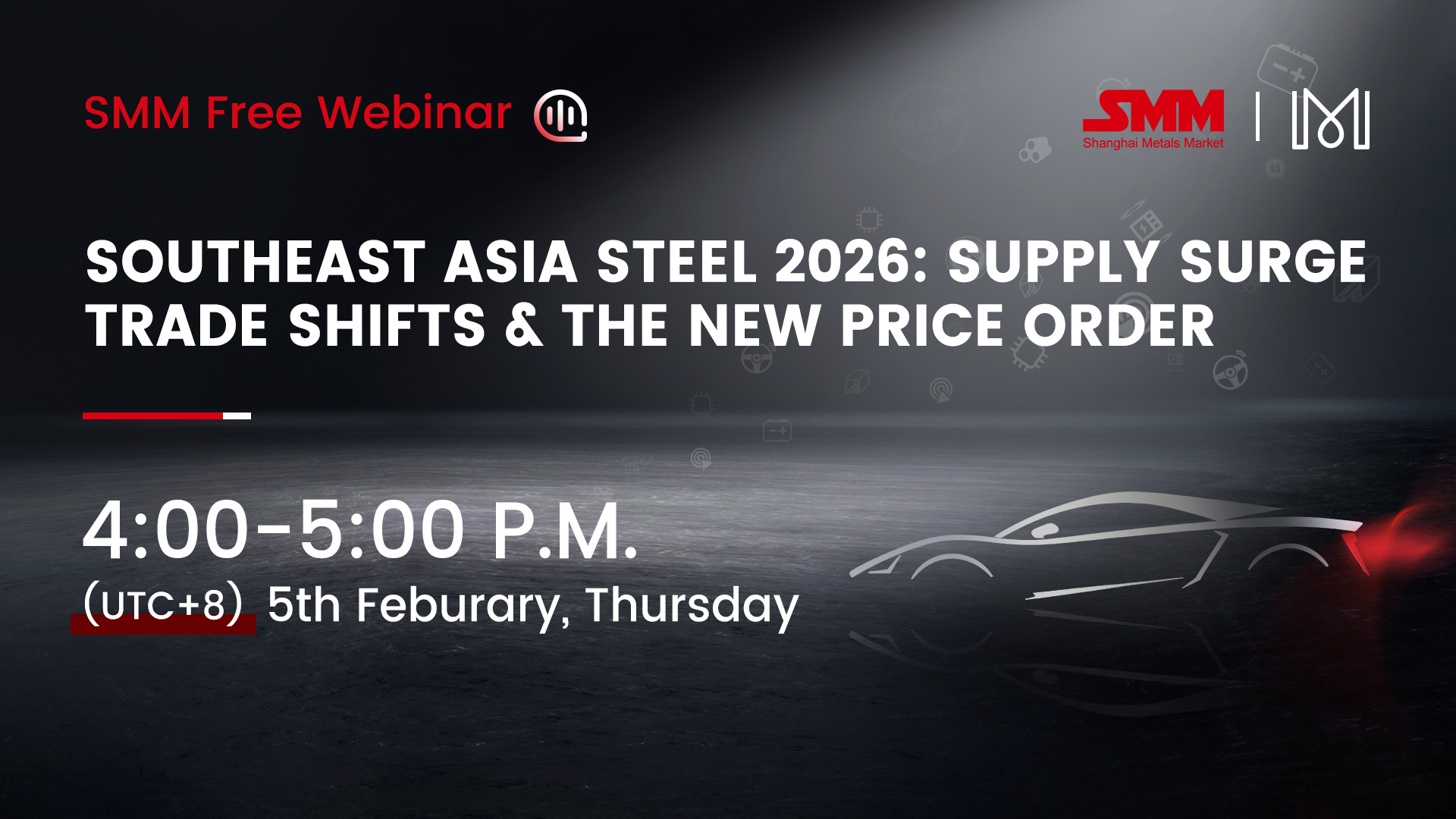 WebinarFeb 5, 16:00 - 23:59 (GMT+8)
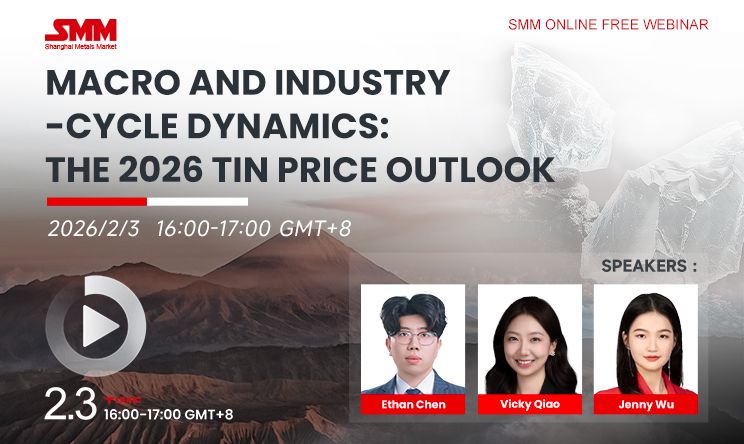 WebinarFeb 3, 16:00 - 23:59 (GMT+8)
 WebinarJan 16, 17:00 - 23:59 (GMT+8)