

1013results found for 'magnesium'
Price
News
- [SMM Aluminum Flash News] TOMRA Expands AUTOSORT™ PULSE to Stainless Steel, Heavy Metals and Magnesium Recycling
TOMRA Recycling has expanded the application of its AUTOSORT™ PULSE Dynamic LIBS sorting system beyond aluminium alloy separation to include stainless steel, heavy metals, magnesium and incinerator bottom ash (IBA). The system can sort 6xxx aluminium alloys, stainless steel grades such as 304 and 316, as well as copper, brass and zinc, enabling recyclers to process multiple material streams with one platform while improving recovery efficiency and operational flexibility.
Jul 7, 2026 11:10 - Shanghai FANUC Develops Automated Magnesium Alloy Die-Casting Solution for Large-Scale Production
[SMM Magnesium Express]Recently, Shanghai FANUC collaborated with Fengyang Ailse Light Alloy Precision Forming Co., Ltd. to develop a customized integrated die-casting automation solution for magnesium alloy, successfully overcoming the bottleneck in large-scale production. This solution covers the entire process, including high-temperature part removal and workpiece handling, and is suitable for producing various magnesium alloy components such as electric vehicle frames and new energy vehicle battery housings. The production line has been operating continuously and stably for over half a year, significantly improving production efficiency and product consistency. With ongoing advancements in die-casting automation, the large-scale application of magnesium alloy in the new energy vehicle and electric two-wheeler sectors is expected to accelerate further.
Jul 6, 2026 19:23 - SPDB Linchuan Branch Issues $550M Syndicated Loan for Fuzhou Magnesium Park Development
[SMM Magnesium Express]Recently, according to Da Jiang News, the Linchuan Branch of Shanghai Pudong Development Bank, in collaboration with financial peers in the jurisdiction, successfully issued the first syndicated loan for the magnesium-based new materials industrial park in Fuzhou City, with a credit amount of 550 million yuan. This loan will be used to support the park's infrastructure construction and corporate capacity expansion, accelerate the aggregation of upstream and downstream supporting industrial projects, and provide financial backing for the Linchuan magnesium-based industry's transition from "point breakthrough" to "chain rise.".
Jul 6, 2026 19:16 - Magnesium prices hit bottom and stabilized, supply and demand were under pressure and consolidating[SMM Spot Magnesium Ingot Express]
[Magnesium Prices Hit Bottom and Stabilize; Supply-Demand Under Pressure, Consolidating] Today, the quotation for 99.90% magnesium ingot in the main production area was 15,750-15,800 yuan/mt, up from the previous working day.
Jul 6, 2026 18:39 - Shandong Firm Secures Funding for Advanced Dissolvable Magnesium Alloys in Shale Gas Tech
[SMM Magnesium Express]Recently, the "Research and Industrialization of High-Performance Dissolvable Magnesium Alloys for Shale Gas Development" project by Shandong Huashengrong Magnesium Technology Co., Ltd. was successfully selected for the 2026 Shandong Provincial Major Scientific and Technological Innovation Project, receiving 8.57 million yuan in provincial scientific funding. Focusing on breakthroughs in key materials for oil and gas extraction, this project ranks among the highest-level scientific initiatives in Shandong Province. With continuous advancements in dissolvable magnesium alloy technology, its application prospects in energy sectors such as shale gas development are expected to expand further, while the company's independent innovation capabilities will accelerate
Jul 6, 2026 08:51 - Shanxi Kelite to Launch $100M Light Alloy Die-Casting Project in July, Targeting Robotics and EV Markets
[SMM Magnesium Express]Recently, it was reported that Shanxi Kelite Precision Casting Technology Co., Ltd. plans to officially commence production of its light alloy integrated die-casting project in mid-July. With a total investment of 100 million yuan, the project can produce 8 million lightweight robotic precision structural components annually, primarily serving sectors such as meal-delivery robots, household service robots, and new energy vehicles. Leveraging Shanxi's magnesium ore resource advantages, the company has successfully transformed from a traditional pipe-casting enterprise into a high-end precision manufacturing entity. It has introduced cold high-pressure die-casting core technologies and established a provincial-level doctoral entrepreneurship station in collaboration with North University of China. With the project's launch, the large-scale application of magnesium alloy in intelligent robotics and new energy vehicles is expected to deepen further, accelerating the transition of traditional casting enterprises toward high-end magnesium alloy manufacturing.
Jul 3, 2026 21:29
Announcements
Dear Users, To optimize the data structure and enhance your data retrieval and analysis efficiency, we will adjust the classification hierarchy of "Magnesium" data in our Database Pro, effective from February 1, 2026. Before Adjustment: After Adjustment: Reason for Adjustment: Sustained Growth in User Attention: We have observed that in recent years, user query frequency, analysis depth, and attention to magnesium-related data have significantly increased. This adjustment aims to respond to your needs, making the classification structure more aligned with your usage habits and enabling easier access and retrieval of relevant data. Impact and Recommendations for You: • Change in Data Access Path: After the adjustment, you can directly locate the "Magnesium" category under the Minor & Precious Metals classification directory in the database, without needing to access it through the "Minor Metal" category. • This adjustment will not result in any loss of historical data, nor will it affect data usage permissions it only changes the classification hierarchy. We believe this adjustment will provide you with a clearer and more efficient data service experience. We sincerely apologize for any inconvenience caused by this adjustment and greatly appreciate your understanding and support. SMM Information & Technology Co., Ltd. January 22, 2026
DataJan 22, 2026 13:54Dear Users, Due to recent volatility in the international trade environment, and to ensure the accuracy and reference value of price information, Shanghai Metals Market (SMM) has conducted a careful assessment and decided to temporarily suspend the update of Magnesium Ingot 9990 CFR (Japan) spot prices effective immediately. We will resume updates for this price category once market trading normalizes and a stable, reliable pricing basis is reestablished. Thank you for your ongoing trust and support. If you have any questions, please feel free to contact us through official channels. Shanghai Metals Market Information Technology Co., Ltd. Magnesium Research Team January 8, 2026
PriceJan 8, 2026 12:03Respected Client, To keep pace with the rapid development of the magnesium industry and the evolving needs for supply-demand analysis, our company has optimized the data model based on the SMM Magnesium Database and is now systematically upgrading the data standards and historical data for magnesium-related metrics in China and globally. Details are as follows: Data Standards and Historical Data Adjustment Notice I. Background of Adjustment With the rapid growth of downstream magnesium alloy demand, the magnesium market landscape continues to evolve. Factors such as technological advancements in die-casting equipment, varying penetration rates of magnesium alloy die-cast parts across different thickness markets, and recycling utilization rates have significantly impacted recycled magnesium production. To better capture the effects of industry changes on supply-demand analysis, and in conjunction with SMM's further in-depth research on the proportion of magnesium added in aluminum industry processes—improving recycled magnesium recovery and utilization coefficients and revising historical data for "primary magnesium" and "magnesium powder" production—we are now adjusting and updating the following metrics in the balance sheet: "recycled magnesium supply," "primary magnesium supply," "magnesium consumption in aluminum products," and "magnesium powder production." II. Adjustment Details Data Points Revised: "Recycled Magnesium Supply," "Primary Magnesium Supply," "Magnesium Consumption in Aluminum Products," "Magnesium Powder Production." Revision Scope: Historical data from January 1, 2023, onward (including retrospective revisions and future forecasts). III. Effective Date December 12, 2025 Shanghai Metals Market Information & Technology Co., Ltd. SMM Magnesium Research Team Zhu Qifan 86-21-5166-6729 December 12, 2025
DataDec 12, 2025 13:10
Events
 WebinarNov 17, 08:30 - 23:59 (GMT+8)
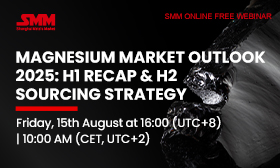 WebinarAug 15, 16:00 - 23:59 (GMT+8)
 WebinarJan 14, 16:00 - 23:59 (GMT+8)