

375results found for 'lithium industry'
Price
News
- [SMM Analysis] Latest Progress of the Murong Lithium Mine
Recently, Chengxin Lithium Group Co., Ltd. (002240.SZ) disclosed on the investor interaction platform that pre-construction preparations for the Murong Lithium Mine, located in Yajiang County, Sichuan Province, had been largely completed, and large-scale construction is expected to begin soon. This progress marked the entry of this lithium industry giant into the substantive development stage of “the largest hard-rock single lithium deposit proven in Asia to date.” The value of the Murong Lithium Mine was first reflected in its remarkable resource endowment. According to data from the Sichuan Mineral Resources and Reserves Review Center, the mine had identified cumulative ore resources of about 61.095 million mt, with lithium oxide (Li₂O) resources as high as 989,600 mt and an average grade of 1.62%. This resource scale made it indisputably the largest hard-rock single lithium mine in Asia, and its grade also ranked among the highest in Sichuan. The mine is located in the well-known Jiajika lithium-beryllium ore district, which forms part of the Songpan-Ganzi-West Kunlun giant lithium metallogenic belt spanning Sichuan, Qinghai, and other provinces and regions, and is known as the “Asian Lithium Belt.” The entire Jiajika ore field had identified total lithium oxide resources exceeding 2 million mt, making it one of the most concentrated regions for hard-rock lithium resources in China and even globally. The Murong Lithium Mine was designed for a production scale of 3 million mt/year, and its mining license is valid until September 5, 2048, providing assurance for long-term and stable mining operations. According to the company’s latest disclosure, the Murong Lithium Mine project had obtained project approval from the Sichuan Provincial National Development and Reform Commission (NDRC), as well as key approvals from departments including natural resources, ecology and environment, and emergency management covering land-use pre-examination, environmental impact assessment, and safety facilities design. Various pre-construction preparations had been largely completed. This means the project is expected to enter the stage of large-scale mine infrastructure and beneficiation plant construction soon. After the project is completed and put into operation, its annual raw ore processing capacity of 3 million mt will translate into considerable production of lithium concentrates, providing stable and high-quality raw material support for the company’s downstream lithium chemicals production sites in Deyang and Suining, Sichuan, as well as Indonesia.
Mar 31, 2026 18:02 - This Week's Key Ex-China Lithium News (3.16-3.20) [SMM New Energy Weekly Ex-China Highlights]
[Sinomine Resource Group Engages with the Zimbabwean Government to Restart Its Lithium Export Business] Sinomine Resource Group confirmed that, after this African country recently suspended shipments of lithium concentrates, the company had been actively engaging with Zimbabwean government authorities to restart its lithium export business. The Chinese miner disclosed this development on Friday in response to an investor inquiry via the Shenzhen Stock Exchange’s official interactive platform. These talks came at a critical time for both Sinomine Resource Group and Zimbabwe. Lithium remained a sought-after mineral because of its essential role in producing batteries used in EVs and renewable energy storage systems. Zimbabwe, which holds substantial lithium reserves, had continued tightening its regulatory framework to ensure more value addition remained in China, rather than allowing the export of raw ore or materials that had undergone only preliminary processing. Sinomine Resource Group said in a statement that it was currently working closely with Zimbabwean government authorities on a new export approval application. The company stressed that the dialogue remained ongoing and formed part of its broader efforts to align with the country’s latest policies and compliance requirements. Although there was no clear timetable yet for when exports would resume, the engagement sent a positive signal that efforts were being made to resolve the issue. Source: https://www.chemanalyst.com/ [Vulcan Energy Achieves Drilling and Permitting Milestones at Its Geothermal Lithium Project in Germany] The company had officially broken ground at the Trappelberg drilling site in the Rohrbach area near Landau. This was Vulcan’s second drilling site after Schleidberg, where the company had completed the drilling and testing of its first geothermal well. Preparatory work at Trappelberg had begun to support the start of drilling in H2 2026. At present, a deep groundwater monitoring well had been completed to ensure the protection of near-surface aquifers during construction and drilling operations. Schleidberg and Trappelberg were 2 of the 5 new drilling sites that Vulcan would develop in the region. Thorsten Weimann, Chief Development Officer and Managing Director of Vulcan Energie Ressourcen GmbH, said: “The groundbreaking ceremony at Trappelberg marks an important step forward in the further development of our Lionheart project. With this new drilling site, we are further developing the geothermal reservoir and laying the foundation for climate-neutral heating in the region and sustainable lithium production in Europe.” Source: https://www.thinkgeoenergy.com/ [Core Lithium’s Finniss Project Secures a Strategic Financing Package of AUD 290 million] The fundamentals of global battery demand were reshaping investment strategies in the critical minerals sector, placing Australia’s lithium industry at a critical turning point. The combined effects of supply chain diversification needs, advances in energy storage technology, and geopolitical factors have created an environment in which strategic positioning determines the long-term value creation potential of mining. In addition, the restart of Core Lithium's Finniss project, backed by A$290 million, demonstrates how well-developed critical minerals strategies can unlock previously stalled projects through innovative financing structures. Against this backdrop, complex financing structures and operational optimization approaches have become key differentiators for projects seeking to capture the evolving market dynamics of the current lithium investment cycle. The sophisticated financing structure underpinning the restart of Core Lithium's Finniss project shows that contemporary mining finance has evolved beyond traditional debt-and-equity models into a strategic consortium model that disperses risk while maximizing operational synergies. Moreover, this financing approach reflects a broader trend across the mining sector. Source: https://discoveryalert.com.au/ [Copper, Cobalt, and Lithium Mines: US Critical Minerals Growth] In early 2026, Secretary of State Marco Rubio, together with senior US officials including Vice President JD Vance and Treasury Secretary Scott Bessent, received representatives from 54 countries and the European Commission at the Critical Minerals Ministerial meeting. The US announced new bilateral frameworks, financing initiatives exceeding $30 billion, and launched the Forum for Resource and Geostrategic Engagement (FORGE), aimed at building secure, diversified, and resilient critical minerals supply chains. Initiatives such as the Orion-Glencore memorandum of understanding and "Project Vault" indicate the US government's commitment to incentivizing private-sector investment and ensuring a stable and reliable supply of cobalt, copper, and other strategic materials, including those from the DRC. Source: https://miningdigital.com/ [Atlantic Lithium's Ewoyaa Project Financing Secures a Strategic Investment of $16.4 million] The global critical minerals landscape is undergoing a fundamental transformation, and institutional capital allocation strategies have moved beyond traditional mining investment models. Pension funds, sovereign wealth funds, and strategic investors now require more sophisticated financing structures to align long-term capital commitments with project de-risking milestones. This shift indicates the growing maturity of financing in the resources sector, which is moving away from speculative early-stage funding toward a more infrastructure-like investment approach that places greater emphasis on predictable returns rather than commodity price speculation. Contemporary lithium project development reflects this evolution, with financing solutions from diversified funding sources incorporating conditional capital structures, local ownership requirements, and ESG compliance frameworks. The combination of milestone-based warrant instruments, strategic partnership agreements, and domestic exchange listings has created an integrated financing ecosystem that balances capital efficiency with political and economic considerations. In addition, these innovations in the lithium industry are continuing to reshape the investment landscape. Source: https://discoveryalert.com.au/
Mar 20, 2026 09:37 - [Keda Manufacturing: Expected Positive Impact on Performance from Rising Lithium Carbonate Prices]
Keda Manufacturing stated during an investor relations activity that the company holds 43.58% of shares in Blue Lithium Industry and controls 48.58% of its voting rights. According to the shareholding ratio, the net profit of Blue Lithium Industry is included in the net profit attributable to the parent company. Blue Lithium Industry adopts a market-driven pricing principle for its lithium carbonate products, with sales prices dynamically adjusted according to market conditions. The increase in lithium carbonate prices in the market is expected to positively contribute to the company's performance.
Feb 28, 2026 21:25 - [SMM Flash News] Total Investment of 5 Billion! Ganfeng LiEnergy Dongguan Base Officially Opened
On February 25, the relocation and commencement ceremony for the new plant of Ganfeng Lithium Industry's Dongguan Base was grandly held at the Machong base factory area.
Feb 27, 2026 17:52 - Last Week (2.24-2.27) Overseas Lithium News [SMM New Energy Overseas Weekly News]
[POSCO and SK On Form Lithium Alliance for Battery Cooperation] POSCO and SK On have signed a long-term lithium supply agreement, aiming to stabilize the battery materials supply chain. According to a statement released by the two companies on Wednesday, POSCO will supply up to 25,000 mt of lithium from this year until 2028 under the agreement. This supply is sufficient to produce batteries for approximately 400,000 EVs. The lithium will be produced by POSCO Argentina at the Salar del Hombre Muerto salt flat in Salta Province, Argentina, and supplied to SK On's EV battery projects in Europe and North America. SK On is also considering using the material for ESS. Source: https://pulse.mk.co.kr/ [Cornwall's Geothermal Revolution: Extracting Green Energy and Lithium from Granite] The UK's renewable energy sector has achieved a significant leap forward, with a pioneering mini power station in Cornwall officially commencing operation, successfully using underground hot granite to produce zero-carbon electricity and extract high-value battery-grade lithium. Led by Geothermal Engineering Ltd., the project innovatively combines green power generation with critical minerals extraction, is expected to revitalize the region's historic mining economy and supply electricity to thousands of households via the power grid. For East Africa, a region rich in geothermal potential (particularly the Kenyan Rift Valley), the dual extraction technology provides an attractive model. If African energy producers can adopt this approach, simultaneously obtaining electricity and high-profit minerals from geothermal wells, it will significantly enhance the economic feasibility of green energy projects across the continent. Source: https://streamlinefeed.co.ke/ [Zimbabwe Bans Lithium Exports: Global Supply Chain Crisis Emerges] Zimbabwe's recent decision to implement a comprehensive ban on lithium exports marks a watershed moment for the global critical minerals market, highlighting the growing influence of resource nationalism on international supply chains. This policy shift reflects a broader trend: mineral-rich countries are prioritizing domestic value creation over raw material exports, fundamentally altering the landscape of the global battery metals market. The impact extends far beyond a single country; its ripple effects will run through international supply chains, from EVs to renewable energy infrastructure. When countries with significant mineral reserves impose export restrictions, the resulting market dynamics can permanently alter the entire industry's price structures, investment flows, and strategic planning. Zimbabwe's recent decision to suspend mineral exports is a prominent example of this phenomenon. This southern African country, which supplied approximately 10% of the world's lithium resources in 2024, has effectively cut off external supply of its battery metal resources, forcing international buyers to scramble for alternative sources, while domestic processing capacity remains severely underdeveloped. Source: https://discoveryalert.com.au/ [Atlantic Lithium Acquisition Proposal Rejected: 2026 Strategic Value Preservation Strategy] When mature miners pursue mergers and acquisitions during market recovery periods, the core of their strategy shifts from acquiring distressed assets to preserving strategic value. The lithium industry exemplifies this dynamic—during phases of rebounding commodity prices, pre-production developers increasingly tend to reject acquisition proposals, prioritizing long-term value creation over immediate liquidity events. Furthermore, understanding broader critical minerals strategies is essential when assessing these complex market dynamics. Market participants observed that spodumene concentrate prices rebounded from a cyclical low of $800/mt in October 2025 to approximately $1,900/mt by February 2026, a 137.5% increase within four months. This rapid recovery has created a significant valuation gap between acquirers' offers and target companies' intrinsic value assessments. The case of Atlantic Lithium's rejected acquisition proposal demonstrates how pre-production lithium developers evaluate conditional non-binding acquisition offers based on the medium and long-term demand fundamentals in the EV and BESS sectors. Enterprises in the late-stage permitting phase generally believe that current market conditions do not fully reflect the full potential of their asset portfolios. Source: https://discoveryalert.com.au/ [Indian Company Deploys Non-Lithium Multi-Ion Battery System] Mumbai-based battery technology developer Gegadyne Energy stated that its delivery of the first non-lithium multi-ion chemistry battery packs to two of the world's largest material handling original equipment manufacturers marks a true "inflection point" for the forklift industry. Gegadyne has completed the first commercial deployment of its non-lithium multi-ion chemistry battery packs with Linde Material Handling India and the Godrej & Boyce Group. The company claims that this battery, with a cycle life exceeding 5,000 cycles, can be charged from 0% to 100% in 15 minutes, thereby "completely eliminating" dependence on the lithium supply chain. Designed for forklifts, cranes, and warehouse equipment, the battery operates effectively within a temperature range of -40°C to 65°C. Source: https://www.forkliftaction.com/
Feb 27, 2026 09:50 - Weekly Review of the Lithium Carbonate Market: Spot Lithium Carbonate Prices Continue to Rise Amid Supply-Side Disruptions [SMM Weekly Review]
This week, spot lithium carbonate prices continued to rise, with the increase expanding. The SMM battery-grade lithium carbonate average price climbed from 152,000 yuan/mt on Tuesday (February 24) to 173,000 yuan/mt on Thursday (February 26), a cumulative rise of 21,000 yuan/mt over three trading days; the industrial-grade lithium carbonate average price also increased from 148,500 yuan/mt to 169,500 yuan/mt, with the same 21,000 yuan/mt gain. The key catalyst driving the accelerated price rise this week stemmed from sudden policy changes in major lithium resource-supplying countries. On Wednesday (February 25), Zimbabwe, the world's fourth-largest lithium resource producer, announced through its Ministry of Mines that it would immediately suspend all exports of lithium concentrates and raw ore (including goods in transit), allowing only enterprises with valid mining rights and approved beneficiation plants to apply for export qualifications. This move aimed to strengthen mineral regulation, combat illegal export activities, and promote the localization of the lithium industry chain. Affected by this unexpected event, the most-traded lithium carbonate futures contract surged by 12% intraday on Thursday, reaching a high of 187,700 yuan/mt. Meanwhile, the spot market transactions remained sluggish, with a clear divergence in sentiment between upstream and downstream players. Overall, upstream lithium chemical plants showed a strong reluctance to sell, with a low willingness to ship spot orders, and some enterprises made limited shipments at relatively high futures levels; downstream material plants maintained a cautious stance, adhering to just-in-time procurement, with most enterprises sticking to a strategy of restocking at lower prices, showing little interest in chasing higher prices. Overall, despite the rapid price surge, market inquiries and actual transactions still appeared sluggish.
Feb 26, 2026 17:29
Announcements
Effective March 17, 2026, SMM will officially launch the following two new price points: "SMM Battery-Grade Lithium Carbonate (CIF South Korea)" and "SMM Battery-Grade Lithium Hydroxide (CIF South Kor
PriceMar 16, 2026 15:10Dear User, As a key intermediate product in the lithium industry chain, lithium sulfate serves as a primary raw material for producing core lithium chemicals such as battery-grade lithium carbonate and battery-grade lithium hydroxide. Its supply and price influence the costs of downstream lithium battery materials and market operations. Currently, the lithium sulfate market lacks open and transparent representative price references. International trade and procurement pricing largely rely on bilateral negotiations, leading to issues such as information asymmetry and delayed price transmission. With lithium sulfate production from African lithium producers, represented by the Zimbabwe region, commencing and gradually entering the market, SMM has compiled and launched the " Africa Lithium Sulfate (CIF China) Price " to promote standardized and transparent pricing for African lithium sulfate and enhance the efficiency of the industry chain. This price aims to objectively reflect the market conditions of African lithium sulfate arriving at main Chinese ports. It will provide a reliable price benchmark for producers, traders, downstream enterprises, and financial institutions, supporting the standardized development and price discovery of the global lithium resources market. SMM's "Africa Lithium Sulfate (CIF China)" was officially launched today (January 21, 2026) . Details are as follows: Africa Lithium Sulfate (CIF China), Specification: Li₂SO₄·H₂O content ≥80% Product Name: Africa Lithium Sulfate (CIF China) Quality Standard: Li₂SO₄·H₂O content ≥80% Definition: CIF main Chinese ports Unit: $/mt Minimum Trading Volume: 60 mt Delivery Period: 2 months Release Time: Weekdays, 12:00 Beijing Time Payment Terms: Letter of credit, telegraphic transfer, or documents against payment other payment terms require separate negotiation. Welcome more relevant enterprises in the industry chain to participate and support SMM in better serving new energy industry chain enterprises. Shirley Wang 021-5166-6838 wangcong@smm.cn Thomas Feng 021-5166-6714 fengdisheng@smm.cn Sylvia Wang 021-5166-6914 wangzihan@smm.cn Jessica Wang 021-5159-5902 wangjie@smm.cn Faith Zhang 021-5166-6878 faithzhang@smm.cn Shanghai Metals Market New Energy Research Team January 21, 2026
PriceJan 21, 2026 15:19To Our Valued Users, Hello! As a key intermediate product in the lithium industry chain, lithium sulfate serves as a primary raw material for producing core lithium salts such as battery-grade lithium carbonate and battery-grade lithium hydroxide. Its supply and pricing directly impact the cost of downstream lithium battery materials and overall market operations. Currently, the lithium sulfate market lacks open and transparent representative price benchmarks, with international trade and procurement pricing largely reliant on bilateral negotiations, leading to issues such as information asymmetry and delays in price transmission. With lithium sulfate production from relevant African lithium producers, represented by the Zimbabwe region, commencing and gradually entering the market, SMM has developed and is now launching the "Africa Lithium Sulfate (CIF China) Price" to promote the standardization and transparency of African lithium sulfate pricing and enhance the efficiency of industrial chain collaboration. This initiative aims to objectively reflect the market conditions of African lithium sulfate arriving at major Chinese ports, providing a reliable price benchmark for producers, traders, downstream enterprises, and financial institutions, thereby supporting the standardized development and price discovery of the global lithium resource market. Release time:2026.Jan.22 The price will be updated every business day at 12:00 Beijing Time for market reference. Product Name: Africa Lithium Sulfate (CIF China) Quality Standard: Li₂SO₄·H₂O content ≥ 80% Definition: CIF major Chinese ports Unit: USD/ton Minimum Transaction Volume: 60 tons Delivery Period: 2 months Release Time: Every business day at 12:00 Beijing Time Payment Terms: Letter of Credit (L/C), Telegraphic Transfer (T/T), or Documents Against Payment (D/P). Other payment terms are subject to negotiation. We welcome more relevant enterprises across the industrial chain to participate and support SMM in better serving the new energy industry. Shirley Wang 021-51666838 wangcong@smm.cn Thomas Feng 021-51666714 fengdisheng@smm.cn Sylvia Wang 021-51666914 wangzihan@smm.cn Jessica Wang 021-51595902 wangjie@smm.cn Faith Zhang 021-51666878 faithzhang@smm.cn Shanghai Metals Market New Energy Research Team January 20, 2026
PriceJan 20, 2026 18:48
Events
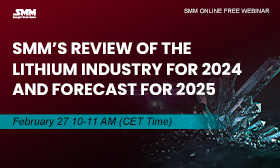 WebinarFeb 27, 17:00 - 23:59 (GMT+8)
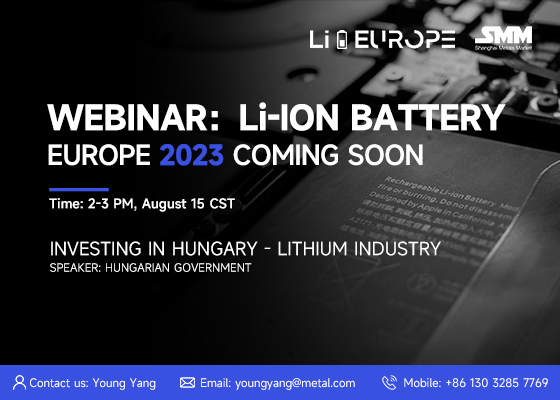 WebinarAug 15, 14:00 - 23:59 (GMT+8)
 WebinarMay 9, 09:00 - 23:59 (GMT+8)