

Price
News
- [SMM Analysis] Riding the Winds In and Outside China, Breaking the Iron Law of Old Cycles: 2026 Energy Storage Battery Cell Semi-Annual Review and Outlook
[SMM Analysis] In H1, the overflow of global utility-scale energy storage long-term contracts intertwined with the growing pains of production line upgrades. This not only completely shattered the cyclical pattern of "retreat after rapid rise" in the energy storage market, but also directly triggered a structural shortage and a strong price recovery for 314Ah battery cells. Furthermore, driven by the looming cancellation of tax rebates at year-end, an even more intense wave of "export rush" is gaining momentum, potentially pushing the full-year battle between volume and price to its peak.
Jul 10, 2026 19:20 - [SMM Analysis] Separator Market 2026 Semi-Annual Review: Supply-Demand Pattern Tightens Marginally, Price Center Gradually Moves Up
Production-wise, China's cumulative production of lithium battery separators from January to June was approximately 17.416 billion m², of which wet-process separators accounted for 15.005 billion m², or 86.16%, and dry-process separators accounted for 2.411 billion m², or 13.84%.
Jul 10, 2026 18:49  【SMM Analysis】2026 H1 Lithium Carbonate Market Review and H2 Outlook
From a supply-demand balance perspective, China's lithium carbonate market exhibited a tight balance in H1 2026, with sellers and buyers continuously seeking new equilibrium points amid bargaining.
Jul 10, 2026 18:43- Dollar Softens, Base Metals Broadly Rise; SHFE Tin, Silicon Metal Up Over 2%; SHFE Copper, Zinc, Gold Up More Than 1% [SMM Midday Review]
SMM, July 10: Metals market: As of midday close, domestic base metals nearly all rose, with SHFE copper up 1.67%, SHFE aluminum up 0.63%, SHFE lead edging down, SHFE zinc up 1.34%, SHFE tin up 2.18%, and SHFE nickel up 1.1%. Additionally, the most-traded cast aluminum futures contract rose 0.57%, the most-traded alumina futures rose 0.37%, the most-traded lithium carbonate futures fell 1.67%, the most-traded silicon metal futures rose 2.74%, and the most-traded polysilicon futures contract rose 2.28%. Ferrous metals mostly fell. Iron ore rose 0.74%, rebar edged up, and hot-rolled coil edged down. Stainless steel fell 0.49%. Coking coal and coke: the most-traded coking coal contract fell 2.09%, and the most-traded coke contract fell 1.51%. On the overseas base metals front, as of 11:41, LME metals mostly rose. LME copper rose 0.38%, LME aluminum rose 0.28%, LME lead fell 0.18%, LME zinc rose 0.39%, LME tin rose 0.7%, and LME nickel rose 0.18%. Precious metals, as of 11:41, COMEX gold fell 0.12% and COMEX silver rose 0.16%. Domestic precious metals: SHFE gold rose 1.15%; the most-traded SHFE silver futures contract rose 3.48%. Additionally, by midday close, the most-traded platinum futures contract rose 2.53%, and the most-traded palladium futures contract rose 3.65%. As of midday close, the most-traded container shipping (Europe route) futures contract rose 1.09% to 2,415 points. As of 11:41 on July 10, midday futures overview: Spot and Fundamentals Zinc: In the Tianjin market, #0 zinc ingot mainly traded at 24,420-24,910 yuan/mt, Zijin traded at 24,540-24,970 yuan/mt, #1 zinc ingot traded around 24,430-24,860 yuan/mt, Zijin was quoted at a discount of 0-10 yuan/mt against the 2608 contract, Huxin was quoted at 26,010 yuan/mt, #0 zinc ingot was quoted at a discount of 60-130 yuan/mt against the 2608 contract, and the Tianjin market was quoted at a discount of around 50 yuan/mt against the Shanghai market... Macro Front Domestic: [National Energy Administration: By 2028, Non-Fossil Energy Consumption Share to Increase by About 1 Percentage Point Annually] The National Energy Administration issued the "Energy Sector Energy Conservation and Carbon Reduction Action Plan (2026-2028)." It proposes that by 2028, the non-fossil energy consumption share will increase by an average of about 1 percentage point annually; reasonably control coal consumption of coal-fired power units, striving to raise the proportion of coal power capacity meeting current energy efficiency benchmark standards by 15 percentage points; build a number of zero-carbon and low-carbon coal mining and oil areas; support the construction of a number of zero-carbon parks, achieve significant progress in energy conservation and carbon reduction in key industries, and continuously improve green energy use. It proposed vigorously promoting energy conservation and carbon reduction in thermal power. A batch of eligible coal-fired power units of 300,000 kW and below will be shut down in a prudent and orderly manner, and the construction of replacement units is encouraged according to the requirements of new-generation coal-fired power ; a batch of 600,000 kW coal-fired power units will undergo ultra-supercritical cross-generation upgrading and retrofitting. Support will be given to eligible units for the co-firing of zero-carbon and low-carbon fuels and the retrofitting and construction of carbon capture, utilization and storage (CCUS). After retrofitting and construction, the carbon emission level per kilowatt-hour should be reduced by about 10%. A number of projects integrating coal-fired power, gas-fired power and new energy will be implemented, supporting the coupling of coal-fired power and new energy through thermal energy storage and other energy storage for peak shaving and peak support, integrated collection and transmission, thereby achieving the effect of integrated carbon reduction. (Jin10 Data APP) [China’s Road Transport Capacity Continues to Expand, New Energy Truck Penetration Rate Exceeds 40%] The China Federation of Logistics and Purchasing released the "2026 China Road Transport Capacity Development Report" today (the 10th). According to the report, the road transport market underwent continuous adjustment and optimization in 2025, with the capacity structure accelerating its upgrade towards scale, specialization, and green development; enterprises saw improvements in their risk resilience and operational resilience. Survey data shows that in the current road freight transport capacity structure, internal combustion engine vehicles remain dominant, accounting for about 50%, but new energy vehicles have already formed an irreversible substitution trend in specific scenarios. Among the surveyed enterprises, the penetration rate of new energy trucks was 44.4%. Among enterprises that have already purchased new energy vehicles, 37.5% chose to "continue expanding the new energy fleet," and 37.5% chose to "maintain the current scale." (CCTV News) [New Breakthrough in Green Hydrogen: China Achieves Minute-Level Preparation of Platinum Group Metal Catalysts] Platinum group metal catalysts are core key materials supporting modern industries such as energy, chemical, and environmental sectors. Recently, a team led by Professor Hu Wenbin from Tianjin University proposed a "transient assembly" strategy, developing a millisecond-scale periodic heat pulse technology that achieved ultra-fast synthesis and precise regulation of platinum group metal core-shell structure catalysts, opening up a completely new technical pathway for the atomically precise preparation of platinum group catalysts. The related results were published online in the international academic journal *Science* on July 10, Beijing time. (Xinhua News Agency) [Guangdong: Plans to Accelerate Technological Breakthroughs in Key Frontier Fields Including 6G, Optical Communications, and Satellite Communications] Recently, the "Guangdong Province Information and Communication Industry 15th Five-Year Plan (Draft for Public Comments)" was released to solicit public opinions. It mentioned supporting basic telecommunications enterprises in actively participating in provincial key R&D programs, leveraging strategic scientific and technological forces such as the Pengcheng National Laboratory and industry leaders to help Guangdong’s information and communication industry establish a sound whole-process innovation ecosystem, accelerating technological breakthroughs in key frontier fields including 6G, optical communications, satellite communications, quantum communications, and agentic communications, and strengthening research on new network architectures such as integrated space-ground networks and integrated communication-sensing-computing networks. Focus on cultivating and developing the new 6G track, vigorously promoting the R&D and industrialisation of core components such as next-generation digital baseband chips, RF front-end chips, and 6G modules, as well as next-generation network communication equipment. Conduct application technology research on the integration of quantum encryption with information communication networks and the convergence of quantum computing with classical computing, and achieve breakthroughs in key technologies such as quantum computing, quantum materials, quantum precision measurement, quantum security, and critical core equipment. (Jin10 Data APP) [PBOC reverse repo operations led to a net withdrawal of 43 billion yuan on the day, and a net withdrawal of 416.5 billion yuan for the week] The PBOC conducted 20 billion yuan of 7-day reverse repo operations today, and with 63 billion yuan of 7-day reverse repos maturing, the net withdrawal for the day was 43 billion yuan. During the week, the PBOC conducted 62 billion yuan of 7-day reverse repo and 1,000 billion yuan of outright reverse repo operations. With 678.5 billion yuan of 7-day reverse repos and 800 billion yuan of outright reverse repos maturing, the net withdrawal for the week was 416.5 billion yuan. US dollar side: As of 11:41, the US dollar index fell 0.28% to 100.66. According to CME "FedWatch": The probability that the Fed keeps interest rates unchanged in July is 74.9%, while the probability of a cumulative 25-basis-point rate hike is 25.1%. For September, the probability of rates remaining unchanged is 35.7%, the probability of a cumulative 25-bp hike is 51.1%, and the probability of a cumulative 50-bp hike is 13.1%. (Jin10 Data APP) Perli, manager of the New York Fed’s Open Market Account, said that the reserve management purchase operations have no preset course, and the New York Fed’s Open Market Trading Desk may raise or lower purchase amounts depending on money market conditions. Additionally, Perli said that as Fed Chairman Warsh appoints a working group on the Fed’s balance sheet, the trading desk is ready to implement any changes and interest-rate control frameworks the committee may decide to pursue. The Fed began reserve management purchase operations last December, anticipating a rapid drain in reserves in April as tax payments flowed into the Treasury General Account. When the Treasury’s account balance at the Fed increases, reserves in the banking system decline. (Jin10 Data APP) Dallas Fed President Logan said that if the Federal Open Market Committee conducts open market operations through a voluntary central clearing mechanism, it would help improve the efficiency and effectiveness of operations and enhance the stability of US financial markets. Logan noted that such arrangements could improve the use of the Fed’s tools, such as the Standing Repo Facility. The facility is designed to provide liquidity to eligible financial institutions, but market usage remains low. Some believe that streamlining the clearing process could enhance its appeal. She also noted that market leverage levels need to be carefully managed and that financial markets must strike an appropriate balance between the returns and risks of leverage, as well as between leverage and liquidity. (Jinshi Data APP) The latest data showed that for the week ending July 4, which included the US Independence Day holiday, initial jobless claims fell by 2,000 to 215,000, below market expectations of 217,000 and persisting near historic lows. However, continuing claims, which reflect the state of re-employment among the unemployed, rose to 1.81 million, hitting a new high since March. Persistently low initial jobless claims, together with recent non-farm payrolls data, paint a picture of a US labour market characterised by shrinking layoffs and a slowdown in hiring. (Wall Street CN) Data-wise: Today will see the release of figures including Germany's final CPI MoM for June, France's final CPI MoM for June, Switzerland's June consumer confidence index, Canada's June employment numbers, China's June M2 money supply YoY, China's new RMB loans for the first half of the year, and China's total social financing growth for the first half of the year. Also in focus: a speech by 2026 FOMC voter and Dallas Fed President Lorie Logan; and the provisional listing of SK Hynix's American Depositary Receipts (ADRs) on the Nasdaq on July 10. Crude oil: As of 11:41, oil prices for both benchmarks edged up, with WTI crude rising 0.25% and Brent crude gaining 0.21%. Technical-level talks between the US and Iran are ongoing, with the market closely watching how the US-Iran situation unfolds. According to Fox News, US Commerce Secretary Howard Lutnick stated that Trump believes oil prices will remain at low levels in the future. India's state-owned Oil and Natural Gas Corporation (ONGC) has approved an expansion of the country's strategic petroleum reserves, highlighting efforts to strengthen energy resilience following the shock of the Iran conflict. According to a document, the board of India's largest oil and gas producer has approved the addition of 1.75 million mt of national crude oil reserve capacity in Mangalore, Karnataka. Specific costs and a timetable have yet to be announced. Upon completion, the project will increase the reserves managed by the Indian Strategic Petroleum Reserves Ltd. The company currently operates underground storage facilities at three locations on the east and west coasts with a total capacity of 5.33 million mt. In addition, two new sites are under construction that will add 6.5 million mt of storage space. ONGC stated in Friday's filing that the project is of "national importance" and that related supporting facilities will be developed under the directive of the Ministry of Petroleum and Natural Gas. (Jin10 Data APP) Spot Market Overview: ► ► ► ► ► ► ►] ► ► ► ► ►
Jul 10, 2026 14:45 - [SMM Analysis] Demand Drives Continuous Growth in Electrolyte Production in H1 2026, Prices Remain in the Doldrums amid Structural Disturbances in Raw Materials
[SMM Analysis: Demand Drives Continuous Growth in Electrolyte Production in H1 2026, Prices in the Doldrums Due to Structural Disturbances in Raw Materials] According to SMM statistics, China's electrolyte production in H1 2026 was approximately 1.416 million mt, up about 56% YoY from H1 2025.
Jul 10, 2026 13:49 - [SMM Cobalt Morning Meeting Summary] Downstream restocking momentum is insufficient, the cobalt industry chain consolidates on a weak note.
SMM Cobalt Morning Brief: This week, the cobalt industry chain continued to consolidate on a weak note overall. Refined cobalt traded around 380,000 yuan/mt. Although smelters slightly raised their offers, high inventory and weak end-use demand limited price recovery. The trading center of cobalt intermediate products moved lower. Cobalt sulphate ground lower on a weak note. Transactions of cobalt chloride and Co3O4 were sluggish. Cobalt powder remained under pressure due to the traditional off-season. The pullback in raw material prices dragged down ternary cathode precursors and ternary cathode materials. LCO remained stable with a weak bias. Future market trends still require attention on Q3 restocking and end-use demand recovery.
Jul 10, 2026 10:33
Announcements
- Data[Notice] Renaming of Monthly Lithium Carbonate Inventory Indicator and Addition of New Indicators
The "Cobalt & Lithium_Lithium Carbonate Inventory" data has been updated to include upstream, downstream, and a new "Others" segment, reflecting a more comprehensive industry inventory.
DataJun 11, 2026 20:39 To strengthen visibility into lithium carbonate inventory trends and expand market data coverage, we have implemented a significant upgrade to our existing data system.
DataMay 13, 2026 11:15Effective March 17, 2026, SMM will officially launch the following two new price points: "SMM Battery-Grade Lithium Carbonate (CIF South Korea)" and "SMM Battery-Grade Lithium Hydroxide (CIF South Kor
PriceMar 16, 2026 15:10
Events
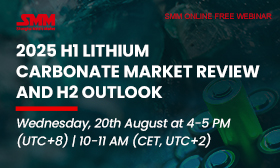 WebinarAug 20, 16:00 - 23:59 (GMT+8)
 WebinarMay 24, 18:00 - 23:59 (GMT+8)