

11210results found for 'first'
Price
News
- Indonesia's ESDM Announces New Nickel Ore HPM Benchmark Price — In-Depth Analysis of Impact on Nickel Prices
Jakarta, April 14, 2026 – Indonesia's Ministry of Energy and Mineral Resources (ESDM) officially issued Ministerial Decree No. 144.K/MB.01/MEM.B/2026, revising the calculation formula for the Nickel Ore Benchmark Price (HPM). The regulation will officially take effect on April 15, 2026, marking a significant shift in resource valuation policy for Indonesia, the world's largest nickel producer. The new decree revised the previous Decree No. 268.K/2025, with core changes aimed at reflecting the true commercial value of nickel ore and its associated minerals: 1. Adjustment of the Correction Factor (CF): · The correction factor for 1.6% grade nickel ore was significantly raised from the original 17% to 30%. · For every 0.1% increase or decrease in nickel grade, the correction factor will be adjusted inversely by 1%. 2. Inclusion of Associated Mineral Value: · The new formula for the first time explicitly incorporated associated minerals such as cobalt (Co), iron (Fe), and chromium (Cr) into the HPM calculation. · Cobalt: Included when content >= 0.05%, with the correction factor (CF) set at 30%. · Iron: Included when content <= 35%, with the correction factor (CF) set at 30%. · Chromium: The correction factor set at 10%. 3. New Pricing Formula: HPM Nickel Ore = [(Nickel HMA * %Ni * CF) + (Cobalt HMA * %Co * CF) + (Iron HMA * %Fe * CF * 100) + (Chromium HMA * %Cr * CF * 100)] * (1-MC) (Note: MC refers to moisture content) Assumptions: · Average grade: moisture content 35-40%, cobalt content 0.07% (HPAL ore), iron content 25% (saprolite ore), chromium content 3%. Based on SMM's estimates, HPM prices have the most obvious room for upward movement. · Here, HPAL ore refers to nickel ore with a grade of 1.3% and below, while saprolite ore refers to nickel ore with a grade above 1.3%.Since HPAL ore has a higher cobalt grade and iron content generally above 35%, the HPM formula for HPAL ore here only considers nickel, cobalt, and chromium, with iron not priced in. · Since saprolite ore has a lower cobalt grade and iron content generally below 35%, the HPM formula for saprolite ore here only considers nickel, iron, and chromium, with cobalt not priced in. Note: This is only a scenario assumption based on publicly available information and does not constitute actual market action advice. Please refer to actual conditions. Driven by the dynamic adjustment mechanism of the benchmark price, the nickel ore benchmark price center shifted significantly upward, providing a higher pricing anchor for mine-side sales. Overall, the CF (adjustment coefficient) for 1.6% grade nickel ore increased from 17% to 30%, driving a significant rise in the benchmark price, reflecting a policy and market reassessment of the value of medium-to-high-grade ore. As the CF increased, the linkage between ore prices and nickel content further strengthened, and price elasticity amplified accordingly. On the other hand, under the current pricing system, by-product value has been fully incorporated into consideration. In particular, the cobalt pricing mechanism provided significant support for low-grade ore (such as limonite). Benefiting from the increase in cobalt prices and its recovery value, the economics of limonite improved notably, and its price performance showed a more prominent upward trend compared to the past, gradually changing the market's traditional perception of it as a "low-value resource." Based on SMM prices, Indonesia's local laterite nickel ore at 1.2% grade (delivered price) averaged $30.5/wmt, far below the new HPM benchmark price of $40.18/wmt. The CIF price of 1.2% grade HPAL nickel ore may subsequently rise to $48.18 (40.18+8)/wmt. Indonesia's local laterite nickel ore at 1.5% grade (delivered price) averaged $70.7/wmt, above the new HPM benchmark price of $57.13/wmt, so theoretically absolute price fluctuations would not be as drastic. Assuming the tax cost increase driven by the HPM benchmark price rise is fully passed through to downstream, the absolute price of saprolite nickel ore may rise to $72.47/wmt after the new HPM benchmark price takes effect. **MHP** According to SMM estimates, taking 1.2% grade nickel ore as an example, based on the benchmark price as of April 1, the new nickel ore HPM is expected to be raised to $40.18/wmt, compared with the previous nickel ore HPM of $16/wmt. Currently, SMM's latest Indonesia's local laterite nickel ore 1.2% (port arrival price) average price is $30.5/wmt, lower than the new HPM. Assuming the HPM benchmark price serves as the minimum price floor for mines, after factoring in freight costs, the selling price of 1.2% grade HPAL ore after April 15 would be $48.18/wmt. Based on this estimate, the cost of producing MHP from externally purchased HPAL ore (after cobalt credit) will rise to approximately $17,760/mt Ni, an increase of approximately $2,600/mt Ni. **NPI** According to SMM estimates, based on the benchmark price as of April 1, taking 1.5% grade nickel ore price as an example, the nickel ore HPM price under the old formula was $26.66/wmt, while the nickel ore HPM price calculated under the new formula is $57.13/wmt, still lower than the current 1.5% Indonesia's local port arrivals under domestic trade price of $70.7/wmt. Assuming the tax cost increase resulting from the HPM price hike is fully passed through to downstream, the absolute nickel ore price is forecast to rise to approximately $72.47/wmt after the new policy is implemented. Based on this estimate, this adjustment will push the full cost of NPI up to $15,741.51/mt Ni, an increase of $570.48/mt Ni from the current level, representing a rise of approximately 3.76%, which is expected to provide further upward support for NPI prices. **Refined Nickel** On the basis of the above-mentioned increases in MHP and high-grade nickel matte raw material costs, the cost of producing refined nickel from integrated high-grade nickel matte is estimated at approximately $21,773/mt Ni, an increase of $622/mt Ni compared with before the HPM formula adjustment; the cost of producing refined nickel from integrated MHP (after cobalt credit) is estimated at approximately $20,560/mt Ni, an increase of $2,652/mt Ni compared with before the HPM formula adjustment. In addition, based on the LME spot settlement price on April 14 and the nickel intermediate product transaction coefficients (91.5% for MHP and 92.5% for high-grade nickel matte), the spot cost of producing refined nickel from externally purchased high-grade nickel matte is $18,705/mt Ni, and the spot cost of producing refined nickel from externally purchased MHP is $19,378/mt Ni. Both costs are higher than the current LME nickel prices, indicating relatively strong cost support. In summary, Indonesia's ESDM reform of the HPM benchmark price formula represents a systematic restructuring of the pricing system, upgrading nickel ore pricing from "single nickel element pricing" to "nickel + cobalt + iron + chromium multi-element comprehensive pricing," reshaping the nickel ore cost basis from multiple dimensions. In the short term, the policy landing beyond expectations has already driven nickel prices to rise significantly, with market sentiment leaning bullish; however, medium and long-term impacts depend on cost pass-through efficiency, the pace of high inventory digestion, and downstream demand absorption capacity. Going forward, close attention is still needed on the actual implementation by Indonesian mine enterprises, smelter procurement price negotiation outcomes, and the substantive magnitude of price increases for intermediate products such as MHP and NPI. Risk warning: According to ESDM Ministerial Decree NO.144.K/MB.01/MEM.B/2026, the benchmark ore price (HPM) is the minimum selling price for metal mineral sales. If metal minerals are sold below the HPM price, the HPM must still be used as the basis for calculating tax obligations and as the benchmark price for levying production fees (royalties). Therefore, the above costs are calculated based on the assumption that the wet-process ore selling price is no lower than the new HPM benchmark price. The resulting integrated MHP (after cobalt credit) production cost of refined nickel is relatively high. However, the actual selling price of nickel ore will need to be negotiated between mines and smelters, and there is a possibility that the final transaction price may be lower than the new HPM benchmark price.
Apr 14, 2026 20:08 ![Return to Work Drove a Sharp Rise in the Operating Rate of Secondary Aluminum Producers in March[SMM Analysis]](https://imgqn.smm.cn/production/admin/votes/imageskkgTu20240508153005.png) Return to Work Drove a Sharp Rise in the Operating Rate of Secondary Aluminum Producers in March[SMM Analysis]
Return to Work Drove a Sharp Rise in the Operating Rate of Secondary Aluminum Producers in March[SMM Analysis][SMM Analysis]Return to Work Drove a Sharp Rise in the Operating Rate of Secondary Aluminum Producers in March, Expected to Decline in April
Apr 14, 2026 18:50![[SMM Analysis] Indonesia's HPM New Policy Pushes Up Costs: How Will the High-Grade NPI Market Change?](https://imgqn.smm.cn/usercenter/VstiG20251217171732.jpeg) [SMM Analysis] Indonesia's HPM New Policy Pushes Up Costs: How Will the High-Grade NPI Market Change?
[SMM Analysis] Indonesia's HPM New Policy Pushes Up Costs: How Will the High-Grade NPI Market Change?[SMM Analysis: Indonesia's HPM New Policy Pushes Up Costs — How Will the High-Grade NPI Landscape Change?] Recently, affected by Indonesia's nickel ore quota and HPM benchmark price adjustments, high-grade NPI production costs have seen a rigid increase. Combined with supply-side increments falling short of expectations and continued inventory destocking, market prices have fluctuated upward... The following is SMM's detailed analysis:
Apr 14, 2026 18:47- Geely Auto Launched i-HEV Hybrid Technology, All Brand Internal Combustion Engine Vehicles to Go Hybrid
Geely Auto released its new-generation oil-electric hybrid technology solution, i-HEV hybrid. This technology can reduce the combined fuel consumption to 2.22 liters per 100 kilometers and increase engine thermal efficiency to 48.41%. Geely Auto stated that this year, i-HEV technology will first be equipped on multiple bestselling China Star car models, including the Xingrui, Xingyue L, fourth-generation Boyue L, and fifth-generation Emgrand. Subsequently, all Geely internal combustion engine vehicles will popularize i-HEV technology, achieving hybridization across the entire product lineup.
Apr 14, 2026 18:15 - [SMM PV News] Mexico's CRE Proposes Updates to DG Framework to Include Energy Storage
Mexico's Energy Regulatory Commission (CRE) has launched a consultation on proposed updates to its distributed generation (DG) framework, officially recognizing energy storage within DG facilities for the first time. While maintaining the general 500 kW limit, the draft clarifies capacity measurement (AC vs. DC) for hybrid systems and introduces stricter technical requirements for grid interconnection and impact assessments. It also updates metering and settlement rules to accommodate surplus energy from storage-equipped setups. In a broader push for renewables, President Claudia Sheinbaum unveiled a 2025-30 expansion plan in February, targeting 13.02 GW of new power capacity over six years, which includes 4.67 GW of solar PV projects backed by a $4.9 billion investment.
Apr 14, 2026 17:26 - EVE Unveils Multi-Tech Battery System, Pioneers Zero-Carbon Sodium Batteries with Grid Integration
In its latest institutional survey, EVE disclosed that the company has built a collaborative system integrating hydrogen, lithium, and sodium multi-technology routes to reduce single dependence on lithium resources, covering diverse scenarios including AIDC, electricity ESS, and specialty vehicles. The company pioneered traceless sodium-ion battery technology, adopting self-degradable low-carbon materials to achieve recycling-free and natural decomposition throughout the battery life cycle, fulfilling the goal of zero-carbon sodium-ion batteries. In October 2025, the first large-capacity sodium-ion battery ESS was connected to grid at the Jingmen base. In December of the same year, the headquarters of EVE Sodium Energy broke ground, with a planned 2 Gwh annual capacity and expected commissioning in 2027.
Apr 14, 2026 17:23
Announcements
9 domestic bauxite price points will be adjusted: from daily updates to monthly updates (on the first Thursday of each month at 5:00 PM Beijing Time).
PriceApr 14, 2026 15:08SMM launches the "SMM China Titanium Dioxide Price Index" to provide a transparent pricing reference and reflect market trends, effective from March 20, 2026.
PriceMar 19, 2026 11:59With the development of the scrap metal industry, companies are paying more attention to scrap aluminum varieties and price points across different geographical regions. To meet market demands and provide more comprehensive spot price information, SMM, after extensive market research and preliminary communication, have launched the following price points for local scrap metal prices in Malaysia and Thailand on November 3, 2025: Malaysian Aluminium Scrap – Talon (Aluminium Wire and Cable) Malaysian Aluminium Scrap – UBC (Used Beverage Cans) Thai Aluminium Scrap – Talon (Aluminium Wire and Cable) Thai Aluminium Scrap – UBC (Used Beverage Cans) Introduction to the new SMM Malaysian scrap aluminum price points: SMM, taking into account the local and international demand for overseas aluminium scrap prices primarily in Southeast Asia, and based on overseas policies and market changes, has decided to launch several price points in reflection of the Southeast Asian aluminium scrap markets and trade. The specific details are as follows: Price Point 1: Addition of Malaysian Aluminium Scrap – Talon (Aluminium Wire and Cable) Name and Definition : Malaysian Aluminium Scrap – Talon (Aluminium Wire and Cable), ExWorks Malaysia, including VAT, MYR/tonne Launch Date : November 3, 2025 (Launched) Updated Frequency : The new price point will be updated before 12:00 PM on the first working day of each week (Kuala Lumpur time) Price Point 2: Addition of Malaysian Aluminium Scrap – UBC (Used Beverage Cans) Name and Definition : Malaysian Aluminium Scrap – UBC (Used Beverage Cans), ExWorks Malaysia, including VAT, MYR/tonne Launch Date : November 3, 2025 (Launched) Updated Frequency : The new price point will be updated before 12:00 PM on the first working day of each week (Kuala Lumpur time) Price Point 3: Addition of Thai Aluminium Scrap – Talon (Aluminium Wire and Cable) Name and Definition : Thai Aluminium Scrap – Talon (Aluminium Wire and Cable), ExWorks Thailand, including VAT, THB/tonne Launch Date : November 3, 2025 (Launced) Updated Frequency : The new price point will be updated before 12:00 PM on the first working day of each week (Kuala Lumpur time) Price Point 4: Addition of Thai Aluminium Scrap – UBC (Used Beverage Cans) Name and Definition : Thai Aluminium Scrap – UBC (Used Beverage Cans), ExWorks Thailand, including VAT, THB/tonne Launch Date : November 3, 2025 (Launched) Updated Frequency : The new price point will be updated before 12:00 PM on the first working day of each week (Kuala Lumpur time) We welcome more companies from both upstream and downstream industries to participate and support SMM in better serving the new energy industry chain. If you have any questions, please feel free to contact Liu Xiaolei at (+86)15021973263 or Chin Khai Yuen at (+60)124247012, or email adrian.chin@metal.com.
PriceNov 3, 2025 17:51
Events
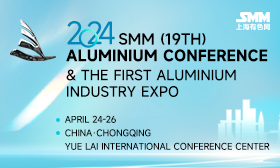 EventsApr 24 - 26, 2024 (GMT+8)China · Chongqing