

446results found for 'electrolytic aluminum'
Price
News
- Divergent Raw Material Prices to Keep Short‑Term Aluminum Costs Stable
SMM, August 3 According to SMM data, the average tax-inclusive full cost of the domestic electrolytic aluminum industry rose 0.9% month-on-month in July 2026, while falling 1.7% year-on-year, mainly driven by slight increases in the monthly average price of alumina, prebaked anode prices, and electricity prices during the period. The monthly average SMM A00 spot price in July (June 26 – July 25) stood at RMB 22,977 per tonne, down 4.2% month-on-month. Electrolytic aluminum profit margins narrowed by RMB 1,146 per tonne to RMB 6,999 per tonne, with average profitability up 56.8% year-on-year. Measured by the monthly average price, 100% of domestic operating electrolytic aluminum capacity was in profit in July. By cost component: Alumina: According to SMM data, the monthly average SMM Alumina Index in July (June 26 – July 25) was RMB 2,745 per tonne, up 1.6% month-on-month. Alumina prices fluctuated within a range through the month as inventories continued to accumulate; overseas alumina prices, however, rose on restocking ahead of production restarts and new capacity ramp-ups. Entering August, the alumina market is expected to maintain its current supply structure. Against a backdrop of net imports, there is no sign of an inflection point toward inventory drawdown, but cost support has lifted Guinean sellers' asking prices, lending upward momentum to alumina costs. In the near term, the tug-of-war between cost support and loose supply in the spot alumina market is set to continue. With prices relatively low at the start of the month, the August average price is expected to edge down slightly. Auxiliary materials: In July, rigid demand from electrolytic aluminum underpinned domestic anode consumption, while export demand from Southeast Asia offset reductions in the Middle East, leaving the prebaked anode market relatively steady. Long-term contract procurement prices rose marginally by RMB 30 per tonne month-on-month. In the fluoride salt market, downstream buyers maintained rigid procurement and held off on purchases to push prices lower, leading to declines in procurement prices at major producers. Entering August, with cost support softening and supply continuing to expand, prebaked anode prices are expected to edge down slightly; fluoride salt prices, by contrast, are projected to rise on the back of rigid cost support combined with low operating rates. Overall, auxiliary material costs for electrolytic aluminum are expected to decline slightly in August. Electricity prices: Electricity prices rose modestly month-on-month in July. Entering August, electricity prices are expected to remain broadly stable, and overall power costs for electrolytic aluminum are projected to hold steady. In summary, the weighted average tax-inclusive full cost of SMM's domestic electrolytic aluminum industry rose slightly in July 2026; electrolytic aluminum costs are expected to decline modestly in August, with the average hovering around RMB 15,700–16,100 per tonne.
Aug 7, 2026 17:25 - 【SMM Aluminum Flash News】Shenhuo Reports 151.06% Net Profit Surge in H1 2026, Driven by Higher Coal and Aluminum Prices
On the evening of July 27, Henan Shenhuo Coal & Power Co., Ltd. (hereinafter referred to as "Shenhuo") released its 2026 semi-annual report. In the first half of this year, the company achieved operating revenue of 24.791 billion yuan, a year-on-year increase of 21.35%; net profit attributable to shareholders of the listed company was 4.781 billion yuan, a year-on-year increase of 151.06%. Regarding the reasons for the performance change, Shenhuo stated that during the reporting period, the company's profitability was significantly enhanced due to factors such as the year-on-year increase in the selling price of coal and electrolytic aluminum products and the year-on-year decrease in the price of alumina, the main raw material.
Jul 28, 2026 17:12 - 【SMM Aluminum Flash News】CMCC3's Vietnam Electrolytic Aluminum Project Produces First Batch of Aluminum Ingots
On July 21, the ingot casting workshop of the Vietnam Electrolytic Aluminum Project Department of China Fifteenth Metallurgical Construction Corporation (CMCC3) successfully produced its first batch of aluminum ingots. This achievement marks a significant milestone in the trial production of the casting system. At 3:00 PM that day, as trial production officially commenced, the holding furnace slowly tilted from 0°C to 20°C. The molten aluminum, after being held at this temperature, smoothly entered the casting machine through a chute. After casting, cooling, and demolding processes, aluminum ingots were successfully formed. Subsequently, a robotic arm precisely grasped the ingots and stacked them. The entire production process ran smoothly and efficiently, and the successful production of the first batch of aluminum ingots signifies the complete success of the trial production in the ingot casting workshop. It is reported that to ensure the smooth progress of trial production, the project team conducted comprehensive inspections and repeated confirmations of key aspects such as equipment installation, electrical power supply, instrument debugging, and system linkage, ensuring the safe, stable, and orderly operation of the entire trial production process. The successful production of the first batch of aluminum ingots demonstrates the project team's commitment to its milestone targets and lays a solid foundation for subsequent trial production and full-scale operation.
Jul 28, 2026 17:06 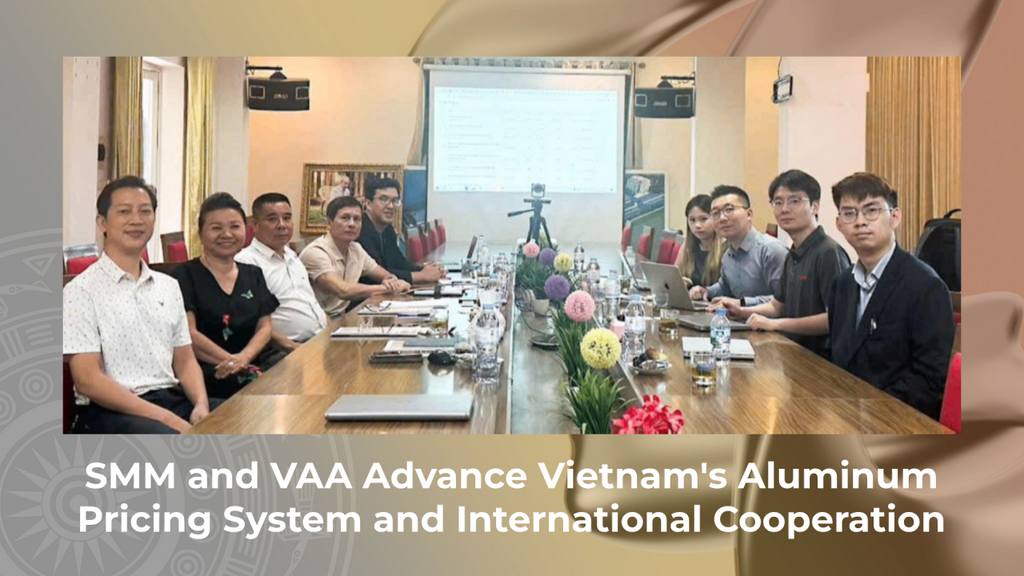 SMM and VAA Advance Vietnam’s Aluminum Pricing System and International Cooperation
Representatives from SMM and the Vietnam Association of Aluminum Profile (VAA) during their meeting in Ho Chi Minh City on July 21, 2026 On July 21, 2026, a delegation from Shanghai Metals Market (SMM) visited the Vietnam Association of Aluminum Profile (VAA) to discuss the development of Vietnam’s aluminum industry, the establishment of a credible local aluminum pricing system, and opportunities for international cooperation. The SMM delegation included: Logan Lu , CEO of SMM Cason Lou , Aluminum Processing Director of the Marketing Department Lexi Chen , Key Account Manager for Overseas Information Sales Khai Yuen Chin , Senior Overseas Aluminum Analyst. They were welcomed by key representatives from VAA, including: Nguyen Minh Ke, President of Vietnam Aluminum Profile Association (VAA) Vu Van Phu, Vice President & Secretary General, VAA, Viet Phap Aluminum Company Le Anh Tuyet, Vice President, VAA; CEO Do Thanh Aluminum Group Nguyen Dung, Chief of Office, VAA Strengthening Transparency in Vietnam’s Aluminum Market During the meeting, SMM and VAA introduced their respective organizations, business activities, and roles within the aluminum industry. The discussion then focused on the development of Vietnam’s aluminum sector, market research and price publication, and potential cooperation surrounding SMM AICE 2026 Southeast Asia Aluminum Conference A key topic was the need for a transparent and internationally recognized aluminum price benchmark in Vietnam. Photo credit: SMM AICE As Vietnam’s aluminum industry continues to expand, the absence of a credible local price reference remains a major challenge for market participants. A reliable benchmark could improve pricing transparency, support more informed commercial decisions, and facilitate cross-border trade. To support this development, SMM officially launched its Vietnam 6063 aluminum billet processing fee and SMM Vietnam 6063 aluminum billet price assessment on July 3, 2026. During the meeting, the SMM team explained the progress of its pricing services in Southeast Asia and addressed VAA’s questions regarding the assessment process. SMM also emphasized the importance of developing a Vietnam aluminum pricing system that reflects local market conditions while gaining recognition from international participants. Official Price Launch at SMM AICE 2026 SMM plans to officially introduce its Vietnam aluminum price and explain the underlying methodology during SMM AICE 2026 Southeast Asia Aluminum Conference , taking place on November 19–20, 2026, in Ho Chi Minh City. The conference will provide a platform for aluminum producers, processors, traders, industry associations, analysts, and other market participants to discuss pricing mechanisms and the broader development of Vietnam and Southeast Asia’s aluminum markets. VAA Chairman Nguyen Minh Ke welcomed SMM’s continued engagement in Vietnam. He highlighted the rapid development of the country’s aluminum industry, particularly following the commissioning of the first phase of a 150,000-ton electrolytic aluminum project, which further strengthens Vietnam’s aluminum value chain. Photo credit: SMM AICE He also noted that the lack of a locally based pricing reference with international credibility has remained a persistent industry challenge. VAA looks forward to deepening its cooperation with SMM and jointly supporting the standardization and international recognition of Vietnam’s aluminum pricing system. Expanding Cooperation Through SMM AICE 2026 SMM and VAA also reached several points of consensus regarding potential cooperation for SMM AICE 2026. VAA expressed its intention to actively consider supporting and participating in the conference. This collaboration could create new opportunities for industry dialogue, information exchange, and stronger connections between Vietnam’s aluminum sector and the wider international market. The visit marks the formal establishment of a cooperative relationship between SMM and VAA. It lays a foundation for future collaboration in aluminum price development, industry information exchange, and international engagement. About the Vietnam Association of Aluminum Profile Established in 2019, the Vietnam Association of Aluminum Profile is one of the country’s most influential aluminum industry organizations. VAA represents nearly 130 member companies involved in aluminum profile manufacturing and trading. Its work focuses on supporting member companies, protecting their legitimate interests, promoting cooperation across the industry, and strengthening the international competitiveness of Vietnam’s aluminum sector. According to VAA, Vietnam’s aluminum profile production reached nearly 1.5 million tonnes in 2024, with an estimated value of USD 4.2 billion, representing year-on-year growth of 14.5%. As the industry continues to grow, cooperation among associations, market information providers, and businesses will become increasingly important in developing stronger market standards and supporting Vietnam’s integration into the global aluminum value chain. Join the Conversation at SMM AICE 2026 Connect with aluminum producers, processors, traders, industry associations, analysts, and decision-makers from across Southeast Asia. Explore the latest market developments, pricing trends, processing technologies, recycling opportunities, and new possibilities for regional cooperation. ? Ho Chi Minh City, Vietnam ? November 19–20, 2026 Register now: bit.ly/AICE26 and secure your Super Early Bird Pass and save up to USD 200. Register before August 31, 2026.
Jul 23, 2026 11:35- 【SMM Aluminum Flash News】Zhongfu Industrial Forecasts 154%-176% Profit Growth in H1 2026
On July 8, Zhongfu Industrial announced that it expects its net profit attributable to owners of the parent company for the first half of 2026 to be between RMB 1.8 billion and RMB 1.95 billion, representing a year-on-year increase of 154.42% to 175.62%. The performance growth is mainly due to cost reduction through collaboration between upstream and downstream industrial chains, high electrolytic aluminum prices, development of high value-added aluminum deep processing products, and the advancement of energy-saving technological transformation projects.
Jul 13, 2026 09:41 - 【SMM Aluminum Flash News】Hongqiao Holdings Forecasts 69.72%-81.04% Net Profit Growth in H1 2026
Hongqiao Holdings announced that it expects its net profit attributable to shareholders of the listed company for the first half of 2026 to be between RMB 15 billion and RMB 16 billion, representing a year-on-year increase of 69.72% to 81.04%. The performance change is mainly due to a significant year-on-year increase in the sales price of electrolytic aluminum, resulting in a significant improvement in the gross profit of related businesses. At the same time, the scale of borrowing has been reduced, leading to a substantial decrease in financial interest expenses. Note: The company's Q2 net profit is expected to be between RMB 8.242 billion and RMB 9.242 billion, while Q1 net profit was RMB 6.758 billion. Based on this, Q2 net profit is expected to increase by 21% to 36% quarter-on-quarter.
Jul 13, 2026 09:40
Events
 WebinarAug 22, 16:00 - 23:59 (GMT+8)