

7616results found for 'change'
Price
News
- Metals broadly declined, with SHFE tin falling below 390,000 intraday, lithium carbonate up nearly 2%, SHFE gold falling for the fifth straight day, and SHFE silver plunging over 5% [SMM Midday Review]
SMM June 24 News: Metal markets: As of the midday close, domestic base metals fell across the board. SHFE copper dropped 0.95%, SHFE aluminum fell 1.11%, SHFE lead dipped 0.12%, SHFE zinc declined 1.7%, SHFE nickel lost 1.94%, and SHFE tin slumped 4.64%, hitting an intraday low of 388,220 yuan/mt. In addition, the most-traded casting aluminum futures contract fell 1.01%, while the most-traded alumina contract edged up 0.52%. Lithium carbonate's most-traded contract rose 1.67%. Silicon metal's most-traded contract dipped slightly. Polysilicon's most-traded futures contract gained 0.28%. Ferrous metals showed mixed performance: iron ore rose 0.68%, rebar edged slightly lower, hot-rolled coil edged up, and stainless steel dropped 1.27%. On the coking coal and coke front, the most-traded coking coal futures contract fell 0.64%, and the most-traded coke futures contract remained on par with 1,953.5 yuan/mt. In the overseas base metals market, as of 11:38, LME metals were nearly all in negative territory. LME copper edged up 0.24%, LME aluminum fell 0.67%, and LME lead dropped 0.44%. Both LME zinc and LME tin fell within 0.5%. LME nickel dipped slightly. In precious metals, as of 11:38, COMEX gold fell 1.86% and COMEX silver dropped 1.34%. In China's precious metals market, the most-traded SHFE gold contract extended its four-day losing streak by falling another 2.37%, hitting an intraday low of 886.34 yuan/g; the most-traded SHFE silver contract extended its three-day decline by falling another 5.08%. Additionally, as of the midday close, the most-traded platinum futures contract fell 0.6% and the most-traded palladium futures contract dropped 1.41%. As of the midday break, the most-traded container shipping futures index contract rose 0.79%, at 3,745 points. Midday futures market quotes as of 11:38 on June 24: Spot Market and Fundamentals Copper: Today, Guangdong's spot #1 copper cathode against the front-month contract: high-quality copper was quoted at 80 yuan/mt, flat from the previous trading day; standard-quality copper was quoted at a premium of 20 yuan/mt, up 10 yuan/mt from the previous trading day; SX-EW copper was quoted at a discount of 60 yuan/mt, up 10 yuan/mt from the previous trading day. The average price of Guangdong #1 copper cathode was 103,310 yuan/mt, down 975 yuan/mt from the previous trading day, and the average price of SX-EW copper was 103,200 yuan/mt, down 970 yuan/mt. Spot market: Guangdong's inventory has increased for four consecutive trading days, mainly driven by rising arrivals... Macro Front Domestic developments: [Three government departments to implement the 2026 insurance compensation policy for first (set of) major technical equipment] The General Offices of the Ministry of Industry and Information Technology, the Ministry of Finance, and the National Financial Regulatory Administration issued a notice on implementing the 2026 insurance compensation policy for first (set of) major technical equipment. The notice states that complete equipment will generally be supported based on the number of units (sets); core systems, key parts, and critical supporting and basic components for major technical equipment will generally be supported based on the number of batches. High-end industrial mother machines, specialized electronic equipment, new-type agricultural machinery, and precision instruments—complete machines with a lower per-unit value—can be supported on a batch basis; high-value single items like aircraft engines and marine engines can be supported on a unit (set) basis. [Ultra-long special government bonds have facilitated the renewal of over 360,000 elevators] On the 24th, the Ministry of Housing and Urban-Rural Development reported that since the state included the renewal and renovation of old residential elevators within the scope of ultra-long special government bond funding, local authorities have actively leveraged policy support to vigorously promote these upgrades, facilitating residents' travel. More than 360,000 old residential elevators have been renewed cumulatively. (CCTV News) [PBOC net injects 242.2 billion yuan via reverse repos today] The PBOC conducted 662.5 billion yuan in seven-day reverse repos today at an operating rate of 1.4%, unchanged from the previous session. A total of 420.3 billion yuan in reverse repos matured today. US dollar: As of 11:38, the US dollar index edged up 0.1% to 101.47. Data: On June 24, S&P Global reported that the preliminary US composite Purchasing Managers' Index (PMI) for June rose to 52.2, up from the prior figure of 51.5 and exceeding the market expectation of 52.1, reaching a five-month high and indicating continued expansion in US business activity. By sector, manufacturing performance was particularly strong. New order growth hit its fastest rate in over four years, driving a marked upturn in factory production. The preliminary US manufacturing PMI for June rose to 55.7, the highest since May 2022, exceeding the expected 54.6 and the prior 55.1. Meanwhile, the service sector also maintained expansionary momentum. The preliminary services PMI for June rose to 51.3, a four-month high, surpassing the expected 51.1 and the prior 50.7. At the same time, easing cost pressures due to reduced tensions in the Middle East also boosted business confidence. However, the survey also indicated that issues such as supply chain delays, rising raw material prices, and a slowdown in hiring persist, suggesting the foundation for economic recovery is not yet solid. (From Wall Street News APP) According to CNBC, the hunt for a new president of the Federal Reserve Bank of Atlanta, now in its seventh month, is drawing close scrutiny. The process is seen as a window into how new Fed Chair Kevin Warsh will reshape the interest-rate-setting Federal Open Market Committee (FOMC). The process has shifted as Warsh began exerting his influence at the US Fed. According to two people familiar with the search process, the Fed had already been identifying candidates for the Atlanta Fed president role under former Chair Powell. However, the process was temporarily halted to allow Warsh to lead the appointment. Both people spoke on condition of anonymity because the search remains ongoing. They said Michael Faulkender, a former senior Treasury official in the Trump administration, has since been added to the list of candidates being considered for the Atlanta Fed job. It remains unclear if Faulkender is still a candidate. (From Jinshi APP) According to the CME "Fed Watch": The probability of the US Fed holding rates steady in July stands at 62.6%, while the chance of a cumulative 25 basis point rate increase is 37.4%. The probability of holding rates steady through September is 29.8%, versus a 50.6% chance of a cumulative 25 bp hike and a 19.6% chance of a cumulative 50 bp hike. Other currencies: Data released on Wednesday showed that Australia's consumer price index (CPI) fell in May, driven by lower fuel costs and declining demand for holiday travel. However, core inflation remained above expectations, suggesting that further rate hikes cannot be ruled out. Australian Bureau of Statistics data showed that the CPI fell 0.7% MoM in May, with the YoY growth rate slowing to 4%, down from the prior 4.2%. The market had expected a 0.4% MoM decline and 4.3% YoY growth. However, core inflation, which strips out volatile items, rose 0.4% MoM in May, above the expected 0.3%, pushing the annualized rate to 3.6%. The Reserve Bank of Australia has already raised rates three times this year in an effort to bring core inflation back within its 2% to 3% target band. The Bank of Japan, in minutes from last week's board meeting, signaled the necessity of further raising its benchmark interest rate. At that meeting, the BoJ raised its policy rate to the highest level since 1995. According to the minutes released Wednesday, one board member stated: "Given that core CPI inflation has approached 2% and financial conditions are accommodative, the Bank should continue to raise the policy rate in response to current economic, inflation, and financial conditions." The BoJ implemented its first rate hike since last December last week and made it clear that further increases are ahead, though the minutes offered no clear guidance on the timing of the next move. Still, the minutes reinforced market expectations for another rate hike by year-end. A survey of economists taken the day after the meeting showed about 90% of respondents expect another rate increase before December, with over a third identifying October as the next adjustment window. Economists now expect the terminal rate for this hiking cycle to reach 1.75%, up from the 1.5% projected in a survey earlier this month. (From Jinshi APP) Data: Today's releases include Australia's May unadjusted CPI YoY, Germany's June IFO Business Climate Index, Switzerland's June ZEW Investor Confidence Index, the US Q1 current account, and US May new home sales annualized total. Also on the radar: The Bank of Japan will release the summary of opinions from its June monetary policy meeting; the 2026 Mobile World Congress Shanghai runs through June 26. Crude oil: As of 11:38, prices on both sides of the Atlantic fell, with US crude oil down 1.08% and Brent crude oil down 0.87%. International crude oil prices remain under pressure following the resumption of tanker traffic through the Strait of Hormuz after a temporary peace agreement between the US and Iran. (Wall Street News) Iran's ambassador in Geneva stated that the Strait of Hormuz is completely open to commercial vessels, and significant volumes of oil have been transported through the waterway in recent days. (From Jinshi APP) On June 23 local time, US President Trump said the US is "committed to reaching a fair deal with Iran" to end the conflict in the Strait of Hormuz. He stated that just the previous day (June 22), 19 million barrels of oil were transported through the Strait. Trump reiterated that "Iran cannot have nuclear weapons" and said that related work is progressing well. (CCTV) Spot Market Overview: ► ► Midday spot commentary for other metals will be updated later—please refresh to view~
Jun 24, 2026 12:02 - [SMM Nickel Sulphate Daily Review] June 24: Nickel prices plunged, nickel salt prices declined
On June 24, the SMM battery-grade nickel sulphate average price edged lower.
Jun 24, 2026 11:52 - Copper prices continued to decline, suppliers began to hold prices firm and sell, and spot premiums bottomed out. [SMM South China Copper Spot]
SMM June 24: Today, Guangdong #1 copper cathode spot against the front-month contract: high-quality copper was quoted at a premium of 80 yuan/mt, unchanged from the previous trading day; standard-quality copper was quoted at a premium of 20 yuan/mt, up 10 yuan/mt from the previous trading day; SX-EW copper was quoted at a discount of 60 yuan/mt, up 10 yuan/mt from the previous trading day. The average price of #1 copper cathode in Guangdong was 103,310 yuan/mt, down 975 yuan/mt from the previous trading day, and the average price of SX-EW copper was 103,200 yuan/mt, down 970 yuan/mt. Spot market: Guangdong inventory increased for the fourth consecutive trading day, driven mainly by increased arrivals. Quotations were chaotic today; standard-quality copper traded at parity in early trading, but some suppliers, seeing copper prices continue to fall, held prices firm and offered at 50 yuan/mt. However, the sharp increase led downstream buyers to refrain from chasing higher prices, and trading showed a pattern of initial strength followed by weakness. The buying sentiment for copper cathode in Guangdong was 2.66, up 0.04 from the previous trading day, and the selling sentiment was 2.85, up 0.04 from the previous trading day (historical data can be accessed via the database). Overall, as copper prices continued to fall, suppliers began to hold prices firm and sell, spot premiums bottomed out, and overall trading was moderate.
Jun 24, 2026 11:31 - Baowu Magnesium's business includes magnesium materials and magnesium-aluminum products, etc. Its Anhui Qingyang mine project has reached a capacity of 20 million mt per year.
Asked "Dear Board Secretary, I would like to inquire whether your company, as found online, can stably mass-produce semiconductor-grade ultra-high-purity magnesium metal ingots and is the only publicly listed firm for such products. Also, what has been the sales proportion of such products in the company's total sales in recent years?" Baowu Magnesium Industry responded on the investor interaction platform on June 23: The company's businesses include magnesium material business, magnesium products business, aluminum products business, mineral products business, and building formwork business. Its main products include magnesium alloys, magnesium alloy deep-processed products, aluminum alloys, aluminum alloy deep-processed products, master alloys, and strontium metal. For the revenue breakdown by product, please refer to the 2025 annual report. The company has not publicly disclosed information regarding the specific products and sales proportions you mentioned. Please refer to the company's officially released periodic reports or announcements for such information. Regarding the question "1. What is the commissioning progress of the mine in the Qingyang project in Anhui, and what is the current ore output? 2. What advantages does the company's vertical retort magnesium smelting technology have? How does it compare with peers in Fugu?" Baowu Magnesium Industry responded on June 17 on the investor interaction platform: The company adopts vertical retort magnesium smelting technology, which features outstanding technical advantages: increased single-retort capacity, shortened production cycle, improved production efficiency, extended service life of reduction retorts, and a higher level of mechanized and automated operations. The Anhui Qingyang mine project has reached a capacity of 20 million mt per year . On June 3, during a survey, Baowu Magnesium Industry stated that the company already has a certain level of technology reserves in magnesium-based hydrogen storage, but the development of the hydrogen storage industry mainly relies on downstream application expansion, which takes time. Currently, downstream application expansion is slow: the hydrogen energy industry chain (production/storage/transportation/utilization) lacks overall maturity, and orders have yet to materialize at scale. On June 3, during a survey, Baowu Magnesium Industry stated that in terms of end-use breakdown, the largest use of magnesium is in magnesium alloys, accounting for about 49%; followed by addition to aluminum alloys, about 26%; steel desulfurization, about 12%; as a metal reducing agent, about 8%; and other fields, about 5%. On June 3, during a survey, Baowu Magnesium Industry stated that the company's magnesium ingot production costs have the following advantages: 1. The company has a complete industry chain advantage, especially in stable raw material supply. 2. The company continues to increase investment in original magnesium smelting technology, enhancing the cost competitiveness of its primary magnesium through large-scale vertical retort magnesium smelting technology and energy efficiency optimization. Baowu Magnesium Industry announced on May 26 that it recently received a notice from its controlling shareholder, Baosteel Metal Co., Ltd., that 263 million shares (26.53% of total shares) will be transferred at no cost to China Baowu Steel Group Corporation Limited. After the transfer, the controlling shareholder will change to China Baowu, while the actual controller remains the State-owned Assets Supervision and Administration Commission of the State Council, unchanged. The announcement shows Baosteel Metal is a wholly owned subsidiary of China Baowu. Before this transfer, China Baowu indirectly held 26.53% of Baowu Magnesium through Baosteel Metal, being the indirect controlling shareholder. After the transfer, China Baowu will directly hold 26.53% and become the controlling shareholder. Performance: Baowu Magnesium Industry disclosed its 2025 annual report on April 29, showing: In 2025, the company achieved revenue of 9,911,752,817.29 yuan, up 10.34% YoY, and net profit attributable to shareholders of the publicly listed firm was 18,548,946.85 yuan, down 111.62% YoY. The decline was mainly due to the continued downward trend of magnesium prices, which caused a significant YoY decline in the magnesium material business profit; meanwhile, the joint venture Anhui Baomei Light Alloy Co., Ltd. is in the ramp-up stage of a new project, with low production and high costs, plus low magnesium prices, which dragged down the company's investment income YoY. Regarding the main business activities during the reporting period, Baowu Magnesium Industry introduced in its 2025 annual report: The company is a leader in magnesium-based new materials under China Baowu, with advantages across the entire industry chain and mine resources, leading vertical retort magnesium smelting technology, and its magnesium alloy capacity and market share are among the global frontrunners. The company focuses on lightweight materials, with products covering automotive, consumer electronics, e-bikes, building formwork, etc. After more than 30 years of development, the company has become a high-tech enterprise integrating mining, non-ferrous metal smelting, and processing, aiming to be a global leader in the magnesium industry. Its businesses include magnesium material business, magnesium products business, aluminum products business, mineral products business, and building formwork business. Its main products include magnesium alloys, magnesium alloy deep-processed products, aluminum alloys, aluminum alloy deep-processed products, master alloys, and strontium metal. Outlook on future development: Baowu Magnesium Industry stated in the 2025 annual report: 2026 marks the start of the company's 15th Five-Year Plan, and the industry will see an important period of high-end and large-scale development. The board will guide management with the core positioning of "building a lightweight solutions provider and becoming the new materials main force of China Baowu," focusing on the main business, deepening cultivation, advancing full-industry-chain upgrading, technological innovation, market expansion, and green development, to achieve sustained improvement in operating performance and significant enhancement of core competitiveness. 1. Strengthen strategic guidance and solidify the foundation for new quality productive forces in the magnesium industry. Accelerate building a full industry chain from primary magnesium to alloys, deep processing, and terminal applications, concentrate on breakthroughs in green smelting and stable, low-cost production technologies, and speed up large-scale promotion of key products. 2. Coordinate the construction of key projects to synergistically improve overall operational efficiency. Speed up construction and comprehensive acceptance of the Huayuan Wujia mine in the Qingyang project, orderly advance main plant construction and production indicator optimization, and steadily push forward key projects in Gansu Baomei, Wutai Baomei, and Chaohu Baomei. 3. Deepen magnesium industry reform and innovation, promoting modern corporate governance. Steadily advance business transformation and renewal, promote asset integration, and further optimize governance, management control, and business management models. 4. Accelerate intelligent development layout and fully advance IT system construction. Complete full implementation of the Baowu standard financial system and rollout of cost systems in subsidiaries, create a full-process IT model project for magnesium business, further enhance operational control, cost calculation, compliant operations, and risk prevention and control capabilities. 5. Focus on attack on primary magnesium cost to continuously enhance market competitiveness. Reduce manufacturing costs of three core components: reduction retorts, center pipes, and cones; optimize steel grades to extend retort service life; reduce auxiliary energy consumption and material-to-magnesium ratio. 6. Implement cost-conscious management and systematically build a high-quality development business model. Deepen overall benchmarking to identify and address gaps, systematically attack the "four major costs" — primary magnesium, energy, logistics, and quality — and improve the operational control system. 7. Strengthen safety and environmental protection fortresses, systematically elevate green development. Continuously strengthen safety and environmental compliance rectification. Highlight risk management in key areas and enhance intrinsic safety. Accelerate green factory and low-carbon capability building. 8. Main risk factors and countermeasures (1) Risk of fluctuating main raw material prices The company's main business is magnesium and aluminum alloys and deep processing, with primary raw materials being magnesium and aluminum metals. Prices are affected by supply-demand dynamics, global and Chinese economic conditions, and closely tied to automotive lightweighting progress, 3C industry demand, etc. If magnesium and aluminum prices swing wildly in the future, it will affect cost control and profitability. The company is raising the self-sufficiency ratio of raw materials, adjusting product mix, and increasing the proportion of deep-processed products to mitigate the impact. (2) Risk of fluctuating market demand The company's magnesium and aluminum lightweight alloy products are mainly used in automotive and consumer electronics. Currently, seizing auto lightweighting opportunities, the company is expanding into downstream deep processing such as magnesium alloy automotive die castings, magnesium alloy building formwork, and aluminum extrusion products. The pace of automotive lightweighting and 3C electronics demand are influenced by macro-economy, industrial policies, and process technology innovation. If downstream demand falls short of expectations, it will affect operating performance. The company is expanding product applications in various fields, increasing penetration rates, to reduce the risk of demand fluctuations. In addition, the Q1 2026 report released by Baowu Magnesium Industry shows: In Q1 2026, revenue was 2.132 billion yuan, up 4.86% YoY; net profit attributable to shareholders of the publicly listed firm was 5.0891 million yuan, down 81.94% YoY. Regarding the increase in Q1 revenue, Baowu Magnesium Industry explained: Sales of main products and material prices rose YoY. For the decline in net profit, the company said it was due to a decrease in product gross margins and increased losses from joint ventures. Baowu Magnesium Industry mentioned that its magnesium alloy capacity and market share rank among global leaders. Looking back at the performance of SMM magnesium alloy AZ91D in Q1 this year: The average price on March 31, 2026 was 19,650 yuan/mt, compared with 17,950 yuan/mt on December 31, 2025, the average price rose by 1,700 yuan/mt in Q1, or 9.47%. The daily average price in Q1 2026 was 18,932.14 yuan/mt, up 1,320.74 yuan/mt, or 7.5% YoY, from 17,611.4 yuan/mt in Q1 2025. According to SMM price quotes: The EXW price of SMM magnesium alloy AZ91D on June 24 ranged from 18,250 to 18,350 yuan/mt, with an average of 18,300 yuan/mt, down 0.54% from the previous trading day. Currently, magnesium alloy prices are in the doldrums alongside magnesium ingot prices, with overall low trading sentiment. Fundamentals side: Supply side, magnesium alloy smelters have stable operating rates, ample spot supply in the market, and overall supply is loose; demand side, downstream die-casting plants show significant divergence in orders, with stable automotive orders, persistently sluggish two-wheeler orders, and alloy processing fees in the doldrums. Overall, the magnesium alloy market maintains a supply-strong-demand-weak pattern, with prices expected to remain in a weak consolidation phase in the short term.
Jun 24, 2026 11:03 - US dollar strength and rate hike expectations weighed on silver prices; spot premiums stagnant, trading sluggish [SMM Daily Review]
[SMM Daily Review: Strong US Dollar and Rate Hike Expectations Pressure Silver Prices, Spot Premium Stalemate, Sluggish Trading] SMM June 24 news, the US dollar index hit a new high in over a year, rate hike expectations continued to weigh on silver, and it suffered a technical breakdown. In the spot market, downstream players mainly stayed on the sidelines, trading was sluggish, and prices held steady with small premiums.
Jun 24, 2026 10:11 - Is the Gold Correction an Opportunity? BofA Sticks to Its $6,000 Target Despite Headwinds from the Fed — Long Term
June 23, 2026 The price of gold is currently feeling the full brunt of U.S. monetary policy. Bank of America, which was still among the market’s biggest optimists as recently as January and had forecast a rapid rise to $6,000 per ounce by spring, has had to adjust its short-term outlook. While the long-term fundamental arguments in favor of the precious metal remain intact, the Federal Reserve’s radically changed interest rate outlook is now forcing the analyst team to adopt a more defensive stance—at least in the short term. Interest Rate Hikes Instead of Cuts: The Fed’s Inflation Trap The key headwind for gold is the abrupt reversal in interest rate expectations. While investors were still firmly expecting interest rate cuts at the start of the year, the war in Iran has sparked a global energy crisis and massively fueled inflation concerns. The CME FedWatch Tool now puts the probability of another rate hike by September at over 70 percent. This restrictive environment weighs on the non-interest-bearing precious metal, as rising bond yields drive up the opportunity cost for gold investors. This shift from an environment of “inflationary rate cuts” to tight monetary policy cuts gold’s immediate upside potential in half, according to BofA. The problem: Even a swift peace agreement would hardly resolve the persistent inflation immediately, given established Trump tariffs, strained supply chains, and rising housing costs. Gold is thus caught in a short-term dilemma: While it benefits as a classic hedge against inflation, it is held back by the central bank’s necessarily restrictive stance. Megatrends remain intact: The structural fundamentals are growing Despite these headwinds, Bank of America is sticking to its overarching bullish scenario, as the U.S. macroeconomic environment provides the perfect breeding ground for higher prices. A ballooning budget deficit of around six percent of gross domestic product and a lack of fiscal consolidation are increasingly raising doubts about the sustainability of the U.S. debt burden—especially as foreign investors are already reducing their holdings of U.S. Treasury bonds. This is accompanied by global de-dollarization: According to recent surveys, 74 percent of central banks expect the dollar’s share of global reserves to decline over the next five years. This promises sustained strong purchasing power from the central banking sector. Once the looming interest rate hikes are fully priced in or off the table, investment demand is also likely to surge significantly. Currently, gold investments account for only 5.5 percent of global equity and bond markets. Analysts at Bank of America see enormous potential for growth here, particularly as institutional investors are shifting from the traditional 60:40 portfolio toward a 60:20:20 structure, in which alternative hedges such as gold are given significantly greater weight. For forward-thinking commodity investors, the report thus paints a clear picture: The short-term correction driven by interest rate policy merely masks massive, structural upside potential. Source: https://goldinvest.de/en/is-the-gold-correction-an-opportunity-bofa-sticks-to-its-usd6-000-target-despite-headwinds-from
Jun 24, 2026 10:08
Announcements
SMM plans to officially launch the Thailand Zamak3 Premium.
PriceJun 18, 2026 17:39SMM publishes N-type 210R wafer—Vietnam and Laos FOB price points
PriceJun 18, 2026 11:43Addition Data Point of 'India DCR (with domestic solar cells) Solar Modules Production: by Monthly' & 'India Solar Cell Production: by Monthly'
DataJun 15, 2026 11:46
Events
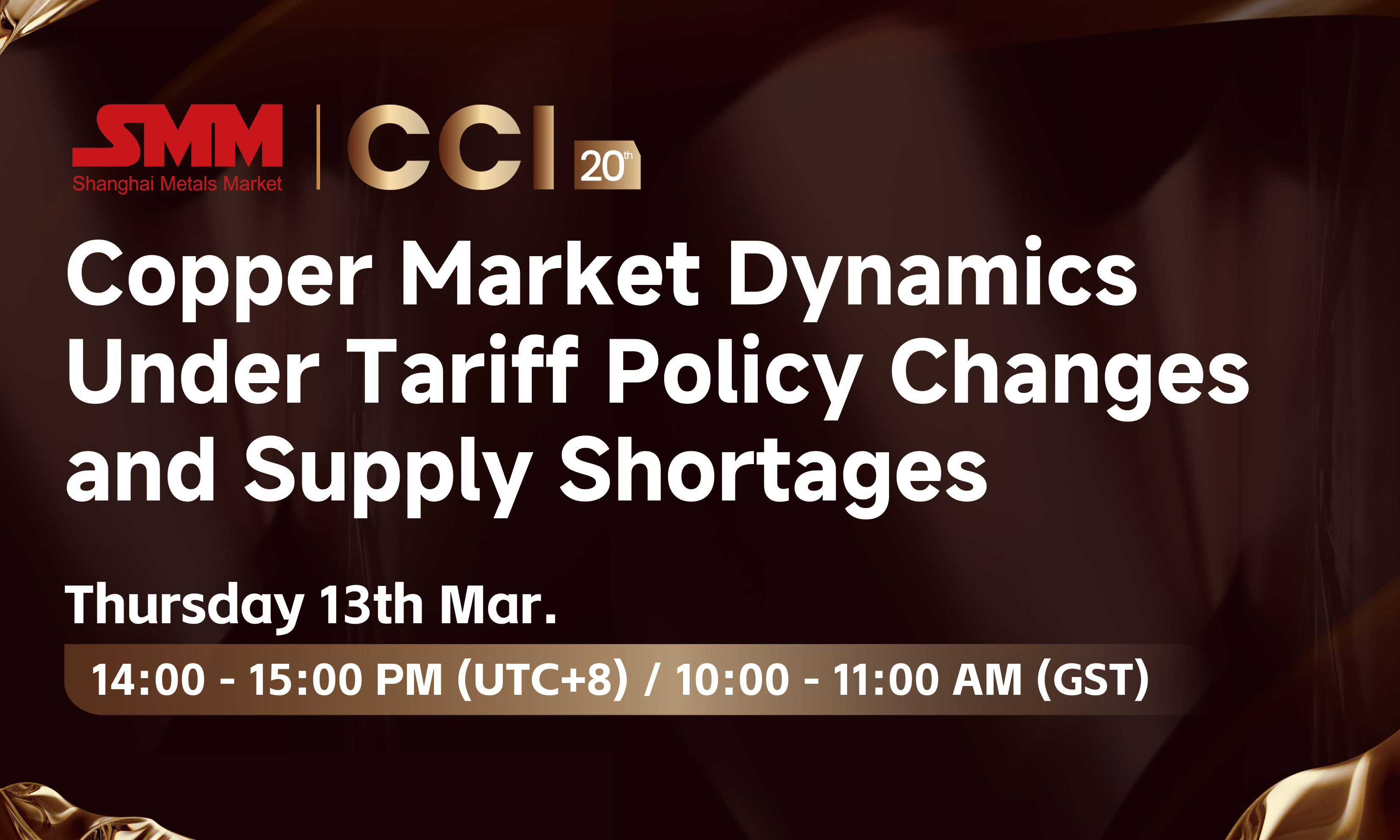 WebinarMar 13, 14:00 - 23:59 (GMT+8)
 WebinarApr 24, 16:00 - 23:59 (GMT+8)
 WebinarMar 24, 16:00 - 23:59 (GMT+8)