

9654results found for 'base'
Price
News
- [SMM Analysis]China-Indonesia Steel Price Spread Inverted, Overseas Demand Still Shows No Improvement
[SMM Analysis] China-Indonesia Steel Price Spread Inverted, Overseas Demand Still Shows No Improvement China-Indonesia Price Spread Inversion From the price spread model, the most notable fluctuations are in the China-Indonesia spread. The slab spread has narrowed to zero, billet has even inverted, and HRC prices are also declining markedly. Specifically, according to SMM survey, Indonesian prices weakened sharply. On one hand, clients hold high inventory and are eager to sell at lower prices. On the other hand, due to quota impacts, exports to the EU are hindered, forcing them to cut prices to compete with Asian resources. Data source: SMM Japanese Steel Scrap Under Pressure and Drifting Lower After the Kanto tender weakened, several Japanese mills including Tokyo Steel successively lowered their scrap purchase prices. Last week, the domestic scrap price index lost stability. Although a downward adjustment occurred at end-July, the downtrend is expected to persist. For finished steel, July EXW prices announced by most major mills last week were largely flat. However, on the export front, after the EU implemented new quota policies, challenges for Japan’s steel exports have intensified. Despite strong reactions from Japan, the short-term trade difficulties are hard to reverse, which is expected to force Japanese mills to further adjust production, continuing production cuts. India HRC Shipments to Southeast Asia to Increase Due to Quotas Last week, Indian steel remained under pressure. Mumbai HRC prices fell about $3/mt WoW to $602/mt EXW, with market transaction prices around $571-611/mt. Monsoon weather dampened construction and infrastructure demand. Spot procurement and restocking willingness remained weak, intensifying competition for low-priced resources. On the export side, affected by EU policies and quota adjustments, Indian steel exports to Europe are facing difficulties, prompting mills to adjust their overseas sales strategies. Flows of resources such as HRC to Southeast Asian markets like Vietnam are expected to increase significantly. Given that fundamentals are unlikely to improve before end-July, India’s domestic steel prices are expected to continue their downward drift through end-July. Copyright and Intellectual Property Statement: This report is independently created or compiled by SMM Information & Technology Co., Ltd. (hereinafter referred to as "SMM"), and SMM legally enjoys complete copyright and related intellectual property rights. The copyright, trademark rights, domain name rights, commercial data information property rights, and other related intellectual property rights of all content contained in this report (including but not limited to information, articles, data, charts, pictures, audio, video, logos, advertisements, trademarks, trade names, domain names, layout designs, etc.) are owned or held by SMM or its related right holders. The above rights are strictly protected by relevant laws and regulations of the People's Republic of China, such as the Copyright Law of the People's Republic of China, the Trademark Law of the People's Republic of China, and the Anti-Unfair Competition Law of the People's Republic of China, as well as applicable international treaties. Without prior written authorization from SMM, no institution or individual may: 1. Use all or part of this report in any form (including but not limited to reprinting, modifying, selling, transferring, displaying, translating, compiling, disseminating); 2. Disclose the content of this report to any third party; 3. License or authorize any third party to use the content of this report; 4. For any unauthorized use, SMM will legally pursue the legal responsibilities of the infringer, demanding that they bear legal responsibilities including but not limited to contractual breach liability, returning unjust enrichment, and compensating for direct and indirect economic losses. Data Source Statement: (Except for publicly available information, other data in this report are derived from publicly available information (including but not limited to industry news, seminars, exhibitions, corporate financial reports, brokerage reports, data from the National Bureau of Statistics, customs import and export data, various data published by major associations and institutions, etc.), market exchanges, and comprehensive analysis and reasonable inferences made by the research team based on SMM's internal database models. This information is for reference only and does not constitute decision-making advice. SMM reserves the final interpretation right of the terms in this statement and the right to adjust and modify the content of the statement according to actual circumstances.
Jul 22, 2026 18:14 - US Outpaces Europe in Critical Minerals Investment, Disrupting EU Plans
The US has surpassed Europe in investment in critical minerals, leaving the latter struggling to shake off its dependence. Citing analysis by the French Institute of International Relations, WSJ reports that over the past five years, the US has invested about $46 billion in critical raw material projects through grants, loans, and tax incentives—eight times the amount invested by the EU. The US is also negotiating prioritized development of mineral resources in countries such as the Democratic Republic of the Congo and Ukraine, while supporting overseas projects through financing plans. WSJ says the US’s aggressive strategy has disrupted Europe’s plans. To secure a loan from the US Export-Import Bank, Pensana, a London-based rare earth developer working on the Longonjo project in Angola, has already moved a processing plant originally planned to be built in the UK to the US.
Jul 22, 2026 18:08 - [SMM Analysis] Korea’s NEV Domestic Sales and Exports Rebound in June, Led by HEVs
Korea’s domestic NEV sales rose 22.1% month on month to 93,722 units in June, while combined BEV, HEV and PHEV exports increased 23.3% to 102,551 units. HEVs accounted for about 78% of incremental growth in both markets. BEV volumes also posted double-digit gains, but their share declined as HEVs expanded faster, highlighting a gap between overall vehicle-market recovery and the pace of BEV-led electrification.
Jul 22, 2026 16:37 - Durban's Global Praise Meets Ground Reality: Congestion and Corridor Bottlenecks Still Cloud SA's Chrome Export Routes
South Africa's ports are sending mixed signals for chrome ore and ferrochrome exporters this week. Fresh recognition of Durban's turnaround is running alongside renewed congestion at the terminal level and worsening delays along the road corridors that carry much of the country's bulk mineral cargo to the coast. Durban's turnaround recognized, but queues are lengthening again The Port of Durban, the primary gateway for South African chrome ore and ferrochrome shipments, was recently ranked the world's most-improved port by the World Bank and S&P, with its performance score surging 479 points in 2025. Transnet says its eight commercial seaports handled more than 300 million tonnes of cargo in the 2025/26 financial year, a 9% rise in vessel traffic and the strongest cargo throughput growth since 2011/12. That progress has not stopped local congestion from creeping back up. Published vessel-waiting-time data tracked in early July showed Durban's delay indicator climbing to roughly four days, up from around two days the previous week, while Coega/Ngqura, another route used for bulk exports, held at about five days. Cape Town was separately ranked South Africa's worst-performing port in the same World Bank/S&P assessment that praised Durban. Corridor and border delays offset port-level gains A significant share of South African chrome ore and concentrate is trucked to the coast rather than moved by rail, making inland corridors as important as the ports themselves. A Trademark Africa-commissioned assessment found that Durban's improved performance is not translating into faster end-to-end transit times, because border crossings along the North-South Corridor remain a persistent bottleneck. Average South African border-crossing times deteriorated by roughly 23% week-on-week to about 9.6 hours in early July, even as Lebombo (the main crossing on the Maputo Corridor used for chrome bound for Maputo harbour) saw truck volumes ease slightly and queue times improve. Further north, congestion at the Kasumbalesa crossing into the DRC has cut daily vehicle clearances by more than half, illustrating how regional border capacity, not just port throughput, shapes actual delivery times for African mineral exporters. Investment and reform response South Africa's transport ministry has extended the tenure of Transnet's turnaround board by six months, to January 2027, to allow more time to complete the appointment of a permanent replacement board and continue the state logistics group's recovery plan. Durban Container Terminal Pier 2, the port's largest container terminal, is set for an 11 billion rand investment from Philippines-based ICTSI as part of Transnet's wider push toward private-sector terminal operation. Cape Town has also expanded private participation, with nine of its eleven terminals now privately operated. On the alternative-route side, Maputo has launched Mozambique's first Port Community System, a digital platform intended to connect shipping lines, customs, transporters and other port users on a single system. If effectively implemented, it could strengthen Maputo's position as an alternative export gateway for South African chrome moved via the Maputo Corridor, though officials note the benefit will depend on execution rather than the platform's existence alone. Why it matters for chrome and ferrochrome trade Bottom line: Global rankings point to a genuine Transnet turnaround, but week-to-week congestion data and deteriorating border-crossing times suggest chrome and ferrochrome exporters should still budget for variable lead times, particularly on Maputo Corridor-bound cargo, rather than assume headline port improvements have fully resolved South Africa's export logistics constraints. NOTE: Compiled by SMM Africa (Zambia office) from Business Day, EWC (Exporters Western Cape) Logistics News Update, and Transnet/World Bank-S&P port performance data. Figures reflect the most recently available public reporting as of 22 July 2026 and are subject to change as Transnet and corridor authorities issue updates.
Jul 22, 2026 16:31 - [Solar: Sofab Inks raises USD 6mn for perovskite scale-up]
Perovskite solar startup Sofab Inks has raised USD 6 million in seed funding led by Cloudberry Ventures to expand production of its nanostructured materials for perovskite solar cells. The company said its metal-oxide nanoparticle material replaces the conventional C60 fullerene-based layer and is designed to improve durability, a key challenge for commercialization. Sofab said its perovskite cell has achieved 22.3% efficiency in 30-cm single-junction perovskite modules and plans to scale manufacturing for commercial-size 1×2 m modules.
Jul 22, 2026 16:26 - [Lithium Battery: Furih Group Plans To Acquire Former US Subsidiary To Boost Silicon-Based Anode Materials]
On the evening of July 20, Furih Group Co., Ltd. issued an announcement stating that it plans to acquire 78.80% of the equity of Bosilis (Nanjing) Co., Ltd. for 399.6 million yuan. The transaction has been approved by the second meeting of the ninth board of directors of Furih Group. Upon completion of the transaction, Bosilis (Nanjing) will become a holding subsidiary of Furih Group and will be included in its consolidated financial statements. As of the date of the agreement signing, Bosilis Co., Ltd. holds 78.8% of its equity, while Nanjing Zhongli Enterprise Management Partnership (Limited Partnership) holds 21.2%.
Jul 22, 2026 16:26
Announcements
SMM will launch a weekly Copper grade A cathode premium, FCA Zambia, on July 31, 2026, to enhance price transparency and provide a reliable reference for global copper trade.
PriceJul 22, 2026 16:36In recent years, continued adjustments to European steel trade protection measures have made stainless steel import quotas an increasingly important factor.
DataJul 22, 2026 16:25SMM HVLP1 copper foil premiums, deliverd to Consumer Works, VAT included, yuan/tonne will officially launch on the SMM website (smm.cn) on July 24, 2026.
PriceJul 17, 2026 16:56
Events
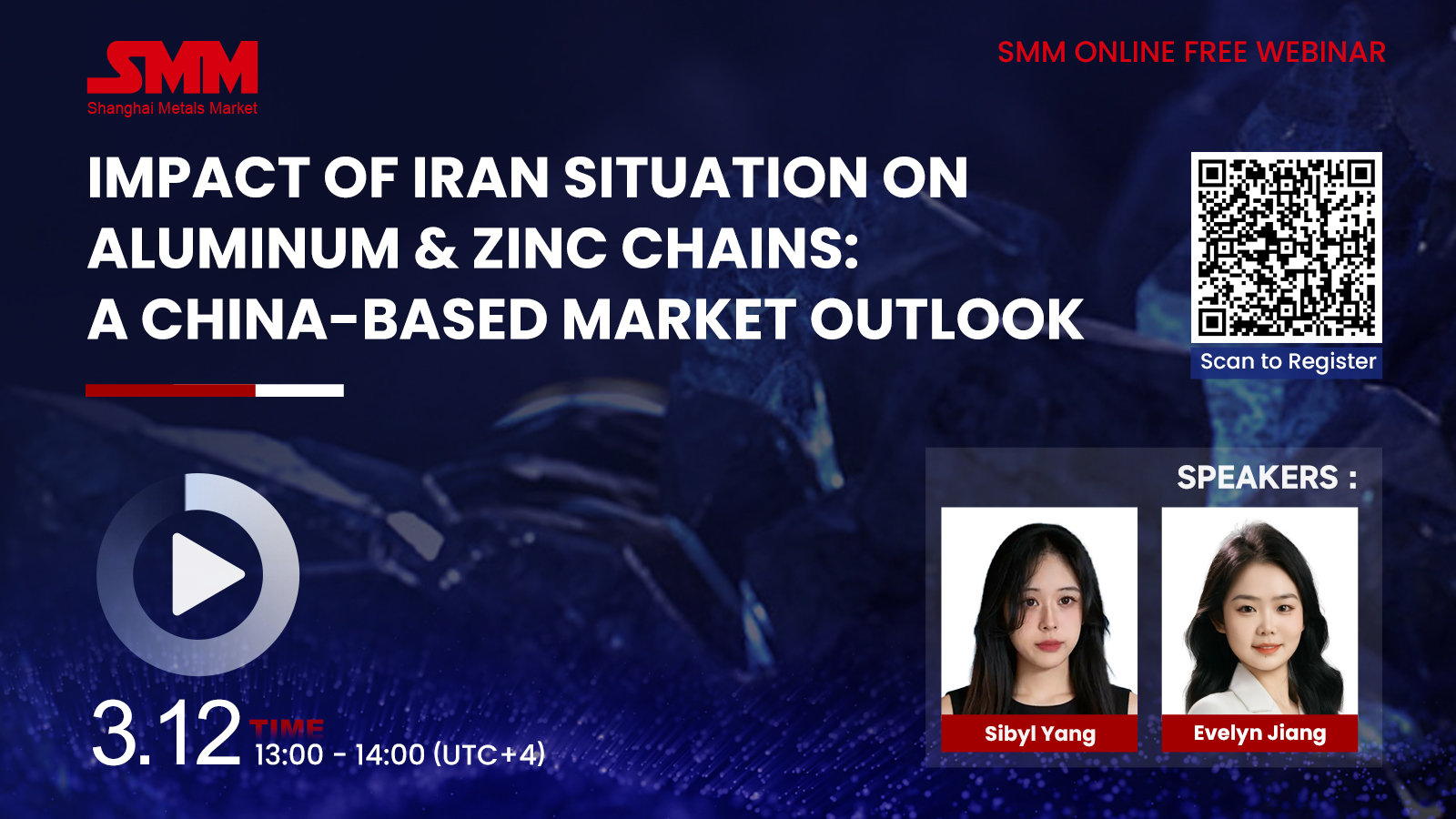 WebinarMar 12, 17:00 - 23:59 (GMT+8)
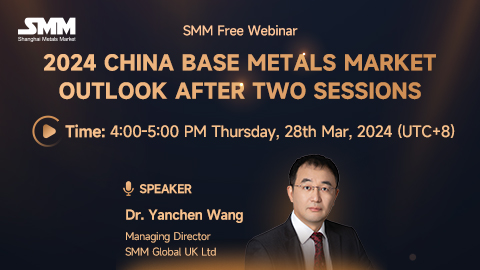 WebinarMar 28, 16:00 - 23:59 (GMT+8)
 WebinarMay 17, 16:00 - 23:59 (GMT+8)