

1070results found for 'Volatility'
Price
News
- 【SMM Analysis】Payables for Some Metals in NCM Settlements Adjusted Upward
This week, ternary cathode material prices continued their downward trend. On the raw material front, nickel sulfate and cobalt sulfate edged lower amid subdued trading activity, while manganese sulfate prices rose slightly. Lithium carbonate and lithium hydroxide saw notable declines recently, influenced by capital market volatility. In terms of transaction sentiment, some manufacturers restocked at lower price levels last week when lithium salt prices fell sharply, leading to relatively active trading. However, entering this week, raw material prices continued to decline with no clear signs of stabilization. With sufficient inventories on hand, downstream battery cell manufacturers generally turned cautious and slowed their procurement pace, resulting in subdued transaction sentiment this week. On the payable front, influenced by the continued decline in absolute nickel sulfate prices, some ternary cathode manufacturers saw upward adjustments in nickel sulfate payables during settlements. Payables for other metals remained relatively stable. On the demand side, EV market demand remained at high levels recently, with orders being executed as normal, while consumer market demand continued to stay subdued.
Jul 16, 2026 14:22 - [SMM Nickel Morning Wrap] U.S. June CPI Below Expectations, the Most-Traded SHFE Nickel Contract Drifts Lower in Early Trading
[7.16 Morning Meeting Minutes] US June CPI rose 3.5% YoY, compared to the expected 3.8% increase and the previous 4.2% rise. US June CPI fell 0.4% MoM, versus the expected 0.1% decline and the previous 0.5% increase. After the release of US June CPI data, traders pushed back their expectations for US Fed interest rate hikes to October. The most-traded SHFE nickel 2609 contract drifted lower in morning trading, closing down 0.43% at 128,870 yuan/mt at the end of the morning session. US inflation cooled significantly in June, with the unadjusted core CPI rising 2.6% YoY, below the expected 2.8% and the previous 2.9%. The cooling inflation further pushed back market expectations for US Fed rate hikes, and the US dollar extended its decline. In the short term, nickel prices may see a rebound, with the most-traded SHFE nickel contract price range between 127,000-133,000 yuan/mt.
Jul 16, 2026 09:29 - [SMM Stainless Steel Daily Review] SS maintains a stable consolidation trend in the short term, while stainless steel spot prices hold steady and end-users remain cautious.
[SMM Stainless Steel Daily Review] SS short-term maintains a relatively stable consolidation pattern; stainless steel spot prices stable, end-users cautiously wait and see On July 15, SMM reported that SS futures showed a relatively stable consolidation pattern. SS futures pulled back in the night session, but after the morning open, the decline was partially recovered, then moved sideways until the close, with the most-traded SS contract settling at 14,595 yuan/mt. Spot market side, demand was in the off-season, and recent volatility intensifies in SS futures with no clear directional guidance, so downstream end-users held a strong wait-and-see sentiment, overall transactions were sluggish; spot prices were largely stable, with only some traders under shipment pressure occasionally releasing low-priced goods. SS futures most-traded contract. At 10:15 a.m., SS2608 reported at 14,660 yuan/mt, up 120 yuan/mt from the previous trading day. Spot premiums for 304/2B in Wuxi area were in the 260-610 yuan/mt range. In the spot market: Wuxi cold-rolled 201/2B coil average flat; cold-rolled raw edge 304/2B coil (Wuxi +25 yuan/mt, Foshan flat); Wuxi cold-rolled 316L/2B coil -100 yuan/mt; hot-rolled 316L/NO.1 coil, Wuxi flat; cold-rolled 430/2B coil, both flat. This week, macro liquidity disturbances intensified, stainless steel futures moved independently with a weak trend, and futures noticeably deviated from the pace of SHFE nickel and other nonferrous metals. During the week, capital sentiment switched frequently, driving SS futures into wild swings, earlier 14,500...
Jul 15, 2026 15:39 - Abrdn’s Minter says bullion is now a structurally important asset
Published: Jul 14, 2026 - 3:39 AM (Kitco News) - The gold market may be consolidating around $4,000 an ounce, but one market strategist believes investors should focus less on short-term price swings and more on gold's evolving role in the global financial system. In an interview with Kitco News, Robert Minter, Director of Investment Strategy at Abrdn, said the recent correction has done little to damage the long-term investment case for gold . Instead, he argued that the liquidation has largely removed speculative excess while leaving the market's strongest sources of demand intact. "I don't think anything has structurally hurt the gold market," Minter said. "I view the removal of length as a positive." According to Minter, the recent weakness reflects a combination of technical factors rather than a deterioration in gold's underlying fundamentals. He pointed to China's crackdown on leveraged precious metals trading, the unwinding of speculative positions and changes in retail investment flows that have weighed on prices over the past several months. While those factors have created short-term volatility, Minter said that he believes they have left the market in a healthier position. More importantly, he argues that gold occupies a much different place in the global financial system than it did only a few years ago. "Clearly gold is an even more structurally important asset than it was before," he said. That conviction is reinforced by continued central bank demand. Minter noted that China's central bank used the recent correction to add another 15 tonnes of gold to its reserves , precisely the type of buying he expected from official institutions. "That's exactly what we told people they would do,” he said. Rather than viewing the correction as a warning sign, Minter said many professional investors are treating prices around $4,000 as an opportunity to increase allocations. "They're looking at $4,000 as, 'What's the right level for me to buy more gold ?'” he said. Minter also challenged the market's increasingly hawkish interpretation of U.S. monetary policy. Although Federal Reserve Chair Kevin Warsh has emphasized price stability since taking office, Minter believes investors have become overly focused on the Fed's rhetoric. "Warsh is the boy who cried hawk," he said. "He's not a hawk." Minter argued that Warsh has intentionally adopted a tougher tone to establish anti-inflation credibility but is simultaneously rewriting the Federal Reserve's policy framework by abandoning many of the indicators investors have traditionally relied upon. He added that this shift reflects a recognition that the Fed's traditional models no longer adequately capture an economy shaped by slower population growth, changing labor dynamics and evolving inflation pressures. Despite the hawkish messaging, Minter said many advisers and institutional investors remain unconvinced that significantly tighter monetary policy is coming. He added that ETF investors, who typically respond quickly to changes in interest-rate expectations, also appear skeptical. "I don't think anyone’s buying the hawk commentary." Instead of focusing on upcoming inflation reports or the timing of the next rate move, Minter said investors should pay closer attention to the long-term trajectory of sovereign debt and global currencies. "I think the major risk in the market is the currency risk," he said. " Gold continues to be the only currency that isn't somebody else's debt." That theme, he added, is becoming increasingly difficult for governments to escape. "I don't see any governments anywhere that have a policy of we're going to pay down our country's debt and get it under control." With debt burdens expected to continue rising across the developed world and central banks continuing to diversify reserves, Minter said gold 's role has evolved beyond a traditional inflation hedge into a core monetary asset. He added that for investors willing to look beyond the current consolidation, he sees little evidence that the secular bull market has been fundamentally altered. Source: https://www.kitco.com/news/article/2026-07-13/abrdns-minter-says-bullion-now-structurally-important-asset
Jul 15, 2026 10:08 - Gold is becoming the reserve asset of the new multipolar world – Sprott’s Paul Wong
Published: Jul 14, 2026 - 3:56 AM (Kitco News) – Gold’s recent price decline reveals an important paradox: a stronger U.S. dollar can pressure gold prices in the short term while ultimately strengthening gold's long-term investment case, according to Paul Wong, managing partner and market strategist at Sprott Inc. In his latest in-depth monthly analysis of the gold market, Wong pointed out that spot gold lost $532.24 per ounce in June – nearly 12% – to finish the month at $4,008 for its fourth consecutive monthly loss. “June’s monthly decline was the largest since October 2008,” he noted. “For the quarter ended June 30, gold fell by $660.04, or -14.14%, the worst quarter since the second quarter of 2013, which is when the Federal Reserve (Fed) began its first rate-hiking cycle after the 2008 Global Financial Crisis.” Wong said gold's latest and deepest monthly correction pushed market sentiment into extreme bearish territory. “The June selling wave in gold began with the signing of the Islamabad Memorandum of Understanding between the U.S. and Iran, which sent oil prices plummeting and the U.S. dollar rising,” he said. “The second selling wave was catalyzed by the market’s hawkish interpretation of new Fed Chair Kevin Warsh's remarks after the June meeting of the Federal Open Market Committee (FOMC). This was Warsh’s first FOMC meeting as Fed chair.” Wong said that rising rate hike expectations drove short-end yields higher, which served to further strengthen the U.S. dollar. “Most quant traders would have interpreted a U.S. dollar breakout combined with rising short-term rates as bearish for gold.” “Investment funds sold gold in the March to May period to unwind extremely leveraged positions,” he noted. “They continued selling during June as macro readings worsened and sovereign-related entities pulled back on gold buying. It was commodity trading advisors, quant and algo-type funds that predominantly drove the waterfall declines in June as they sold further or entered modest short positions.” “The drop in gold prices appears to be much more significant than the actual moves in the U.S. dollar and federal funds rates,” he added. “It suggests that much of the potential negative effects of a higher-rate, stronger-dollar combination have already been discounted.” Wong wrote that gold’s decline in the first half of 2026 matches previous periods of extreme bearish sentiment. “In June, gold fell below its 200-day moving average for the first time since October 2023 (see Figure 1) and has now reached extreme oversold levels,” he said. “Over the past decade, gold has tended to find support when prices fall to 90% of its 200-day moving average (Figure 1, lower panel). The drawdown has reached -26% (Figure 1, middle panel), the largest drawdown in a decade since the lows of 2016.” Meanwhile, the U.S. Dollar Index has increased by 2.91% year-to-date, while U.S. two-year Treasury yields have risen by 70 basis points year-to-date. “At the beginning of the year, fed funds futures were pricing in 2.3 rate cuts for the remainder of 2026,” Wong noted. “This has now shifted to 1.5 rate hikes due to the change in inflation expectations.” Wong said the emerging policy conflict at the Fed is one of the most significant narratives for markets. “One of the biggest questions facing markets today is whether Fed Chair Kevin Warsh is a hawk or a pragmatist,” he wrote. “Will he prioritize inflation control or accommodate the political and market pressures for lower interest rates? Warsh inherited an economy that remains surprisingly resilient. Labor markets are strong, growth is solid, asset prices are elevated, and inflation is still running well above the Fed’s 2% target. Simultaneously, President Trump has repeatedly called for lower rates. There is a tension between economic realities and political expectations.” Wong noted that the debate is now shifting from the expectation of rate cuts to potential rate hikes. “Warsh's inherited problem is that inflation never really died,” he said. “The economy has refused to slow, job openings remain elevated, payroll growth has surprised to the upside, consumer spending is healthy, and manufacturing and services activity continue to expand. Meanwhile, inflation remains sticky. Core PCE inflation8 is running around 3.3–3.4%, headline CPI inflation remains above 4%, and services inflation continues to prove difficult to tame.” “The AI buildout is also creating new inflationary pressures as memory shortages and rising component costs feed into consumer prices,” he added. “Investors are increasingly concerned that inflation may be more persistent than policymakers and markets expected.” But despite this persistent inflation, investors seem to doubt that Warsh will be genuinely hawkish on monetary policy. “Many continue to believe in the ‘Fed put,’ the idea that significant market weakness would eventually force policymakers to reverse course and lower rates,” Wong said. “Trump’s preferred outcome appears straightforward: lower rates, strong growth, rising equity markets and continued investment. The challenge is that the current economic backdrop does not clearly justify an easier policy. Warsh, therefore, finds himself caught between political demands for easier money and economic data that may argue for tighter policy. Maintaining Fed independence while navigating those pressures could prove challenging.” “The rising tension between inflation, politics and central bank credibility creates an environment that has historically supported gold,” Wong said. “Ultimately, the question is whether the Fed remains willing and able to prioritize price stability over political and market pressures. The answer to this question may prove far more important for gold than the precise path of interest rates over the next few quarters.” Wong also updated his analysis of another key market narrative: The cyclical strength of the U.S. dollar within a broader secular decline. “For years, we have maintained the view that the U.S. dollar is in long-term decline, not necessarily in exchange-rate terms, but in its purchasing power and role as the dominant store of monetary value,” he wrote. “Massive fiscal deficits, a rising debt burden, persistent monetary expansion, accelerating central bank gold purchases and increasing geopolitical fragmentation all point toward the gradual erosion of the U.S. dollar-centric system.” But the reality, Wong said, is more nuanced. “Despite repeated predictions of its demise, the dollar continues to stage powerful rallies periodically,” he said. “These rallies put pressure on commodities, precious metals, emerging markets and risk assets.” “Gold may be in a secular bull market, but it has also experienced sharp corrections alongside silver, copper, oil and other hard assets,” he warned. “A weakening monetary regime doesn't prevent powerful U.S. dollar rallies.” In order to understand this seeming contradiction, investors must separate two forces that are often lumped together. “The dollar remains structurally indispensable to global financial system settlements even as its long-term role as a monetary reserve slowly erodes,” Wong said. “In other words, the dollar may be experiencing secular decline, but it can still have powerful cyclical periods of strength for many years.” And every big U.S. dollar rally creates economic and financial stress for the rest of the world. “A stronger dollar increases debt-servicing costs for foreign borrowers, tightens global liquidity, raises funding costs and often forces traders to unwind leveraged positions and carry trades,” he said. “At the same time, dollar strength encourages central banks to diversify reserves. Countries increasingly seek to reduce dependency on a financial system that can be influenced and coerced by U.S. policy objectives. China has expanded the use of alternative settlement systems such as CIPS and mBridge, while many nations are exploring regional trade arrangements and various reserve diversification strategies.” Wong believes that gold is becoming the reserve asset of a new, multipolar world. “The paradox is that the stronger the U.S. dollar becomes, the greater the incentive for countries to find alternatives to it,” he said. “The most likely outcome is not the replacement of the dollar with a single reserve currency but the gradual emergence of a more diversified or multipolar system. The U.S. dollar may remain dominant in reserves and funding while other currencies gain influence in trade, regional currencies become more important, and gold acts as a neutral reserve asset between the various competing blocs. Hence, reserve managers seem focused on diversifying rather than replacing. They still need dollars; they just want fewer of them.” “Gold occupies a unique position in this evolving framework as it is ‘outside money,’” Wong wrote. “Unlike sovereign currencies, it carries no political allegiance. Unlike government bonds, it has no counterparty risk. Unlike bank deposits, it cannot be frozen or sanctioned if held domestically.” “As geopolitical tensions rise and reserve diversification accelerates, central banks increasingly view gold as a strategic reserve asset,” he said. “Its role is gradually evolving from an inflation hedge to a monetary hedge, a reserve asset and potentially a form of monetary collateral.” Wong noted that before Russia’s full-scale invasion of Ukraine, the IMF calculated that gold reserves averaged 12% of total world reserves since 2000, according to IMF data. “Since the freezing or seizure of Russia’s FX reserves and growing concerns of global currency and sovereign bond debasement, gold reserves as a percentage of total world reserves have soared to a recent high of ~34%, before closing the quarter at 27%,” he said. “The long-term secular trend of gold returning as a strategic reserve asset remains intact.” Wong also explored the counterintuitive reasons why gold seems to sell off during financial and liquidity crises. “Investors often expect turmoil to boost gold prices automatically, but history suggests otherwise,” he said. “During periods of acute funding stress, market participants need dollars. To obtain those dollars, they frequently sell their most liquid assets. Gold, as one of the world's most liquid and desired reserve assets, often serves as a source of liquidity. This occurred during the 2008 financial crisis and the March 2020 pandemic shock, and could occur again during future dollar squeezes. This does not represent a failure of gold. It is gold performing its reserve function.” Wong pointed out that even as gold continues its secular ascent as a reserve asset, the yellow metal’s shorter-term price movements remain beholden to the U.S. dollar. “Over the long run, gold and the dollar can rise for very different reasons: gold reflecting growing demand for a neutral reserve asset and store of value, and the dollar reflecting its central role in the global funding system,” he said. “However, on a cyclical basis, gold still tends to exhibit a negative correlation with the U.S. Dollar Index (DXY). As shown in Figure 3, gold's long-term trend remains firmly higher, but periods of dollar strength have frequently coincided with temporary corrections or consolidation phases in gold prices. This distinction between gold's secular monetary revaluation and its cyclical sensitivity to dollar liquidity conditions is critical for understanding short-term volatility within a longer-term bull market.” Wong cautioned that the U.S. dollar can remain strong even as long-term dollar dominance declines. “Likewise, gold could experience meaningful corrections while remaining in a secular bull market,” he said. “Periodic dollar rallies, tighter liquidity, commodity weakness and gold corrections drive the cyclical trend. The secular trend points toward reserve diversification, central bank gold purchases, alternative payment systems and a gradual decline in the dollar's share of global reserves.” And these two forces are not actually contradictory. “Each episode of dollar strength creates additional incentives for diversification, while each diversification effort reinforces gold's long-term monetary role,” Wong said. “Each episode may accelerate the transition toward a more diversified monetary system, one in which gold increasingly serves as the neutral reserve asset linking competing currency blocs.” Source: https://www.kitco.com/news/article/2026-07-13/gold-becoming-reserve-asset-new-multipolar-world-sprotts-paul-wong
Jul 15, 2026 10:03 - Weifang Longda Zinc Industry Co., Ltd. Invites You to the 2026 SMM Zinc Conference
As the inaugural year of the "15th Five-Year Plan," 2026 sees the zinc industry undergoing profound transformation against a backdrop of intensifying global macro fluctuations and the deepening of China's high-quality development initiatives. Structural tension has emerged between tight ore supply and the release of smelting capacity; diverging inventory trends inside and outside China reflect a complex supply-demand rebalancing; and technological innovation has become a key driver for resolving bottlenecks and reshaping the competitive landscape. New energy, new-type infrastructure, and other key areas highlighted in the 15th Five-Year Plan are injecting fresh momentum into traditional zinc consumption. Meanwhile, green, low-carbon, and circular economy imperatives, propelled by technological innovation, are accelerating the restructuring of the industry's underlying logic. With the collective support of upstream and downstream enterprises across the zinc industry, industry associations, and relevant stakeholders, SMM 2026 Zinc Industry Conference —held jointly with the 8th Hot-Dip Galvanizing Industry Development and Technology Innovation Forum, the 14th Zinc Salt, Zinc Oxide, and Secondary Zinc Resource Development Forum, and the Foundry Zinc Alloy Development Forum—is about to convene from August 6 to 8 in Qingdao, Shandong. Under the theme "Converging Zinc Momentum, Building the Zinc Industry, Embarking on a New Journey," the conference is driven by the twin engines of macro perspectives and fundamental analysis. Adhering closely to the high-quality development thread of the 15th Five-Year Plan, it focuses on four key dimensions—macro policies, supply-demand patterns, global trade, and technological innovation—aiming to drive cost reduction and efficiency gains through technological breakthroughs, address market volatility through collaborative innovation, and jointly chart a new blueprint for the high-quality, sustainable development of the zinc industry. Weifang Longda Zinc Industry Co., Ltd. will be prominently attending this grand event, joining industry peers to explore development trends and jointly propel the zinc industry to new heights. Click to register now and attend this profoundly significant and far-reaching industry event, joining us in creating a brilliant new chapter! I. Indonesia Plant Location: Kawasan Industri Modern Cikande, Modern Industrial Road, Block W, Number 3, Kecamatan Kibin, Kabupaten Serang, Provinsi Banten. Phase 1 of the base focuses on the production of multiple zinc products, including zinc oxide, zinc alloy, and zinc ingot. Among them, zinc oxide capacity reaches 60,000 mt/year, with commissioning and trial operation scheduled for October 2026. Zinc alloy and zinc ingot production lines are concurrently being established to enhance product supply capabilities. The primary output will be indirect process zinc oxide, ISCC PLUS-certified recycled zinc oxide, and national-standard zinc alloy and zinc ingot, supporting the company's expansion into global markets and extending its global green capacity footprint. II. Vietnam Plant Location: Phuoc Long Industrial Zone, Street No. 1, My An Commune, Tay Ninh Province. The base is being developed in multiple phases. The zinc alloy and zinc ingot project has already commenced operations, with a capacity of 20,000 mt/year. Phase 2 plans for a zinc oxide capacity of 30,000 mt/year, which is expected to be realized in Q1 2027, fully covering the production of all categories—zinc alloy, zinc ingot, and zinc oxide—to complete the overseas product matrix. 3. Two Major Production Sites in China (Integrated Layout) Leveraging profound technical expertise, Longda Zinc Industry’s plant focuses on the production of indirect process zinc oxide and ISCC PLUS certified recycled zinc oxide, with an annual capacity of 60,000 mt. Renowned for consistent quality and excellent performance, its products are widely used in various industrial fields such as rubber tires, paints and coatings, and ceramics, meeting both the demands of traditional industrial production and the stringent standards of high-end manufacturing. The company has built a reliable brand image in the market and, as a participant in standard-setting, contributes practical experience to the industry’s standardized development. Longda New Materials specializes in the resource recovery of zinc-containing solid waste, equipped with mature production processes and a comprehensive supporting system. The site can handle 3 categories of general industrial solid waste containing zinc (hot-dip galvanizing slag, hot-dip silicon-aluminum-zinc slag, tire pyrolysis slag, etc.) and 11 categories of hazardous waste containing zinc (hot-dip galvanizing ash, steel mill ash, steel cord copper mud, etc.), with an annual disposal capacity of 260 kt. Through advanced resource recovery processes, various zinc-containing wastes are harmlessly and efficiently transformed into zinc ingots meeting national standards and zinc alloy products. This model addresses industrial solid waste pollution at the source, reduces reliance on primary ores, and achieves the recycling of zinc resources. Once all four production sites in and outside China are fully operational, the company will achieve scale advantages with an annual capacity of 150 kt for zinc oxide, 100 kt for zinc ingot and zinc alloy, and a stable disposal capacity of 260 kt/year for solid and hazardous waste, further consolidating its industry position in zinc product manufacturing and resource recycling. Contact Yang Wenxue 18053607877 sales@wflongda.com Long-press or scan the code to register now 2026 SMM Zinc Industry Conference
Jul 15, 2026 09:57
Announcements
SMM will launch new import and export price assessments for billets in the Black Sea, Philippines, and Turkey, effective from 13 July 2026, to better reflect market dynamics and support global trade.
PriceJul 2, 2026 14:22To better serve industry clients and more closely align with the market, SMM plans to add 2 copper scrap price points, which will be officially launched on June 4, 2026.
PriceJun 4, 2026 16:30Announcement on Adjusting the Quotation Frequency of Battery-Grade Lithium Fluoride Prices from Weekly to Daily
PriceFeb 28, 2026 10:53
Events
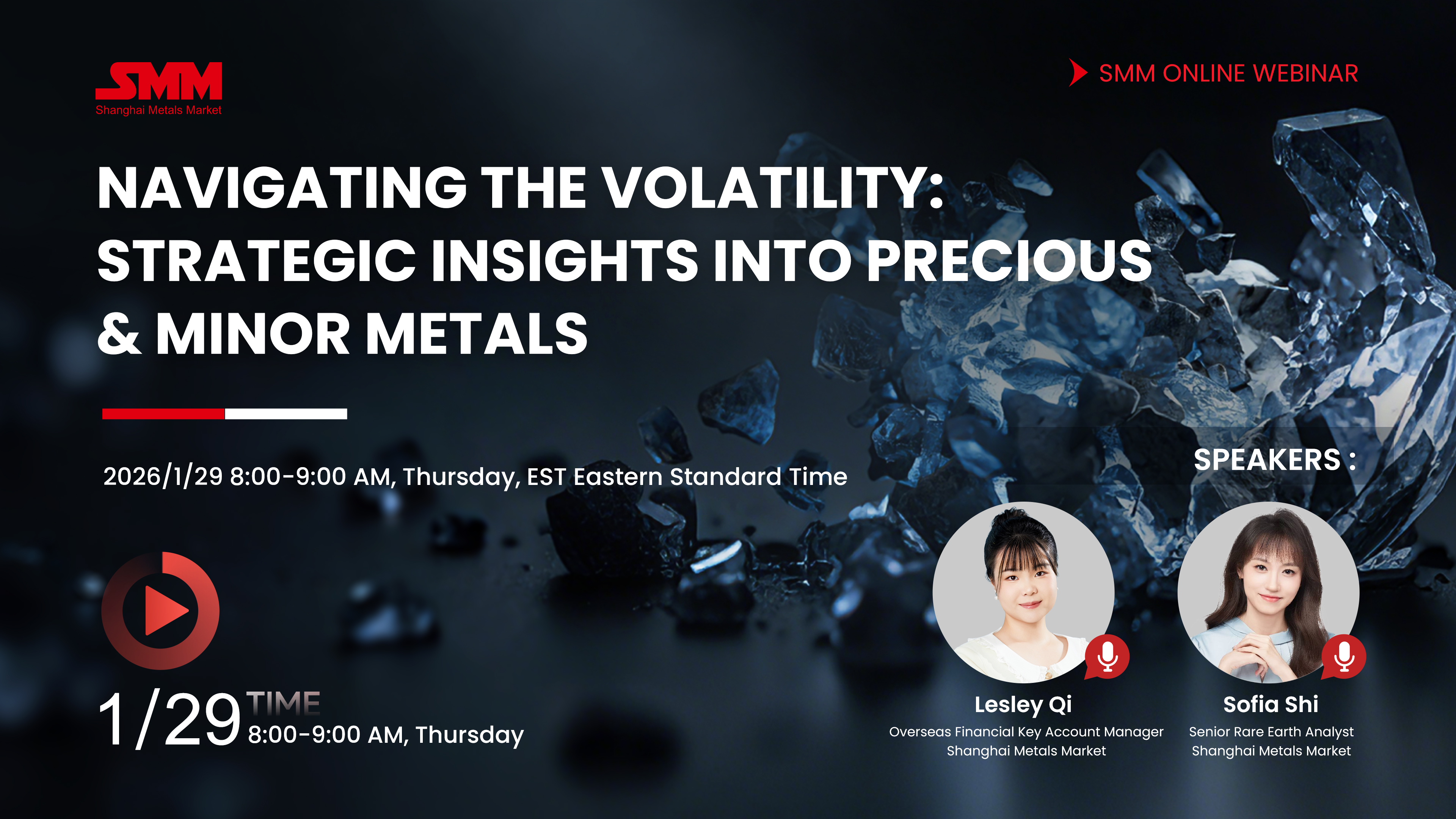 WebinarJan 29, 21:00 - 23:59 (GMT+8)