

527results found for 'Sulfur'
Price
News
- Crude Oil Posted Largest Monthly Decline in Nearly Five Years, Metals Showed Mixed Performance, Gold Fell for Three Consecutive Months, Silver Rose on Monthly Basis [Overnight Market]
SMM News, May 30: Metals market: Overnight, base metals fell collectively in both domestic and overseas markets. LME copper and LME tin both led the decline with a 0.98% drop. SHFE zinc fell 0.86%, while the remaining metals saw relatively small fluctuations in their declines. The alumina front-month contract closed flat at 2,888 yuan/mt, and the foundry aluminum front-month contract fell 0.26%. Overnight, ferrous metals showed mixed performance. Stainless steel fell 0.74%, and iron ore fell 0.26%. Hot-rolled coil and rebar both rose around 0.2%. For coking coal and coke, coking coal rose 0.7% and coke rose 0.89%. Precious metals: Overnight COMEX gold rose 0.83%, up 1.03% on the week, but down 1.29% on the month, marking a third consecutive monthly decline. COMEX silver fell 0.43% overnight, down 0.81% on the week, and up 2.1% on the month. Domestically, SHFE gold rose 1.61%, down 0.23% on the week and down 1.61% on the month, recording a third consecutive monthly decline alongside the overseas market. SHFE silver rose 0.64% overnight, down 1.23% on the week, and up 3.08% on the month. As of 8:25 AM on May 30, overnight closing prices: Macro Front China: From January to April, total operating revenue of national state-owned and state-holding enterprises fell 0.5% YoY, while total profits rose 1.9% YoY. Specifically, total operating revenue was 26.27 trillion yuan, and total profits were 1.37 trillion yuan. Taxes payable rose 3.9% YoY to 2.12 trillion yuan. At the end of April, the asset-liability ratio of state-owned enterprises was 65.5%, up 0.4 percentage points YoY. (Xinhua News Agency) On May 29, in Q1 this year, China's integrated circuit exports reached $72.47 billion, up 77.5% YoY, of which memory product exports reached $45.99 billion, up 174.2% YoY. The surge in memory product exports also transmitted to supply chain service segments. A logistics enterprise executive said that since the beginning of this year, the company's orders related to memory exports doubled, with large orders exceeding 100 million yuan per transaction increasing significantly. Industry insiders noted that the explosive growth in memory product exports was driven by both cyclical factors of tight global supply and demand, and structural industrial changes including industry chain upgrades and market share gains in China's domestic memory sector. The Deputy Secretary General of the Shenzhen Electronics Chamber of Commerce said that compared to March last year, memory prices had risen nearly tenfold, with some even seeing more than tenfold increases. This was mainly because the significant price increases drove up the total (export) value. Domestic brand prices had a large price spread compared to ex-China brands, making them very competitive in terms of pricing. (CCTV Finance) [MIIT and Seven Departments: Encouraging Equipment Manufacturing in Aerospace, Shipbuilding, Automotive, Robotics and Other Sectors] On May 29, the General Office of the Ministry of Culture and Tourism, the General Office of the Central Publicity Department, the General Office of MIIT, the General Office of the Ministry of Education, the General Office of the State-owned Assets Supervision and Administration Commission of the State Council, the Office of the National Cultural Heritage Administration, and the General Office of the All-China Federation of Trade Unions issued a notice on promoting industrial culture, protecting industrial heritage, and developing industrial tourism. The notice mentioned enriching industrial tourism product supply. It encouraged actively developing industrial heritage tourism, promoting the revitalization of industrial sites through creative design, new business format integration, and facade renovation, and developing new scenarios, formats, and models for industrial tourism. It strongly promoted "factory tours," encouraging enterprises in equipment manufacturing sectors such as aerospace, shipbuilding, automotive, and robotics, consumer goods industries such as textiles and apparel, arts and crafts, and food processing, as well as e-commerce logistics, to innovate and launch programs including production process observation, simulated operations, hands-on experiences, and product customization, creating themed sightseeing factories while ensuring production safety and confidentiality requirements. It called for orderly expansion of smart industrial tourism, supporting the use of BeiDou, artificial intelligence, ultra-high-definition video, virtual reality, autonomous driving, and other digital technologies and equipment to create immersive and intelligent industrial tourism experiences. It supported industrial tourism venues in developing themed commerce, immersive experiences, specialty markets, and other formats to create "industrial tourism+" consumption scenarios. It encouraged localities to launch a batch of high-quality industrial tourism routes and brands with regional and industry characteristics. It encouraged industrial enterprises to strengthen product promotion, expand product sales, and build enterprise brands through industrial tourism. The Shanghai International Energy Exchange announced adjustments to the daily price limit for crude oil and low-sulfur fuel oil futures contracts to 17%, the hedging position trading margin ratio to 18%, and the general position trading margin ratio to 19%; it also adjusted trading limits for related crude oil and low-sulfur fuel oil futures contracts. US dollar: As of the overnight close, the US dollar index fell 0.07% to 98.93, down 0.39% on the week and up 0.85% on the month. Market optimism over the extension of the US-Iran ceasefire agreement weakened safe-haven demand. The US April PCE price index rose 3.8% YoY, the highest level since May 2023, in line with expectations, compared to the previous reading of 3.5%; the US April core PCE price index rose 3.3% YoY, a new high since November 2023, also in line with expectations, compared to the previous reading of 3.2%. Additionally, separate data released by the Bureau of Economic Analysis showed that the US economy grew at an annualized rate of 1.6% in Q1, below preliminary data. The initial estimate released last month showed growth of 2%. The data indicated that US consumers became more cautious amid cost-of-living pressures and uneven labor market performance. The Middle East conflict pushed up fuel and other raw material prices, with the impact transmitting to the broader economy and sending consumer confidence to record lows. Meanwhile, this inflation data is likely to further reinforce warnings from some US Fed officials that if price pressures fail to ease, the US Fed will need to consider raising interest rates. Kevin Warsh, who was just sworn in as Fed Chairman on May 22, may need to convince other officials that inflation expectations can be controlled without rate hikes. (Wallstreetcn) Minneapolis Fed President Kashkari said it is too early to conclude that interest rates need to rise, but he believes the US Fed should keep all policy options open. He stated it is too early to conclude that an immediate rate hike is needed. The Fed needs to continue watching economic data and monitoring developments in the Middle East conflict before he would consider whether policy adjustments are necessary. Kashkari noted that under both the most optimistic and most pessimistic scenarios, inflation could remain significantly elevated for an extended period. He is closely monitoring this risk, as well as the possibility that inflation expectations could become unanchored. (Wallstreetcn) US Fed Vice Chair for Supervision Michelle Bowman said it is too early to judge the impact of the Iran conflict on inflation, and policymakers need to look through transitory price shocks. She supported officials retaining language in their statement after last month's policy meeting that hinted further interest rate cuts remain possible. As she thinks about the future path of monetary policy, she wants a clearer understanding of the economic impact of the Middle East conflict and the persistence of those effects. As long as the Fed maintains credibility in its commitment to achieving its inflation target, it is appropriate to look through transitory inflation increases driven primarily by rising energy prices. She expects the "one-time" impact of tariffs implemented by US President Trump to fade. (Wallstreetcn) Macro: Next week, China will release May RatingDog Manufacturing PMI and May RatingDog Services PMI data; the US will release May S&P Global Manufacturing PMI final, May ISM Manufacturing PMI, April construction spending MoM, April JOLTs job openings, May ADP employment, May S&P Global Services PMI final, May ISM Non-Manufacturing PMI, April factory orders MoM, May Challenger job cuts, initial jobless claims for the week ending May 30, May unemployment rate, May seasonally adjusted non-farm payrolls, May average hourly earnings YoY, and May average hourly earnings MoM data; the UK will release May Nationwide house price index MoM, May Manufacturing PMI final, April central bank mortgage approvals, May Services PMI final, and May Halifax seasonally adjusted house price index MoM data; the Eurozone will release May Manufacturing PMI final, April unemployment rate, May CPI YoY preliminary, May CPI MoM preliminary, May Services PMI final, April PPI MoM, April retail sales MoM, Q1 GDP YoY revised, and Q1 seasonally adjusted employment QoQ final data; Switzerland will release April real retail sales YoY, April trade balance, May CPI MoM, and May seasonally adjusted unemployment rate data; France will release May Manufacturing PMI final, May Services PMI final, April industrial output MoM, and April trade balance data; Germany will release May Manufacturing PMI final and May Services PMI final data; in addition, Australia Q1 GDP YoY and Canada May employment data will also be released. Crude oil: As of the overnight close, oil prices in both markets fell together, with WTI down 1.28% and Brent down 0.87%. On a weekly basis, oil prices suffered heavy losses this week, with WTI down 9.15% and Brent down 8.3%, both recording a second consecutive weekly decline and the largest weekly drop since April. WTI fell 16.47% on the month and Brent fell 16.77% on the month, with WTI posting its largest monthly decline since November 2021 and Brent its largest monthly decline since March 2020. According to Xinhua News Agency, US President Trump said on the 29th that the US and Iran had reached agreement on secondary issues beyond Iran's nuclear program and Strait of Hormuz passage, and crude oil fell in response. The oil market in May underwent a clear three-phase evolution: Early month (May 1-6): Oil prices pulled back slightly from near four-year highs, but Brent briefly surged to around $114 after OPEC+ announced a modest production increase and shipping attacks, before plunging to the $101-106 range after US-Iran de-escalation signals emerged. Mid-month (May 7-20): Oil prices oscillated between ceasefire breakdowns and mediation progress, with the continued blockade of the Strait of Hormuz maintaining an elevated risk premium. Month-end (May 21-29): Driven by reports of a US-Iran agreement in principle to reopen the strait, Brent briefly fell to the $93-100 low range, WTI touched $88-92, and Brent closed around $92. (Wallstreetcn) Nevertheless, analysts emphasized that until the conflict truly ends and the strait resumes normal passage, global crude oil inventories will continue to deplete by approximately 10 to 14 million barrels per day, and physical market fundamentals remain tight. The decline in oil prices under ceasefire expectations reflected more the pricing of future supply recovery rather than a fundamental change in the current supply-demand pattern. (Wallstreetcn) Recently, reports disclosed that calculations by Goldman Sachs showed global crude oil inventories could fall below the equivalent of 100 days of global demand as early as the end of May. Goldman Sachs estimated that as of the end of April, global crude oil inventories were equivalent to approximately 101 days of global demand, and were expected to fall to 98 days by the end of May. Of this, "visible inventory" observable through satellites and other means was estimated at only 73 days of demand. Reports indicated that currently only a few vessels can pass through the Strait of Hormuz each day, resulting in a daily global crude oil supply loss exceeding 10 million barrels. (Wallstreetcn)
May 31, 2026 08:44 - 【SMM analysis】 National Waste Lithium Battery Recycling Projects Surge This Week, Adding Over 200,000 mt/year Capacity
SMM May 28 News:This week (May 22–29), China's waste lithium battery recycling sector witnessed a wave of project public announcements and launches, spanning more than ten provinces and cities including Guangdong, Hebei, Jiangsu, Anhui, Tianjin, Zhejiang, and Hubei.
May 29, 2026 19:44 - Hebei Invests 500M Yuan in New Energy Vehicle Battery Project in Lingang Economic Zone
The Bohai New Area Administrative Committee and Huanghua Municipal People's Government of Cangzhou, Hebei Province, released a notice on the proposed approval of the environmental impact report for a Hebei company’s new energy vehicle power battery material processing and echelon utilization and resource center project. The total investment is 500 million yuan, and the location is in the Lingang Economic and Technological Development Zone. Construction will include a combined dismantling and black mass workshop, a concentration and crystallization workshop, one raw material warehouse, one hazardous waste room, a concentrated sulfuric acid pump area, and storage tank area. The project will build one dismantling and echelon utilization line,
May 29, 2026 19:31 - [SMM Analysis] Downstream Rigid Procurement Demand Persisted, MHP and High-Grade Nickel Matte Payable Indicators Fluctuated at Highs This Week
Downstream Rigid Procurement Demand Persisted, MHP and High-Grade Nickel Matte Payable Indicators Fluctuated at Highs This Week
May 29, 2026 17:58 - [SMM Analysis] Nickel Prices Fluctuated Lower This Week as Tug-of-War Between Supply-Side Support and High Inventory Intensified
Nickel prices overall moved sideways this week with a slight pullback. Early in the week, driven by rising expectations for US Fed interest rate hikes and repeated geopolitical tensions over the Strait of Hormuz, the most-traded SHFE nickel contract briefly fell below 141,000 yuan/mt. However, from mid-week onward, strong supply-side support logic helped nickel prices stabilize above 142,000 yuan/mt, after which they moved sideways, with a weekly decline of 0.26%. Spot market side, the average SMM #1 refined nickel price was 143,700 yuan/mt this week, down 150 yuan/mt WoW. Jinchuan nickel premiums dropped significantly this week, with the range falling to 600-1,000 yuan/mt. Domestic mainstream electrodeposited nickel premiums were affected by contract rollover, with the range falling to -700-100 yuan/mt. Spot market transactions were mediocre this week, with downstream buyers only making just-in-time procurement and consumption remaining mediocre. On the macro front, Kevin Warsh was officially sworn in as Fed Chairman, while facing two major challenges — surging US Treasury yields and rising US inflation expectations. Market expectations for interest rate cuts continued to be pushed back, and expectations for interest rate hikes further strengthened. The US April PCE price index rose 3.8% YoY, hitting a three-year high, with the core index accelerating to 3.3% YoY. The US dollar index fluctuated at highs, continuing to weigh on non-ferrous metal prices. Geopolitical tensions remained stagnant this week. Iranian officials stated that the Iran-US "memorandum of understanding" text had not been finalized and Iran had not agreed to any memorandum of understanding. Should tensions ease, expectations for a recovery in sulfur supply would exert short-term pressure on nickel prices; on the other hand, a continued stalemate would mean sulfur cost support remains intact, providing a floor for nickel prices. Inventory side, Shanghai Bonded Zone inventory was approximately 1,700 mt this week, flat WoW. China's social inventory was approximately 117,000 mt, an inventory buildup of approximately 4,200 mt WoW. Currently, nickel prices are in a prolonged tug-of-war between bulls and bears. High inventory continues to suppress nickel price elasticity, serving as the core resistance constraining price upside. The most-traded SHFE nickel contract is expected to trade in a core range of 138,000-148,000 yuan/mt next week.
May 29, 2026 16:48 - Aluminum Fluoride Market Sees Mixed Raw Material Trends, Cost Support Eases Slightly
【SMM Aluminum Brief】This week, trends in the core raw materials market for aluminum fluoride diverged. Fluorite prices continued to weaken, the aluminum hydroxide market remained stable, while sulfuric acid prices stayed elevated due to cost support and tight supply. Amid mixed movements in raw material prices, overall cost support for the aluminum fluoride industry has eased slightly compared with earlier periods, though the overall cost base remains relatively high and production-side pressure on enterprises has not yet significantly eased.
May 28, 2026 18:59
Announcements
Announcement on the Addition of Four Price Points: SMM EXW Zambia Sulfuric Acid, SMM EXW DRC Sulfuric Acid, SMM DAP DRC Sulfur, and SMM DDP DRC Sulfur.
PriceMay 21, 2026 14:45SMM will update the SMM CIF Indonesia Sulfur price daily instead of weekly, starting May 18, 2026, to better reflect market changes. Updates will be published by 12:00 PM Beijing time on working days.
PriceMay 13, 2026 10:21SMM officially released SMM: Sulfuric Acid Demand: Total: Annual data, with China as the data region.
DataMar 17, 2026 15:22
Events
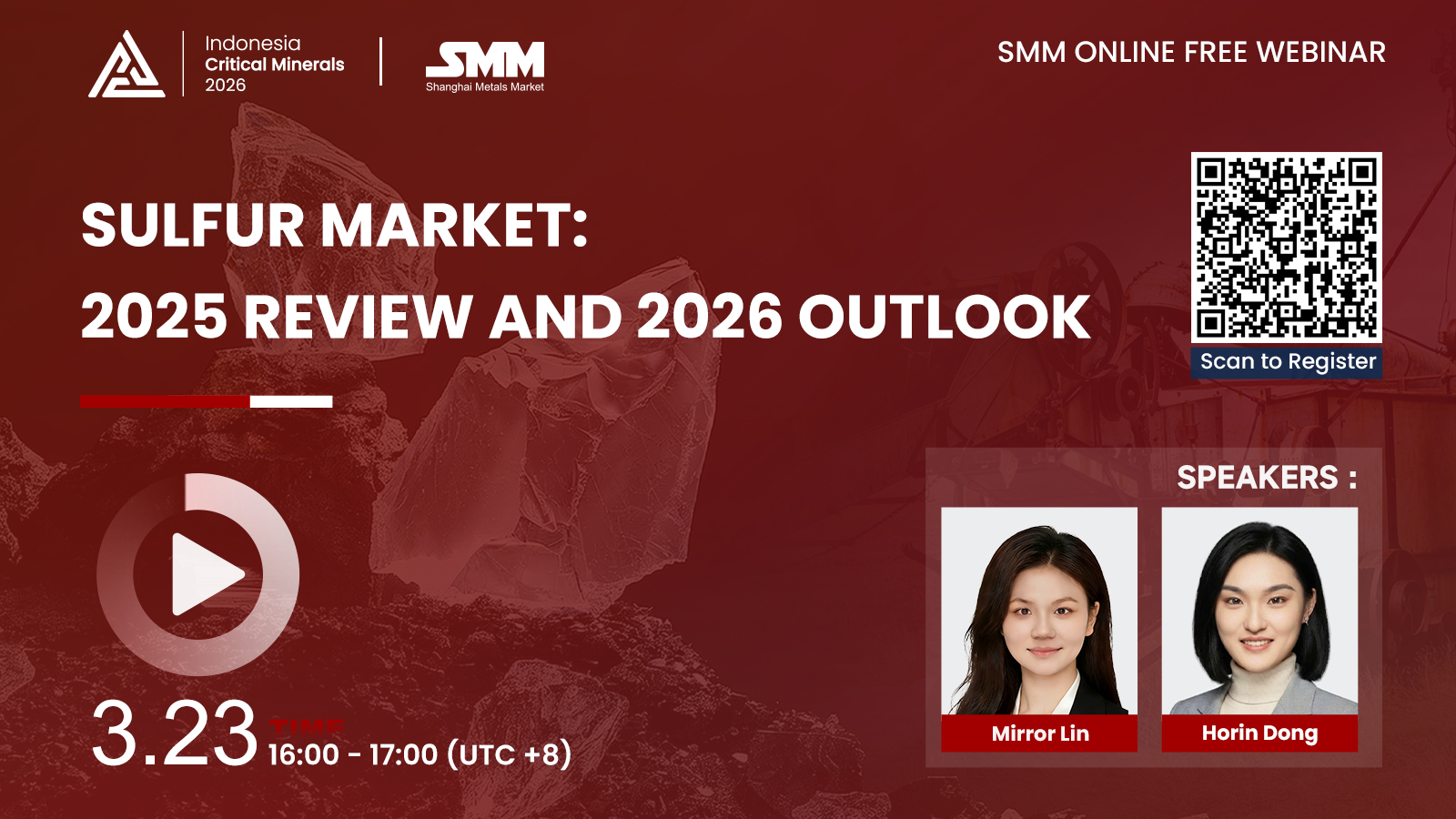 WebinarMar 23, 16:00 - 23:59 (GMT+8)