

800results found for 'Rare earths'
Price
News
- [SMM Rare Earth Morning Briefing] Pr-Nd oxide continues to decline, dragging down metals; magnetic material scrap market takes a wait-and-see approach; medium-heavy rare earths remain stable.
[Pr-Nd Oxide Continues to Decline, Dragging Metals Down, Magnetic Material Scrap Waits and Sees, Medium-Heavy Rare Earths Stable] Yesterday, some traders continued to sell at low prices, but metal plants' purchase willingness remained poor. Pr-Nd oxide prices further dropped, market confidence was unstable, and downstream inquiries and trading continued to be sluggish. For medium-heavy rare earths, downstream purchasing enthusiasm for dysprosium oxide and terbium oxide markets remained relatively low, plant quotations remained firm, and prices fluctuated relatively little for the time being.
Aug 5, 2026 10:01 - Malaysia Considers Lifting Ban on Unprocessed Rare Earth Exports Amid Intensifying Global Competition
According to foreign media reports, Malaysia is considering allowing the export of some unprocessed rare earths to strengthen its position in supply chains across industries ranging from auto manufacturing to national defense and consumer goods. Malaysia suspended the export of unprocessed rare earths in 2024 to stimulate investment in the domestic processing industry—a common tactic among resource-rich developing countries. However, as competition surrounding these minerals intensifies, authorities are now assessing the feasibility of easing the restrictions, according to a senior government official.
Aug 4, 2026 16:07 - Indonesia Resumes Mineral Exports, Clarifies Rare Earth Ban Only Applies to Primary Products
[SMM Rare Earth Flash] The Indonesian Presidential Office stated that exports of mineral products potentially containing associated rare earth elements have been resumed, and clarified that the rare earth export ban applies only to rare earths exported as primary products, not to associated rare earths in mineral products such as bauxite, alumina, copper cathode, and nickel derivatives. Indonesian Presidential Chief of Staff Dudung Abdurachman said that the policy serves as a transitional guideline for exporters, inspection agencies, and customs authorities, and will ease export delays previously caused by mandatory rare earth detection. PT Sucofindo, responsible for the detection, will gradually release 85 previously delayed inspection reports involving exports of alumina, copper cathode, and nickel derivatives, which is expected to prompt the resumption of shipments for over a hundred stranded vessels. The Indonesian government will further establish limits for associated rare earth content, detection standards, and inspection procedures.
Aug 4, 2026 14:49 - [SMM Rare Earth Morning Briefing] Oxy-Oxide Stalemate Drags Down Ore Price Center, Metal Undergoes Slight Correction, and Wait-and-See Sentiment for Magnetic Material Scrap Persists.
[Stagnant Oxides Drag Down Ore Price Center, Metals See Slight Correction, Magnetic Material Scrap Wait-and-See Continues] Currently, the overall circulation frequency of rare earth ore remains poor, market trading is stagnant, and weak oxide prices have caused the center of actual transaction prices for rare earth ore to shift downward.
Aug 4, 2026 10:07 - [SMM Nickel Morning Brief] Strait of Hormuz Negotiations to Begin, the Most-Traded SHFE Nickel Contract Plunged in Early Trading
[8.4 Morning Briefing] Trump stated that an agreement has been reached regarding the Strait of Hormuz, and an agreement on denuclearization will also be reached, with negotiations scheduled to begin on Monday afternoon; Iranian Foreign Ministry spokesman Baghaei stated that the situation in the Strait of Hormuz will not return to the pre-conflict state, and the new shipping lane agreed with Oman will be determined through mutual consultations. The most-traded SHFE nickel 2609 contract plunged below 130,000 yuan in the morning session, closing at 129,520 yuan/mt at the end of the morning session, down 1.91%. As U.S.-Iran negotiations begin, the Strait of Hormuz is expected to resume navigation, sulfur cost support has weakened, and nickel prices have fallen sharply. In the short term, the most-traded SHFE nickel contract is expected to trade in the range of 128,000-135,000 yuan/mt.
Aug 4, 2026 09:53 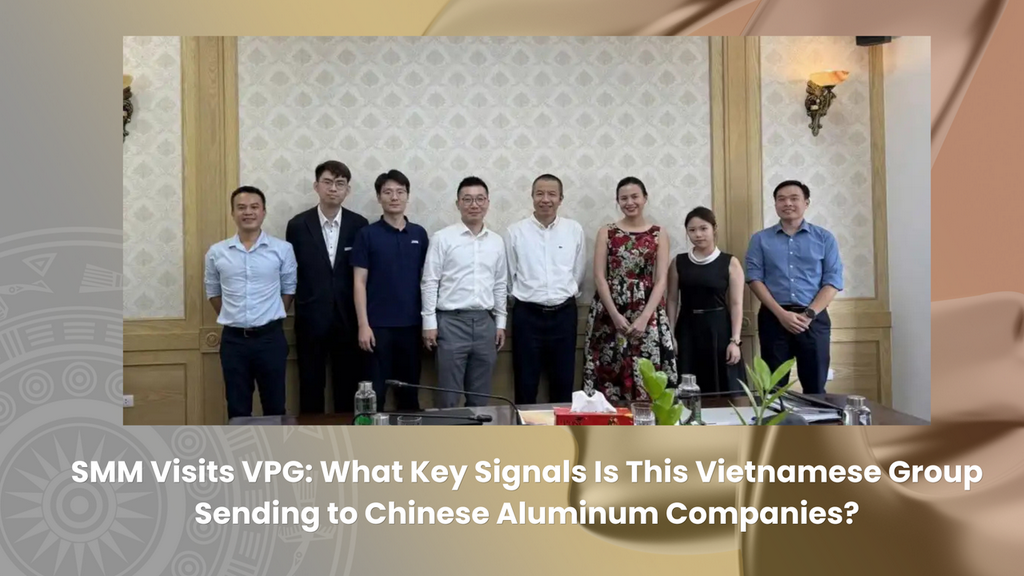 SMM Visits VPG: What Key Signals Is This Vietnamese Group Sending to Chinese Aluminum Companies?
On July 23, 2026, a delegation from Shanghai Metals Market Information Technology Co., Ltd. (SMM) visited VPG (Viet Phuong Group). The delegation included: Logan Lu, CEO of SMM Cason Lou, Director of Aluminum Processing, Marketing Department Lexi Chen, Key Account Manager for Overseas Information Sales Khai Yuen Chin, Senior Overseas Aluminum Analyst The two sides held in-depth discussions on bauxite resource development in Southeast Asia, alumina project development, regional logistics networks, and the development of a Vietnam-based aluminum pricing system. SMM noted that as the global aluminum value chain continues to restructure, China’s alumina market is expected to see sustained demand for overseas resources. Given resource availability and cost considerations, high-quality overseas alumina resources—particularly those from Vietnam and other Southeast Asian markets—are expected to gain greater market potential and competitive advantages. VPG shared updates on the progress of its current projects and said it is actively advancing mineral processing and alumina projects, with Southeast Asia and other international markets set to become key areas of future development. Since 2008, VPG has been engaged in bauxite exploration and development in Sekong Province, Laos, and is currently advancing an integrated industrial project covering bauxite mining, mineral processing, and alumina production. Both sides agreed that establishing an open, transparent, and regionally representative local aluminum pricing system would help improve information transparency and strengthen the international influence of Southeast Asia’s aluminum value chain. They also expressed expectations for deeper cooperation in market research, pricing services, and industry exchanges. What Signals Does SMM’s Visit to VPG Send to Chinese Companies? 01 Vietnam Is Becoming an Important Hub Connecting the Global Aluminum Value Chain In recent years, an increasing number of international companies have viewed Vietnam as an important gateway connecting Southeast Asian resources with global markets. Supported by its established port infrastructure, rapidly expanding manufacturing sector, and growing international trade network, Vietnam is not only benefiting from the relocation of global manufacturing capacity but is also emerging as an important regional hub for the aluminum value chain. For Chinese companies seeking opportunities in Southeast Asia, Vietnam is gradually evolving from an “investment destination” into a “supply chain partner.” 02 Vietnam’s Rapid Market Growth Is Creating New Export Opportunities With free trade agreements such as the EU-Vietnam Free Trade Agreement (EVFTA) taking effect, Vietnam has become a strategic sourcing hub for aluminum products used in the solar industry, including aluminum profiles and PV module frames, with export growth exceeding 20%. EVFTA tariff benefits for EU buyers, together with US Section 301 tariffs, have also encouraged some international buyers to shift sourcing toward Vietnam. Meanwhile, Vietnam aims for electric vehicles to account for 50% of urban vehicles by 2030. As electric vehicles use nearly 30% more aluminum than conventional vehicles, growing EV adoption could generate significant additional aluminum demand. This widening demand gap is expected to create substantial opportunities for aluminum suppliers and exporters. Against this backdrop, SMM AICE is expanding internationally by bringing its conference to Vietnam. The event aims to establish an authoritative platform connecting Chinese aluminum companies with Vietnam and the broader Southeast Asian market, promoting the transition of China-Vietnam aluminum cooperation from “resource complementarity” toward “full-value-chain cooperation and mutual growth.” 03 Future Competition Will Be About Information, Not Just Opportunities Vietnam’s market continues to develop rapidly. At the same time, market rules, policies, cost structures, and pricing mechanisms are constantly evolving. For Chinese companies, identifying projects alone is no longer enough. Timely access to local policies, industry development trends, supply chain changes, and market pricing information is becoming increasingly important. This is also why SMM continues to deepen its presence in the Vietnamese market. Recently, SMM AICE has been conducting intensive visits across Vietnam and the broader Southeast Asian industrial value chain, maintaining close communication with government authorities, industry associations, mining companies, alumina producers, aluminum processors, and other market participants. Through more transparent market intelligence and pricing systems, SMM aims to help global companies better understand market dynamics and reduce decision-making risks. To help more aluminum companies seize emerging opportunities and establish an early presence in the Vietnamese market, SMM AICE Vietnam is coming to Vietnam with a major industry gathering. VPG — Viet Phuong Group Founded in 1996, VPG (Viet Phuong Group) is a well-established diversified investment group in Vietnam, with businesses spanning mining, energy, infrastructure, finance, real estate, and other sectors. Mining is one of the group’s key strategic businesses, with projects involving mineral resources including bauxite, rare earths, and quartz sand. In the aluminum sector, VPG has been engaged in bauxite exploration and development in Sekong Province, Laos, since 2008. The group is currently advancing an integrated project covering bauxite mining, mineral processing, and alumina production. Leveraging Vietnam’s established port infrastructure and regional logistics network, VPG plans to export alumina products to China and other global markets through the Laos–Vietnam cross-border logistics corridor, further integrating into Southeast Asia’s aluminum supply chain. In recent years, the company has continued to advance project development, international cooperation, and market expansion, with the ambition of building a regional aluminum industry platform spanning resource development, alumina production, and international trade. Join the Conversation at SMM AICE 2026 Connect with aluminum producers, processors, traders, manufacturers, certification organisations, industry associations and decision-makers from across Southeast Asia and the global market. Explore aluminum pricing, primary aluminum supply, processing technologies, low-carbon development, CBAM compliance and new opportunities for regional cooperation. ? Ho Chi Minh City, Vietnam ? November 19–20, 2026 Register now: bit.ly/AICE26 and secure your Super Early Bird Pass and save up to USD 200. Register before August 31, 2026.
Aug 3, 2026 16:42
Announcements
Dear User, Greetings! In recent years, the rare earth-NdFeB magnetic material industry chain has been continuously developing. During the process of refining its industry chain, SMM identified that the existing NdFeB-related data in the original terminal could no longer meet market demands. Therefore, after multiple rounds of surveys and verification, SMM has revised and expanded its original NdFeB data. The specific adjustments are as follows: NdFeB Production: 1. Discontinued 1 data point, namely the Monthly NdFeB Magnet Output by Manufacturer. The discontinued data location: Rare Earth - Rare Earth Production – NdFeB Magnet. 2. Added 5 data points, respectively [National Monthly Total Production], [Monthly Total Production of Sample Enterprises], [Monthly Production of Top-Tier Enterprises], [Monthly Production of Mid-Tier Enterprises], [Production Volume of Marginal Enterprises per Month]. The above data locations are all under Rare Earth - Rare Earth Production – NdFeB Magnet. 3. The above data are all updated monthly, with the update date being the last working day of each month, and the data dimension being the current month's data. 4. The data start date is January 2025. NdFeB Operating Rate: 1. Added five data points: [National Average Operating Rate], [Average Operating Rate of Sampled Enterprises in the Current Month], [Operating Rate of Top-Tier Enterprises in the Current Month], [Operating Rate of Mid-Tier Enterprises in the Current Month], [Operating Rate of Marginal Enterprises in the Current Month]. 2. The above data are located under Rare Earths - Rare Earth Operating Rate – NdFeB Magnet. 3. These data are updated monthly, with the update date being the last working day of each month, reflecting the current month's data. 4. The data series begins in January 2025. NdFeB Capacity 1. Added new category: Rare Earth - Rare Earth Capacity 2. Added four data points: [Quarterly Total NdFeB Capacity in China], [Quarterly NdFeB Capacity of National Top-Tier Enterprises], [Quarterly NdFeB Capacity of Mid-Tier Enterprises Nationwide], [Quarterly NdFeB Capacity of Small-Scale Enterprises Nationwide] 3. Location of the above data: Added new category: Rare Earth - Rare Earth Capacity 4. The above data is updated quarterly, with the update date being the last working day of the final month of each quarter. The data dimension reflects the current quarter. 5. The data start date is March 2025. NdFeB Supply-Demand Balance 1. Discontinued 3 data series: [SMM NdFeB Supply-Demand Balance: Supply], [SMM NdFeB Supply-Demand Balance: Consumption], [SMM NdFeB Supply-Demand Balance: Supply-Demand Balance] 2. Added 3 data series: [SMM NdFeB Supply-Demand Balance: National Total Supply], [SMM NdFeB Supply-Demand Balance: National Total Consumption], [SMM NdFeB Supply-Demand Balance: National Total Supply-Demand Balance] 3. Data location: Rare Earth - Supply-Demand Balance - NdFeB 4. These data series are updated monthly on the last business day of each month, reflecting the previous month's data (e.g., July data updated on August 29). 5. Data coverage starts from January 2025. Pr-Nd Alloy Supply-Demand Balance 1. Added a new classification for Pr-Nd alloy supply-demand balance 2. Added three datasets: [SMM Pr-Nd Alloy Supply-Demand Balance: Supply], [SMM Pr-Nd Alloy Supply-Demand Balance: Consumption], [SMM Pr-Nd Alloy Supply-Demand Balance: Supply-Demand Balance] 3. Data location: Rare Earth - Supply & Demand Analysis - Pr-Nd Alloy 4. The above data is updated monthly, with the update date set as the last working day of each month, reflecting the current month's data 5. The data series starts from January 2025 NdFeB Production and Operating Rate Forecast 1. Discontinued two data series: [Production - Forecast] and [Operating rate - Forecast]. 2. These will be replaced by two alternative data series: [NdFeB - Monthly production schedule expectation] and [NdFeB - Monthly operating rate expectation]. The above data adjustments will officially take effect on September 10, 2025. Users can then query the aforementioned data in the SMM data terminal. For any inquiries, please contact the SMM Rare Earth Research Team. SMM Rare Earth Research Team Shi Xin Contact: shixin@smm.cn
DataSep 8, 2025 18:51