

10570results found for 'Price'
Price
News
- Surging Copper Prices Dampen End-User Purchasing, Slow Spot Market in Shandong
Affected by sharply surging copper prices, end-user purchasing was weak, and trading in the spot copper cathode market in Shandong was sluggish today.
Aug 6, 2026 11:40 - Tianjin Zinc: High Zinc Prices, Market Relatively Quiet [SMM Midday Review]
[Tianjin Zinc: High Zinc Prices, Market Quiet] In the Tianjin market, #0 zinc ingot mainstream transactions were at 25,460-25,680 yuan/mt, Zijin transactions were at 25,580-25,750 yuan/mt, #1 zinc ingot transactions were near 25,460-25,590 yuan/mt. Zijin was quoted at a premium of 0-50 yuan/mt against the 2609 contract, Huzinc was quoted at 26,940 yuan/mt, and #0 zinc ingot was quoted at a discount of 20-120 yuan/mt against the 2609 contract. Tianjin market was quoted at a discount of 90 yuan/mt against Shanghai market.
Aug 6, 2026 11:39 - [SMM Computing Power Express] South China: 32 Units of 5090 Available for Split Rental, Monthly Rent 11,500, Six-Month Minimum Contract
SMM learned that a data center in South China has deployed 32 units of RTX 5090 server rental resources, with a monthly rental price of 11,500 yuan per unit, a lease term starting from six months, supporting individual unit rental, and an additional 1,000 yuan per month per unit when paired with a RoCE networking solution. This batch of resources has been on the market for three days. SMM believes that the split-rental model lowers the entry barrier for buyers; a half-year short-term contract offers high flexibility, making it suitable for short-term flexible demand; however, splitting rentals and using short-term contracts may increase the per-unit cost, and lessees need to comprehensively compare whole-unit rental plans.
Aug 6, 2026 11:38 - [SMM Computing Power Express] A single H100 in Zhejiang is available for rent at 76,000 yuan/month, with a one-year minimum lease. Delivery on August 16.
SMM learned that a data center in Zhejiang has released one NVIDIA H100 server rental resource, with a monthly rent of 76,000 yuan, expected to be delivered on August 16. This resource is a spot order for a single unit, and the lessor offered favorable pricing to avoid vacancy pressure. SMM believes that a single-unit resource has high price negotiation flexibility, suitable for those with stable demand to lock in long-term low prices, but attention must be paid to performance and equipment maintenance clauses under long-term leases.
Aug 6, 2026 11:38 - Copper Prices Shot Up, Suppressing Downstream Procurement; Spot Premiums Turned from Premium to Discount [SMM Shandong Copper Cathode Spot Weekly Review]
This week, spot premiums for copper cathode in Shandong pulled back significantly. As of Thursday, spot was reported at a discount of 110 yuan/mt, with the market quickly shifting from premium to discount, marking a steep decline. Affected by the sharp surge in copper prices, procurement by downstream end-users was sluggish. Suppliers proactively cut prices to facilitate transactions, and offers in the market diverged notably, with the spread between high and low prices widening. Smelters in the province completed maintenance and resumed production, and some suppliers showed strong willingness to sell, choosing to quickly cut prices to move goods; however, other suppliers with tight spot supply prioritized long-term contract deliveries and were reluctant to sell spot orders or offer significant discounts. Overall, the regional market exhibited an oversupply condition, with the continuously surging copper prices suppressing downstream purchase willingness to near freezing. Looking ahead to next week, if copper prices stay high, demand will be hard to improve, and there is still further downside room for spot premiums in Shandong.
Aug 6, 2026 11:31 - Copper prices hit a recent high, downstream unwilling to purchase, suppliers had to cut prices to sell [SMM South China Spot Copper]
SMM, August 6: In Guangdong, spot #1 copper cathode against the front-month contract: high-quality copper was quoted at a premium of 90 yuan/mt, down 20 yuan/mt from the previous trading day; standard-quality copper was quoted at a premium of 10 yuan/mt, down 20 yuan/mt; and SX-EW copper was quoted at a discount of 50 yuan/mt, down 20 yuan/mt. The average price of #1 copper cathode in Guangdong was 107,900 yuan/mt, up 910 yuan/mt from the previous trading day, while the average price of SX-EW copper was 107,820 yuan/mt, up 930 yuan/mt. Spot market: Guangdong inventory increased again, mainly due to higher arrivals and weaker consumption. Copper prices continued to rise and hit a recent high, so downstream enterprises purchased cautiously, and suppliers had to keep lowering prices to sell, but transactions remained sluggish. In Guangdong, the electrolytic copper purchase sentiment index was 2.30, down 0.1 from the previous trading day, and the shipment sentiment index was 2.83, up 0.02 (historical data can be accessed via the database query). Overall, with copper prices hitting a recent high, downstream buyers were unwilling to purchase, and suppliers had to cut prices to sell, resulting in lackluster trading.
Aug 6, 2026 11:30
Announcements
SMM launches a new price assessment for battery-grade LDP, effective August 10, 2026, to provide a transparent, spot-trading-based price reference.
PriceAug 6, 2026 11:28To further refine price definitions and better reflect real‑world trade practices, SMM will update the names and definitions for three Indonesia NPI price points.
PriceAug 5, 2026 18:02SMM will launch the Southern Vietnam Rebar EXW Price Assessment on August 5, 2026, providing a daily market reference for CB300V Φ10 rebar prices based on market research and transactions.
PriceAug 5, 2026 15:46
Events
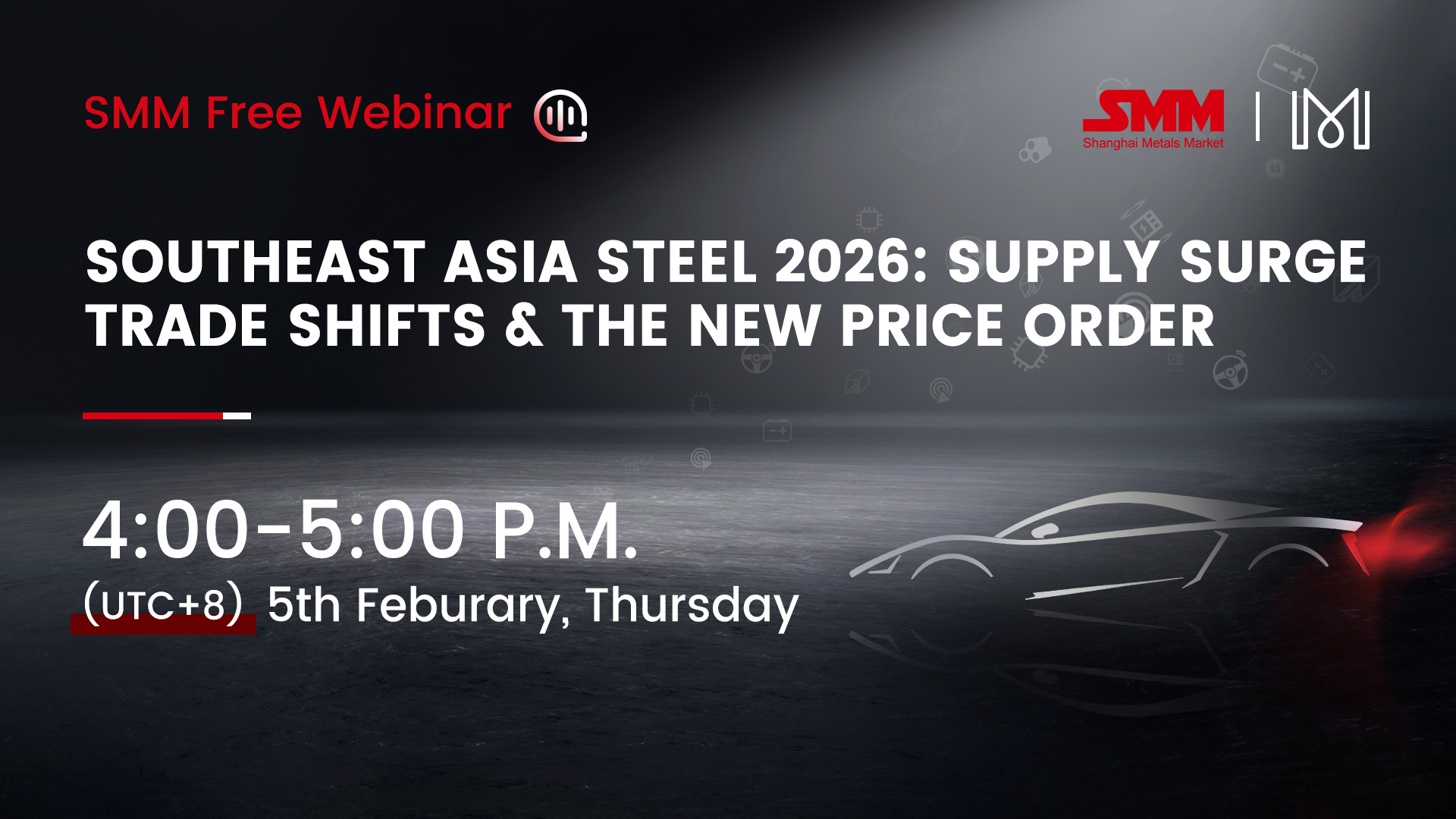 WebinarFeb 5, 16:00 - 23:59 (GMT+8)
 WebinarFeb 3, 16:00 - 23:59 (GMT+8)
 WebinarJan 16, 17:00 - 23:59 (GMT+8)