
Allianz Global Investors (AllianzGI) has agreed to acquire an indirect stake in German grid operator Amprion from insurer Talanx, with the deal expected to close in Q2 2026. As part of the partnership, both firms plan to invest significantly in Germany’s power grid. Amprion, which operates over 11,000 km of extra-high-voltage lines, aims to spend €36.4 billion by 2029 to build or upgrade 9,300 km of network to support rising energy demands.
Mar 30, 2026 00:15Philippines Market: Tight Supply and Surging Freight Rates Supported Ore Prices to Fluctuate at Highs Philippine nickel ore prices rose sharply this week. In terms of prices, Philippine nickel ore CIF China quotes were $64-68/wmt for Ni 1.3% grade, $71-75/wmt for Ni 1.4% grade, and $78-82/wmt for Ni 1.5% grade, up $6 WoW. The average CIF price from the Philippines to Indonesia was $65.5/wmt for 1.3% grade and $72.5/wmt for 1.4% grade. Supply side, although the Philippines was transitioning into the dry season, mining hubs such as Surigao and Homonhon continued to see heavy rainfall due to a low-pressure area (LPA) east of Mindanao. Although Metro Manila and most parts of Luzon saw hot and sunny weather, the probability of rainfall exceeding 50 mm in Surigao and Caraga remained “very high.” Strong thunderstorms and scattered precipitation were expected to further intensify during March 9 to 13. Affected by the trough of the low-pressure area and the easterlies, persistent rainfall may continue to disrupt open-pit mining and vessel loading operations in southern regions. Market supply remained scarce. Driven by both supply tightness caused by cuts in Indonesia’s RKAB quotas and expected supply gaps, mainstream prices for Philippine nickel ore have surged recently. As of Friday, March 13, nickel ore inventory at Chinese ports stood at 5.23 million mt, down 500,000 mt WoW. Current total port inventory was equivalent to about 41,100 mt Ni in metal content. Demand side, China’s NPI prices rose this week, with spot transaction prices up about 1,089.9 yuan per nickel unit. As smelters had sufficient stockpiling earlier and showed limited acceptance of recently high-priced nickel ore, most were currently taking a wait-and-see stance. In terms of ocean freight rates, affected by a sharp jump in oil prices, nickel ore freight rates climbed, with the ocean freight rate from the Philippines to Lianyungang reaching $15/mt or above. Looking ahead, Philippine nickel ore prices are expected to continue fluctuating at highs. Indonesia Market: Under Weather Disruptions and RKAB Policy Clarification, Tight Supply Continued Indonesia's local nickel ore prices rose somewhat this week. Indonesia’s nickel ore benchmark price (HPM) for the first half of March was set at $17,104/dmt, down 3.21% MoM. According to SMM Indonesia nickel ore premium data, average premiums for 1.4%, 1.5%, and 1.6% grade laterite nickel ore were reported at $35, $39, and $39.5/wmt, respectively. Among them, the port arrivals under domestic trade price for 1.6% grade was $65.2-74.2/wmt. The simultaneous strengthening in premiums this month reflected both the release of smelters’ restocking demand and pessimistic expectations over RKAB quota cuts, while the delivered price of 1.2% grade limonite ore also edged up to $24-26/wmt. From the supply and demand fundamentals, as of March 13, Indonesia’s key nickel ore producing areas of Morowali, Konawe, and Halmahera were affected this week by strong thunderstorms and extremely high humidity of up to 94%. Weather continued to fluctuate, causing soil to become highly saturated and seriously hindering mine drying and transport operations. Morowali and Konawe will face a heavy rainfall system over the weekend with precipitation probability as high as 80%, while Halmahera, under high-humidity conditions, is expected to see rainfall intensity rebound again next Friday, with overall logistics capacity remaining constrained. At present, RKAB approvals for most small- and medium-sized mines remained pending. As existing quotas could no longer be used for next month’s production and sales, rising supply uncertainty was pushing nickel ore prices higher. Demand side, as some Indonesian smelters faced uncertainty over nickel ore resources and found it difficult to secure high-grade saprolite ore, nickel ore prices remained firm. To secure raw material supply, some smelters even raised trading bonuses. Overall, although the impact of the current MOMS system failure on mines had largely faded, overall nickel ore supply remained tight. Although spot supply of limonite ore was relatively sufficient, some related production lines were currently running at low load due to a tailings dam landslide accident at some MHP projects in an Indonesian industrial park, leading to temporary weakness in overall demand. However, considering concerns among some Indonesian smelters over RKAB approval uncertainty, raw material stockpiling demand from newly commissioned projects, and continued growth in demand from outer islands, limonite ore prices are expected to closely track saprolite ore and remain high. On the policy side, in response to recent market rumors that “production quotas (RKAB) will be uniformly supplemented by an additional 25%-30%,” Tri Winarno, Director General of Minerals and Coal at Indonesia’s Ministry of Energy and Mineral Resources (ESDM), clarified on March 3, 2026, that RKAB supplements would be based on individual assessments of enterprise production capacity and compliance, rather than a uniform proportional increase, and indicated that the approval process would start in H2 2026. Officials emphasized that this was a routine regulatory process for resource optimization, rather than a passive countermeasure to the previous output cap policy. Looking ahead, affected by the relatively slow progress of RKAB approvals, nickel ore prices are expected to remain more likely to rise than fall in April.
Mar 14, 2026 10:59
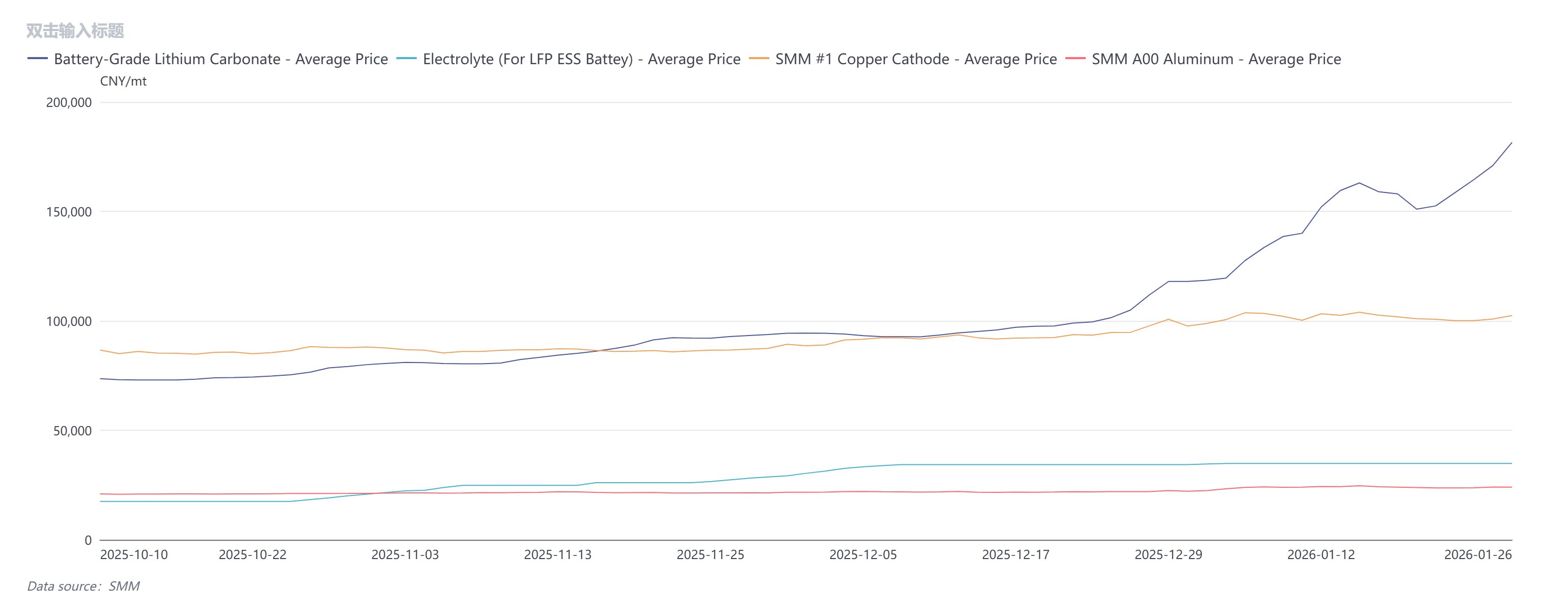
Recent Middle East conflicts have disrupted the region's booming energy storage market, a major destination for Chinese exports. To assess the real impact on Chinese supply chains and project deliveries, we must analyze baseline demand amidst these geopolitical uncertainties.
Mar 9, 2026 17:58Philippine Ore Prices Strengthened Sharply, With Multiple Supply-Side Risks Supporting the Cost Floor Philippine nickel ore prices rose sharply this week. In terms of pricing, Philippine nickel ore CIF China: NI 1.3% grade at $58-63/wmt, NI 1.4% grade at $65-69/wmt, and NI 1.5% grade at $72-76/wmt, up $4 from the previous week. The average CIF price from the Philippines to Indonesia was $62.5/wmt for 1.3% grade and $69.5/wmt for 1.4% grade. Supply side, the Philippines was in a transition to the dry season, but affected by a developing low-pressure area (LPA) east of Mindanao, heavy rainfall continued in mining hubs such as Surigao and Homonhon Island. Although Metro Manila and most of Luzon had sunny and hot weather, the probability of weekly rainfall exceeding 50 mm in Surigao and the Caraga region was “high to extremely high,” and strong thunderstorms and scattered rainfall were expected to further intensify from March 9 to 13. Influenced by the LPA trough and the Dongfeng, this persistent rainy weather could continue to disrupt open-pit mining and vessel loading operations in the southern regions mentioned above. Currently, available spot cargo in the market was limited; coupled with the tightness in nickel ore supply and a potential demand gap driven by expectations of RKAB quota cuts in Indonesia, mainstream prices for Philippine nickel ore have risen markedly in recent periods. As of Friday, March 6, China’s port nickel ore inventory stood at 5.73 million mt, down 370,000 mt WoW. Current total port nickel ore inventory was equivalent to metal content of about 45,000 mt Ni. Demand side, domestic NPI prices rose this week, while spot transaction prices fell by about 1,092.6 yuan/nickel unit. From the perspective of smelters’ procurement departments, given ample earlier stockpiling and limited acceptance of recently extremely high-priced ore, most were currently staying on the sidelines. In terms of ocean freight rates, ocean freight rates rose sharply recently due to the situation in Iran, with the ocean freight rate from the Philippines to Tianjin Port at $11/mt. Looking ahead, Philippine nickel ore prices are expected to fluctuate at highs. Indonesia Market: Tight Supply and Demand Drove Premiums Higher; Authorities Clarified the RKAB Supplement Mechanism Indonesia's local nickel ore prices rose significantly this month. For the first half of March, the Indonesian nickel ore benchmark price (HPM) was set at $17,104/dmt, down 3.21% MoM. According to SMM data on Indonesia nickel ore premiums, the average premiums for 1.4%, 1.5%, and 1.6% grade laterite nickel ore were reported at $34, $38, and $38.5/dmt, respectively. Among them, the port arrivals under domestic trade price for 1.6% grade was $65.2–72.2/wmt. The dual strengthening of premiums this month reflected the release of smelters’ restocking demand and pessimistic expectations over RKAB quota reductions; meanwhile, the delivered price of 1.2% grade limonite ore also edged up in tandem to $24–26/wmt. Supply and demand fundamentals, as of March 6, Sulawesi and Halmahera were in a period of wild swings at the tail end of the rainy season, and intermittent heavy rainfall continued to hinder mine logistics. Morowali was currently overcast with extremely high humidity (94%); although rainfall remained light for now, a strong rainfall system was expected around March 13, with precipitation reaching 48 mm. Konawe likewise remained mostly cloudy with daily thunderstorms. Meanwhile, Halmahera was set to face a high-precipitation weekend, with the probability of thunderstorms as high as 65% on March 7–8. Although Indonesia’s Meteorology, Climatology, and Geophysics Agency (BMKG) forecast that the dry season would arrive earlier in April, the above areas were still unable to reach full-load mining and loading capacity due to highly saturated soil moisture and localized gusts. Under the dual pressure of tight tradable availability and uncertainty over RKAB quotas, some NPI smelters were forced to significantly step up procurement this month to secure raw material supply. While spot supply of limonite ore was relatively ample, a tailings dam landslide incident at certain MHP projects in an Indonesian industrial park kept the relevant production lines operating at low load, resulting in a phase of overall demand weakness. However, considering concerns among some Indonesian smelters over uncertainty in RKAB approvals, raw material stockpiling needs for newly commissioned projects, and continued growth in demand from outer islands, limonite ore prices were expected to closely track saprolite ore and remain elevated. Policy side, regarding recent widespread market rumors that “production quotas (RKAB) will be uniformly increased by an additional 25%–30%,” Tri Winarno, Director General of Minerals and Coal at Indonesia’s Ministry of Energy and Mineral Resources (ESDM), clarified on March 3, 2026 that RKAB increases would be based on individual assessments of enterprises’ production capability and compliance, rather than a uniform proportional increase, and indicated that the approval process would begin in H2 2026. Officials emphasized that this move was a routine regulatory process to optimize resources, not a passive offset against the previous production cap policy.
Mar 8, 2026 18:19Against this backdrop, the value of energy storage and grid infrastructure becomes particularly prominent. If conflict persists, the core objective of energy systems will shift from cost optimization to systemic resilience. Distributed energy, microgrids, and storage possess an insurance-like function; their value becomes more visible under extreme conditions. Even if elevated raw material prices increase project costs, higher policy priority may provide long-term support.
Mar 2, 2026 11:39In times of peace, oil and gas are cost variables; in a war context, traditional energy becomes a security variable. The escalation of conflict in the Middle East at the end of February led to a high opening for oil prices on the first trading day of March. During peacetime, energy prices fluctuate around the supply-demand gap, with the market focusing on production, inventory, and cost curves. However, in a war environment, the market first trades not on production but on deliverability. Whether key shipping routes are open, whether insurance costs soar, and whether sanctions spread, all quickly translate into risk premiums. As a result, oil prices exhibit high fluctuations, even if actual supply has not significantly decreased, as prices are pushed up by delivery uncertainties. Energy thus transforms from a commodity into a strategic resource. As an analyst in the new energy sector, I believe that this change does not simply benefit new energy. Rising oil prices reinforce the logic of electrification, making EVs and renewable energy more economically attractive. However, the macroeconomic uncertainty brought about by war may also dampen consumer and investment confidence. If high oil prices drive inflation and slow growth, overall demand for cars and industry will slow down, and new energy will not be immune. Therefore, the investment logic for new energy is no longer unidirectional, but depends on the balance between substitution effects and macroeconomic contraction effects. A deeper change lies in the fact that capital is beginning to re-evaluate energy security. The traditional oil and gas system is highly dependent on cross-border transportation and continuous fuel supply, with its vulnerabilities lying in shipping and geopolitics. In contrast, wind and PV do not require continuous fuel input during operation, and energy storage can enhance the stability of the power system, giving new energy strategic value in a war environment. They are not only low-carbon tools but also a path to reducing external dependence. The security attributes of new energy are thus being revalued. However, it must be recognized that this security attribute is not absolute. The manufacturing of new energy is highly dependent on critical minerals such as lithium, nickel, and cobalt, with their mining and processing concentrated and heavily reliant on transportation. If upstream resource policies tighten or logistics are disrupted, risks will also propagate through the industry chain. Therefore, the security of new energy is operational security, not supply security. This means that future investment logic will shift from simply pursuing the lowest cost to focusing on supply chain control capabilities and regional diversification. In a war environment, the allocation of risk premiums by capital changes. Transportation premiums, geopolitical premiums, and supply chain concentration premiums all rise. The volatility of traditional energy intensifies; new energy generation assets gain a security bonus; and critical minerals and midstream processing capabilities become new strategic nodes. Efficiency is no longer the sole criterion, with redundancy and controllability becoming important components of the valuation system. Deglobalization and supply chain restructuring may push up the cost center of the industry, but they also enhance the strategic position of assets. In this context, the value of energy storage and power grid assets stands out. If conflicts persist, the core goal of the energy system will shift from cost optimization to system resilience. Distributed energy, microgrids, and energy storage have insurance-like attributes, and their value becomes more evident in extreme scenarios. Even if high raw material prices increase project costs, an elevated policy priority may still provide long-term support. Over the past five to ten years, the narrative of the energy transition has largely focused on new energy as a tool for decarbonization to ensure sustainable development of the planet. However, geopolitical tensions in the last two to three years have redefined new energy as part of the energy security framework. Within new energy, it is not just the power generation assets that are being repriced, but also energy storage and the power grid. 1) In a war environment, the core issue of the energy system shifts from efficiency to resilience During peacetime, the goal of the energy system is to maximize efficiency: lowest cost, highest utilization rate, and optimal allocation. Cross-border trade and centralized power generation have made the global energy structure highly globalized and scaled. War exposes the vulnerabilities of such a system. Maritime transport routes, natural gas pipelines, tanker insurance, key ports, and large power plants can all become risk nodes. At this point, the system's priority is no longer efficiency but resilience – the ability to maintain basic operational capacity under shocks. Energy storage and the power grid are at the core of a resilient system. 2) Energy storage: from an arbitrage tool to system insurance In normal circumstances, the value of energy storage mainly comes from electricity arbitrage, ancillary services, and peak load regulation, with its return on investment depending on fluctuations in electricity prices and policy subsidies. However, in a wartime context, the value of energy storage is redefined. It is no longer merely an economic optimization tool but a guarantee of power system stability. Energy storage can provide emergency support during fuel supply disruptions or grid shocks, preventing the power system from collapsing due to a single point of failure. This means that energy storage assets have insurance-like attributes. When system risks rise, capital's risk appetite for these assets increases. Even if high raw material prices drive up project costs, there may still be stronger policy support because of the rising strategic value. The valuation logic of energy storage thus transitions from "IRR-driven" to "system safety premium." 3) Power grid: an undervalued strategic hub The impact of war on the energy system often first manifests in the transmission and distribution network. Centralized energy structures rely on a few key periods, and once damaged, the impact is widespread. Therefore, power grid upgrades and digitalization have become the focus of secure investments. Enhancements in smart grids, regional interconnections, grid redundancy, and distributed access capabilities can significantly strengthen the system's resilience to shocks. The investment logic for power grid assets becomes clearer in a wartime context: it is not only infrastructure but also the backbone of national energy security. In the long term, power grid upgrades will be a necessary prerequisite for the expansion of new energy. The fluctuations in new energy generation require more robust transmission, distribution, and dispatching capabilities. When risk environments rise, countries are more inclined to accelerate grid construction to reduce dependence on external energy. 4) Distributed Energy and Microgrids: The Strategic Significance of Decentralization While centralized energy systems are efficient, they are also highly vulnerable. Although distributed PV, community energy storage, and microgrids are relatively small in scale, they possess the capability for independent operation. In a war context, distributed energy has two advantages: first, it reduces the risk of single-point failures; second, it decreases reliance on cross-border fuel transportation. The strategic value of such assets is being re-evaluated in high-risk environments. 5) Deep Changes in Investment Logic The rising value of energy storage and power grids means that new energy investments no longer solely revolve around installation growth and cost reduction, but rather around system security and supply chain control. Key changes include: a. Capital is more focused on localized manufacturing and supply chain diversification; b. The weight of security in investment decisions has increased; c. The cost center may shift upward in stages, but the strategic premium has risen. The valuation system of the new energy industry is transitioning from a growth premium to a strategic premium. What opportunities and risks does geopolitics bring to China's new energy industry? 1) China's Energy Security Structure: From Import Dependence to Electrification Advantage China has long been one of the world's largest crude oil importers, with persistent energy security issues. In a wartime environment, oil price fluctuations and transportation risks increase, directly affecting energy costs and macro expectations. However, unlike before, China has established the most complete new energy manufacturing system globally. The high integration of the PV, wind, energy storage, battery, and EV industry chains gives China a manufacturing and scale advantage during the energy transition. In a war context, this advantage is beginning to translate into security attributes: an increase in electrification means a reduction in dependence on external fuels; an increase in new energy installations means a more resilient energy structure. Thus, China's new energy system has the potential for alternative security. 2) Energy Storage and Power Grid: China's Most Strategic Assets If the war becomes protracted, the core of the energy system will no longer be power generation capacity itself, but system stability. China's layout in energy storage and power grid gives it a relative advantage at this stage. In terms of energy storage, China possesses the world's largest battery manufacturing capacity and cost advantages. Under the logic of energy security, energy storage is no longer solely about economics, but has become an important tool for ensuring the stability and emergency response capability of the power system. At the policy level, there may be an emphasis on increasing the proportion of energy storage in the power system. Regarding the power grid, China has developed the world's largest ultra-high voltage transmission network and grid construction capabilities. The increased redundancy and interconnectivity of the grid help to absorb more new energy installations while enhancing the system's resilience against shocks. In a high-risk environment, investment in the grid may accelerate. This means that, under the security logic, China's energy storage and power grid assets have structural strategic premiums. 3) Critical Minerals and Supply Chain: Advantages and Risks Coexist China has advantages in the new energy manufacturing sector, but still relies on overseas layouts for upstream resources. The supply chains for critical minerals such as lithium, nickel, and cobalt are highly internationalized, and wars or geopolitical risks may amplify policy and logistics uncertainties. For China's new energy industry chain, the real challenge lies not in the manufacturing end, but in the stability and cost fluctuations of the resource end. The trend of supply chain deglobalization may push up the cost center, compressing profit margins. The core of future competition will shift from scale expansion to resource control capabilities and the diversification of global layouts. 4) New Energy Vehicles: China's Structural Advantages and Short-term Fluctuations The impact of the war environment on new energy vehicles also has a dual nature. On one hand, rising oil prices reinforce the economic advantages of EVs. In a context of high oil prices, the cost advantages of using EVs become even more evident, which is conducive to increasing the penetration rate among end-users. China has the world's largest EV capacity and supply chain system, with scale and cost advantages. On the other hand, high oil prices may suppress consumer confidence through inflation and macroeconomic uncertainty. If the war continues for a long time, global economic growth may slow down, putting overall car demand under pressure. Although new energy vehicles have a substitution logic, they cannot be completely independent of the macro cycle. Therefore, the short-term performance of China's new energy vehicle industry will depend on the relative strength of the substitution effect and macroeconomic drag. 5) Long-term Structure: Re-stratification of Strategic Assets In the era of energy security, the competitiveness of China's new energy system will be more reflected in three aspects: First, manufacturing scale and cost control capabilities; Second, the system support capacity of the power grid and energy storage; Third, the diversification of upstream resources and supply chain layout. War has accelerated the stratification of the global energy system. Traditional energy bears higher fluctuation risks; new energy power generation and power grid assets gain a safety premium; critical minerals become the focal point of geopolitical competition. For China, the new energy industry is no longer just an engine for growth but also a part of the energy security system. The investment logic will shift from pure growth rate and subsidies to strategic position and supply chain stability. Overall, as energy transitions from a cost variable to a security variable, the strategic value of China's new energy system rises, but it also faces higher supply chain risks and global competitive pressures. Energy storage and the power grid are becoming the core of system stability; new energy vehicles benefit under the substitution logic, but one must be wary of macro cycles; critical minerals will determine the cost center and industrial profit margins. In an era where war reshapes the energy order, stability is more important than growth. SMM New Energy Analyst Yang Le 13916526348
Mar 2, 2026 10:42