

560results found for 'Minor Metals'
Price
News
- [SMM Analysis] H1 2026 China Rhenium Market Semi-Annual Review
The China rhenium market in H1 2026 generally saw an initial rise and stabilization, followed by a mild pullback and consolidation at highs, driven by four core factors: rigid raw material supply, supply-demand tug-of-war in the industry chain, structural divergence between investment and industrial demand, and price divergence between domestic and overseas markets. In H1, rhenium prices remained supported at high levels by structural supply deficits, yet trading stayed persistently sluggish with strong industry-wide wait-and-see sentiment; there was no clear unilateral trend, and a tug-of-war between longs and shorts ran throughout the period. I. Early February: Cooling Trading, Counter-Trend Price Rise In early February, the rhenium market showed a typical split: market activity fell MoM, but prices climbed steadily. On the sentiment side, gold and silver price fluctuations triggered a cautious mood across precious metals, which spilled over into the minor metals segment—there were many inquiries but few actual deals, with only small amounts of rigid demand supporting transactions, and cautious selling by retail investors led to a significant cooling in trading. On the price side, the core support came from tightening raw material supply. Ammonium rhenate supply remained tight and prices rose, sharply lifting smelting costs for midstream processors and pushing up finished product prices like rhenium pellets. Meanwhile, raw material prices rose faster than the pace of finished product price adjustments, squeezing midstream margins; the industry widely increased scrap recovery ratios to offset cost pressure. At that time, Sinopec’s tender for ammonium rhenate failed, confirming upstream producers’ inclination to hold back from selling and hold prices firm, bullish on the outlook. In the medium and long term, incremental rhenium recovery from copper-molybdenum smelting is limited by raw ore grades and technical barriers, making it difficult to fully close the supply gap, which provides sustained high-level support for rhenium prices. II. Post-Chinese New Year to Early Q2: High-Level Stalemate, Intensified Supply-Demand Tug-of-War After the Chinese New Year holiday, the rhenium market entered a prolonged consolidation phase at highs. Mainstream quotations for raw materials stabilized at 27,000–28,000 yuan/kg, with a few high-priced sources touching 30,000 yuan/kg; the price range was firm with minimal fluctuations. Upstream hold-back-from-selling attitudes gradually softened, with small-scale selling to test market acceptance, but without concentrated dumping, supply increments were manageable and the rigid supply structure remained intact. Midstream processors focused on delivering pre-holiday orders, with production schedules full from March to April. However, their acceptance of high-priced ammonium rhenate was low, and they generally negotiated rationally, refusing to rush to buy amid the continuous price rise. Downstream demand showed structural divergence: investment appetite continued to cool—retail investors exited and low-price selling increased, weighing on market sentiment; meanwhile, steady recovery in industrial demand from aviation, catalysts, and other sectors provided fundamental support, offsetting some bearish factors. At the same time, capital rotated into the energy sector, and speculative interest in minor metals waned, leaving rhenium prices lacking strong upward momentum. Overseas critical mineral competition intensified, raising import supply chain uncertainty and providing long-term bottom support for the market. III. Late Q2: China Pulls Back Weakly, Overseas Strengthens Against Trend In late H1, China’s rhenium market weakened slightly, with raw material and finished product prices pulling back simultaneously, while overseas markets rose independently, resulting in a significant divergence between domestic and overseas trends. In China, the mainstream transaction range for ammonium perrhenate pulled back to 26,000-27,000 yuan/kg, and small and medium-sized producers offered low-priced goods to recoup funds, with spot order prices dropping to 24,000-25,000 yuan/kg, dragging down the overall price center. The mainstream transaction price for rhenium pellets pulled back to around 46,000 yuan/kg. The tug-of-war in the industry chain further intensified. After concentrated restocking at the beginning of the year, downstream inventories were sufficient. Entering the traditional off-season, purchasing sentiment was cautious, with a strong willingness to push for lower prices and probe the bottom, mostly making purchases based on rigid demand in small lots. Upstream still held expectations for the future market, controlling volumes and selling cautiously, which capped the downside room and prevented a sharp decline. Overseas markets saw strong demand resilience and tight supply, with prices of ammonium perrhenate and rhenium pellets continuing to rise. However, the rise in overseas markets had limited boosting effect on the domestic market, and the price spread between Chinese and overseas markets continued to diverge. IV. Summary of Key Bullish and Bearish Factors in H1 (I) Key Bullish Factors First, as a rare and dispersed metal by-product of copper and molybdenum, rhenium has strong primary supply rigidity, while recovery capacity release is slow, leading to a long-standing structural supply-demand gap. Second, intensified exclusivity in the critical minerals supply chain outside China has raised import risks, and expectations of tightening supply in the long term underpin the market. Third, industrial rigid demand has been recovering steadily, providing continuous fundamental support. Fourth, upstream producers’ willingness to hold prices firm is solid, with no concentrated sell-offs, limiting downside room for the market. (II) Key Bearish Factors First, the ebb of speculative capital and repeated retail selling disturbed spot prices, with sluggish trading activity. Second, raw material cost transmission was sluggish, squeezing midstream profits, increasing the substitution ratio of scrap, and contracting demand for primary ammonium perrhenate. Third, after completing phased restocking, downstream purchasing willingness was weak in the off-season, making it difficult to spur a market rebound. Fourth, the decoupling of domestic and overseas market trends prevented the bullish benefit of overseas price increases from transmitting to the domestic market. V. Overall Summary of H1 In H1 2026, the rhenium market overall showed features of consolidating at highs, mixed bullish and bearish factors, and weak transactions. The market underwent three stages: price increases, sideways consolidation, and a weak pullback. The core contradiction has always been the two-way balance between rigid upstream supply underpinning prices and weak downstream demand, coupled with capital outflows capping gains. Industry chain profits diverged significantly: the upstream resource segment had stable earnings, while midstream processing enterprises remained under pressure, and the industry accelerated the pace of scrap recovery and recycling. Overall, there was no one-sided trend in H1. The tug-of-war between suppliers and buyers dominated market movements. The structural supply-demand gap supported high-level operation and laid the fundamental foundation for the rhenium market’s consolidating pattern in H2.
Jul 6, 2026 15:05 - SMM Launches 40% Imported Ore Zinc Smelting Daily Profit Index by Province [SMM Analysis]
[Covering Seven Major Production Regions! SMM Launches Daily Provincial Profit Indicator for Zinc Smelting Using 40% Imported Ore] In May 2026, SMM added daily profit models for domestic ore in the eight major zinc smelting regions of Inner Mongolia, Henan, Gansu, Hunan, Guangxi, Yunnan, Shaanxi, and Sichuan for market reference. ...
Jun 30, 2026 18:10 - Refined Zinc Export Window Nears Opening, Will June Exports Surge? [SMM Analysis]
[Refined zinc export window nearing opening; will exports surge in June?] According to the latest customs data, refined zinc imports in May 2026 stood at 5,000 mt, down 1,000 mt or 17.15% MoM and 81.28% YoY. From January to May, cumulative refined zinc imports reached 54,000 mt, down 65.28% YoY. Refined zinc exports in May were 3,900 mt, down 0.49% MoM but up 177.81% YoY.
Jun 23, 2026 14:28 - Three consecutive rare earth price rises and zirconium price adjustments push minor metals sector higher at open; Oriental Zirconium, China Rare Earth Nonferrous hit limit up [SMM Flash]
SMM, June 18: The Regulations for the Implementation of the Mineral Resources Law of the People's Republic of China, which took effect on June 15, listed 36 types of minerals, including rare earths, tungsten, lithium, cobalt, gallium, and germanium, as national-level strategic minerals, subjecting them to full-chain, high-intensity control. The prices of Pr-Nd oxide, dysprosium oxide, and terbium oxide saw their third consecutive daily increase on June 17; Orient Zirconium issued a price adjustment notice, raising the prices of its related zirconium products effective June 18, 2026; and the favor of some market funds all contributed to the opening strength of the minor metal sector. As of around 9:57 on June 18, the minor metal industry sector rose by 3.09%. In terms of individual stocks: Orient Zirconium, Shenghe Resources, and Zhongxi Nonferrous hit the daily limit; China Rare Earth, Jintian Titanium, China Northern Rare Earth, China Tungsten High-Tech, Tin Industry Co., and Yunnan Germanium led the gains. Market News Orient Zirconium raised the prices of its related zirconium products effective June 18, 2026 On June 18, Orient Zirconium issued a product price adjustment notice. The notice indicated that based on current market conditions, Orient Zirconium decided to raise the prices of its related zirconium products starting from June 18, 2026, with the price adjustments as follows: zirconium oxychloride products (including mother liquor materials) increased by 1,500 yuan/mt; zirconium dioxide products increased by 4,500 yuan/mt; fused zirconium products increased by 2,000 yuan/mt; at the same time, the prices of other zirconium series products from Orient Zirconium will be adjusted accordingly. [Aidite: The company has already laid out a powder substitute plan and fully implemented it; the new material can replace the original imported powder] On June 17, Aidite stated on an interactive platform while answering investor questions that the company had received a notice from Japan's Tosoh regarding the suspension of zirconia powder supply. To ensure the stability of its own supply, the company had already laid out a powder substitute plan and fully implemented it; the new material can replace the original imported powder, and the entire new product line has passed rigorous customer verification. Currently, several core major clients have completed the switch and signed long-term orders at the recent dealer conference. The company will actively take a series of measures to avoid any adverse impact from the Japanese powder supply disruption. In the future, the company will seize the window of opportunity for high-quality material breakthroughs and, leveraging its technical and delivery advantages, continue to expand its market share. Spot Market Zirconium According to the SMM price assessment, on June 18, the price of zirconium oxychloride (Zr(Hf)O2≥36%) was quoted at 17,500-18,000 yuan/mt, with an average of 17,750 yuan/mt, up 5.97% from the previous trading day. The zirconium industry chain had long been under pressure, with sluggish traditional demand from ceramics and high industry inventories. Zircon sand and zirconium oxide prices persistently hovered at lows, trading was sluggish, and the market was at the bottom of the cycle. Since entering Q2 this year, driven by export controls on zirconium products to Japan, price hikes by overseas zirconium ore producers, and demand expectations for solid-state batteries, zirconium raw material prices stopped falling and stabilized, inventories destocked, and the industry moved out of the bottom range, embarking on a volatile recovery trend. Upstream zircon sand imports have tightened, overseas miners continue to raise prices, and cost support has been strengthening. Dongfang Zirconium Industry completed a round of price hikes in April and raised zirconium product prices again on June 18. For the zirconium market outlook, supported by tightening raw material supply, zirconium prices will hold up well in the short term. Going forward, attention should be paid to changes in raw material supply and downstream demand. Rare Earth In the rare earth market: Rare earth oxide prices were relatively stable overall, but downstream purchasing activity has decreased as the holiday approaches. Pr-Nd oxide and dysprosium oxide ended their three-day winning streak and both pulled back slightly on June 18, while terbium oxide prices held steady on June 18 after a previous three-day rise. Expectations for production cuts in the scrap recycling sector and news-driven factors previously drove Pr-Nd prices, dysprosium oxide, and terbium oxide higher. However, after the afternoon session on June 17, shipments of Pr-Nd oxide from traders increased slightly, and the center of the actual trading range shifted lower. For medium-heavy rare earths, oxide suppliers held firm offer prices, but actual buying from metal enterprises was limited, and downstream magnetic material enterprises showed limited acceptance of high metal prices. Affected by the stalemate in market trading, rare earth prices are expected to move sideways in the short term. Tin Additionally, in the tin market: On June 18, the average price of SMM 1# tin fell 0.93% from the previous trading day. Driven by the US Fed keeping rates unchanged but signaling a hawkish bias, with half of policymakers expecting rate hikes this year, nonferrous metals fell overall and tin prices also pulled back. Currently, on the fundamental side: (1) Supply side: In June, most smelters focused on maintaining stable production. (2) Demand side: Downstream purchases were cautious, buying according to orders. Spot market: Overall trading sentiment in the spot market was light. Although tin prices have pulled back, they remain at relatively high levels and the holiday is approaching. Additionally, as the electronics industry enters its traditional off-season, downstream enterprises such as solder makers are only purchasing on a "buy on dips for essential needs" basis. Institutional Views Guojin Securities’ research report on June 14 showed: Rare Earth: Dysprosium oxide may benefit from the boost by MLCC, with a significant rebound trend from price lows. From the start of the year, the price center has continued to rise. We believe this is likely related to supply-side documents released in 2024-2025, with ongoing supply-side reform in the industry. Exports fell 1% YoY for full-year 2025, while exports from early 2026 to date have increased significantly, indicating strong restocking demand outside China. The rare earth sector will continue to see dual improvements in valuation and performance, and 2026 is also a key year for resolving industry competition among key targets. On the resource side, attention is recommended for China Rare Earth (medium-heavy rare earth leader, biggest beneficiary of supply-side reform), Zhongxi Nonferrous (undervalued, high-growth South China rare earth leader), and China Northern Rare Earth (light rare earth leader, with significant cost advantages); other related targets include Bao Gang United Steel, JL MAG Rare-Earth, etc. Tin: It believes that invisible inventory of tin ingots is gradually drying up, so tin prices are expected to strengthen under the backfill of macro liquidity or spillover from tech markets. The supply-demand pattern for tin will improve in the long term. Tungsten: This period, tungsten prices continued their rebound trend. It believes that against the backdrop of increased strategic stockpiling outside China, tungsten may have higher priority; tungsten's supply-demand fundamentals have seen strong resonance. Molybdenum: The destocking of imported ore has been significant, and domestic molybdenum prices have stabilized and rebounded. Steel procurement volume remains robust, destocking along the industry chain is progressing, and the deadlock of molybdenum prices with "volume but no price" is gradually being broken, with the upward channel becoming clearer. Molybdenum is also a military metal, with persistently low inventory, and increased defense spending outside China may further boost molybdenum prices. Huafu Securities’ research report on June 14 showed: Other Minor Metals: Industry leaders' long-term contract performance was impressive, and market sentiment in tungsten clearly stabilized. The tungsten market overall has walked out of a mild recovery, with the previous consolidation at lows being reversed somewhat. Industry leaders' long-term contract transactions were impressive, serving as a key driver for the upward movement in futures, and overall market sentiment clearly stabilized. However, the spot and scattered cargo atmosphere remained mediocre, with no widespread price-following adjustments upstream or downstream, and the rebound pace was gentle, with the market overall in a stage of steady recovery. Open Source Securities' 2026 mid-year investment strategy for the metals industry showed: Copper: Supply side, most miners outside China still face declining grades and recovery rates, and disruptive factors persist (Ivanhoe’s KK copper mine, Codelco’s El Teniente copper mine). While Chinese enterprises are increasing output, the overall increase is limited. Under an optimistic scenario, global supply growth may be below 2% in 2026-2027. Demand side, H1 electricity demand in China and the US maintained high growth rates, which may contribute marginal increments to copper demand. Open Source Securities believes that the supply-demand structure contradiction for copper will further highlight in 2026, supporting the rise in copper price center. Lithium: On the supply side of the lithium industry, capital spending cuts and the gradual formation of supply discipline, coupled with frequent disruptions, have led to a marked decline in supply elasticity compared with the past. Meanwhile, sustained strong demand from the energy storage sector is improving the structure of lithium demand, while industry inventory pressure is easing marginally. Lithium prices are expected to see a phased recovery. Enterprises with advantages in resource security, low costs and integrated layout are likely to show stronger earnings recovery than the industry average. Lithium mines and lithium chemicals companies with high resource self-sufficiency and strong cost control deserve attention. Tungsten: As an advantaged strategic metal in China, tungsten mine supply is constrained by resource depletion, environmental protection and other factors. Together with the total mining volume control implemented by the state, tungsten mine production release is limited. On the demand side, emerging sectors are boosting tungsten demand, which is expected to support tungsten prices over the long term. Recommended reading:
Jun 18, 2026 12:34 - Foshan Juchuang Invites You to the 2026 SMM (14th) Minor Metal Industry Conference
In 2026, global competition for critical minerals is entering a white-hot stage, geopolitical maneuvering continues to deepen, and global industry and supply chains are undergoing accelerated restructuring. A new round of technological revolution centered on AI semiconductors, new energy, high-end manufacturing, and aerospace & aviation is propelling the minor metals industry into a historic period of development opportunity and profound transformation. Worldwide, the EU’s Critical Raw Materials Act and the US’s Inflation Reduction Act (IRA) continue to be implemented, Mineral Security Partnerships keep expanding, and the trend toward localization and regionalization of critical mineral supply chains is intensifying. The resource games, technical barriers, and trade rule reconfigurations surrounding strategic minor metals such as antimony, indium, gallium, germanium, bismuth, selenium, tellurium, and rhenium have become the core focus of global high-end manufacturing competition. As the world’s core supplier of minor metals, China holds a dominant position globally in the smelting and supply of many minor metal varieties. Against this backdrop, the 2026 SMM (14th) Minor Metals Industry Conference brings together upstream and downstream enterprises across the entire industry chain for antimony, indium, gallium, germanium, bismuth, selenium, tellurium, rhenium, and others, as well as research institutes, government agencies, financial and investment institutions, and trade service providers, to create a high-standard, full-chain, in-depth exchange and cooperation platform. The conference will deliver in-depth interpretation of global policy shifts, provide insights into supply-demand patterns and price trends, decode growth opportunities in end-use applications, and match government-enterprise resources with cross-border cooperation opportunities, helping enterprises accurately grasp industry trends, break through development bottlenecks, optimize supply chain layouts, and seize market opportunities, thereby jointly promoting the high-quality and sustainable development of China’s minor metals industry. Foshan Juchuang Automation Co., Ltd. will make a grand appearance at this conference. We will keep pace with the times, target our goals, forge ahead with determination, and march forward courageously! Click to register immediately. We are looking forward to meeting you at the conference. Foshan Juchuang Automation Co., Ltd. is a manufacturer specializing in soldering equipment. Our main products include solder melting furnaces, extrusion machines, rolling mills, wire drawing machines, winding machines, horizontal continuous casting machines, solder bar molds, and more. We are a professional manufacturer integrating design, production, and sales. Our company has strong technical capabilities, and our R&D team brings together senior and intermediate R&D engineers from various product areas, all from the machinery and non-standard equipment industries. “Dare to strive, strive to innovate” is the driving belief of the Juchuang team. Guided by the principle of “quality products, professional service”, we provide clients with high-quality, cost-effective, and durable products through high cost-performance, fast delivery times, and enthusiastic, attentive service, thereby earning unanimous praise from our clients. We will live up to our clients’ expectations and trust, diligently provide them with quality products and excellent after-sales service, and strive to become an outstanding supplier in the soldering equipment industry. Main Products Meeting Contact: Zhu Wei zhuwei@smm.cn
Jun 5, 2026 11:34 - Guangxi Yusheng Germanium Industry invites you to join the 2026 SMM (14th) Minor Metal Industry Conference.
In 2026, global competition for critical minerals has entered a white-hot stage, geopolitical maneuvering continues to deepen, and global industry chains and supply chains are being restructured at an accelerated pace. A new round of technological revolution centered on AI semiconductors, new energy, high-end manufacturing, and aerospace is propelling the minor metal industry into a period of historic development opportunities and profound transformation. Globally, the EU's Critical Raw Materials Act and the US Inflation Reduction Act (IRA) continue to be implemented, the Minerals Security Partnership keeps expanding, and the trend toward localization and regionalization of critical mineral supply chains intensifies. The competition over resources, technical barriers, and trade rule restructuring for strategic minor metals such as antimony, indium, gallium, germanium, bismuth, selenium, tellurium, and rhenium has become the core focus of global high-end manufacturing competition. As the world's core supplier of minor metals, China holds a dominant position in the smelting and supply of many minor metal varieties. Against this backdrop, the 2026 SMM (14th) Minor Metals Industry Conference gathers upstream and downstream enterprises across the entire industry chain for antimony, indium, gallium, germanium, bismuth, selenium, tellurium, rhenium, etc., as well as scientific research institutes, government agencies, financial and investment institutions, and trade service providers, to build a high-standard, full-chain, deep-level exchange and cooperation platform. The conference will deeply interpret global policy shifts, assess the supply-demand pattern and price trends, dissect growth opportunities in end-use applications, and connect government-enterprise resources and cross-border cooperation opportunities, helping enterprises accurately grasp industry trends, overcome development bottlenecks, optimize supply chain layouts, seize market opportunities, and jointly promote the high-quality sustainable development of China's minor metal industry. Guangxi Yusheng Germanium High-tech Co., Ltd. will make a grand appearance at the conference. Keeping pace with the times, we will set our sights on the goals, forge ahead with determination, and press forward courageously! Click to sign up now. We look forward to meeting you at the conference. Guangxi Yusheng Germanium High-tech Co., Ltd. is a key introduced enterprise in Hechi City specializing in the smelting and deep processing of rare and dispersed metals. It is deeply engaged in the germanium industry, with its germanium capacity consistently ranking among the top in China. It is a key enterprise in China's germanium industry, dedicated to the green development, deep processing, and technological innovation of germanium, contributing to the high-quality development of China's indium, germanium, and gallium industries. I. Core Strengths and Honors in the Germanium Industry The company was founded in July 2016, and achieved an output value of RMB 2.4 billion in 2025. It has been listed among the Top 100 Manufacturing Enterprises in Guangxi for two consecutive years in 2024 and 2025. In the germanium industry, the company boasts strong technical capabilities; its key germanium purification technology won the second prize of the China Nonferrous Metals Industry Science and Technology Award. It has led the establishment of a major pilot platform for the efficient separation and extraction of germanium, indium, lead, and silver metals, supported by the regional Science and Technology Department, continuously driving breakthroughs in germanium industry technology. The company has been recognized as a high-tech enterprise and a specialized and sophisticated enterprise, and has passed multiple certifications such as Green Factory, practicing the green development concept of the germanium industry. II. Germanium Resource Security and Industrial Layout The company boasts outstanding resource security advantages, owning 10 proprietary mines and 3 beneficiation plants. It has established non-ferrous metal resource production sites in Guizhou, Guangxi, Xinjiang, and other regions, relying on its own high-quality germanium-rich zinc ore resources to provide stable raw material support for germanium production. Currently, the company has 17 subsidiaries (including holding companies) and branches in multiple core cities, moving towards collectivization and internationalization, and building a complete layout covering germanium resource development, production and processing, and market expansion. III. Germanium Industry System and Core Capacity The company has built an integrated germanium industry system featuring "green mining and beneficiation – circular smelting – deep processing". It has invested over RMB 1.2 billion to construct intelligent production lines, adopting globally leading processes to treat high-germanium zinc concentrates, significantly improving germanium recovery rates and achieving green production. With a core focus on the deep processing of high-purity germanium, it can produce high-purity germanium products with a purity of 7N (99.99999%), widely used in high-end fields such as infrared optics and fiber-optic communications. The Phase I high-purity germanium project with an annual capacity of 50 mt has been successfully put into production, with its capacity ranking among the top in China. IV. Future Plans for the Germanium Industry Looking ahead, the company will continue to deeply cultivate the germanium industry. Once all projects reach full production, it will build a high-purity germanium production line with capacity ranking among the top in China, filling the gap in Guangxi's critical metal germanium industry, further improving the domestic germanium industry chain layout, enhancing the competitiveness of China's germanium industry in the global rare metal sector, contributing to national strategic material security, and working with industry peers to promote the coordinated development of the indium, germanium, and gallium industries.
Jun 1, 2026 11:00
Announcements
We have updated the organization of our Other Minor Metals section for better navigation, grouping price points by specific metal categories.
Apr 21, 2026 13:49SMM launches new price points for osmium powder and osmium ingot to support the rare metals industry.
PriceMar 9, 2026 14:10SMM launches graded price points for hafnium oxide and crystal hafnium to enhance pricing reference for the hafnium industry.
PriceMar 9, 2026 14:03
Events
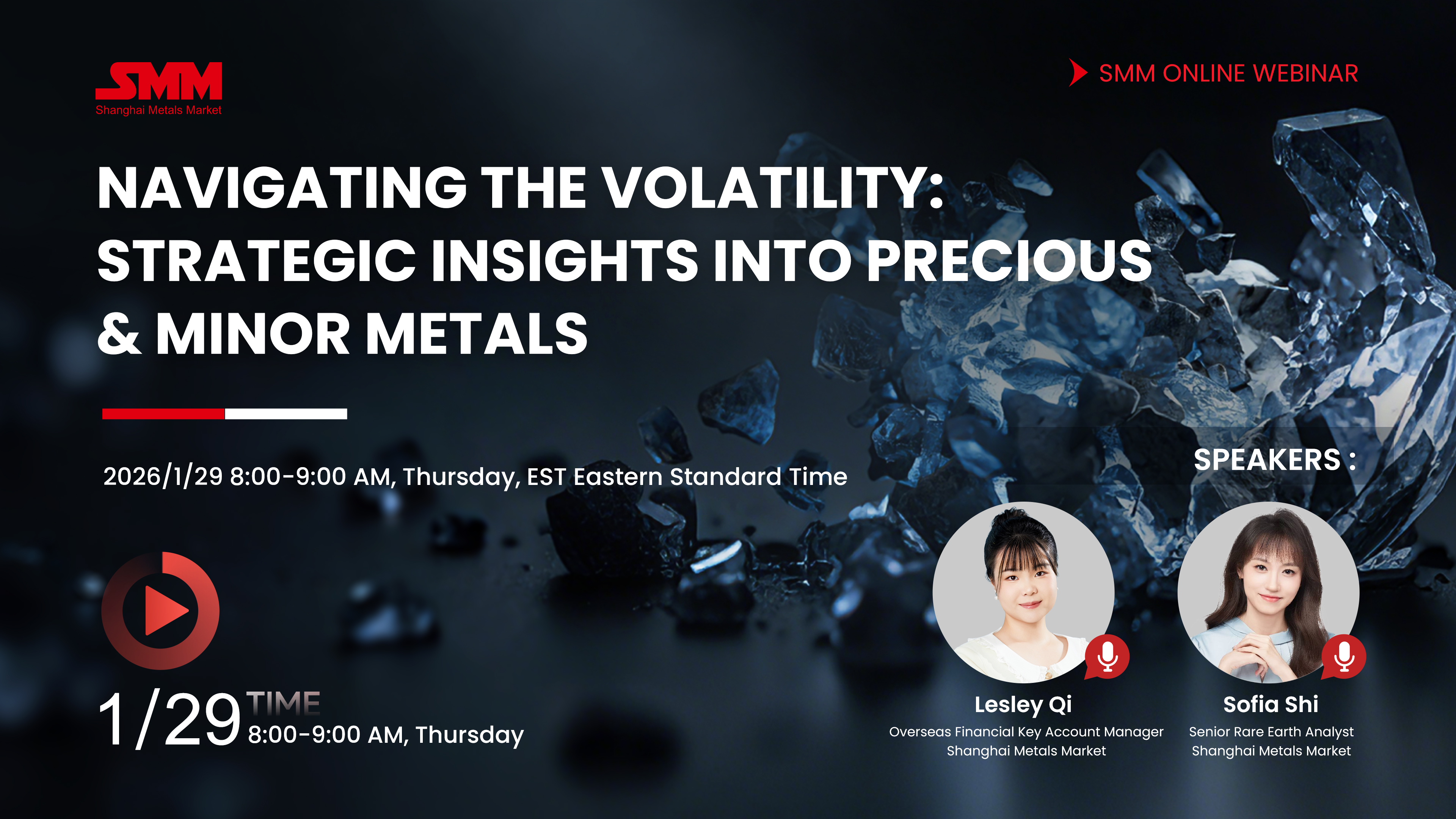 WebinarJan 29, 21:00 - 23:59 (GMT+8)