

1154results found for 'Battery recycling'
Price
News
- The most-traded SHFE tin contract surged sharply late in the night session and closed at a high level, downstream enterprises showed weak purchase willingness [SMM Tin Morning Brief]
[SMM Tin Morning Brief: The Most-Traded SHFE Tin Contract Surged Sharply Late in the Night Session and Closed at a High, While Downstream Enterprises Showed Weak Purchase Willingness]
Apr 1, 2026 08:58 - [SMM Analysis] The Golden Age of Battery Recycling amid Accelerating Global Energy Transition
As the global energy transition accelerates, the NEV industry is booming at an unprecedented pace. Behind this green transformation, battery recycling—a critical link tied to resource security, environmental protection, and the sustainable development of industry—has quietly emerged as a new industry worth hundreds of billions. From an “environmental burden” to an “urban mine,” the battery recycling industry is demonstrating unprecedentedly broad prospects. Strong policy support has laid a solid foundation for the development of the battery recycling industry. In February 2025, the Executive Meeting of the State Council reviewed and approved the Action Plan for Improving the Recycling System for NEV Power Batteries, explicitly proposing the improvement of the standards system to achieve standardized, safe, and efficient recycling and utilization of power batteries. More importantly, the Interim Measures for the Administration of the Recycling and Comprehensive Utilization of Retired NEV Power Batteries, which will officially take effect on April 1, 2026, marks a new stage in the law-based and standardized management of power battery recycling and utilization in China. The core provisions of this new regulation, jointly issued by six departments including the MIIT, the National Development and Reform Commission, and the Ministry of Ecology and Environment, include: Establishing a digital ID system: generating a unique and dynamic digital ID for each power battery pack to enable full life cycle flow monitoring and information-based traceability Implementing the “vehicle-battery integrated retirement” system: retired NEVs must include their power batteries to prevent battery loss Clarifying the responsibilities of all parties: power battery enterprises and NEV producers must establish recycling service outlets and assume fallback responsibility for collection Defining red lines for comprehensive utilization: enterprises engaged in the comprehensive utilization of retired power batteries must complete the relevant procedures in accordance with the law, and such batteries are prohibited from being used in restricted fields such as e-bikes Battery recycling is not only an industry, but also a green revolution concerning the sustainable development of humanity. From policy support to technological innovation, and from resource security to industrial upgrading, China’s battery recycling industry is advancing at an unprecedented speed and with unprecedented intensity. As the 14th Five-Year Plan is implemented in greater depth and the “dual carbon” goals continue to advance, this “urban mine” of battery recycling will release enormous economic, environmental, and social value, contributing China’s wisdom and solutions to the global energy transition and the development of the circular economy.
Mar 31, 2026 22:41 - [SMM Analysis] Indonesia’s Battery Recycling Advances Further
Recently, Hyundai Motor Group signed a cooperation agreement with Zhejiang Huayou Recycling Technology Co., Ltd. to jointly build an EV power battery recycling system in Indonesia. The cooperation covers the recycling and reuse of battery production scrap and end-of-life batteries, aiming to achieve a closed-loop resource system across the entire battery life cycle. Background of the Cooperation As the world’s largest nickel producer, Indonesia is pushing with unprecedented determination to transform itself from a raw material exporter into a global EV battery manufacturing hub. According to the Indonesian government’s plan, by 2030 the country will achieve total EV battery capacity of 100 GWh and plan to produce about 600,000 pure EVs annually. The HLI Green Power battery plant, jointly established in Indonesia by Hyundai Motor Group and LG Energy Solution, is a key part of this strategy. Located in Karawang, West Java, the plant has a total investment of $1.1 billion and began operations in 2024. It has annual capacity of 10 GWh and can supply battery cells for more than 150,000 EVs. The plant mainly supports EV models of Hyundai Motor Group in Southeast Asia, India, and other markets. However, with the rapid expansion of battery capacity, the disposal of end-of-life batteries and manufacturing scrap has become an increasingly prominent issue. The Indonesia Battery Association forecasts that by 2030 the country’s end-of-life power batteries will reach 120,000 mt. But the existing recycling system has clear shortcomings: insufficient processing capacity, lack of technical standards, and more than 70% of processing handled through informal recycling channels. In the suburbs of Jakarta, multiple open-air acid-leaching lithium workshops have even emerged, causing soil heavy metal levels to exceed EU limits by 50 times. This cooperation carries multiple implications for the development of Indonesia’s battery industry and even that of Southeast Asia as a whole: Improving the Local Industry Chain: Through the New Energy Law, the Indonesian government has designated EVs as a national strategic industry and requires foreign automakers to commit to building battery plants in Indonesia, with 40% local sourcing of parts to be achieved by 2027. The cooperation between Hyundai Motor and Huayou Recycling helps Indonesia build a complete industry chain spanning mineral extraction, battery manufacturing, and recycling. Addressing Resource Challenges: Although Indonesia is rich in nickel resources, it produces almost no cobalt, and its lithium resources depend on imports from Australia. Through battery recycling, it can partially reduce its import dependence on critical minerals and improve resource security. Attracting More Investment: The Indonesian government has introduced fiscal incentives such as zero import tariffs, exemption from luxury sales tax, and a reduction in VAT from 11% to 1%, to attract foreign investment into the battery industry. The battery recycling cooperation in Indonesia between Hyundai Motor Group and Huayou Recycling is not only a commercial move by the two enterprises, but also a reflection of the global battery industry's transition toward a circular economy. With the rapid expansion of the EV market, battery recycling has shifted from an environmental protection issue to a matter of resource strategy and economics.
Mar 31, 2026 22:36 - 【SMM analysis】Lithium Battery Recycling Sees March Surge, Slight April Growth Expected
SMM March 31 News: For Lithium battery recycling, the purchase volume of black mass by downstream hydrometallurgy recycling enterprises, up 48% MoM,
Mar 31, 2026 18:32 - 【SMM Analysis】Recycling Industry Events This Week (March 3.23-3.27)
Recycling Industry Events This Week (December. 29-31)
Mar 31, 2026 18:29 - 【SMM Analysis】Recycling Industry Events This Week (March 3.16-3.20)
Recycling Industry Events This Week (December. 29-31)
Mar 31, 2026 18:25
Announcements
Dear Users, Greetings! In recent years, as the global new energy vehicle industry entered a large-scale retirement period and resource security strategies were upgraded, China's lithium battery recycling market continued to expand rapidly. In August this year, China officially began allowing the import and export of black mass, and it is expected that more black mass meeting quality requirements will enter China in the future. Against this backdrop, the value and pricing mechanism of overseas black mass in the Chinese market are attracting close attention from both upstream and downstream segments of the industry chain. In response to market changes, addressing the industry's practical needs for evaluating the value of recycled raw materials, and promoting the establishment of a more open and fair pricing benchmark in the lithium battery recycling sector, the Shanghai Metals Market (SMM), after in-depth market surveys and discussions has decided: On January 9, 2026, SMM will officially launch new weekly price for lithium battery recycling. The newly added price are as follow: 1. SMM Battery Black Mass, NCM/NCA, % payable of SMM's Nickle sulphate, FOB Malaysia, 9% < Ni < 20% 2. SMM Battery Black Mass, NCM/NCA, % payable of SMM's Cobalt sulphate, FOB Malaysia, Specification: 5% < Co < 10% 3. SMM Battery Black Mass, NCM/NCA, % payable of SMM's Lithium Carbonate, FOB Malaysia, Specification: 3% < Li < 3.5% Details of this price point are as follows: Description: SMM Battery Black Mass, NCM/NCA, % Payable of SMM's Nickel Sulphate, FOB Malaysia, 9% < Ni < 20% SMM Battery Black Mass, NCM/NCA, % Payable of SMM's Cobalt Sulphate, FOB Malaysia, 5% < Co < 10% SMM Battery Black Mass, NCM/NCA, % Payable of SMM's Lithium Sulphate, FOB Malaysia, 3% < Li < 3.5% Quality: Ni 9%-20%, Co 5%-10%, Li 3%-3.5% Quantity: Minimum 30 tonnes Definition: FOB Malaysia main ports Timing: 1-2 Months Unit: % Payment Terms: 50% Payment in advance T/T in USD , other payment terms normalized Pulication: Weekly, Friday 12pm Beijing time Relevant companies from the New Energy Industry Chain are welcomed to participate and support SMM in better serving the New Energy Industry Companies. Relevant companies from the New Energy Industry Chain are welcomed to participate and support SMM in better serving the New Energy Industry Companies. Shirley Wang 021-51666838 wangcong@smm.cn Thomas Feng 021-51666714 marui@smm.cn Freya Lin 021-51666902 linziya@smm.cn Rayna Lei 021-20707873 leiyue@smm.cn Melanie Choy (Malaysia) +6012-4926909 melanie.choy@smm.cn Shanghai Metals Market New Energy Research Team November 26, 2025
PriceDec 29, 2025 18:56Dear Users, Greetings! On December 12, 2025, SMM will officially launch new weekly price points for lithium battery recycling. The newly added price points are as follow: 1. SMM Black Mass, NCM/NCA, % payable of SMM's Nickle sulphate, FOB Malaysia, Specification: 18% < Ni < 40% 2. SMM Black Mass, NCM/NCA, % payable of SMM's Cobalt sulphate, FOB Malaysia, Specification: 5% < Co < 18% 3. SMM Black Mass, NCM/NCA, % payable of SMM's Lithium sulphate, FOB Malaysia, Specification: 5.5% < Li < 6.5% The price will be updated and maintained every Friday at 12:00 PM. Relevant companies from the New Energy Industry Chain are welcomed to participate and support SMM in better serving the New Energy Industry Companies. Shirley Wang 021-51666838 wangcong@smm.cn Maria Ma 021-51595780 marui@smm.cn Freya Lin 021-51666902 linziya@smm.cn Rayna Lei 021-20707873 leiyue@smm.cn Melanie Choy (Malaysia) +6012-4926909 melanie.choy@smm.cn Shanghai Metals Market New Energy Research Team December 2, 2025
PriceDec 2, 2025 17:22Dear User, Hello! On September 12, 2025, SMM officially launched new weekly price points for lithium battery recycling. The newly added price points include: 1. SMM Black Mass, NCM/NCA, Payable indicator, cobalt, FOB Koera, % payable of SMM's Cobalt Metal (in-whs Rotterdam) , Specification: 18% < Ni < 40% 2. SMM Black Mass, NCM/NCA, Payable indicator, nickel, FOB Koera, % payable of LME's Nickel Cash Official price , Specification: 5% < Co < 18% The price are updated and maintained every Friday at 12:00 PM. On September 12, 2025, this week’s SMM NCM/NCA black mass‘s weekly price was 87%-91%, remaining unchanged from last week. We welcome more related companies in the industry chain to participate and support SMM in better serving the new energy industry chain.
PriceOct 28, 2025 18:20
Events
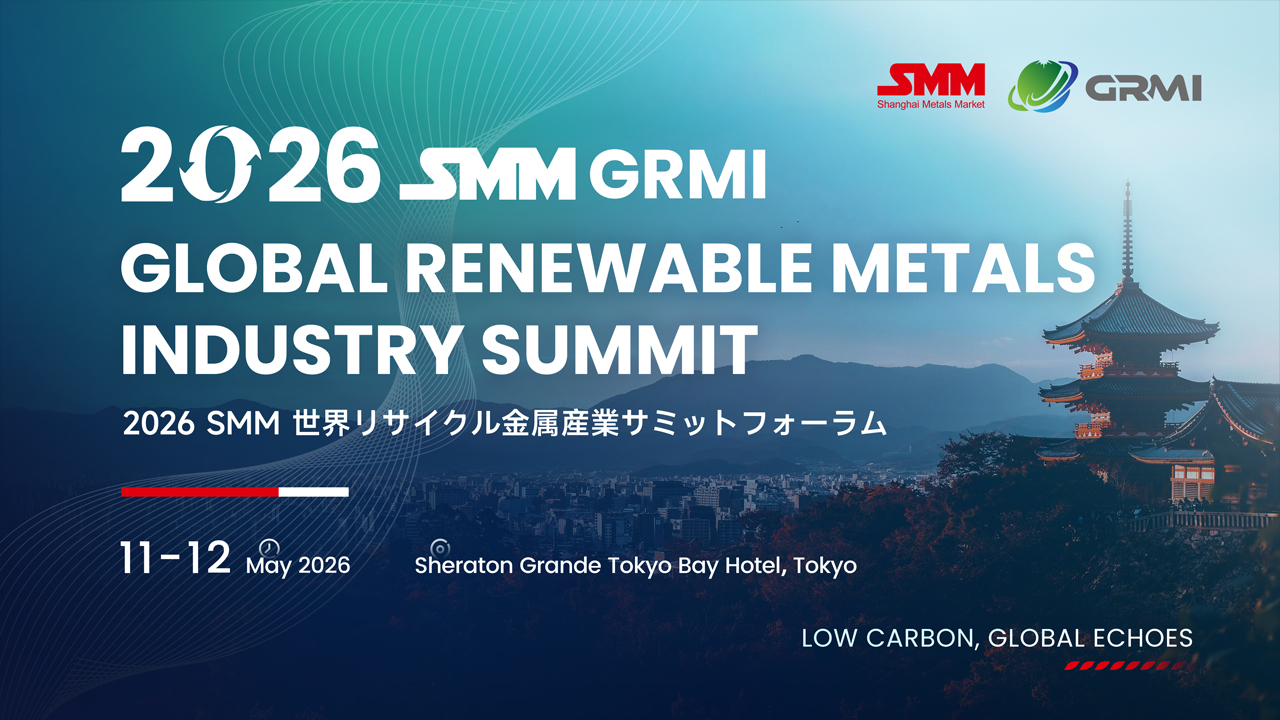 EventsMay 11 - 12, 2026 (GMT+8) Sheraton Grande Tokyo Bay Hotel, Tokyo
 WebinarMar 14, 16:00 - 23:59 (GMT+8)
 EventsOct 24 - 25, 2024 (GMT+8)To Be Determined