
On February 26, EVE Energy officially announced the signing of a strategic cooperation framework agreement with Arctech, securing a two-year collaboration scale of 12GWh for energy storage batteries and systems. This includes 10GWh of large-scale energy storage battery products and 2GWh of energy storage system products.
Feb 28, 2026 10:04
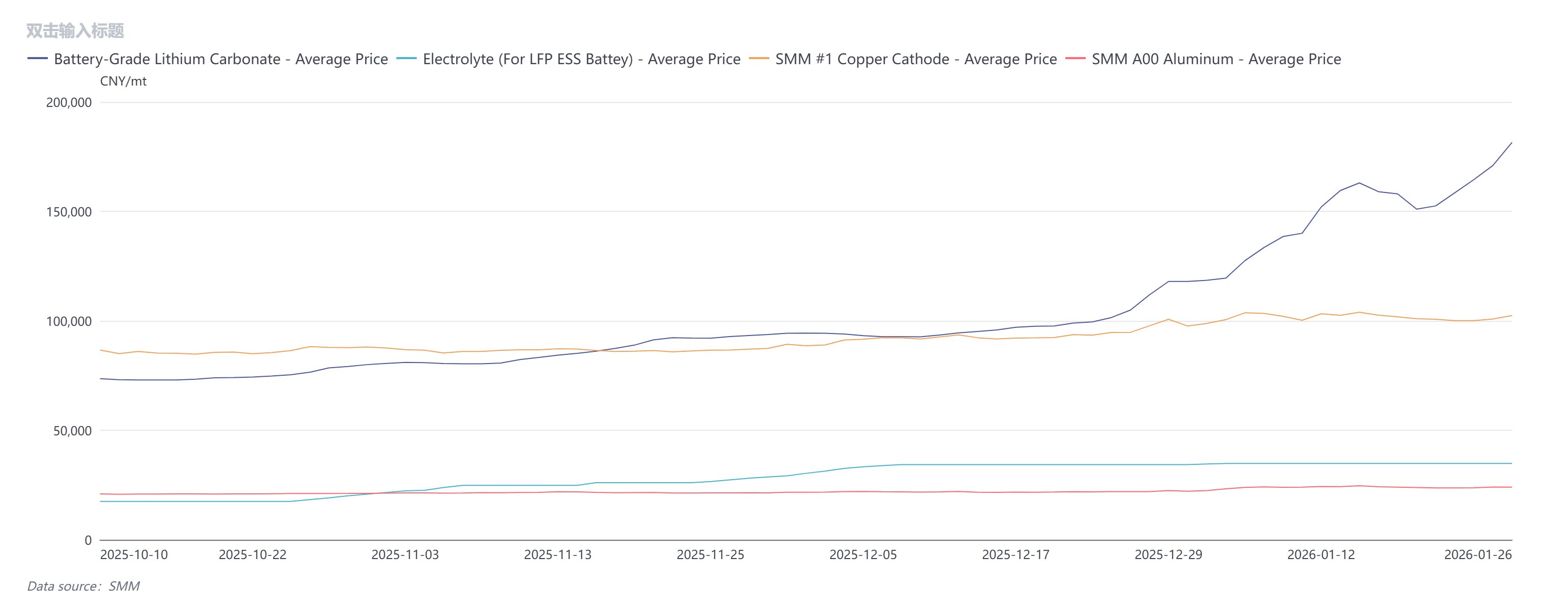
China Huadian launched a 12 GWh energy storage tender for 2026, explicitly requiring ≥314Ah cells. The contract uniquely links pricing to SMM’s lithium carbonate index to manage market volatility. With bids opening February 11, 2026, this tender cements 314Ah technology and SMM benchmarks as the new standard for utility-scale projects.
Feb 6, 2026 14:42The New South Wales (NSW) government recently announced that the sixth round of its long-duration storage (LDS) tender has awarded long-term energy service agreements to six large-scale lithium-ion battery energy storage projects, with a combined capacity of about 1.17 GW / 11.98 GWh. This brings the state’s contracted storage capacity to around 30 GWh. The latest tender allows NSW to meet ahead of schedule the targets set out in its Energy Roadmap of deploying 2 GW of long-duration storage by 2030 and reaching 28 GWh by 2034. The successful projects are located across multiple regions of the state and involve international developers including Neoen, BW ESS, Ark Energy, FRV, Bridge Energy and Iberdrola. Individual projects typically offer storage durations of more than 8 to 11 hours.
Feb 5, 2026 08:00On January 16, the REPT Battero-SAIKE Technology Chongqing Project Construction Campaign was successfully held in Fuling High-Tech Zone, Chongqing. This project is a further collaboration between Tsingshan and SAIC Group after their joint venture in Liuzhou for new energy lithium batteries and power battery systems. Through the "cell + system" collaborative model, REPT SAIKE provides cells while SAIKE REPT handles system integration, deepening the industrial chain synergy. The initial phase of the project is planned to have an annual production capacity of 12GWh of ESS and power new energy lithium batteries, mainly producing power batteries for passenger and commercial vehicles as well as home and industrial and commercial ESS batteries. The production line design will meet the production needs of a diversified product system, including the self-developed "Wending Battery."
Jan 22, 2026 18:59One year after the launch of its solid-state battery products, Gotion High-tech (002074.SZ) recently held its 2025 Global Technology Conference, announcing the construction completion of a 0.2 GWh pilot line for all-solid-state batteries and the launch of six new products, including Gotion's quasi-solid-state battery. It is reported that over four customers have already installed this quasi-solid-state battery in their vehicles for testing. At the conference, Zhu Baoxing, Chief Scientist of Gotion High-tech, introduced that the energy density of the battery cell in Gotion's quasi-solid-state battery can reach over 300 Wh/kg, and the system energy density can exceed 235 Wh/kg. The application scenarios are mainly concentrated in three areas: eVTOL, new energy vehicles (NEVs), and humanoid robots. Zhu Baoxing told Cailian Press that the standards for quasi-solid-state batteries are safety, as well as the high capacity and long driving range behind it. Therefore, the automakers selected by the company for vehicle installation testing are all well-known international and domestic brands, whose products have longer driving ranges and newer car models, capable of achieving 1,000 kilometers in terms of driving range. "Several automakers are expected to announce the installation of Gotion's quasi-solid-state battery in their vehicles this year." Technological maturity, cost controllability, and safety assurance are considered the three necessary conditions for quasi-solid-state batteries to be introduced to the market. Regarding when quasi-solid-state batteries can be introduced to the market, Zhu Xingbao stated in post-conference exchanges that they are expected to be rapidly introduced to the market within five years. However, achieving full-scale commercialization will still take some time. Quasi-solid-state batteries face the challenge of "having it all" As a "compromise" solution to all-solid-state batteries, quasi-solid-state batteries are highly anticipated by the industry for their advantages of high energy density and long driving range, as well as their better ability to address the thermal runaway risk issues of liquid lithium batteries. This has made it a competitive track for domestic battery producers. However, Zhu Xingbao noted that mass production and vehicle installation of quasi-solid-state batteries are not easy. In terms of technology, true solid-state battery technology involves a fundamental change in the method of ion transport. During the industrialisation process of producing quasi-solid-state batteries, it is necessary to transform the original production lines for liquid lithium batteries. This requires continuous exploration to determine which equipment needs to be added, which needs to be replaced, which can be retained, and significant adjustments to parameters. The proportion of changes exceeds expectations. In his view, quasi-solid-state batteries already have the conditions for implementation at present, but it depends on how deeply the technology is explored. "If we only reduce the electrolyte from 100% to 90%, the battery will certainly work, but whether safety has been improved is questionable, indicating that the real challenges have not been overcome." According to Zhu Xingbao, Gotion's quasi-solid-state battery has overcome multiple key battery technologies. In terms of safety, which has attracted the most attention, its solid-state design provides the battery with a "nanoscale" bulletproof vest, allowing it to remain "non-flammable and non-explosive" even when pierced by a 3mm steel needle. In terms of implementation, Gotion High-tech has planned to construct a 12GWh quasi-solid-state battery production line. Currently, the "001" prototype vehicle equipped with Gotion's quasi-solid-state battery has accumulated a total mileage of over 10,000 kilometers. Zhu Xingbao stated that some automakers have already introduced semi-solid-state batteries with a range of 1,000 kilometers to the market in the early stages, but the yield rate may only be 45%. For enterprises, this makes commercial implementation impossible. Products introduced to the market must be profitable for businesses; otherwise, they cannot survive. "It is necessary to solve both scientific and technical issues while also achieving profitability. This is the main challenge in promoting semi-solid-state batteries," he further revealed. Currently, the company's second-generation semi-solid-state batteries have begun to incorporate a higher capacity system. However, their stability issues still need to be addressed to reduce safety risks, and further scientific research is required. Additionally, when it comes to commercial implementation, it is also necessary to see if a high yield rate can be achieved. When will all-solid-state batteries be available? It is worth noting that among the six products released by Gotion High-tech this time is the "Jinshi" all-solid-state battery. According to Pan Ruijun, the head of the company's business, this battery adopts the sulphide route, with a battery cell energy density of 350Wh/kg and a single cell capacity of 70Ah. It has already commenced vehicle installation testing. Solid-state batteries have become a global R&D focus due to their high safety and energy density advantages, propelling power batteries into a critical window of technological iteration. Zhu Xingbao told media outlets such as Cailian Press that the popularity of solid-state batteries is precisely due to the diversity of technological routes, using materials with high electrical conductivity to replace electrolytes. Currently, the sulphide route is the most popular in the market, but this material poses higher requirements for practical applications in terms of sealing, process, and cost. In addition, there are also routes such as borohydride compounds and thin-film solid-state electrolytes. "Each electrolyte material has absolute advantages but also absolute disadvantages. Therefore, domestic producers currently choose a composite route, seeking breakthroughs through collaborative optimization of multi-material systems and mutual learning," Zhu Xingbao said. In terms of controlling the pace of industrialisation, the industry has formed a strategic consensus on a "two-step" approach. Semi-solid-state batteries, as a transitional solution, already have the conditions for rapid implementation within 3-5 years. In Gotion High-tech's view, they may be rapidly introduced to the market within five years. As for all-solid-state batteries, the sulphide route holds the most promise, with advantages such as high ionic conductivity and good mechanical stability. In the future, the industry will certainly continue in-depth research on this system, constantly overcoming existing challenges. Previously, industry experts had stated that in China, the industry's planning goal was to achieve stable sulphide by 2025, enabling its application at the battery industrialisation level. By 2026, it would be tested at the battery cell level, with the industry continuing to intensify its efforts in this area. Gotion High-tech, which has achieved road testing, has made leading progress. Industry analysts believe that the commercialisation window for semi-solid-state batteries may emerge from 2025 to 2028. Zhu Xingbao stated that China already has very advanced technology in the field of power batteries, but it also faces the challenge of potentially being replaced by disruptive technologies in the future, which underscores the necessity of R&D in solid-state batteries. Currently, the United States, Japan, and South Korea are all betting on this path. In his view, if the R&D of solid-state batteries succeeds, they will replace liquid batteries, and China's power battery technology will continue to lead globally.
May 20, 2025 13:13[12GWh Battery Factory Secures 9 Billion Yuan in Financing] AESC's Sunderland Gigafactory in the UK has secured £1 billion (approximately 9.4 billion yuan) in financing. It can supply batteries for up to 100,000 EVs annually, representing a sixfold increase compared to the UK's existing capacity.
May 16, 2025 11:38