

4217results found for '파워볼 전용 사이트 승부벳 st1313.top 코드8899 슬롯머신 종%E'
Price
News
- [SMM Nickel Midday Review] On March 10, nickel prices rebounded as four Indonesian HPAL nickel plants suspended production
SMM Nickel News, March 10: Macro and Market Updates: (1) US President Trump: The war has basically ended, and he is considering controlling the Strait of Hormuz; it is “still a long way off” from deploying US ground troops to Iran, and it is too early to talk about seizing Iran’s oil. (2) Russian President Putin and US President Trump held a phone call that day, focusing on the Middle East situation related to Iran and the progress of negotiations on the Ukraine issue. Spot Market: On March 10, SMM #1 refined nickel prices rose by 2,700 yuan/mt from the previous trading day. In terms of spot premiums, the average for Jinchuan #1 refined nickel was 6,650 yuan/mt, down 600 yuan/mt from the previous trading day; the range for domestically mainstream brands of electrodeposited nickel was -300-400 yuan/mt. Futures Market: After the morning open, the most-traded SHFE nickel 2605 contract plunged straight away, hitting a low of 132,000 yuan/mt, then rebounded sharply. As of the morning close, it was quoted at 137,240 yuan/mt, up 0.87%. In the morning session, nickel prices rebounded on news that four Indonesian high-pressure acid leaching (HPAL) nickel plants were forced into a full shutdown due to a landslide accident in February. In the short term, the most-traded SHFE nickel contract price is expected to move sideways within the 130,000-140,000 yuan/mt range.
Mar 10, 2026 11:27 - Slow Social Inventory Drawdown; Lead Prices Remained in the Doldrums [SMM Lead Morning Meeting Minutes]
Futures: Overnight, LME lead opened at $1,940/mt and stayed relatively strong during the Asian session, hitting a high of $1,942/mt. Entering the European session, it pulled back to hover near the intraday moving average before sliding to an intraday low of $1,927.5/mt. It edged up slightly before the close and finally settled at $1,931/mt, down $15/mt, or 0.77%. Overnight, the most-traded SHFE lead 2604 contract opened at 16,710 yuan/mt. After rising early to a high of 16,750 yuan/mt, it turned lower and weakened, staying under pressure around 16,700 yuan/mt and moving sideways. It rose slightly late in the session and finally closed at 16,720 yuan/mt, down 35 yuan/mt from yesterday, or 0.21%. On the macro front: US President Trump said at a press conference that the US military action against Iran would end “soon,” but “not” within this week. To address market turbulence caused by the military action and to stabilise international oil prices, Trump announced the cancellation of some oil-related sanctions. National Bureau of Statistics (NBS): In February 2026, the national CPI rose 1.3% YoY. On average in January–February, the national CPI increased 0.8% from the same period a year earlier. The work report of the Standing Committee of the National People’s Congress in 2026 disclosed this year’s legislative “construction blueprint”. Centered on accelerating the building of a strong financial country, China will formulate the Financial Law and the Financial Stability Law this year, and revise the Law of the People’s Bank of China and the Law on Banking Supervision and Administration, to build the top-level design of financial rule of law. Spot fundamentals: In the Shanghai market, Chihong lead was quoted at discounts of -100~0 yuan/mt against the SHFE lead 2604 contract. After SHFE lead probed lower and then rebounded, suppliers quoted in line with the market. As delivery approaches, circulating cargoes increased in Jiangsu, Zhejiang, Shanghai. In addition, cargoes self-picked up from production site at primary lead smelters were mostly shipped at discounts, while some suppliers showed significant divergence in shipments. Mainstream producing areas offered ex-works quotations at discounts of 50 yuan/mt to premiums of 100 yuan/mt against the SMM #1 lead average price. Circulating cargoes in the secondary lead market were limited, and smelters held prices firm for shipments. Secondary refined lead was quoted ex-works at discounts of 50 yuan/mt to premiums of 25 yuan/mt against the SMM #1 lead average price. Meanwhile, quotations for imported crude lead increased. Downstream enterprises showed strong wait-and-see sentiment, with relatively scattered procurement, and spot order market transactions showed no obvious improvement for now. Inventory: As of March 6, LME lead inventory stood at 283,875 mt, down 1,025 mt from the previous day; as of March 9, SMM social inventory of lead ingots across five regions continued to rise. Lead price forecast for today: After the Chinese New Year holiday factor faded, both supply and demand for lead ingots increased, but even if secondary lead enterprises delayed resuming operations, lead ingot inventories at smelters were still being digested slowly. With delivery of the SHFE lead 2603 contract approaching, and considering that the spread between futures and spot prices has recently stayed above 200 yuan/mt, suppliers in the spot market showed strong willingness to transfer inventory and ship to delivery warehouse, gradually moving smelter plant inventories to delivery warehouses. Social inventory of lead ingots is expected to continue rising in the short term, and lead price expectations are expected to remain in the doldrums.
Mar 10, 2026 09:00 - [SMM Analysis] High Inventories: Are Rising Spot Premiums in Multiple Regions an Illusion?
As of March 9, SMM recorded total social inventory of copper cathode in major regions of China at 578,900 mt, up 1,700 mt from last week and up 70,400 mt from February 24, reaching a historical high. Over the same period, spot premiums for SMM #1 copper cathode gradually recovered from premium -260 yuan/mt on February 27 to parity on March 10. Overall, this upswing in spot premiums was mainly driven by the approach of delivery, under which the contango price spread between nearby and next-month contracts stayed around 300 yuan/mt; suppliers held prices firm and withheld sales, while about half of the material was converted into warrants and locked in, jointly tightening circulating supply. Observing the inventory accumulation pace, from the week of March 2 to March 9, inventories in three key regions increased by 14,400 tons, a growth of 2.65%. This marks a significant slowdown compared to the average weekly increase of approximately 45,000 tons during the period from February 5 to February 26. The deceleration in inventory buildup provided room for improvement in premiums. Current inventory accumulation primarily stems from two factors: First, the continued arrival of imported copper. According to SMM research, a substantial volume of imported copper continues to arrive recently, and it is expected that arrivals will not see a significant decline in March. The steady inflow of imported materials provides a continuous supply supplement to the domestic market and is a crucial support for maintaining high total inventory levels. The actual situation of imported arrivals in April remains to be confirmed, requiring close attention to customs data at month-end and changes in port clearance pace. Second, some cargoes are being delivered into bonded/warehouse warrant stocks. According to the electrolytic copper spot purchasing and selling sentiment indices for the Shanghai region recorded by SMM, the purchasing sentiment index rose from 2.08 on February 24 to 2.78 on March 10, while the selling sentiment index increased from 2.09 to 2.90 over the same period. Some downstream players have limited acceptance of current copper prices, maintaining a procurement strategy focused on immediate needs, resulting in selling sentiment slightly outpacing purchasing sentiment. Based on SMM's communications with enterprises: Upstream Producer 1: Recent consumption is relatively good, with daily sales around 2,000 tons. Upstream Producer 2: Currently produced electrolytic copper is primarily for export. Domestic inventories are low, so there's no rush to sell. Unwilling to sell when discounts are excessive. Trader 1: Quotations in the Changzhou market are higher than in Shanghai, mainly because locally available circulating cargoes are mostly warrants. Under the current spread structure, holders have high flexibility in selling – they can choose to sell or hold. Trader 2: The market is not short of supply; there are still a large number of warrants in warehouses awaiting digestion. However, due to the delivery mechanism, the incentive to sell depends on the premium level. Only when the premium exceeds the cost of capital will there be a strong willingness to liquidate. Downstream User 1: Recent orders are relatively robust. When copper prices fell on March 9, we already replenished inventories at the low point. Current raw material inventory can sustain operations until March 15. There are no immediate plans for further procurement; subsequent needs will primarily be met through long-term contract drawdowns. Downstream User 2: The recent spot premium has been quite firm, mainly due to the spread between months. Without such a high monthly spread, the premium would definitely not reach this level. In summary, this round of recovery in spot premiums is driven by multiple factors: First, the approach of delivery and the widening monthly spread strengthened holders' willingness to support prices. With delivery approaching, the Contango spread between months remains around 300 yuan/ton. Holders are underpinning prices, reluctant to sell, and strongly inclined to deliver stocks into warrants. Second, the inventory structure further amplified the tightness of available circulating supply. Taking Jiangsu as an example, out of 118,000 tons of social inventory, 94,000 tons were futures warrants. This portion is locked in delivery warehouses, making it difficult to form effective supply in the short term, leading to a phase of relative tightness in spot market circulating cargoes. According to SMM, some downstream companies in Jiangsu struggled to source materials in the market and opted to procure using the SMM Flat Copper Price average as a benchmark with minor adjustments. Third, the comprehensive resumption of work by downstream enterprises released procurement demand. After the Lantern Festival, downstream processing enterprises in Jiangsu, Zhejiang, and Shanghai entered a full resumption phase. Surveys indicate that companies in the battery materials sector maintain high operating rates. Copper foil processors reported that downstream battery manufacturers sustain high operating rates, with March production schedules already showing characteristics of the peak season. Copper tube companies, supported by peak season stocking from the air conditioning industry, have operating rates exceeding pre-holiday levels. Although the recovery pace in the wire & cable and copper rod sectors is relatively slow, overall procurement demand has significantly improved compared to the first week after the holiday. Fourth, the decline in copper prices activated downstream restocking intentions. Recently, Shanghai copper futures prices retreated somewhat, stimulating downstream enterprises to purchase at dips. Previously suppressed by high copper prices, downstream players mostly maintained a cautious just-in-time procurement strategy, resulting in generally low raw material inventory levels. After the price pullback, some companies took the opportunity to replenish stocks, boosting spot transaction activity.
Mar 10, 2026 17:14 - Silicon Metal Prices Recovered Somewhat; Module Prices Remained Temporarily Stable [SMM Silicon-Based PV Morning Meeting Minutes]
[SMM Silicon-Based PV Morning Meeting Minutes: Silicon Metal Prices Recovered Slightly; Module Prices Temporarily Stable] Over the weekend, N-type recharging polysilicon was quoted at 45-53 yuan/kg, the N-type polysilicon price index stood at 48.21 yuan/kg, and granular polysilicon was quoted at 43-45 yuan/kg. Polysilicon prices remained temporarily stable over the weekend. Bearish market sentiment was strong, with limited transactions this weekend. The market focused on subsequent order signings and operating dynamics of top-tier enterprises.
Mar 9, 2026 11:47 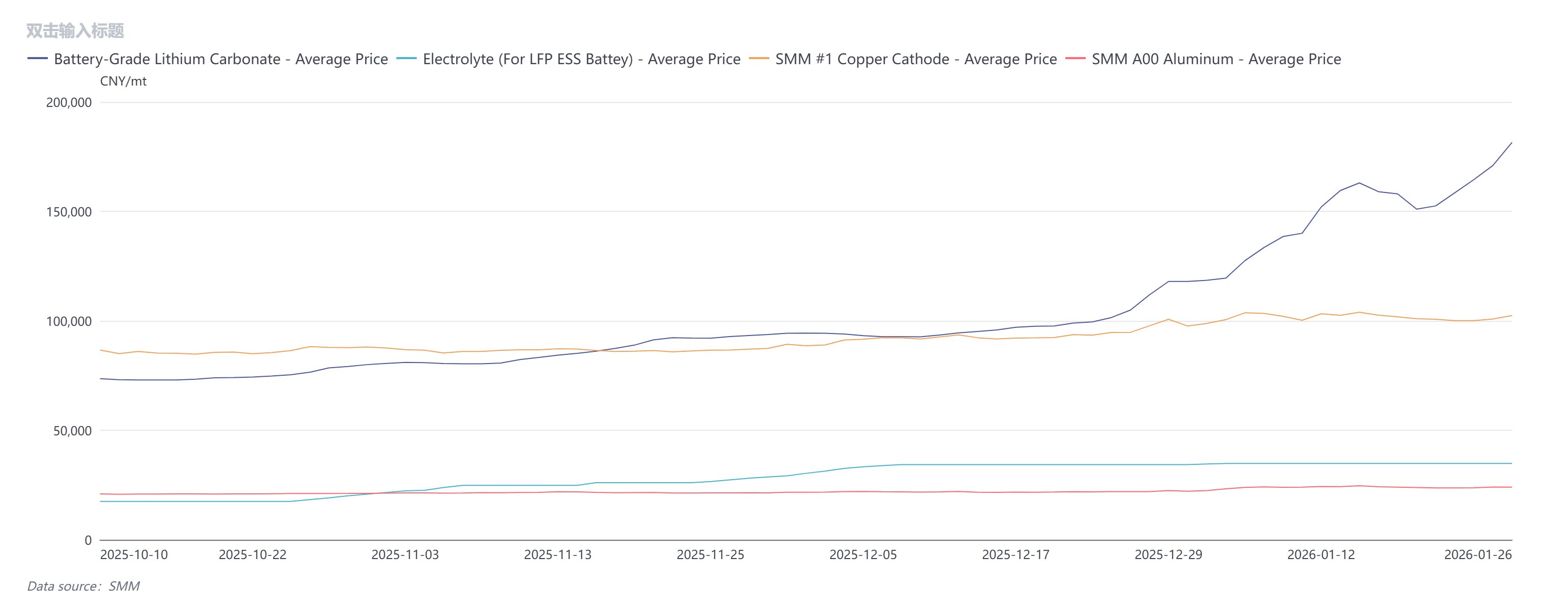 Amidst Middle East Conflicts: What is the Path Forward for China's Energy Storage Exports?
Recent Middle East conflicts have disrupted the region's booming energy storage market, a major destination for Chinese exports. To assess the real impact on Chinese supply chains and project deliveries, we must analyze baseline demand amidst these geopolitical uncertainties.
Mar 9, 2026 17:58- Where Gold & Oil Prices Go Next
It’s now been officially one week since combined U.S. and Israeli forces started striking locations within Iran.
Mar 9, 2026 09:45
Announcements
Singapore, as a globally significant transshipment hub for tin ingots, holds a critical position in the global tin industry landscape. In recent years, due to policy adjustments in major producing countries and changes in global tin resource reserves, the volume of tin ingots transshipped through Singapore has fluctuated at different stages. Against this industry backdrop, the Singapore Tin Ingot FOB price is of paramount importance to upstream and downstream enterprises in the global tin industry chain. In response to market changes, to meet the broad user demand for Singapore Tin Ingot FOB price discovery, and to enhance market information transparency, SMM has decided: Starting from September 26, 2025, to publish the ‘SMM Tin 99.9% Ingot premium, FOB Singapore, USD/tonne’ price. Price details are as follows: - Description: SMM Tin 99.9% Ingot premium, FOB Singapore, USD/tonne - Quality: Tin ingot with 99.9% purity, conforming to LME specification (BS EN 610:1996) and containing 200 - 300 ppm lead. - Definition: FOB Singapore, excluding tax, premium on top of LME cash prices - Unit: USD/tonne - Quantity: Min 5 tonnes - Timing: Within 2 weeks - Payment Terms: Cash against document, telegraphic transfer, other terms normalized - Publication: Weekly, Friday 10:30 AM Beijing Time SMM Tin Industry Research Department September 23, 2025
PriceSep 23, 2025 15:06As the world's largest exporter of tin ingots, Indonesia plays a significant role in the global tin industry landscape. Its tin ingot exports impact the international market structure. In recent years, Indonesia's tin ingot exports have fluctuated due to factors such as policy adjustments and changes in resource reserves. Against this industry backdrop, timely Indonesia tin FOB prices are crucial for upstream and downstream enterprises in the global tin industry chain. In response to market changes, to meet the broad user demand for Indonesia tin ingot FOB price discovery, and to enhance market information transparency, SMM has decided: Starting from September 19, 2025, to publish the ‘SMM Tin 99.9% Ingot premium, FOB Indonesia, USD/tonne’ price. Price details are as follows: - Description: SMM Tin 99.9% Ingot premium, FOB Indonesia, USD/tonne - Quality: Tin ingot with 99.9% purity, conforming to LME specification (BS EN 610:1996) and containing 200 - 300 ppm lead. - Definition: FOB Indonesia, excluding tax, premium on top of LME cash prices - Unit: USD/tonne - Quantity: Min 5 tonnes - Timing: Within 2 weeks - Payment Terms: Cash against document, telegraphic transfer, other terms normalized - Publication: Weekly, Friday 10:30 AM Beijing Time SMM Tin Industry Research Department September 12, 2025
PriceSep 12, 2025 17:38- Price[SMM Announcement] New Price Announcement for ‘SMM Tin 99.9% Ingot premium, CIF Shanghai, USD/tonne’
As the world's core consumer of the tin industry, China holds a pivotal position in the global tin industry chain. In recent years, influenced by factors such as adjustments in domestic and overseas policies, changes in global tin resource reserves, and fluctuations in consumer demand, the trade volume of Shanghai tin ingots has also exhibited periodic variations. Against this industry backdrop, the Shanghai tin ingot CIF price is crucial for upstream and downstream enterprises in the global tin industry chain. To actively respond to market changes, meet the widespread user demand for Shanghai tin ingot CIF price discovery, and enhance market information transparency, SMM has decided: Starting from September 26, 2025, to publish the ‘SMM Tin 99.9% Ingot premium, CIF Shanghai, USD/tonne’ price. Price details are as follows: - Description: SMM Tin 99.9% Ingot premium, CIF Shanghai, USD/tonne - Quality: Tin ingot with 99.9% purity, conforming to LME specification (BS EN 610:1996) and containing 200 - 300 ppm lead. - Definition: CIF Shanghai, excluding tax, premium on top of LME cash prices - Unit: USD/tonne - Quantity: Min 5 tonnes - Timing: Within Two Weeks - Payment Terms: Cash against document, telegraphic transfer, other terms normalized - Publication: Weekly, Friday 10:30 AM Beijing Time SMM Tin Industry Research Department September 23, 2025
PriceSep 23, 2025 15:01